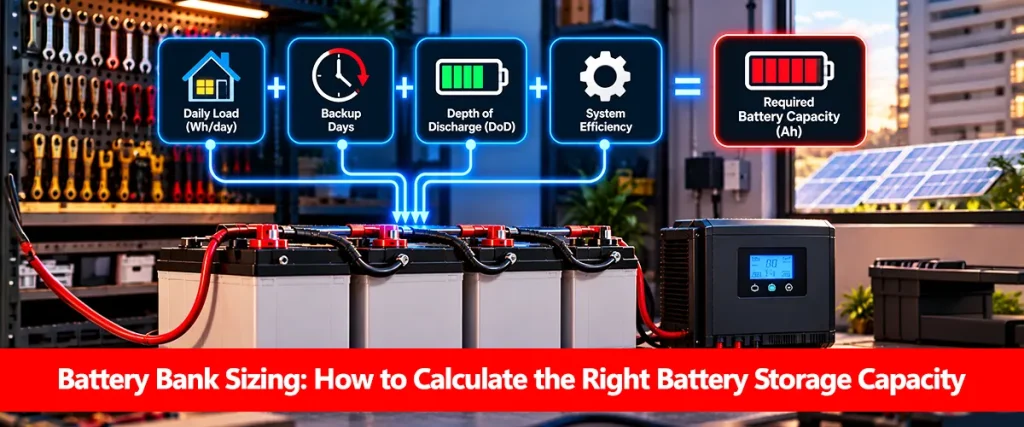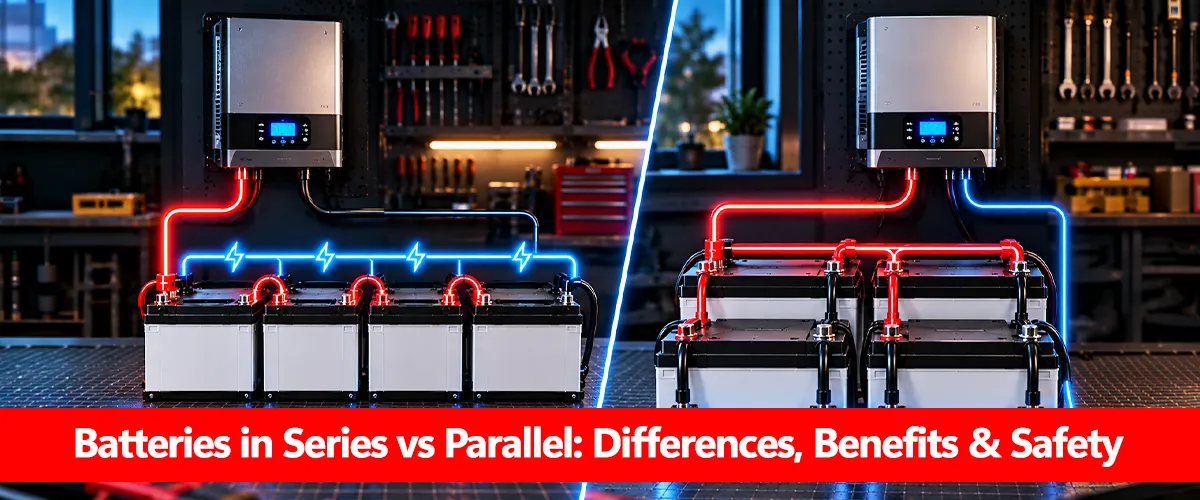
Batteries in series vs parallel differ mainly in how they affect battery-bank voltage and amp-hour capacity. A series connection increases total voltage while keeping the Ah rating unchanged for identical batteries. A parallel connection keeps voltage unchanged while increasing total Ah capacity.
Both configurations are used in solar systems, inverters, UPS installations, and other battery-powered applications. Choosing the correct arrangement depends on system requirements, battery compatibility, and manufacturer specifications.
What Is a Series Battery Connection?
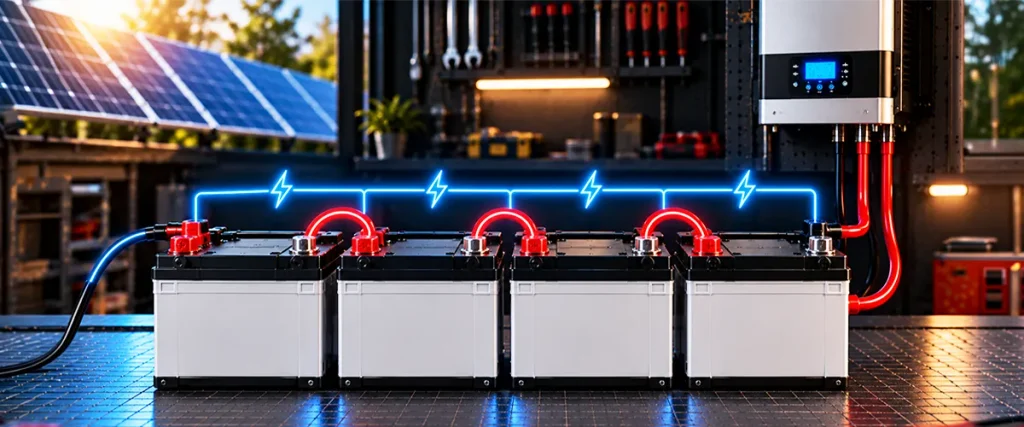
A series connection joins the positive terminal of one battery to the negative terminal of another, creating a battery bank with higher combined voltage.
Key characteristics:
- Increases total battery-bank voltage.
- Maintains the same Ah rating for identical batteries.
- The same current flows through each battery.
- Requires compatible batteries and equipment.
- Must remain within manufacturer-approved voltage limits.
Series connections are commonly used when equipment requires a higher DC input voltage.
What Is a Parallel Battery Connection?
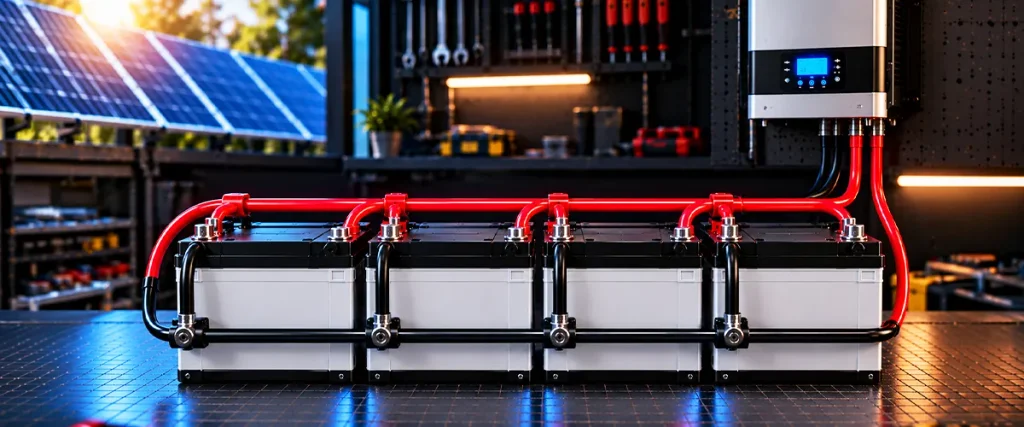
A parallel connection joins corresponding positive terminals together and corresponding negative terminals together. This maintains the nominal voltage while increasing the combined amp-hour capacity.
Key characteristics:
- Maintains the same nominal voltage.
- Increases total Ah capacity.
- Distributes current between parallel branches.
- Requires suitable wiring and electrical protection.
- Must follow the manufacturer’s parallel connection limits.
Parallel connections are used when additional battery capacity is needed without changing the system’s nominal voltage.
Batteries in Series vs Parallel: Key Differences
| Feature | Series Connection | Parallel Connection |
| Voltage | Increases | Remains unchanged |
| Ah capacity | Remains unchanged | Increases |
| Current flow | Same through each battery | Shared between branches |
| Main purpose | Higher system voltage | Greater charge capacity |
| Main consideration | Voltage compatibility | Current sharing and protection |
For identical batteries, both arrangements can increase total stored energy. The difference is how that energy is distributed between voltage and amp-hour capacity. Learn more about these measurements in our battery voltage explained and battery capacity guides.
Which Is Better: Series or Parallel?
Neither connection is universally better. The correct choice depends on the electrical requirements of the complete system.
Choose series when:
- Equipment requires a higher battery-bank voltage.
- The inverter supports the combined voltage.
- The batteries are approved for series operation.
Choose parallel when:
- System voltage must remain unchanged.
- Additional Ah capacity is required.
- The manufacturer permits parallel operation.
Some battery banks combine series and parallel connections to achieve the required voltage and capacity. These arrangements require appropriate system design. For capacity planning, read battery bank sizing.
Safety Precautions for Battery Connections
Incorrect battery connections can cause overheating, excessive current, equipment damage, or fire. Battery banks should always be assembled according to the manufacturer’s instructions and applicable electrical safety requirements.
Important precautions include:
- Use batteries with compatible chemistry, voltage, and specifications.
- Follow manufacturer limits for series and parallel connections.
- Use correctly rated cables, fuses, and protective devices.
- Verify terminal polarity before connecting equipment.
- Follow battery balancing and management requirements.
- Avoid mixing old and new batteries unless explicitly approved.
- Have high-current installations designed and checked by a qualified professional.
Lithium batteries may also require specific battery management system compatibility before series or parallel operation.
Conclusion
Understanding batteries in series vs parallel is essential when designing a reliable battery bank. Series connections increase voltage, while parallel connections increase Ah capacity without changing nominal voltage.
Choose the arrangement that matches your equipment requirements, and always follow manufacturer-approved connection and protection guidelines. For more information, explore how many batteries do I need, battery bank sizing, and the Battery Calculations and Sizing category at Batteries Hub.
Frequently Asked Questions
Does Connecting Batteries in Series Increase Capacity?
Series connections increase voltage. For identical batteries, the Ah rating remains unchanged, but the total stored energy increases because the combined voltage is higher.
Does Parallel Wiring Increase Battery Voltage?
No. Parallel connections maintain the nominal voltage while increasing the combined Ah capacity.
Can Lithium Batteries Be Connected in Series or Parallel?
Some lithium batteries support these configurations, but others do not. Always check the manufacturer’s approved wiring arrangements and BMS requirements.
Can Different Battery Types Be Connected Together?
Mixing different chemistries or incompatible battery specifications is generally unsafe unless the system is specifically engineered and approved for that arrangement.
Do Series and Parallel Connections Affect Battery Runtime?
Yes. Both can increase total stored energy when additional identical batteries are added. Actual runtime depends on the load, usable capacity, discharge behavior, and system efficiency.