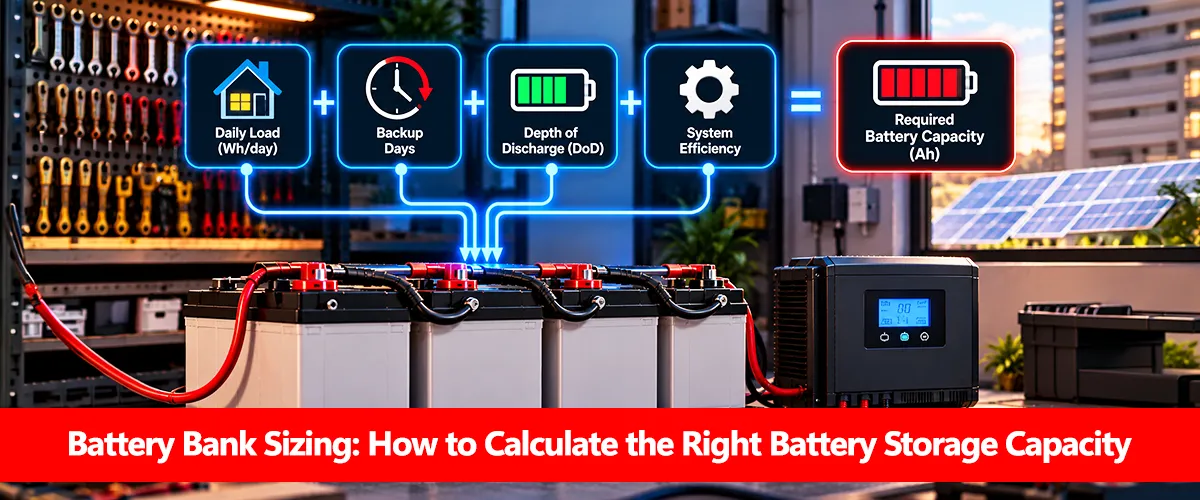
Battery bank sizing is the process of determining how much battery energy storage a system needs to support its electrical loads for a specified period. The correct battery bank depends on energy consumption, required backup duration, system voltage, usable depth of discharge, and electrical conversion losses. An undersized battery bank may shut down before the required backup period ends, while an unnecessarily large system increases cost and installation complexity. This guide explains how to estimate the storage capacity your application actually needs.
Key Takeaways
- Battery bank sizing starts with energy consumption in watt-hours or kilowatt-hours.
- Depth of discharge and inverter efficiency increase the nominal capacity required.
- System voltage determines the equivalent amp-hour capacity.
- Battery chemistry, discharge-current limits, and operating conditions affect usable storage.
- The final configuration must meet both energy and power requirements.
Start With Your Daily Energy Requirement
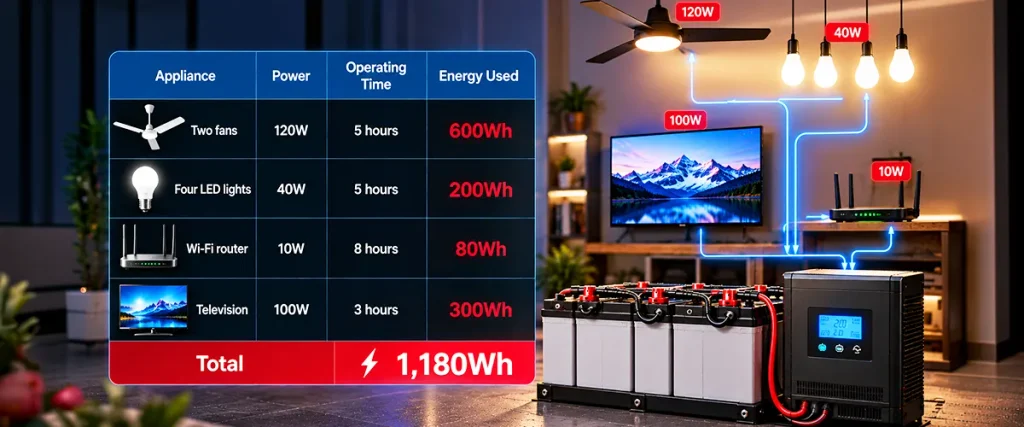
The first step is to determine how much electricity your appliances consume during the period the battery must support them. For a backup system, this might mean four hours of load shedding. For an off-grid solar system, it may include nighttime consumption and additional days without sufficient solar generation. Calculate energy demand by multiplying each appliance’s operating wattage by its expected running hours. Add the results to obtain the total watt-hours required.
Consider a small household backup arrangement:
| Appliance | Power | Operating Time | Energy Used |
| Two fans | 120W | 5 hours | 600Wh |
| Four LED lights | 40W | 5 hours | 200Wh |
| Wi-Fi router | 10W | 8 hours | 80Wh |
| Television | 100W | 3 hours | 300Wh |
| Total | 1,180Wh |
This household requires approximately 1.18kWh of appliance energy for the specified operating periods. Actual consumption should be measured where possible because appliance wattage can vary.
Battery Bank Sizing Formula
Once the required appliance energy is known, adjust it for battery discharge limits and electrical conversion efficiency. These factors account for energy that cannot be used and losses occurring between the battery and connected equipment.
Nominal Battery Bank Capacity (Wh) = Required Load Energy (Wh) ÷ (Allowed DoD × System Efficiency)
For example, suppose a household needs 3,000Wh of AC electricity during an outage. Assume 80% allowed depth of discharge and 90% inverter efficiency.
Required capacity = 3,000 ÷ (0.80 × 0.90)
Required nominal battery storage ≈ 4,167Wh, or 4.17kWh
This estimate assumes the stated efficiency represents the relevant conversion losses and that battery capacity remains available under the operating conditions. Manufacturer specifications should be used for final design. For more on the underlying calculation, read how to calculate battery capacity.
Convert Required Storage Into Amp-Hours
Battery banks are often described using both energy capacity and amp-hour ratings. Once you know the required nominal storage in watt-hours, divide it by the battery bank’s nominal voltage to estimate the necessary Ah capacity.
Using the previous 4,167Wh requirement:
- 12V system: 4,167 ÷ 12 ≈ 347Ah.
- 24V system: 4,167 ÷ 24 ≈ 174Ah.
- 48V system: 4,167 ÷ 48 ≈ 87Ah.
The required energy remains approximately the same, but the Ah rating changes with voltage. For lithium batteries, use the actual nominal pack voltage, such as 12.8V, 25.6V, or 51.2V, when applicable. Our Wh to Ah conversion guide explains this relationship in greater detail.
Choose a Suitable Battery Bank Voltage
Battery bank voltage affects current flow, inverter compatibility, wiring requirements, and the overall electrical design. Higher-voltage systems generally draw less current for the same power demand, which can reduce resistive losses when the system is appropriately engineered. However, voltage selection should not be based on efficiency alone. The inverter, charger, solar charge controller, and battery management system must support the chosen configuration.
Common options include:
- 12V: Often used for smaller battery-powered applications.
- 24V: Suitable for various medium-power inverter installations.
- 48V-class systems: Common in larger residential solar and energy-storage setups.
Always use the manufacturer’s supported nominal voltage and battery configuration. Never connect a battery bank to equipment designed for an incompatible voltage.
Account for Battery Chemistry and Usable Capacity
Battery chemistry influences how much rated energy can be used regularly without exceeding the manufacturer’s operating recommendations. A lead-acid system may be designed around a more conservative depth of discharge, while many LiFePO4 batteries permit a greater usable discharge range.
For example, consider a 4kWh nominal battery bank:
- At 50% DoD, estimated usable battery-side energy is 2kWh.
- At 80% DoD, estimated usable battery-side energy is 3.2kWh.
- At 90% DoD, estimated usable battery-side energy is 3.6kWh.
These percentages are illustrative rather than universal recommendations. The actual allowed discharge range depends on the battery model, intended cycle life, and protection settings. Read our guides to depth of discharge and battery cycle life for more context.
Sizing a Battery Bank for Solar Backup
Solar battery sizing requires consideration of when energy is consumed and when solar generation is available. A system that operates primarily at night needs enough stored energy to support nighttime loads, while an off-grid installation may require additional reserve capacity for periods of poor weather.
Before selecting storage, determine:
- Nighttime consumption: Energy used when solar generation is unavailable.
- Required autonomy: Number of hours or days the battery must support loads.
- Available charging energy: Whether solar production can replenish the battery.
- Usable battery capacity: Energy permitted under the selected discharge limit.
- Power requirements: Whether the battery can support simultaneous loads and starting surges.
A larger battery bank does not automatically solve insufficient solar generation. The panels, charge controller, and charging system must also be capable of replenishing the stored energy.
Example: Battery Bank for Eight Hours of Home Backup
Suppose a household in Pakistan needs to support a continuous 250W load for eight hours during an extended electricity outage. The connected equipment includes efficient fans, lighting, a router, and other essential low-power devices.
Step 1 — Calculate appliance energy
250W × 8 hours = 2,000Wh
Step 2 — Account for usable discharge and efficiency
Assume 80% DoD and 90% inverter efficiency.
2,000 ÷ (0.80 × 0.90) = 2,778Wh
Step 3 — Convert to a 24V-class battery requirement
Using 25.6V nominal voltage:
2,778Wh ÷ 25.6V ≈ 108.5Ah
The theoretical minimum is therefore approximately 2.78kWh or 109Ah at 25.6V. A final design should allow for operating uncertainties, aging, manufacturer specifications, and suitable commercially available battery sizes.
Check Power Output, Not Just Storage Capacity
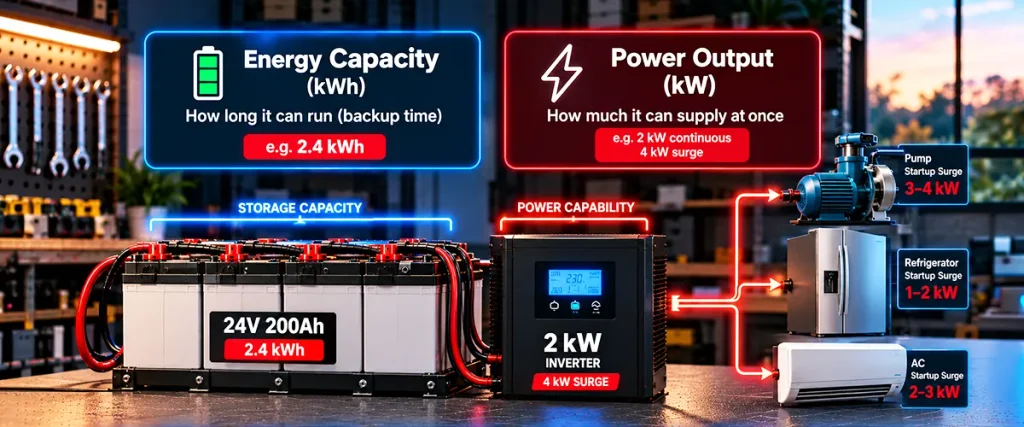
A battery bank can contain enough energy for the required backup period but still be unable to supply the instantaneous current demanded by appliances. This is especially important for pumps, refrigerators, motors, and other equipment with starting surges.
Before finalizing a battery bank, check:
- Maximum continuous battery discharge current.
- Short-duration surge-current capability.
- Inverter continuous and peak power ratings.
- Battery management system limitations.
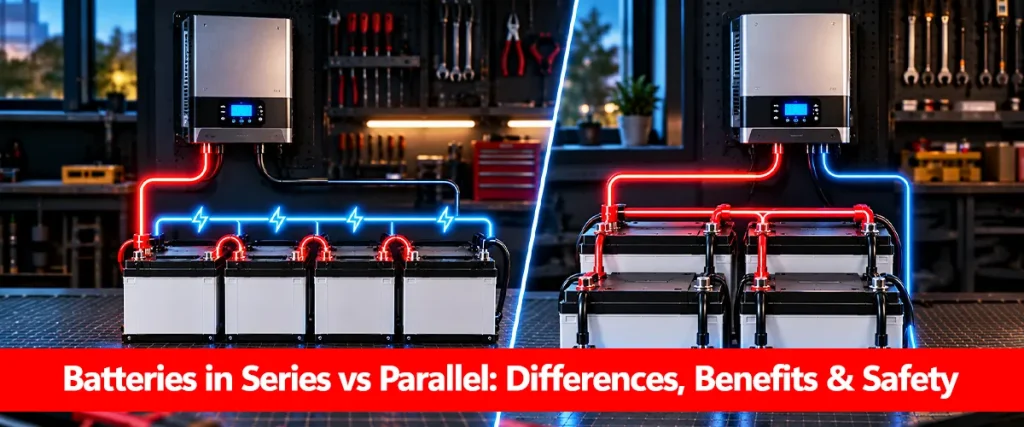
- Approved series and parallel connections.
- Cable sizing and electrical protection requirements.
The battery bank must satisfy both energy capacity (kWh) and power capability (kW). These are different design requirements.
Common Battery Bank Sizing Mistakes
Sizing errors often occur when users select batteries based only on Ah ratings or overlook the operating conditions of the complete system. These mistakes can result in disappointing backup performance.
Avoid the following:
- Confusing battery voltage with stored energy.
- Ignoring inverter and conversion losses.
- Assuming 100% of nominal battery capacity is usable.
- Overlooking appliance starting surges.
- Failing to account for battery aging and temperature.
- Mixing batteries with incompatible specifications.
- Selecting storage without checking charging capability.
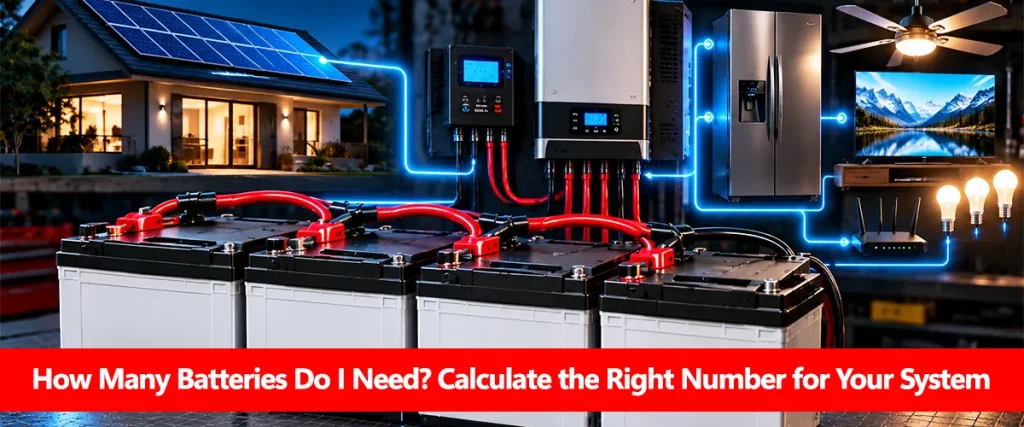
For a separate guide focused on determining the quantity of batteries required, see how many batteries do I need.
Conclusion
Battery bank sizing requires more than selecting a battery with a large Ah rating. Start with the energy your appliances consume, account for usable depth of discharge and conversion efficiency, and then select a compatible battery-bank voltage and capacity.
For dependable performance, verify charging capability, discharge-current limits, inverter compatibility, and operating conditions before installation. A correctly sized system should meet both the required backup duration and the electrical power demand.
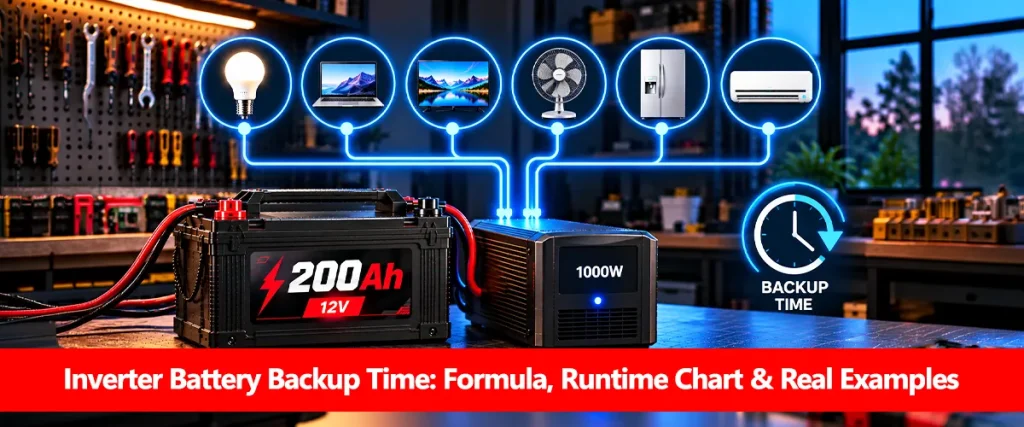
Explore more tutorials in Battery Calculations and Sizing, including battery capacity calculations, battery runtime calculations, and inverter battery backup time. Visit Batteries Hub for more battery guides and practical energy-storage information.
Frequently Asked Questions
How Do I Calculate Battery Bank Size?
Multiply appliance wattage by operating hours to calculate required energy. Divide that energy by the allowed depth of discharge and applicable system efficiency to estimate nominal battery capacity.
Is a 5kWh Battery Bank Enough for a Home?
It depends on the home’s electrical consumption and required backup duration. A 5kWh nominal battery does not necessarily provide 5kWh of usable AC energy.
Does Higher Battery Voltage Mean More Storage?
Not by itself. Storage capacity depends on both voltage and amp-hours. A higher-voltage bank can store more energy when Ah remains unchanged.
Can I Connect Different Batteries in One Bank?
Mixing batteries with different chemistries, capacities, ages, or electrical characteristics can create performance and safety problems. Follow manufacturer-approved configurations and compatibility requirements.
How Much Extra Battery Capacity Should I Allow?
The appropriate design margin depends on load uncertainty, aging, temperature, required reliability, and manufacturer specifications. There is no single percentage suitable for every system.