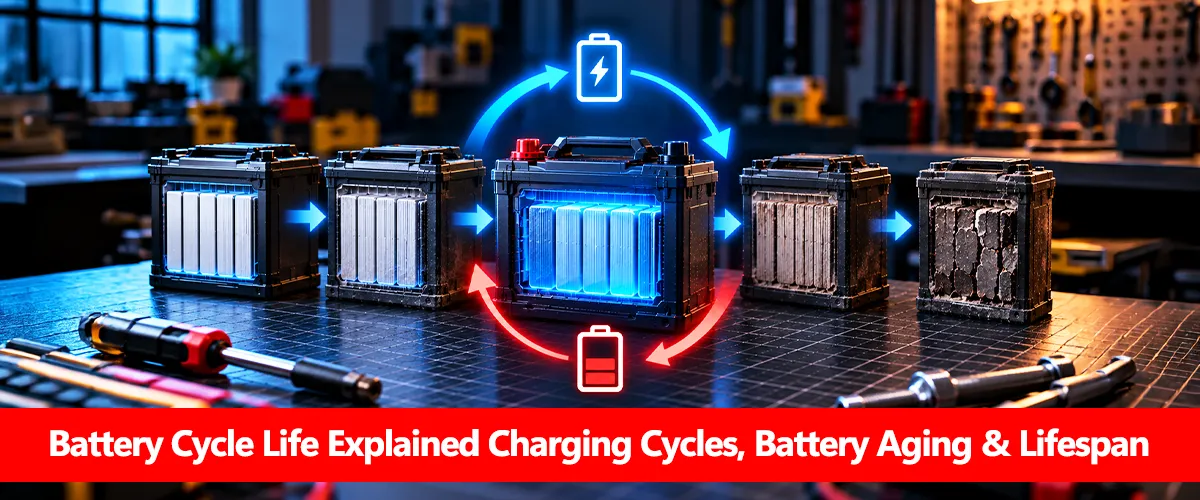
Battery cycle life is the number of charge and discharge cycles a rechargeable battery can complete before its capacity falls to a specified level. For example, a battery rated for 3,000 cycles at 80% capacity retention is expected to retain approximately 80% of its original rated capacity after completing 3,000 cycles under the manufacturer’s stated test conditions.
Cycle life is an important indicator of battery durability, especially for batteries used repeatedly in solar systems, UPS installations, smartphones, and electric vehicles. However, the number printed on a battery’s specification sheet is not a guarantee of how many years it will last.
Understanding how cycles are counted, what causes battery aging, and why operating conditions matter can help you interpret these ratings correctly.
Key Takeaways
- Battery cycle life measures repeated charge-discharge use before a defined capacity-loss threshold.
- Two partial discharges can sometimes equal one full equivalent cycle.
- Depth of discharge, temperature, current, and charging habits influence battery degradation.
- Battery chemistry affects cycle durability, but manufacturers’ test conditions matter just as much.
- Calendar aging means a battery can deteriorate even when it is rarely used.
What Is Battery Cycle Life?
Battery cycle life describes how many charging and discharging cycles a battery can withstand before its performance falls to a specified endpoint. That endpoint is commonly defined using remaining capacity, such as 80% of the battery’s initial rated capacity, although some manufacturers use different thresholds.
Inside an electrochemical cell, the anode, cathode, and electrolyte support reversible reactions that store and release electrical energy. Over repeated operation, chemical and structural changes gradually reduce the amount of charge the battery can hold. Internal resistance may also increase, affecting voltage stability and performance under load. To understand these underlying processes, begin with our guide to what a battery is and how it works.
What Counts as One Battery Cycle?
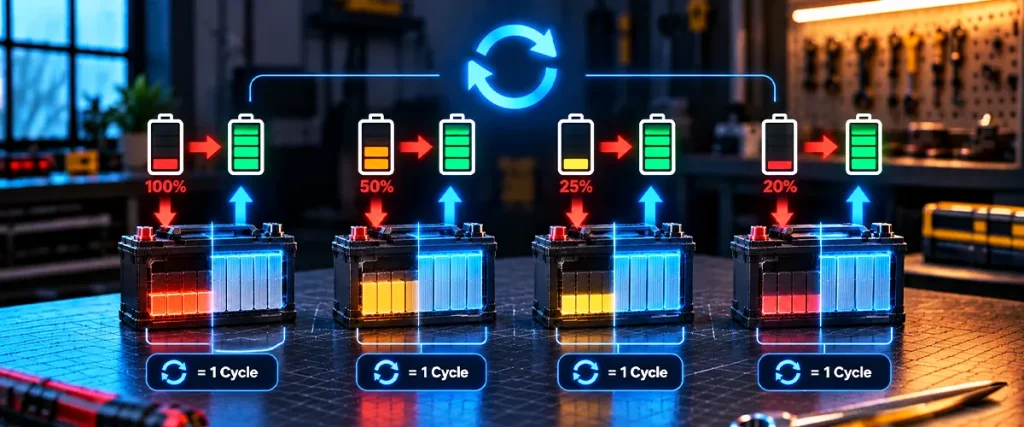
A battery cycle generally involves discharging and then recharging a battery, but cycle-counting methods are not identical across every product. Some specifications refer to complete charge-discharge cycles, while battery management systems may track equivalent full cycles based on accumulated discharge. Consider a smartphone battery that uses 50% of its capacity one day and another 50% the following day. Those two discharge events together represent approximately one full equivalent cycle, even if the phone was charged between them.
Full and Partial Cycle Examples
- 100% discharge: Approximately one full equivalent cycle.
- 50% discharge twice: Approximately one full equivalent cycle.
- 25% discharge four times: Approximately one full equivalent cycle.
- 20% discharge five times: Approximately one full equivalent cycle.
These are simplified charge-throughput examples. Actual cycle counters can use different algorithms and thresholds, so a displayed cycle count may not follow this method exactly.
What Does 80% Capacity Retention Mean?
An 80% capacity-retention rating describes a battery that can still hold approximately 80% of its initial capacity after the specified cycling test. It does not mean the battery suddenly stops working when that threshold is reached. Instead, the battery has reached the defined performance endpoint used for its cycle-life rating.
For example, a new 100Ah battery might retain approximately 80Ah of measured capacity at the specified end-of-life threshold. Its nominal voltage may remain broadly similar, but the amount of electrical energy available during discharge will generally be lower than when it was new.
This decline is one aspect of battery health. Our upcoming guide to state of charge vs state of health explains why a battery can show a full charge while having reduced capacity.
Why Do Batteries Lose Capacity After Repeated Cycles?

Battery aging occurs because electrochemical reactions are not perfectly reversible. During normal use, certain side reactions and changes within the electrodes gradually reduce the amount of active material or lithium available for storing energy. The exact degradation mechanisms vary by battery chemistry, but common contributors include:
- Electrode changes: Repeated cycling can alter electrode structures and reduce usable capacity.
- Electrolyte reactions: Unwanted chemical reactions may consume active materials over time.
- Internal resistance growth: Greater resistance can increase heat generation and voltage drop.
- Temperature stress: Excessive heat can accelerate chemical degradation.
- High-current operation: Demanding charge or discharge conditions can increase battery stress.
These effects explain why a battery’s real-world performance changes gradually rather than remaining constant throughout its service life. Learn more about current-related stress in our battery C-rate guide.
How Does Depth of Discharge Affect Cycle Life?
Depth of discharge (DoD) describes the percentage of battery capacity used during a discharge event. Repeatedly discharging a battery deeply often results in fewer cycles before it reaches a defined capacity-retention threshold, although the relationship varies between chemistries.
A battery cycled repeatedly through only part of its capacity may withstand more individual cycles than the same battery discharged almost completely each time. However, each shallow cycle delivers less energy, so comparing cycle counts without examining discharge depth can be misleading.
When reviewing a cycle-life claim, check:
- The depth of discharge used during testing.
- The capacity-retention percentage defining end of life.
- The test temperature and charge-discharge current.
- Whether the figure refers to complete or partial cycles.
Our dedicated guide to depth of discharge explains how DoD percentages affect battery operation.
Does Battery Chemistry Affect Cycle Life?
Yes. Different rechargeable battery chemistries have different aging characteristics, which influence their expected cycle durability. However, chemistry alone cannot establish a battery’s actual lifespan because cell construction, charging conditions, temperature, and manufacturer quality also matter.
For example, lithium iron phosphate (LiFePO4) batteries are often designed for applications requiring frequent cycling and long service life. Lead-acid batteries can also provide reliable performance, but their cycle life is particularly sensitive to deep discharge and charging practices.
Chemistry-Specific Considerations
- Lead-acid: Deep cycling, prolonged partial charging, and sulfation can reduce service life.
- Lithium-ion NMC/NCA: Temperature, high state of charge, and operating conditions significantly influence aging.
- LiFePO4: Often offers strong cycle durability, though performance still depends on proper charging and protection.
- Nickel-based batteries: Cycle performance varies by chemistry, cell design, and operating conditions.
For further reading, explore LiFePO4 battery technology and LiFePO4 vs lead-acid batteries.
Is Battery Cycle Life the Same as Battery Lifespan?
Cycle life and calendar lifespan are related, but they are not identical. Cycle life refers to deterioration associated with repeated charging and discharging, while calendar aging describes deterioration over time, even when the battery is not actively cycling.
A battery used only occasionally may reach the end of its useful service life because of age, heat, or storage conditions before completing its advertised cycle count. Conversely, a frequently cycled battery may experience significant cycle-related deterioration within a relatively short period. This distinction matters for automotive batteries and home backup storage. See our application-specific guides to how long car batteries last and how long solar batteries last.
How Can You Improve Battery Cycle Life?
Good battery management can reduce unnecessary stress and help preserve usable capacity over time. The appropriate operating practices depend on chemistry, so manufacturer-approved charging and discharge settings should always take priority over generic advice.
For everyday battery care, consider the following:
- Avoid excessive temperatures. Keep battery installations within their specified operating range and provide appropriate ventilation or thermal management.
- Use compatible charging equipment. Incorrect voltage or current settings can increase degradation and create safety risks.
- Manage discharge depth. Avoid routinely exceeding the manufacturer’s recommended discharge limits.
- Prevent prolonged improper storage. Follow chemistry-specific storage charge and maintenance guidance.
- Respect current limits. Avoid charging or discharging beyond the specified continuous ratings.
- Monitor battery condition. Capacity changes, unusual heating, and repeated protection events may indicate developing problems.
These habits can support long-term performance, but they cannot eliminate the natural chemical aging of rechargeable cells.
Why Is Cycle Life Important for Solar and UPS Batteries in Pakistan?
Household solar systems and UPS batteries in Pakistan may undergo frequent charging and discharging because of daily electricity usage, solar generation patterns, and load shedding. A battery operating through regular discharge cycles needs to maintain adequate capacity over an extended period.
For these applications, cycle-life ratings help indicate expected durability, but they should be interpreted alongside usable energy, operating temperature, backup requirements, and warranty conditions. A higher advertised cycle count does not necessarily guarantee better performance if the products were tested under different conditions. It is particularly important to verify whether a manufacturer’s cycle-life figure assumes shallow discharge, controlled temperature, or relatively low current. Those conditions may differ substantially from everyday backup operation.
Conclusion
Battery cycle life indicates how many charge-discharge cycles a rechargeable battery can complete before reaching a specified level of capacity degradation. It is a valuable durability measurement, but it does not independently predict how many years a battery will last. Understanding partial cycles, capacity retention, depth of discharge, and calendar aging helps put manufacturer ratings into perspective. For reliable long-term performance, choose a battery suitable for the application and operate it within its approved limits.
Explore more educational articles in our Battery Fundamentals category, including battery C-rate, depth of discharge, and state of charge vs state of health. Visit Batteries Hub for additional battery guides.
Frequently Asked Questions About Battery Cycle Life
Is 3,000 Battery Cycles Good?
A 3,000-cycle rating can indicate substantial cycling durability, but its significance depends on the battery chemistry, depth of discharge, test temperature, and remaining capacity at the rating endpoint. The number alone is insufficient for comparing products fairly.
Does Charging a Phone Twice Count as Two Cycles?
Not necessarily. Many devices use equivalent full-cycle accounting rather than simply counting charging sessions. Two partial discharges totaling 100% of capacity may represent approximately one equivalent full cycle.
Can a Battery Work After Its Rated Cycle Life?
Yes. Reaching the specified cycle-life endpoint usually means the battery has declined to a defined capacity or performance level, not that it instantly stops functioning. Continued use depends on safety, remaining performance, and application requirements.
Does Fast Charging Reduce Battery Cycle Life?
Fast charging can increase stress under certain conditions, particularly if it produces excessive heat or exceeds suitable cell operating limits. Well-designed charging systems manage current and temperature to reduce these risks.
Does a Higher Cycle-Life Rating Mean Better Battery Quality?
Not automatically. Cycle-life ratings should be compared using equivalent test conditions, including discharge depth, temperature, current, and capacity-retention endpoint. Safety, reliability, and application suitability also matter.