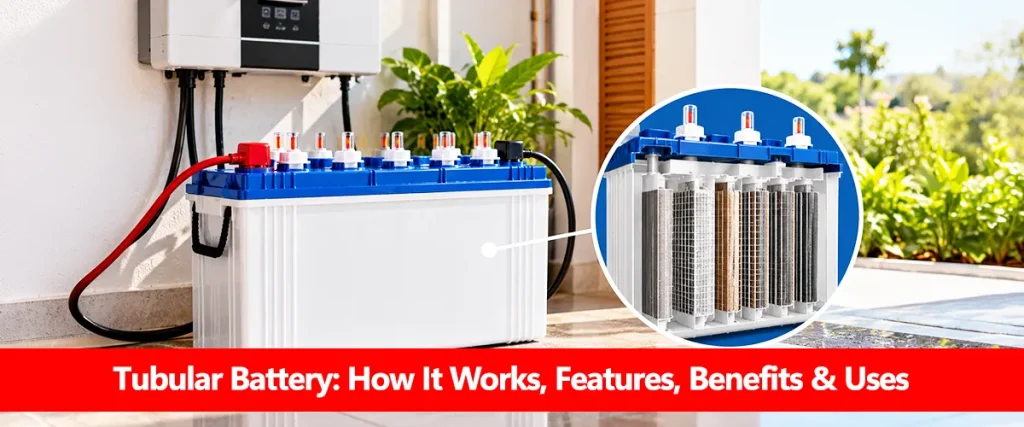
A LiFePO4 battery (Lithium Iron Phosphate battery) is a rechargeable lithium-ion battery that uses lithium iron phosphate as its positive electrode material. It is known for its long cycle-life potential, good thermal stability, and suitability for repeated charging and discharging.
LiFePO4 batteries are widely used in solar energy storage, UPS systems, electric vehicles, and off-grid power applications. Their performance depends on cell quality, charging conditions, temperature, and battery management.
How Does a LiFePO4 Battery Work?
A LiFePO4 battery stores electrical energy through the reversible movement of lithium ions between its electrodes. During discharge, lithium ions move from the negative electrode toward the lithium iron phosphate positive electrode, while electrons flow through the external circuit. Charging reverses this process.
Main components include:
- Positive electrode: Uses lithium iron phosphate (LiFePO4).
- Negative electrode: Commonly uses graphite.
- Electrolyte: Enables lithium-ion movement.
- Separator: Prevents direct electrical contact between electrodes.
- Current collectors: Conduct electrical current.
- Battery management system (BMS): Provides monitoring and protection in battery packs.
LiFePO4 is a specific chemistry within the broader lithium-ion battery family.
Key Features of LiFePO4 Batteries
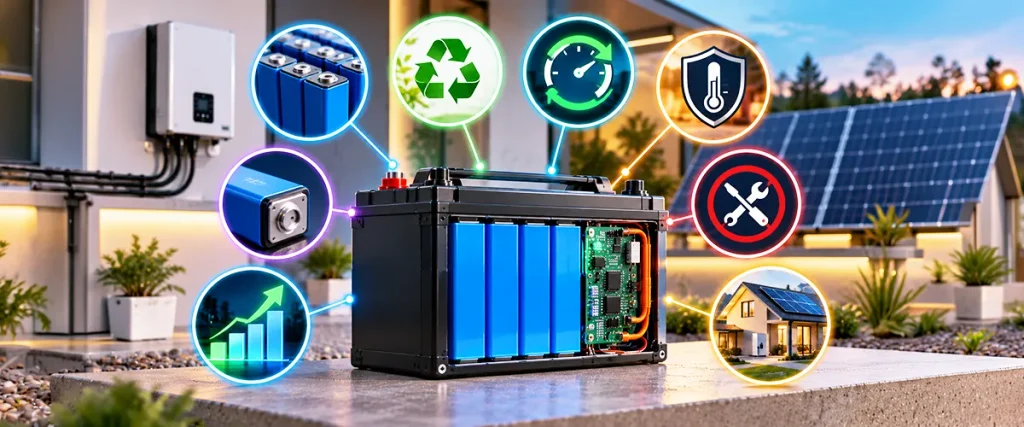
LiFePO4 technology has several characteristics that make it suitable for energy storage applications.
| Feature | Description |
| Battery chemistry | Lithium iron phosphate |
| Rechargeability | Rechargeable |
| Nominal cell voltage | Approximately 3.2V |
| Common battery configuration | 12.8V, 25.6V and 51.2V packs |
| Cycle life | Often several thousand cycles under specified conditions |
| Thermal stability | Generally good compared with some other lithium-ion chemistries |
| Maintenance | Low routine maintenance |
| Common uses | Solar, UPS, EVs and backup power |
Actual cycle life and performance depend on the manufacturer’s specifications and operating conditions.
Common Applications of LiFePO4 Batteries
LiFePO4 batteries are used in systems requiring repeated charging, dependable energy storage, and long-term operation.
Common applications include:
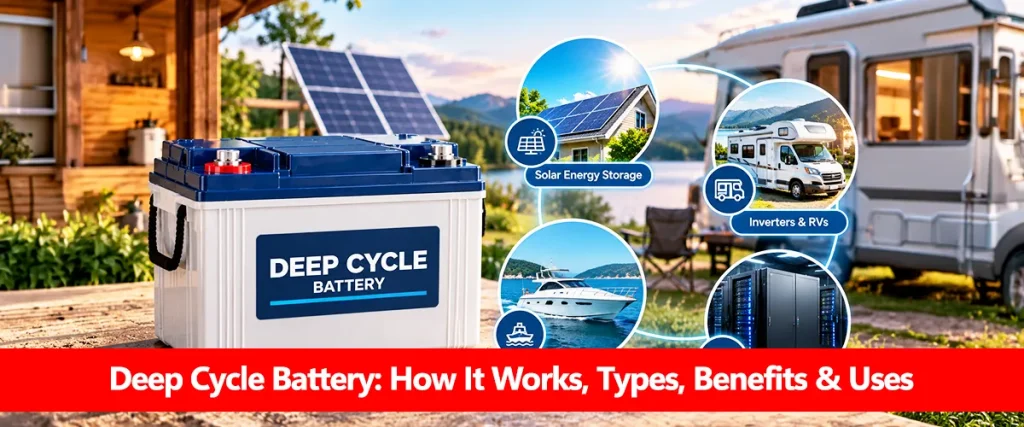
- Solar energy storage: Storing electricity generated by solar panels.
- UPS systems: Providing backup power during outages.
- Home inverters: Supporting compatible household power systems.
- Electric vehicles: Supplying energy for electric propulsion.
- Off-grid systems: Providing stored energy where grid access is limited.
- Marine and RV systems: Powering onboard electrical equipment.
Battery voltage, capacity, charging compatibility, and installation requirements must match the intended application. For more information, explore deep cycle batteries and LiFePO4 batteries for UPS.
Advantages of LiFePO4 Batteries
LiFePO4 batteries offer several practical benefits for rechargeable energy storage.
Main advantages:
- Long cycle-life potential.
- Good thermal and chemical stability.
- High usable capacity in suitable designs.
- Relatively low self-discharge.
- Low routine maintenance requirements.
- Good efficiency in properly designed systems.
- Suitable for repeated deep-cycle operation.
These advantages make LiFePO4 technology useful for applications involving frequent battery cycling.
Limitations of LiFePO4 Batteries
Despite their benefits, LiFePO4 batteries have operating limitations.
Important limitations include:
- Higher initial cost than many lead-acid batteries.
- Lower energy density than some other lithium-ion chemistries.
- Charging restrictions at low temperatures.
- Requires compatible charging equipment.
- Needs suitable battery management and protection.
- Performance and lifespan can decline under excessive heat or unsuitable charging conditions.
LiFePO4 batteries are generally more thermally stable than several other lithium-ion chemistries, but they are not completely free from fire or electrical hazards.
LiFePO4 Battery Charging and BMS
Correct charging is essential for maintaining battery performance and safety. LiFePO4 batteries typically use a constant-current and constant-voltage charging profile with voltage limits specific to their chemistry and cell configuration. A battery management system (BMS) helps protect the battery by monitoring important operating conditions.
Common BMS functions include:
- Overcharge protection.
- Over-discharge protection.
- Overcurrent protection.
- Temperature monitoring.
- Cell voltage monitoring.
- Cell balancing.
Charging below freezing can damage many LiFePO4 cells unless the battery has suitable low-temperature charging protection or heating. Always follow manufacturer charging specifications rather than applying conventional lead-acid charging settings. Read our battery management system guide for further details.
Important LiFePO4 Battery Specifications
Understanding battery specifications helps evaluate performance and compatibility.
| Specification | Meaning |
| Nominal voltage | Reference cell or battery pack voltage |
| Rated capacity (Ah) | Charge capacity under specified conditions |
| Energy capacity (Wh) | Stored electrical energy |
| State of charge (SoC) | Estimated remaining charge |
| Depth of discharge (DoD) | Percentage of capacity discharged |
| Cycle life | Number of cycles under defined conditions |
| Internal resistance | Influences losses and current delivery |
LiFePO4 batteries often tolerate relatively deep discharge, but the recommended operating limits depend on the manufacturer.
Learn more about depth of discharge and battery cycle life.
LiFePO4 Battery Maintenance and Safety
LiFePO4 batteries require less routine maintenance than many flooded lead-acid batteries, but regular inspection and appropriate operating conditions remain important.
Recommended practices:
- Use a LiFePO4-compatible charger.
- Follow manufacturer voltage and current limits.
- Avoid charging below the permitted temperature.
- Protect the battery from excessive heat.
- Keep terminals and electrical connections secure.
- Do not bypass the BMS.
- Avoid using damaged or swollen batteries.
- Follow manufacturer storage instructions.
A properly designed and installed battery system is essential for safe long-term operation.
LiFePO4 vs Other Battery Types
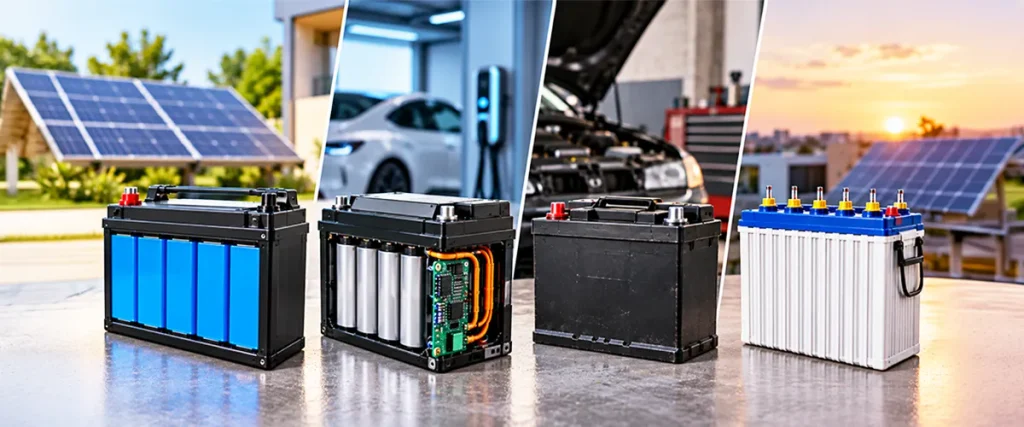
LiFePO4 differs from other battery technologies in energy density, cycle life, charging requirements, and thermal behavior.
Compared with many lead-acid batteries, LiFePO4 generally offers greater usable capacity relative to its rated capacity and longer cycle-life potential. However, its initial cost and charging requirements differ.
For detailed comparisons, explore:
Conclusion
A LiFePO4 battery is a rechargeable lithium-ion battery known for its long cycle-life potential, good thermal stability, and suitability for repeated energy storage. It is widely used in solar, UPS, electric vehicle, and off-grid applications. However, correct charging, battery management, and temperature protection remain essential for safe and reliable performance. Explore types of batteries, best battery type for solar, and the Battery Types and Chemistries category. Visit Batteries Hub for more battery education.
Frequently Asked Questions
What Does LiFePO4 Stand For?
LiFePO4 stands for lithium iron phosphate, the material used in the battery’s positive electrode.
Is a LiFePO4 Battery Rechargeable?
Yes. LiFePO4 batteries are rechargeable lithium-ion batteries designed for repeated charging and discharging.
How Long Does a LiFePO4 Battery Last?
Many LiFePO4 batteries are rated for several thousand cycles, but actual service life depends on temperature, depth of discharge, charging conditions, and battery quality.
Can a LiFePO4 Battery Be Used for Solar Power?
Yes. LiFePO4 batteries are commonly used in compatible solar energy storage systems.
Does a LiFePO4 Battery Need a BMS?
Most multi-cell LiFePO4 battery packs require suitable monitoring and protection, commonly provided by a BMS.
Can LiFePO4 Batteries Be Charged With a Lead-Acid Charger?
Only if the charger is explicitly compatible with the battery’s LiFePO4 charging requirements and the manufacturer permits its use.