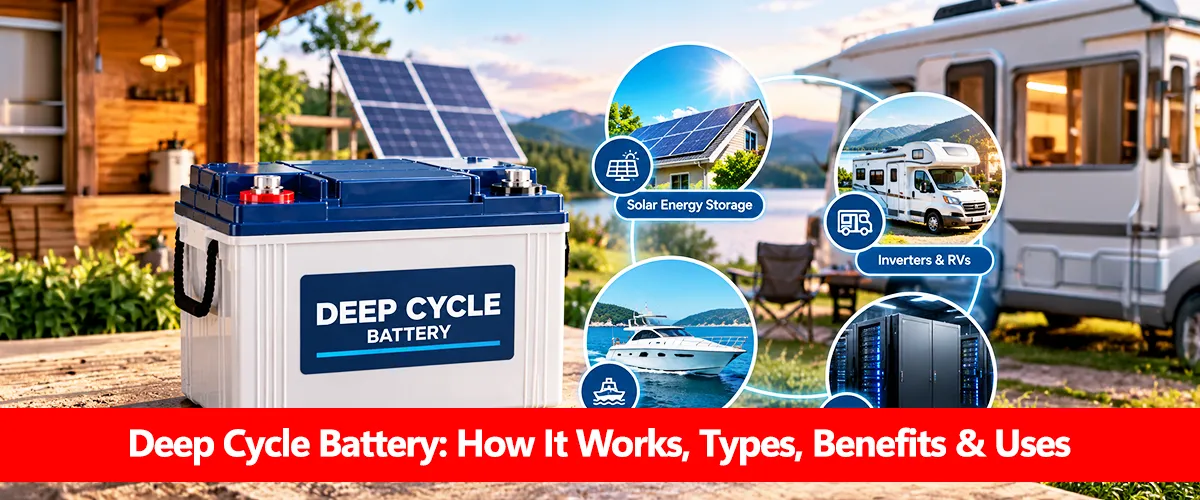
A deep cycle battery is a rechargeable battery designed to deliver electrical energy over extended periods and withstand repeated charging and discharging cycles. Unlike batteries primarily designed for short bursts of high starting current, deep-cycle batteries are built for sustained energy delivery.
Deep-cycle batteries are commonly used in solar energy storage, UPS systems, marine equipment, and off-grid applications. Their performance depends on battery chemistry, construction, depth of discharge, and charging conditions.
How Does a Deep Cycle Battery Work?
A deep-cycle battery stores chemical energy and converts it into electrical energy during discharge. Charging reverses the relevant electrochemical reactions, restoring its stored energy. The internal process depends on the battery chemistry. Lead-acid deep-cycle batteries use reactions involving lead-based plates and sulfuric acid, while lithium-based batteries operate through lithium-ion movement between electrodes.
Main components generally include:
- Anode and cathode: Electrodes involved in electrochemical reactions.
- Electrolyte: Enables ionic movement inside the battery.
- Separator: Prevents direct contact between electrodes where required.
- Terminals: Connect the battery to an electrical system.
- Battery casing: Protects internal components.
Some lithium-based deep-cycle batteries also include a battery management system (BMS) for monitoring and protection.
Types of Deep Cycle Batteries
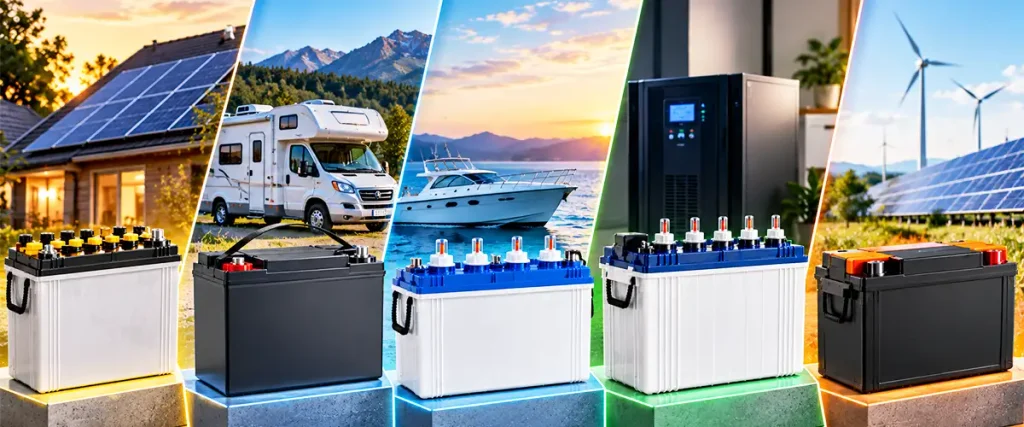
Deep-cycle describes a battery’s intended discharge characteristics rather than one specific chemical composition.
| Battery Type | Key Characteristic | Common Application |
| Flooded lead-acid | Serviceable liquid electrolyte design | Solar and inverter systems |
| AGM | Absorbent glass-mat construction | Backup and mobile power |
| Gel | Immobilized gel electrolyte | Selected cyclic applications |
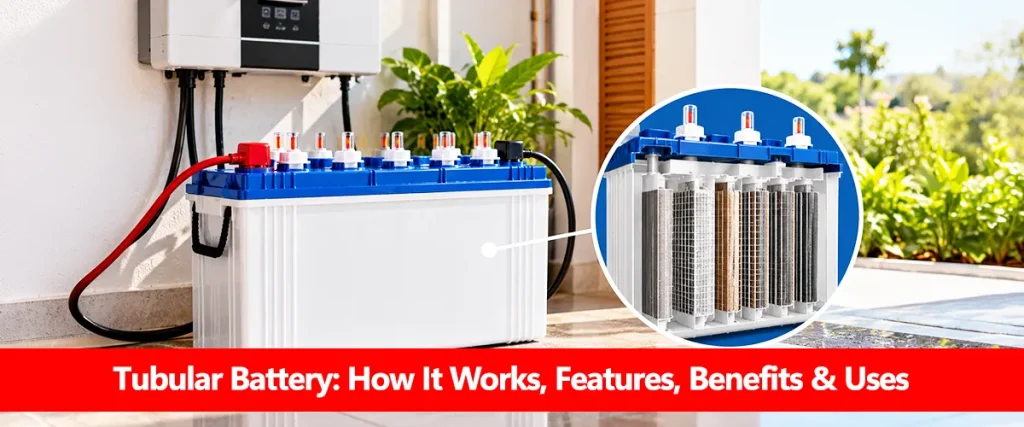
| Tubular lead-acid | Durable tubular positive plates | UPS and solar storage |
| LiFePO4 | Lithium-based chemistry with high cycle-life potential | Solar and off-grid systems |
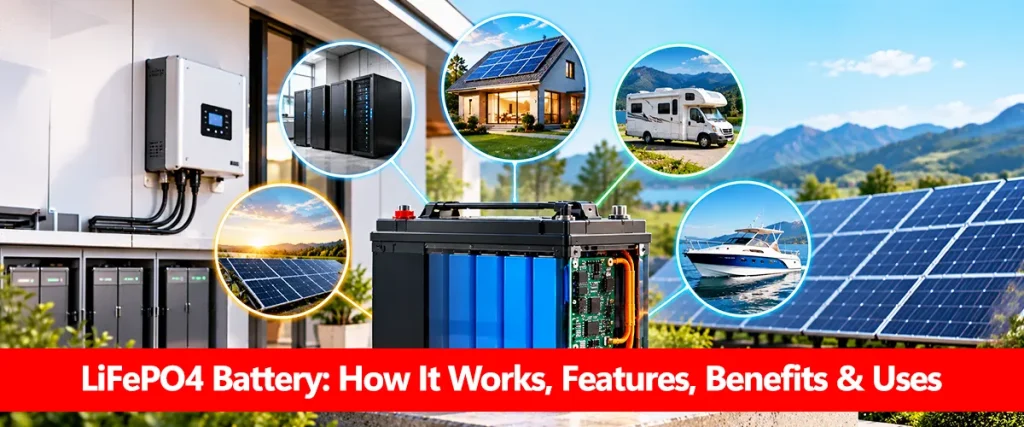
Different chemistries have different charging requirements, usable capacity limits, and service-life expectations. Explore gel batteries, tubular batteries, and LiFePO4 batteries for chemistry-specific details.
Key Features of Deep Cycle Batteries
Deep-cycle batteries are designed to provide sustained energy delivery across repeated discharge cycles.
Important features include:
- Rechargeable energy storage.
- Designed for repeated cycling.
- Available in multiple battery chemistries.
- Suitable for sustained electrical loads.
- Different depth-of-discharge limits depending on chemistry.
- Available in various voltage and capacity ratings.
Not all deep-cycle batteries offer the same cycle life or usable energy. Manufacturer specifications should be used when evaluating performance.
Common Applications of Deep Cycle Batteries
Deep-cycle batteries are widely used in electrical systems that require stored energy over extended periods.
Common applications include:
- Solar energy storage: Supplying electricity when solar generation is unavailable.
- UPS and inverter systems: Supporting equipment during power interruptions.
- Marine systems: Powering onboard electrical accessories.
- Recreational vehicles: Supplying electricity to appliances and lighting.
- Off-grid installations: Supporting electrical loads without continuous grid access.
- Industrial equipment: Providing energy for repeated operating cycles.
The battery must be compatible with the system voltage, charging equipment, and expected load.
Advantages of Deep Cycle Batteries
Deep-cycle batteries provide several benefits for applications involving repeated energy use.
Main advantages:
- Designed for repeated charge-discharge operation.
- Suitable for sustained electrical loads.
- Available in different chemistries and capacities.
- Useful for renewable energy storage.
- Can provide dependable backup power when correctly sized.
- Available in maintenance-free and serviceable designs.
Their suitability depends on the specific battery technology and operating conditions.
Limitations of Deep Cycle Batteries
Deep-cycle batteries also have performance and maintenance limitations.
Important limitations include:
- Limited cycle life under defined operating conditions.
- Excessive discharge can reduce lifespan.
- Incorrect charging may cause permanent damage.
- Some lead-acid designs require routine maintenance.
- High temperatures can accelerate battery aging.
- Weight and energy density vary significantly by chemistry.
Deep-cycle construction does not mean a battery can be discharged completely without consequences.
Important Deep Cycle Battery Specifications
Understanding battery ratings helps evaluate performance and compatibility.
| Specification | Meaning |
| Nominal voltage | Reference operating voltage |
| Rated capacity (Ah) | Charge capacity under specified conditions |
| Energy capacity (Wh) | Stored electrical energy |
| Depth of discharge (DoD) | Percentage of capacity discharged |
| State of charge (SoC) | Estimated remaining charge |
| Cycle life | Number of cycles under defined conditions |
| Internal resistance | Influences losses and power delivery |
Actual battery performance depends on discharge rate, temperature, chemistry, and battery condition.
Deep Cycle Battery Maintenance
Proper charging and operating conditions help maintain battery performance.
Recommended practices:
- Use a charger compatible with the battery chemistry.
- Follow manufacturer charging voltage and current limits.
- Avoid excessive discharge.
- Protect the battery from extreme temperatures.
- Inspect terminals and electrical connections.
- Follow electrolyte maintenance requirements for serviceable lead-acid batteries.
- Ensure lithium battery protection systems are functioning correctly.
Maintenance requirements vary significantly between flooded lead-acid and lithium-based batteries.
Deep Cycle vs Regular Battery
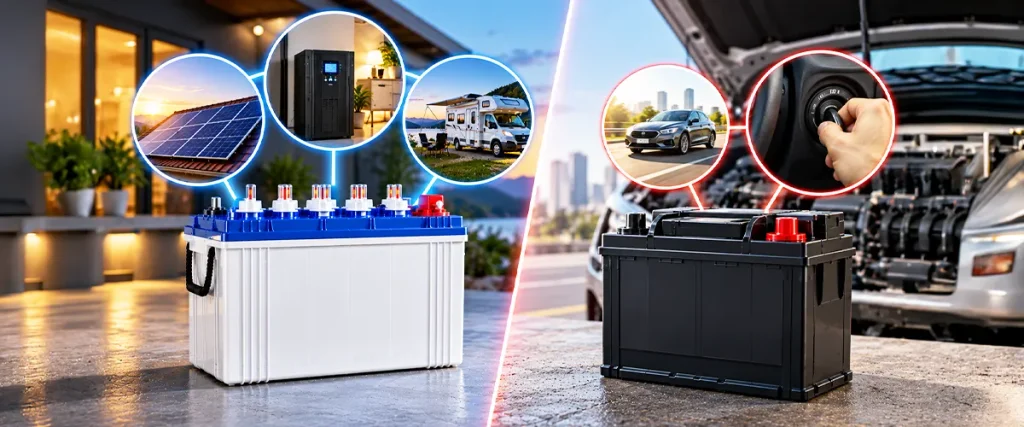
The main distinction is intended use.
A conventional automotive starting battery is optimized for delivering high current over short periods. A deep-cycle battery is designed for repeated, sustained energy delivery. Some dual-purpose batteries support both functions, but performance depends on their construction. Read our dedicated deep cycle vs regular battery guide for a detailed comparison.
Conclusion
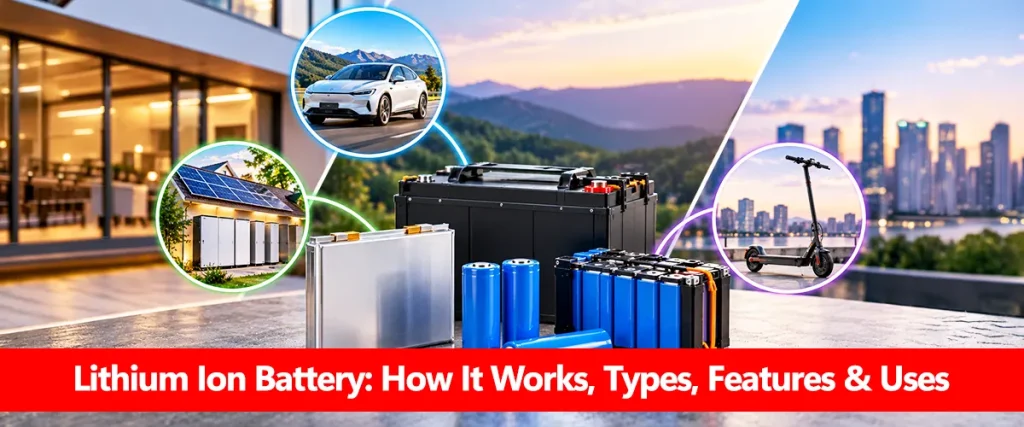
A deep cycle battery is designed for sustained energy delivery and repeated charging cycles. It is commonly used in solar storage, backup power, marine systems, and off-grid installations. Choosing the appropriate deep-cycle battery requires understanding its chemistry, rated capacity, discharge limits, charging requirements, and expected cycle life. Explore lithium-ion batteries, types of batteries, and the Battery Types and Chemistries category. Visit Batteries Hub for more battery education.
Frequently Asked Questions
What Is a Deep Cycle Battery?
A deep-cycle battery is a rechargeable battery designed for repeated discharge and recharge cycles while supplying energy over extended periods.
Is a Deep Cycle Battery Rechargeable?
Yes. Deep-cycle batteries are rechargeable and require charging equipment compatible with their chemistry.
Are All Deep Cycle Batteries Lead Acid?
No. Deep-cycle batteries include lead-acid and lithium-based technologies, including LiFePO4.
Can a Deep Cycle Battery Be Used for Solar Power?
Yes. Deep-cycle batteries are commonly used in solar storage systems when correctly matched to the charging equipment and electrical requirements.
How Long Does a Deep Cycle Battery Last?
Its lifespan depends on chemistry, depth of discharge, temperature, charging conditions, and cycle frequency.
Can a Deep Cycle Battery Be Used in a Car?
Some batteries are designed for both starting and cycling, but a deep-cycle battery should not replace an automotive starting battery unless it meets the vehicle’s starting and electrical requirements.