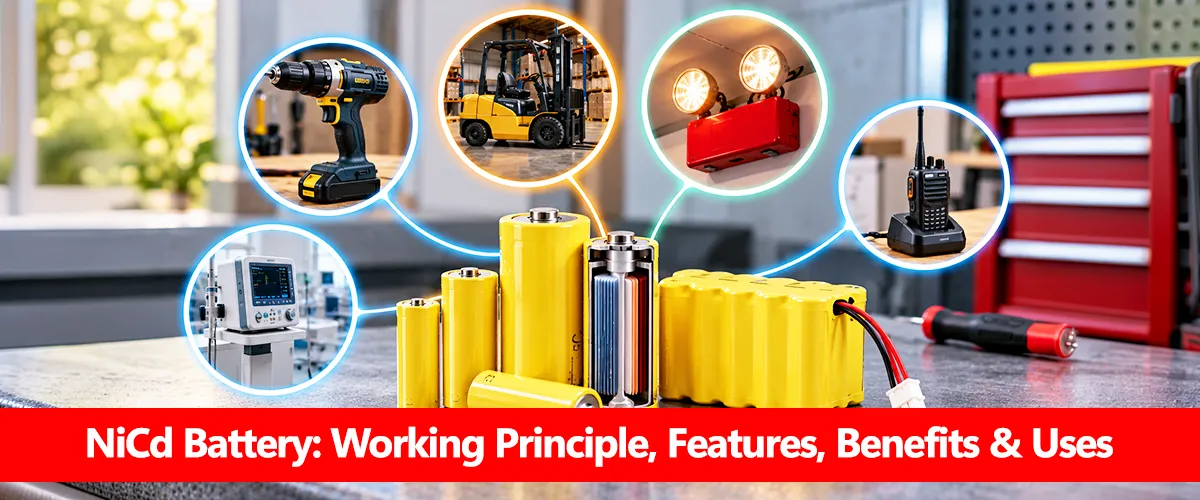
A NiCd battery (Nickel-Cadmium battery) is a rechargeable battery that uses nickel-based positive electrodes and cadmium-based negative electrodes to store and release electrical energy. It is known for its durability, high discharge-current capability, and ability to operate across a relatively wide temperature range.
Nickel-cadmium technology has historically been used in cordless tools, emergency lighting, aviation equipment, and industrial backup systems. Although newer types of batteries are increasingly common, NiCd batteries remain useful in certain specialized applications.
How Does a NiCd Battery Work?
A NiCd battery operates through reversible electrochemical reactions between its positive and negative electrodes. During discharge, the cadmium-based negative electrode is oxidized while the nickel-based positive electrode is reduced, producing electrical energy. Charging reverses these reactions and restores stored energy.
The battery uses an alkaline electrolyte, usually potassium hydroxide, which supports ion transport during operation. Unlike a lithium-ion battery, a NiCd battery does not rely on lithium-ion movement between intercalation electrodes.
Its main components include:
- Positive electrode: Contains nickel oxyhydroxide in the charged state.
- Negative electrode: Uses cadmium-based active material.
- Electrolyte: Typically potassium hydroxide solution.
- Separator: Prevents direct contact between electrodes.
- Battery casing: Protects internal components.
- Terminals: Connect the battery to an electrical circuit.
A NiCd battery typically provides a nominal voltage of approximately 1.2V per cell, although actual voltage changes during charging and discharging.
Key Features of NiCd Batteries
Nickel-cadmium batteries are recognized for their robust construction and ability to supply relatively high currents. Their characteristics make them suitable for equipment where dependable power delivery is more important than maximizing energy density.
| Feature | Description |
| Battery chemistry | Nickel-Cadmium |
| Rechargeability | Rechargeable |
| Nominal cell voltage | Approximately 1.2V |
| Electrolyte | Alkaline, commonly potassium hydroxide |
| Discharge capability | High current in suitable designs |
| Cycle life | Depends on design and operating conditions |
| Maintenance | Varies between sealed and vented models |
| Common uses | Industrial, aviation and emergency equipment |
NiCd batteries are available in different cell sizes and industrial configurations. Their capacity, internal resistance, and discharge characteristics depend on the specific design.
Common Applications of NiCd Batteries

A NiCd battery is commonly associated with equipment requiring repeated charging, reliable current delivery, and operation under demanding conditions. While many consumer devices have moved toward NiMH batteries or lithium-based alternatives, nickel-cadmium technology remains relevant in selected industries.
Common applications include:
- Emergency lighting: Providing backup electricity during power interruptions.
- Aviation systems: Supporting approved aircraft electrical and backup applications.
- Industrial equipment: Supplying power in demanding operating environments.
- Cordless tools: Used in many older rechargeable power tools.
- Railway systems: Supporting certain onboard electrical and backup functions.
- Communication equipment: Providing power in selected industrial installations.
Battery selection depends on equipment compatibility, required discharge current, operating temperature, and applicable safety standards.
Advantages of NiCd Batteries
The main advantages of a NiCd battery come from its established chemistry and robust operating characteristics. In properly designed systems, nickel-cadmium batteries can withstand repeated cycling and deliver high currents without requiring the same protection architecture used in many lithium battery packs.
Key advantages include:
- Good high-current discharge capability.
- Durable construction in suitable designs.
- Reliable operation across a relatively wide temperature range.
- Established technology for industrial backup applications.
- Rechargeable operation with good cycle-life potential.
- Availability in specialized industrial configurations.
These benefits help explain why NiCd technology continues to be used in certain applications despite the development of newer rechargeable battery chemistries.
Limitations of NiCd Batteries
Despite their durability, NiCd batteries have important disadvantages. The most significant concern is cadmium, a toxic heavy metal that requires careful handling, regulated disposal, and appropriate recycling. Other limitations include lower energy density than many modern lithium-ion batteries, relatively high self-discharge, and susceptibility to voltage depression under certain repeated operating patterns.
Important limitations include:
- Cadmium-related environmental and health concerns.
- Lower energy density than many lithium-based batteries.
- Self-discharge during storage.
- Possible voltage depression and memory-related effects.
- Reduced performance under unsuitable charging conditions.
- Restrictions on certain uses and sales in some markets.
NiCd batteries should never be discarded with ordinary household waste where battery recycling or hazardous-waste collection is required.
NiCd Battery Charging and Maintenance

Correct charging is essential for maintaining NiCd battery performance. Nickel-cadmium batteries require charging methods suited to their chemistry, and unsuitable chargers can cause overheating, excessive pressure, or premature battery damage.
Charging equipment may use temperature monitoring, voltage behavior, or timed charging controls depending on the battery design. A charger intended for a LiFePO4 battery or another lithium chemistry should not be used unless explicitly approved for NiCd charging.
For safe operation:
- Use a NiCd-compatible charger.
- Follow manufacturer charging-current limits.
- Avoid prolonged overcharging and excessive heat.
- Inspect batteries for damage or leakage.
- Follow maintenance instructions for vented industrial cells.
- Recycle batteries through appropriate collection facilities.
Sealed consumer NiCd cells should not be opened or refilled. Maintenance procedures for industrial vented batteries depend on manufacturer requirements.
Important NiCd Battery Specifications
Understanding battery terminology helps evaluate the performance and suitability of nickel-cadmium technology. A NiCd battery’s rated capacity and voltage describe its electrical characteristics, while cycle life and internal resistance influence long-term operation.
| Specification | Meaning |
| Nominal voltage | Approximately 1.2V per cell |
| Rated capacity (Ah or mAh) | Charge capacity under specified conditions |
| Energy capacity (Wh) | Stored electrical energy |
| State of charge (SoC) | Estimated remaining charge |
| Depth of discharge (DoD) | Percentage of capacity removed |
| Cycle life | Number of cycles under defined conditions |
| Internal resistance | Influences voltage drop and power delivery |
Real-world battery performance depends on temperature, discharge rate, charging conditions, and battery age. Manufacturer specifications provide the most reliable basis for evaluating a particular cell.
NiCd Battery vs Other Battery Chemistries
NiCd batteries differ from other rechargeable batteries in electrode materials, charging requirements, environmental impact, and energy density. For instance, a NiMH battery uses a hydrogen-absorbing metal alloy instead of cadmium at its negative electrode.
Modern LiFePO4 batteries offer different voltage characteristics, protection requirements, and cycle-life performance. Emerging solid-state batteries represent another approach to rechargeable energy storage, although their designs and commercial maturity vary.
These technologies are not automatically interchangeable. Equipment voltage, charging compatibility, current requirements, and safety considerations must be checked before changing battery chemistry.
Conclusion
A NiCd battery is a rechargeable nickel-cadmium battery known for its durability, high-current capability, and use in demanding industrial applications. Its 1.2V nominal cell voltage and established charging technology make it suitable for certain specialized electrical systems.
However, cadmium toxicity, environmental restrictions, and lower energy density limit its suitability for many modern consumer applications. Proper charging, handling, and recycling are essential. Explore the Battery Types and Chemistries section at Batteries Hub to learn more about rechargeable battery technologies.
Frequently Asked Questions
What Does NiCd Stand For?
NiCd stands for Nickel-Cadmium, a rechargeable battery chemistry that uses nickel-based positive electrodes and cadmium-based negative electrodes.
Are NiCd Batteries Rechargeable?
Yes. NiCd batteries are designed for repeated charging and discharging using compatible nickel-cadmium charging equipment.
What Is the Voltage of a NiCd Battery?
A typical NiCd cell has a nominal voltage of approximately 1.2V. Battery packs can provide higher voltages by connecting multiple cells in series.
How Long Does a NiCd Battery Last?
Its lifespan depends on cell design, charging practices, temperature, discharge conditions, and usage frequency. Properly maintained industrial NiCd batteries can provide long service life.
Do NiCd Batteries Have a Memory Effect?
NiCd batteries can experience memory-related effects and voltage depression under certain repetitive charging and discharging patterns. However, not every apparent loss of capacity is caused by a true memory effect.
Are NiCd Batteries Still Used Today?
Yes. Although their use has declined in many consumer products, NiCd batteries remain in certain aviation, railway, emergency lighting, and industrial applications.
Are NiCd Batteries Environmentally Friendly?
NiCd batteries contain toxic cadmium and require appropriate recycling and disposal. They should not be placed in ordinary household waste where regulated battery collection is available.