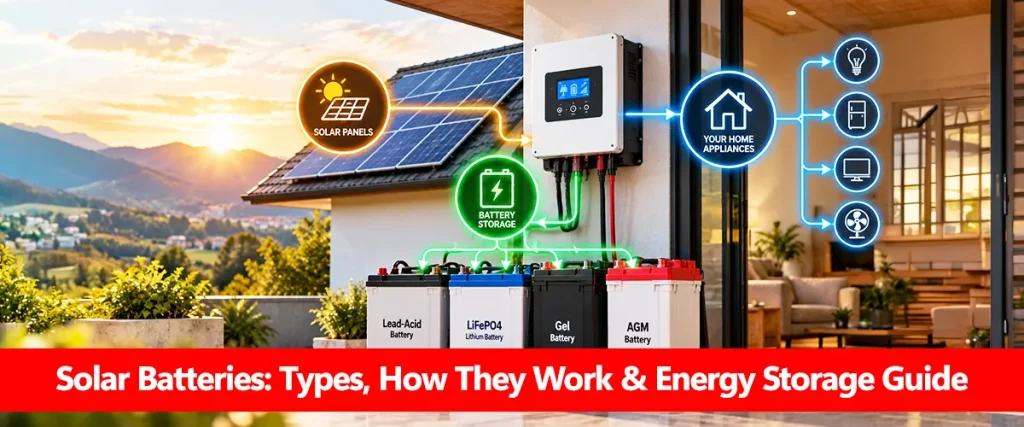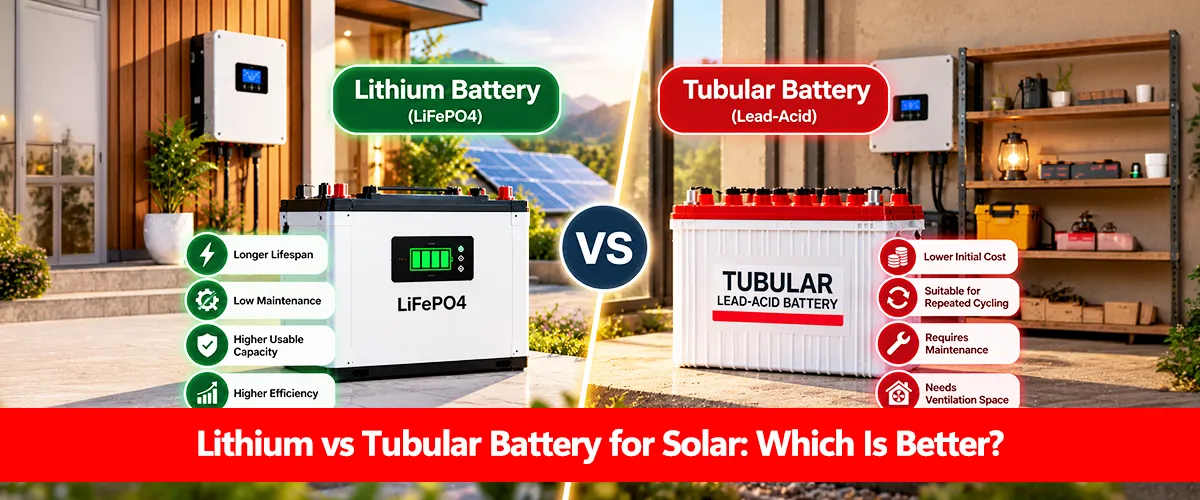
Lithium vs tubular battery for solar is an important comparison when choosing energy storage for a hybrid inverter, off-grid installation or home solar backup system. Both batteries can store solar electricity, but they differ in usable capacity, charging efficiency, lifespan, maintenance and initial cost.
Lithium batteries, particularly LiFePO4, generally provide longer cycle life and greater usable energy. Tubular lead-acid batteries remain a practical alternative for installations with limited upfront budgets or existing compatible equipment. The right choice depends on how frequently the solar battery storage system charges and discharges.
Lithium and Tubular Solar Batteries Explained
A lithium solar battery uses rechargeable lithium-ion chemistry to store electricity generated by photovoltaic (PV) panels. LiFePO4 is commonly used for stationary storage because of its cycle-life potential, efficiency and thermal stability. Most LiFePO4 batteries also include a battery management system for monitoring and protection.
A tubular battery is a lead-acid battery with tubular positive plates designed to support repeated cycling. Many tubular models used in solar and inverter systems are flooded batteries that require periodic electrolyte maintenance and suitable ventilation.
Lithium vs Tubular Battery for Solar: Quick Comparison
| Feature | Lithium (LiFePO4) | Tubular Lead-Acid |
| Battery chemistry | Lithium iron phosphate | Lead-acid |
| Usable capacity | Generally higher | Generally lower |
| Energy density | Higher | Lower |
| Charging efficiency | Generally higher | Generally lower |
| Charging speed | Often faster with compatible equipment | Usually slower near full charge |
| Cycle life | Generally longer | Usually shorter with frequent deep cycling |
| Maintenance | Low routine maintenance | Flooded models require water checks |
| Weight | Lighter for comparable stored energy | Heavier |
| Initial cost | Usually higher | Usually lower |
| Solar application | Daily cycling and long-term storage | Budget-sensitive backup |
These differences describe common battery characteristics. Actual performance depends on manufacturer specifications, operating temperature and charging conditions. For a broader comparison outside solar applications, see tubular vs lithium battery.
Which Battery Provides More Usable Solar Energy?
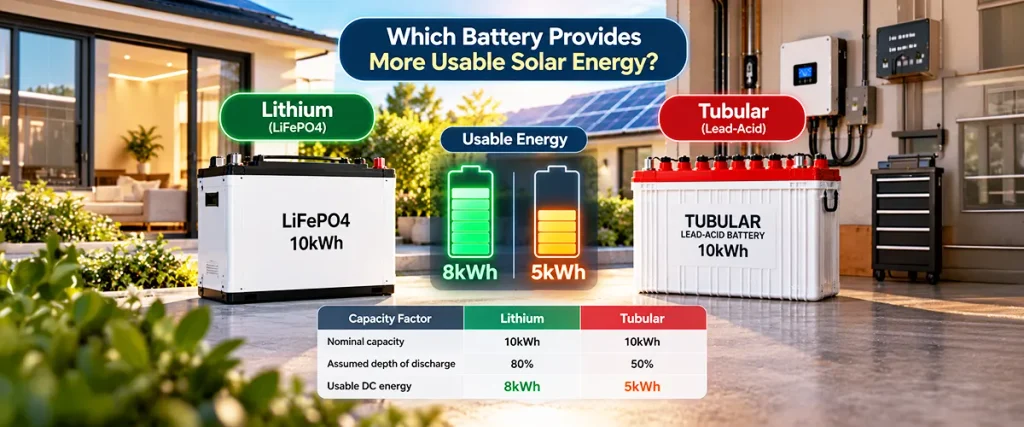
Usable capacity is one of the biggest differences between lithium and tubular batteries. A battery’s rated capacity does not always equal the amount of energy available for regular use because discharging too deeply can reduce its lifespan.
For illustration, compare two battery banks with the same nominal storage capacity of 10kWh:
| Capacity Factor | Lithium | Tubular |
| Nominal capacity | 10kWh | 10kWh |
| Assumed depth of discharge | 80% | 50% |
| Usable DC energy | 8kWh | 5kWh |
These are illustrative discharge assumptions, not universal limits. Actual usable energy depends on battery specifications and operating conditions.
Under these assumptions, lithium provides more usable energy from the same nominal capacity. However, inverter losses and discharge-current limitations must also be considered. Accurate solar battery sizing should therefore use manufacturer-approved depth of discharge values rather than nominal capacity alone.
Charging Efficiency and Daily Solar Performance
Solar batteries often charge during daylight and discharge after sunset. This daily cycling pattern makes charging efficiency and charge acceptance important considerations.
LiFePO4 batteries generally have higher charging efficiency and can often accept relatively high charging currents within manufacturer limits. Tubular lead-acid batteries typically require more time near full charge because their absorption stage involves gradually decreasing charging current.
This difference can matter when solar generation is available for only a limited period. However, neither battery will charge properly without sufficient PV generation and compatible equipment. Understanding how solar batteries work helps explain how solar production and household demand affect charging.
Lithium vs Tubular Battery Lifespan in Solar Systems
Lithium batteries, particularly LiFePO4 models, generally provide longer cycle life than conventional flooded tubular lead-acid batteries. This can make lithium attractive for solar installations that discharge the battery every evening.
Tubular batteries are designed for cycling, but repeated deep discharge, undercharging and high operating temperatures can accelerate degradation. Lithium batteries also age over time, especially when operated outside their recommended temperature and charging limits.
Actual service life depends on usage and manufacturer specifications rather than chemistry alone. Our how long do solar batteries last guide explains the main factors affecting long-term performance.
Inverter Compatibility and Charging Requirements
Replacing tubular batteries with lithium requires more than matching the voltage printed on the battery label. A hybrid inverter must support the battery’s operating voltage range, charging profile, current limits and protection requirements.
Important compatibility checks include:
- Battery nominal and operating voltage.
- Maximum charging and discharge current.
- Inverter charging settings.
- Battery management system compatibility.
- Supported communication protocols, where required.
- Temperature-related charging restrictions.
- Manufacturer-approved battery configurations.
Tubular batteries commonly use lead-acid bulk, absorption and float charging. Lithium batteries require chemistry-specific charging controls, and some systems need communication between the inverter and battery management system.
An existing lead-acid charging profile should not automatically be used for lithium. Our lead acid charger for lithium battery guide explains these compatibility restrictions.
Maintenance, Safety and Installation Space
Lithium batteries generally need less routine maintenance than flooded tubular batteries. They do not require electrolyte refilling, although battery connections, ventilation requirements and electronic protection still need attention.
Flooded tubular batteries commonly require distilled-water checks and suitable ventilation because charging may produce hydrogen gas. Both technologies also require protection from excessive heat, overcurrent and unsuitable operating conditions.
Lithium batteries typically occupy less space for comparable stored energy, which can be useful in residential installations. However, high temperatures can accelerate aging in both chemistries. Proper installation and solar battery maintenance remain important regardless of battery type.
Which Costs Less Over the Life of a Solar System?
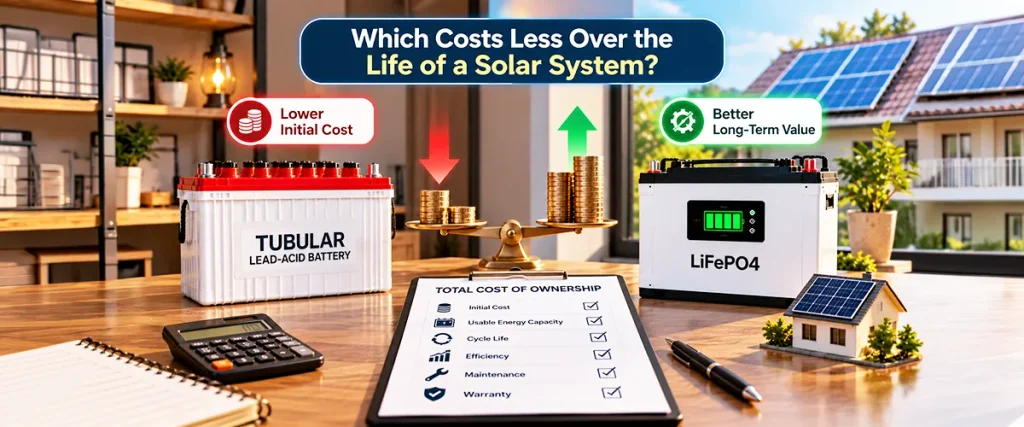
Tubular lead-acid batteries generally have a lower initial purchase price, making them attractive for households with limited installation budgets.
Lithium batteries usually require a larger upfront investment, but their longer cycle-life potential, higher usable capacity and reduced maintenance needs may improve long-term value in frequently cycled solar systems.
To compare total ownership cost, consider:
- Initial battery and installation cost.
- Usable energy capacity.
- Expected charging and discharging cycles.
- Round-trip efficiency.
- Maintenance and replacement requirements.
- Warranty coverage and after-sales support.
A battery with a lower purchase price may cost more over time if frequent replacement is required. For local market estimates, compare the latest solar battery prices in Pakistan rather than relying on a fixed price assumption.
Which Battery Should You Choose for Your Solar Setup?
The best choice depends on how the solar system will be used and how much long-term value matters compared with initial cost.
| Solar Requirement | Battery to Consider |
| Daily solar charging and discharging | LiFePO4 |
| Regular nighttime electricity use | LiFePO4 |
| Limited initial budget | Tubular lead-acid |
| Occasional solar backup | Tubular or lithium |
| Limited installation space | Lithium |
| Minimal routine maintenance | Lithium |
| Existing tubular-compatible system | Tubular, unless upgrading equipment |
| Long-term frequent cycling | LiFePO4 |
For a new system, calculate the required usable energy before choosing battery quantity. Our how many batteries for solar guide covers battery count, while best battery type for solar compares the wider range of storage chemistries.
Conclusion
The lithium vs tubular battery for solar comparison shows that LiFePO4 generally offers higher usable capacity, better charging efficiency, longer cycle-life potential and lower routine maintenance.
Tubular batteries remain suitable where initial affordability and compatibility with existing equipment are priorities. However, their maintenance requirements and performance under frequent deep cycling should be considered.
For daily solar energy storage, LiFePO4 often provides stronger long-term advantages. For occasional backup and budget-sensitive installations, a properly selected tubular battery can still be practical.
Frequently Asked Questions
Which Is Better for Solar: Lithium or Tubular Battery?
LiFePO4 is often better suited to frequent solar cycling because of its usable capacity, efficiency and lifespan potential. Tubular batteries can be practical when initial cost is the main priority.
Do Lithium Solar Batteries Last Longer Than Tubular Batteries?
Generally, LiFePO4 batteries offer longer cycle life than conventional flooded tubular batteries. Actual lifespan depends on charging conditions, temperature and discharge depth.
Can I Replace a Tubular Solar Battery With Lithium?
Replacement may be possible if the inverter supports the lithium battery’s voltage, charging profile, current limits and BMS requirements. Equipment compatibility should be verified before installation.
Which Battery Charges Faster With Solar Panels?
Compatible LiFePO4 batteries can often accept faster charging than tubular lead-acid batteries, particularly near full charge. Actual charging time depends on solar generation, charger output and battery specifications.
Are Tubular Batteries Good for Solar Backup?
Yes. Properly selected tubular deep-cycle batteries can provide solar backup, especially for budget-sensitive installations. Frequent deep discharge and maintenance requirements should be considered.
Is Lithium Worth the Extra Cost for Solar?
Lithium may offer better long-term value when the battery cycles regularly because of its lifespan potential, usable capacity and lower maintenance needs. The result depends on actual battery specifications and usage.
Is Lithium Better Than All Lead-Acid Solar Batteries?
Lithium generally offers advantages in energy density and frequent cycling, but different lead-acid designs have their own applications. Our lead acid vs lithium solar battery comparison covers the wider chemistry differences.