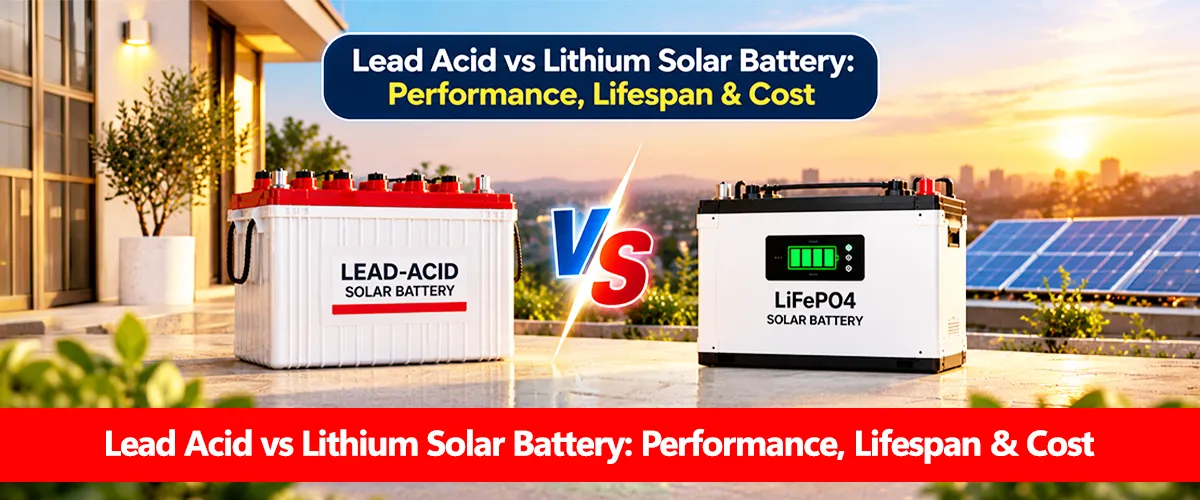
Lead acid vs lithium solar battery is an important comparison for homeowners choosing energy storage for hybrid solar systems, off-grid installations and backup electricity. Both technologies store solar-generated energy, but they differ in usable capacity, charging efficiency, cycle life, maintenance and long-term cost.
Lithium batteries, particularly LiFePO4, generally offer higher usable capacity, longer cycle-life potential and lower routine maintenance. Lead-acid batteries remain practical because of their lower initial cost and compatibility with many existing inverter systems. Choosing the right solar battery storage technology depends on daily electricity consumption, backup requirements and available budget.
Understanding Lead-Acid and Lithium Solar Batteries
A lead-acid battery stores electrical energy through chemical reactions involving lead-based electrodes and sulfuric acid electrolyte. Solar installations may use flooded tubular, AGM or gel batteries, depending on maintenance requirements and charging compatibility.
A lithium-ion battery stores energy through the movement of lithium ions between electrodes. Lithium iron phosphate (LiFePO4) is commonly used for stationary solar storage because of its cycle-life potential and thermal stability. These batteries require chemistry-specific charging controls and suitable protection electronics.
Lead Acid vs Lithium Solar Battery: Quick Comparison
| Feature | Lead-Acid Solar Battery | Lithium Solar Battery |
| Common types | Flooded, tubular, AGM, gel | LiFePO4, selected other lithium-ion chemistries |
| Usable capacity | Generally lower | Generally higher |
| Energy density | Lower | Higher |
| Charging efficiency | Generally lower | Generally higher |
| Charging speed | Often slower near full charge | Often faster with compatible equipment |
| Cycle life | Usually shorter under frequent deep cycling | Often longer, especially LiFePO4 |
| Maintenance | Depends on battery type | Generally low |
| Weight | Heavier for similar stored energy | Lighter |
| Initial cost | Usually lower | Usually higher |
| Battery protection | Charging and electrical protection | BMS and compatible charging equipment |
| Solar suitability | Backup and selected cycling applications | Frequent cycling and long-term storage |
These are general differences rather than guaranteed specifications. Performance varies by battery construction, temperature and operating conditions. Our lithium vs lead acid battery article covers the wider chemistry comparison beyond solar applications.
Usable Capacity: Which Battery Stores More Practical Energy?
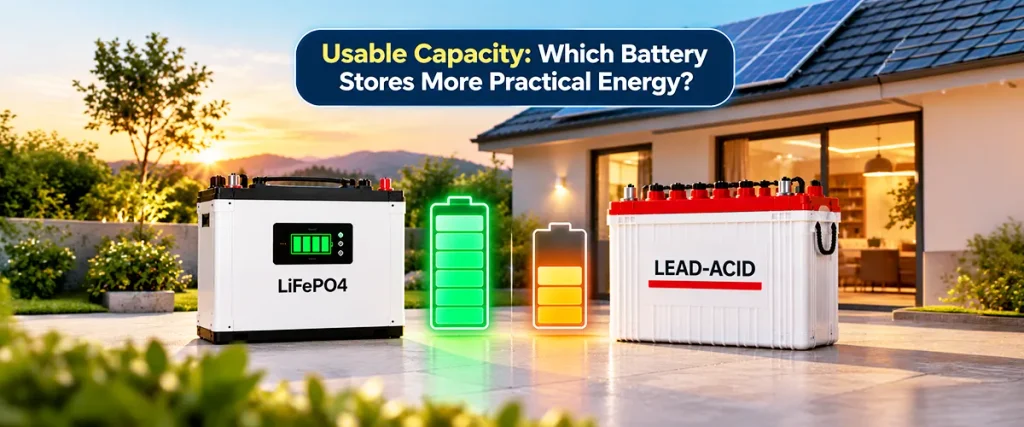
Usable energy is one of the most important factors when comparing solar batteries. Although two battery banks may have identical nominal capacity, their recommended depth-of-discharge limits can result in different amounts of available electricity.
For example, suppose a solar installation requires 5kWh of usable DC energy. With an assumed 80% depth of discharge, a lithium battery bank would require approximately 6.25kWh of nominal capacity. At an assumed 50% depth of discharge, a lead-acid battery bank would require approximately 10kWh.
These are illustrative assumptions, not universal discharge limits. Actual depth of discharge depends on manufacturer specifications, and inverter losses would increase the nominal capacity required to deliver the same AC energy.
Correct solar battery sizing should therefore compare usable kilowatt-hours rather than battery Ah ratings alone. Individual battery quantities can then be determined through how many batteries for solar.
Charging Efficiency and Solar Energy Utilization
Solar battery efficiency affects how much electricity can be recovered after charging and discharging. Lithium batteries generally have higher round-trip efficiency than conventional lead-acid batteries, meaning less energy is lost during storage.
Lead-acid batteries also tend to accept charging current more slowly as they approach full charge. Lithium batteries can often accept higher charging currents within their specified limits, which may help them use available solar generation more effectively.
However, charging performance also depends on the photovoltaic (PV) system, hybrid inverter, charge controller and battery condition. Understanding how solar batteries work helps explain how solar production, household consumption and battery charging interact.
Charging Profiles and Inverter Compatibility
Lead-acid and lithium batteries require different charging settings. Lead-acid batteries commonly use bulk, absorption and float charging stages, while lithium batteries require chemistry-specific voltage, current and charge termination settings. An inverter configured for a conventional lead-acid battery should not automatically be used with lithium storage.
Important compatibility checks include:
- Battery operating voltage and inverter input range.
- Manufacturer-approved charging voltage and current.
- Supported battery chemistry and charging profile.
- Battery management system communication requirements.
- Charging temperature restrictions.
- Maximum continuous discharge current.
- Approved battery bank configurations.
For lead-acid systems, bulk absorption float charging explains how charging stages operate. Lithium systems may require coordination with a battery management system to prevent unsafe charging conditions.
If replacing an existing battery, verify the charger specifications carefully. Our lead acid charger for lithium battery guide explains why matching nominal voltage alone is insufficient.
Lead-Acid vs Lithium Solar Battery Lifespan
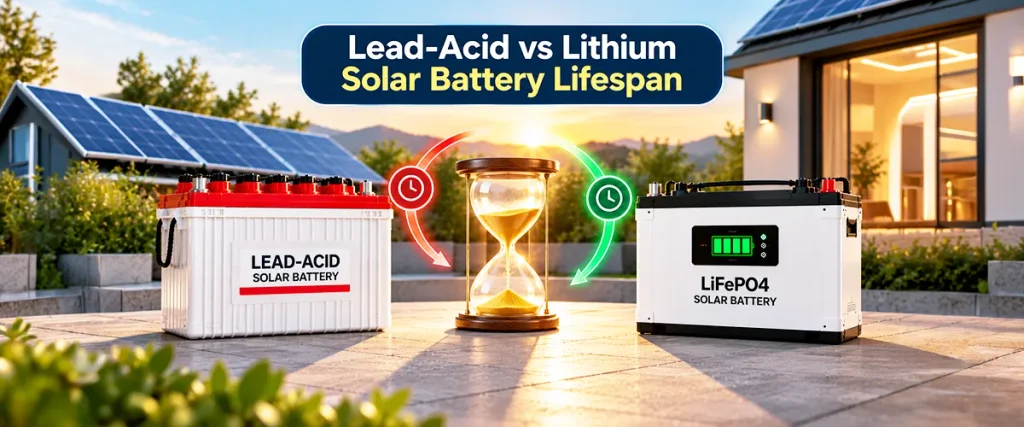
Battery lifespan is especially important in solar installations that charge during daylight and discharge regularly after sunset. LiFePO4 batteries generally provide longer cycle-life potential than conventional lead-acid batteries under comparable cycling conditions. Lead-acid batteries can experience accelerated deterioration when repeatedly discharged deeply or left partially charged for extended periods.
However, lithium batteries also experience aging, particularly when exposed to unsuitable temperatures or charging conditions. The actual service life of both technologies depends on battery quality, cycling frequency and operating environment. Manufacturer specifications should be compared at similar discharge depths and temperatures. Our guides on battery cycle life and how long solar batteries last explain these factors in greater detail.
Maintenance, Safety and Installation Requirements
Maintenance is another major difference between lead-acid and lithium solar batteries. Flooded lead-acid batteries may require distilled-water replenishment, electrolyte checks and suitable ventilation because charging can release hydrogen gas. By comparison, sealed lead-acid batteries such as AGM and gel eliminate routine water refilling. Lithium batteries generally require less routine servicing but still need electrical protection, suitable installation conditions and temperature monitoring.
LiFePO4 offers relatively strong thermal stability compared with many other lithium chemistries, but it is not completely free from safety risks. Both battery technologies require correct fusing, wiring and charging protection. Regular solar battery maintenance helps identify developing problems before they affect system reliability.
Initial Price vs Long-Term Solar Battery Cost
Lead-acid batteries generally have a lower initial purchase price. This can make them attractive for households with limited budgets or installations that use backup power only occasionally. Lithium batteries typically require a higher initial investment, but longer cycle-life potential, greater usable energy and lower routine maintenance may reduce their lifetime cost in frequently cycled systems.
When comparing total ownership cost, consider:
- Initial battery and installation expense.
- Usable energy delivered per charge.
- Expected number of charging cycles.
- Round-trip efficiency and energy losses.
- Maintenance requirements.
- Warranty coverage and replacement frequency.
- Inverter or charger upgrades required for compatibility.
A lower-priced battery is not necessarily cheaper over several years. For local market comparisons, review solar battery prices in Pakistan and evaluate the manufacturer’s actual warranty conditions.
Which Is Better for Different Solar Applications?
The better choice depends on how frequently the battery will be used and whether upfront affordability or long-term performance matters more.
| Solar Application | Battery Type to Consider |
| Daily solar charging and discharging | LiFePO4 |
| Regular nighttime electricity use | LiFePO4 |
| Occasional backup during outages | Lead-acid or lithium |
| Limited initial installation budget | Lead-acid |
| Limited installation space | Lithium |
| Low-maintenance energy storage | Lithium |
| Existing lead-acid inverter installation | Compatible lead-acid or approved lithium upgrade |
| Frequent deep cycling | Suitable LiFePO4 battery |
For a comparison focused specifically on tubular designs, see lithium vs tubular battery for solar. If you are evaluating all available chemistries, our best battery type for solar guide provides broader selection criteria.
What to Check Before Switching From Lead-Acid to Lithium
Upgrading an existing solar battery bank requires checking whether the inverter, charger and electrical protection can support the new chemistry. The replacement battery must also meet the system’s energy and power requirements.
Before switching, verify:
- Compatible battery voltage and operating range.
- Lithium charging profile and current limits.
- BMS communication and protection requirements.
- Inverter discharge-current capability.
- Temperature restrictions and installation space.
- Manufacturer-approved series or parallel connections.
- Warranty and installer support.
An existing solar installation may need additional equipment before a battery replacement is possible. The process is similar to the compatibility checks involved when replacing a UPS lead-acid battery with lithium, although solar inverters have their own requirements.
Battery storage is also not essential for every PV installation. Some grid-connected systems operate without batteries, as explained in can solar panels work without batteries.
Conclusion
The lead acid vs lithium solar battery comparison shows that lithium batteries, particularly LiFePO4, generally offer higher usable capacity, better charging efficiency, longer cycle-life potential and reduced routine maintenance.
Lead-acid batteries remain practical for budget-sensitive installations and occasional backup requirements. Their lower initial cost may be attractive when daily cycling is limited and compatible equipment is already available.
For frequently cycled solar systems, lithium often offers stronger long-term advantages. The final decision should consider usable energy, inverter compatibility, safety, warranty and total ownership cost rather than purchase price alone.
Frequently Asked Questions
Which Is Better for Solar: Lead-Acid or Lithium Battery?
LiFePO4 is often a better fit for frequently cycled solar storage because of its usable capacity, efficiency and cycle-life potential. Lead-acid batteries can be suitable when initial cost is the main concern.
Do Lithium Solar Batteries Last Longer Than Lead-Acid Batteries?
Generally, suitable LiFePO4 batteries offer longer cycle life than conventional lead-acid batteries. Actual lifespan depends on operating temperature, depth of discharge and charging conditions.
Can I Replace Lead-Acid Solar Batteries With Lithium?
Replacement may be possible if the hybrid inverter supports the lithium battery’s voltage, charging requirements, BMS and discharge-current limits. Always verify compatibility before installation.
Which Solar Battery Charges Faster?
Lithium batteries can often accept higher charging current and recharge faster than lead-acid batteries when supported by the battery and charging equipment.
Are Lead-Acid Solar Batteries Maintenance-Free?
Some sealed lead-acid batteries require no routine water refilling, while flooded designs may require electrolyte maintenance. All batteries still need proper charging and inspection.
Is a Lithium Solar Battery Worth the Higher Price?
Lithium may offer better long-term value in systems that cycle frequently because of its usable capacity, efficiency and expected lifespan. The result depends on battery specifications, usage and ownership costs.
Do Lead-Acid and Lithium Batteries Need Different Inverters?
Not always, but their operating voltage ranges and charging requirements differ. Some hybrid inverters support both chemistries through separate settings, while others require specific battery compatibility.
Can Lead-Acid and Lithium Batteries Be Connected Together?
They should not be directly mixed in the same battery bank without an explicitly manufacturer-approved system design. Different charging requirements and operating characteristics can create imbalance and safety risks.