A lithium battery for UPS is a rechargeable energy storage battery that supplies backup electricity through a compatible uninterruptible power supply during a power outage. Lithium batteries are used in selected modern UPS systems because they can offer longer service life, lower weight, faster charging and greater usable energy than conventional lead-acid batteries.
However, lithium batteries are not universal replacements for traditional UPS batteries. The UPS must support the specific lithium chemistry, voltage range, charging requirements and battery protection system. Understanding these conditions is essential before installing lithium storage for computers, office equipment or household backup.
How Does a Lithium Battery Work in a UPS?
A lithium UPS battery stores electrical energy when mains power is available. During an outage, the UPS draws direct current (DC) from the battery and converts it into alternating current (AC) for connected equipment.
The UPS charger replenishes the battery according to its approved charging profile, while electronic protection monitors operating conditions. In many lithium UPS systems, a battery management system measures cell voltage, temperature and current to prevent unsafe operation.
Lithium batteries can support the same basic backup function as lead-acid batteries, but the equipment controlling charging and discharging must be designed for their different electrical characteristics.
Types of Lithium Batteries Used in UPS Systems
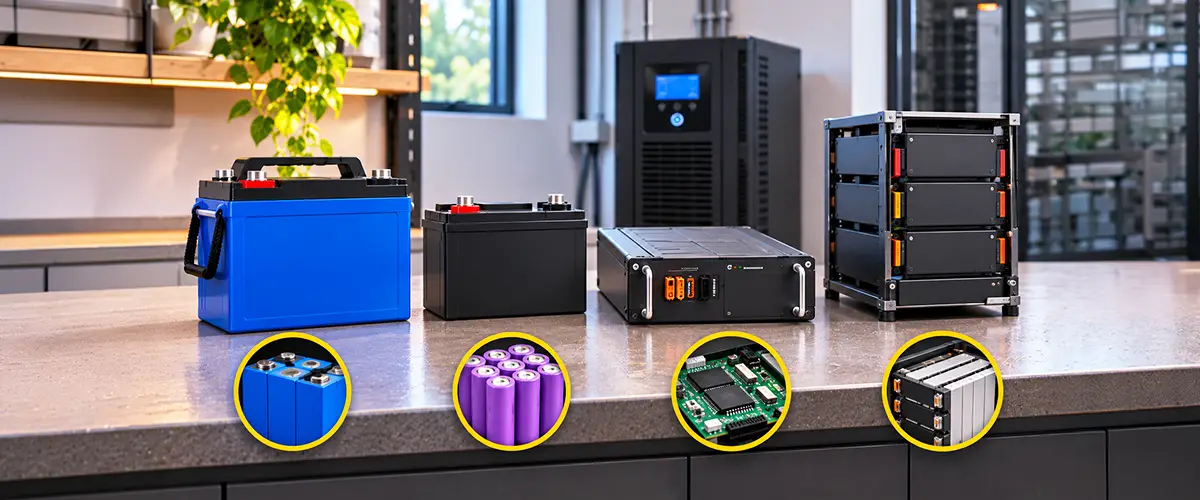
Lithium-ion is a family of rechargeable battery chemistries rather than one single battery type. UPS manufacturers use different chemistries depending on energy density, safety requirements, discharge capability and system design.
| Lithium Battery Type | Main Characteristic | UPS Application |
| LiFePO4 (LFP) | Strong thermal stability and cycle-life potential | Compatible residential and commercial UPS |
| NMC lithium-ion | Higher energy density | Selected manufacturer-designed UPS systems |
| Integrated lithium battery pack | Battery cells with dedicated protection and communication | Model-specific UPS replacement or expansion |
| Modular lithium battery system | Approved expandable storage architecture | Selected larger UPS installations |
LiFePO4 is attractive for applications involving regular battery cycling, but it is not the only lithium chemistry used in UPS equipment. Eaton, for example, uses LiFePO4 cells in selected 5P lithium UPS products, while other commercial UPS systems use different manufacturer-approved lithium configurations. The detailed characteristics of LiFePO4 batteries are covered separately, along with their particular use in LiFePO4 battery for UPS.
Lithium vs Lead-Acid Batteries for UPS
Lead-acid batteries remain common in traditional UPS equipment because of their affordability and established compatibility. Lithium batteries offer different benefits, particularly when battery replacements, weight and space are important.
| Feature | Lithium UPS Battery | Lead-Acid UPS Battery |
| Energy density | Generally higher | Lower |
| Weight | Usually lighter for comparable energy | Heavier |
| Cycle life | Generally longer | Often shorter |
| Recharge capability | Can be faster with compatible charging | Commonly slower near full charge |
| Routine water maintenance | Not required | Not required for sealed VRLA |
| Initial investment | Usually higher | Usually lower |
| Charging controls | Lithium-specific with BMS | Lead-acid charging profile |
| Replacement compatibility | Must be explicitly supported | Common in traditional UPS models |
Lithium batteries can reduce replacement frequency, but overall performance depends on the specific battery pack and UPS design. A suitable tubular battery for UPS may still be practical for approved external-battery systems, especially where initial cost is the main concern.
Can You Use a Lithium Battery in an Existing UPS?
Not every UPS designed for lead-acid batteries can safely operate with lithium storage. Even when a lithium battery has a similar nominal voltage, its charging limits, discharge protection and connection requirements may differ.
For example, a conventional 12V sealed lead-acid UPS battery and a four-cell LiFePO4 battery pack may appear electrically similar, but they do not necessarily have compatible charging behavior or protection characteristics.
Before considering lithium, check:
- Whether the UPS manufacturer approves lithium operation.
- The required battery voltage and permitted operating range.
- Charging voltage, current and termination behavior.
- Battery management system compatibility.
- Continuous discharge and starting-current requirements.
- Connectors, wiring and protective devices.
- Firmware, monitoring and warranty requirements.
Some manufacturers offer approved lithium UPS systems or retrofit solutions for specific models. A generic lithium pack should not be installed as a direct replacement without explicit approval. Our replace UPS lead-acid battery with lithium guide covers retrofit considerations, while lead-acid charger for lithium battery explains why charging compatibility matters.
How Long Does a Lithium UPS Battery Provide Backup?
The backup time of a lithium battery depends on usable stored energy, connected electrical load, discharge limits and UPS efficiency.
A larger battery can generally power the same load for longer, provided the UPS supports the battery configuration and has sufficient output capacity.
For an illustrative example, consider a compatible UPS with a 25.6V 100Ah LiFePO4 battery:
| Parameter | Example Value |
| Nominal battery voltage | 25.6V |
| Battery capacity | 100Ah |
| Nominal stored energy | 2,560Wh |
| Assumed depth of discharge | 80% |
| Assumed UPS efficiency | 90% |
| Connected load | 300W |
| Estimated backup time | 6.1 hours |
The simplified calculation is:
Backup Time = 2,560 × 0.80 × 0.90 ÷ 300 = 6.14 hours
This is an energy-based example, not a guaranteed runtime or a recommendation to connect this battery to a particular UPS. Actual backup time can be reduced by standby consumption, power limits, temperature and shutdown thresholds. For a detailed calculation, see how to calculate UPS backup time and battery runtime calculations.
Does Lithium Battery Voltage Affect UPS Compatibility?
Yes. UPS systems are designed to operate within a specific DC battery-voltage range. A battery with unsuitable voltage can prevent normal operation or damage equipment.
Lithium UPS batteries may be supplied as integrated packs, while larger external systems use approved battery-bank arrangements. The battery’s nominal voltage must not be confused with its full charging voltage or lowest permitted discharge voltage.
Battery capacity also matters. A 12V-class lithium pack and a 24V-class pack with the same Ah rating contain different amounts of stored energy.
Understanding battery voltage, Ah vs Wh and battery bank sizing helps explain these differences. However, actual battery configuration should always follow the UPS manufacturer’s approved specifications.
Charging Requirements for Lithium UPS Batteries
Lithium batteries require charging controls matched to their chemistry and manufacturer specifications. The UPS charger must support appropriate voltage limits, charging current, temperature restrictions and battery protection behavior.
Some lithium UPS systems can recharge faster than comparable lead-acid systems. However, charging time depends on the battery capacity and the charger’s available output, not chemistry alone.
An unsuitable charging profile may result in incomplete charging, protective shutdowns or battery damage. In particular, lead-acid float and equalization settings should not automatically be applied to lithium batteries. The concepts covered in battery charging voltage and battery charging current are useful for understanding these limits.
Why Is a BMS Important for Lithium UPS Batteries?
A battery management system plays a central role in lithium UPS safety and reliability. It monitors individual cells and helps keep charging and discharging within permitted limits.
Depending on the system design, a BMS may:
- Monitor battery voltage and temperature.
- Limit or stop charging under unsafe conditions.
- Protect against excessive discharge current.
- Balance cells within the battery pack.
- Report battery status and fault conditions.
- Disconnect the battery when protection limits are exceeded.
However, a BMS cannot compensate for an incompatible UPS charger or unsuitable installation. In some systems, a BMS protection shutdown can interrupt battery output, making communication and protection coordination especially important.
Correct configuration also helps reduce the risk of battery overcharging and avoidable battery deterioration.
Lithium UPS Battery Lifespan and Maintenance
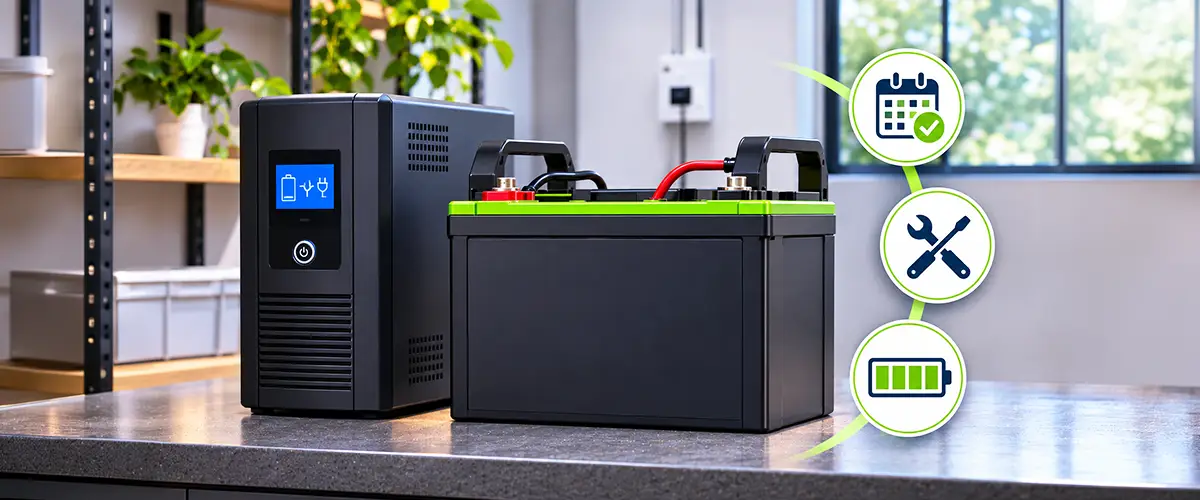
Lithium UPS batteries generally offer longer service-life potential than conventional valve-regulated lead-acid batteries when used under suitable conditions. Eaton describes approximately 10–15 years of expected float service life for certain lithium UPS battery systems, compared with typical lead-acid replacement intervals of about 3–5 years. These figures apply to the manufacturer’s specified UPS applications and should not be treated as guarantees for every lithium battery.
Battery lifespan depends on chemistry, temperature, charge levels and frequency of use. Regular cycling contributes to wear, while excessive heat can accelerate calendar aging. Although lithium batteries do not require distilled-water maintenance, their operating condition should still be monitored. Understanding battery cycle life and state of charge vs state of health helps explain the difference between remaining charge and battery aging.
Where Are Lithium UPS Batteries Most Useful?
Lithium UPS batteries can be useful where compact size, reduced weight and long service life provide practical value.
| Application | Why Lithium May Be Useful |
| Office networking | Reduced battery replacement frequency |
| Server racks | Compact storage and monitoring |
| Security and communication systems | Long-term backup reliability |
| Frequently cycled backup systems | Higher cycle-life potential |
| Limited installation space | Higher energy density |
| Approved household UPS systems | Usable capacity and reduced maintenance |
For ordinary desktop UPS equipment, replacing the existing battery with its manufacturer-approved cartridge may remain more practical than attempting a lithium conversion.
When choosing between backup technologies, UPS vs inverter helps explain equipment differences. The wider selection criteria are covered in best battery for UPS and best battery for inverter.
Lithium UPS Battery Advantages and Limitations
Lithium batteries offer several advantages, but not every system will benefit equally.
Important advantages include higher energy density, reduced weight, longer cycle-life potential, potentially faster recharging and lower routine maintenance.
Their main limitations include higher initial cost, strict charger compatibility requirements, integrated electronic protection and model-specific replacement options.
Lithium batteries also need proper temperature control and electrical protection. They are not completely maintenance-free or immune to overheating. The best choice depends on the UPS design, expected backup frequency and long-term ownership requirements rather than chemistry alone.
What to Check Before Choosing a Lithium Battery for UPS
Before purchasing a lithium battery or dedicated lithium UPS system, review the manufacturer’s product documentation.
- UPS compatibility: Confirm support for the exact battery model.
- Battery voltage: Check nominal and operating voltage limits.
- Required power: Verify continuous and peak discharge capability.
- Usable energy: Compare Wh or kWh within approved discharge limits.
- Charging profile: Confirm voltage, current and temperature restrictions.
- BMS protection: Check required monitoring and communication functions.
- Warranty: Review battery coverage, capacity retention and replacement policy.
- Installation safety: Verify approved connectors, protection devices and service support.
For applications requiring longer backup, calculate the expected load and operating time before selecting battery capacity. Our how to choose UPS battery capacity and 100Ah vs 200Ah battery for UPS guides cover the capacity decision separately.
Conclusion
A lithium battery for UPS can provide compact, efficient and long-lasting backup storage when used with compatible equipment. Its advantages include higher energy density, reduced weight, longer cycle-life potential and relatively low routine maintenance.
However, lithium batteries require suitable charging controls, battery management and manufacturer-approved electrical connections. An ordinary lead-acid UPS cannot automatically accept a lithium replacement. The safest approach is to choose a dedicated lithium UPS or an explicitly supported battery system that meets the connected load and required backup duration.
Frequently Asked Questions
Can I Use a Lithium Battery in a Normal UPS?
Only if the UPS manufacturer explicitly supports that lithium battery and its charging requirements. Most conventional lead-acid UPS systems should not be converted using an unapproved lithium pack.
Is a Lithium Battery Better Than Lead-Acid for UPS?
Lithium generally offers advantages in weight, energy density, service-life potential and cycling. Lead-acid batteries remain practical for traditional UPS systems because of their established compatibility and lower initial cost.
How Long Does a Lithium UPS Battery Last?
Some manufacturer-designed lithium UPS systems have expected service-life ratings around 10–15 years under specified conditions. Actual lifespan depends on battery design, operating temperature and usage.
Can a 12V Lithium Battery Replace a 12V UPS Battery?
Not automatically. Matching nominal voltage does not guarantee charging, discharge-current, connector or BMS compatibility. The replacement must be approved for the specific UPS.
Does a Lithium UPS Battery Charge Faster?
It can, when the battery and UPS charger support a higher charging rate. Actual recharge time depends on charger current, battery capacity and protective limits.
Does a Lithium Battery Need a Special UPS?
It needs a UPS explicitly designed or approved for its chemistry and electrical requirements. Some UPS manufacturers offer dedicated lithium models or supported retrofit configurations.
Is LiFePO4 Suitable for UPS Backup?
Yes. LiFePO4 is used in selected UPS systems because of its cycle-life potential and thermal characteristics. It still requires compatible charging and battery management.
Can Lithium and Lead-Acid Batteries Be Used Together in a UPS?
They should not be mixed in the same battery bank unless the equipment manufacturer explicitly approves a specialized configuration. Their charging and operating requirements differ.
Does a Lithium UPS Battery Need Maintenance?
It does not require routine water refilling, but battery health, temperature, charging behavior and BMS warnings should still be monitored according to manufacturer instructions.