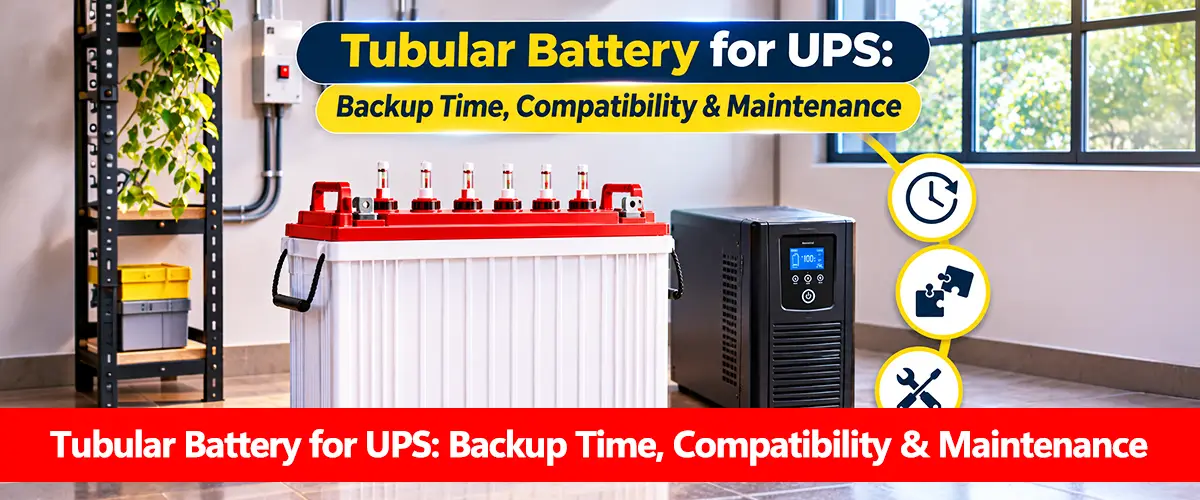
A tubular battery for UPS is a deep-cycle lead-acid battery designed to store electrical energy and supply backup power through a compatible uninterruptible power supply during electricity outages. It is commonly used in home UPS and inverter systems that support larger external battery banks.
Tubular batteries can be practical for households experiencing regular load-shedding because of their deep-cycle construction and relatively affordable initial cost. However, not every UPS supports them. Battery voltage, charging current, ventilation and storage capacity must match the equipment. Understanding how a UPS battery works helps explain where tubular technology is suitable.
How Does a Tubular Battery Work With a UPS?
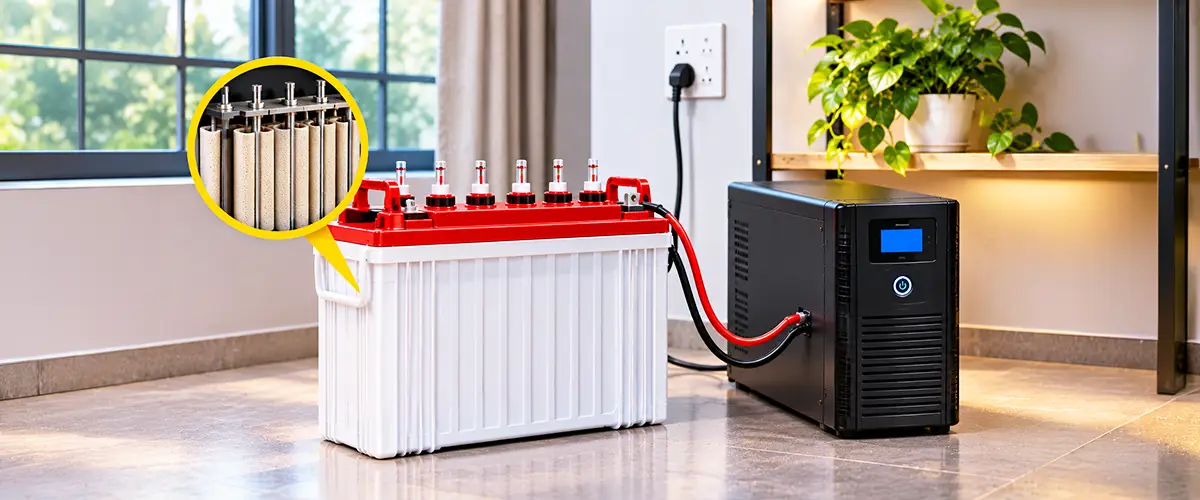
A tubular battery stores electricity through reversible chemical reactions involving lead-based electrodes and sulfuric acid electrolyte. Its tubular positive-plate construction is intended to withstand repeated charging and discharging.
When mains electricity is available, the UPS charger replenishes the battery. During a power outage, the battery supplies direct current (DC) to the UPS inverter, which converts it into alternating current (AC) for connected appliances.
Unlike a conventional automotive starting battery, a tubular battery is designed for energy storage and repeated cycling. This makes it relevant for extended home backup battery applications, provided the UPS supports its electrical requirements.
Can You Use a Tubular Battery With Any UPS?
No. Tubular batteries are generally suitable for UPS or inverter-charger systems specifically designed to support external lead-acid battery storage.
Compact desktop UPS units often use manufacturer-approved sealed AGM or VRLA battery cartridges. These systems may have limited charging current, restricted battery compartments and no approved external-battery connection.
| UPS Type | Tubular Battery Suitability |
| Compact desktop UPS | Usually not suitable unless explicitly approved |
| External-battery home UPS | Often suitable with compatible specifications |
| Long-backup inverter UPS | Common application |
| Online UPS with approved external bank | Depends on manufacturer requirements |
| Hybrid inverter with UPS mode | Possible with supported lead-acid charging |
An external tubular battery should never be connected to a compact UPS simply because its voltage matches. The UPS vs inverter guide explains why backup equipment can have very different battery requirements.
What Size Tubular Battery Is Suitable for UPS?
Tubular batteries are commonly available in capacities such as 150Ah, 185Ah, 200Ah and 250Ah. The required size depends on the load in watts, desired backup duration and inverter efficiency.
For example, a 12V 200Ah battery has approximately:
12V × 200Ah = 2,400Wh (2.4kWh)
This is its nominal stored energy, not the electricity necessarily available to appliances. A suitable discharge limit must be considered to reduce excessive wear on the battery.
Higher capacity can support longer backup, but the correct choice depends on the UPS charging capability and connected load. Our 100Ah vs 200Ah battery for UPS guide covers the differences, while how to choose UPS battery capacity explains capacity selection.
How Long Does a Tubular Battery Last on UPS Backup?
Backup time depends on nominal capacity, permitted depth of discharge, load and conversion losses.
Consider a compatible UPS operating with a 12V 200Ah tubular battery. Assume 50% usable depth of discharge and 85% inverter efficiency.
| Parameter | Example Value |
| Battery rating | 12V 200Ah |
| Nominal energy | 2,400Wh |
| Assumed depth of discharge | 50% |
| Assumed inverter efficiency | 85% |
| Connected load | 200W |
| Estimated backup time | 5.1 hours |
Backup Time = 2,400 × 0.50 × 0.85 ÷ 200 = 5.1 hours
This simplified estimate assumes the rated energy remains available at the operating discharge rate. In practice, lead-acid batteries can deliver less usable energy at higher currents, particularly when their capacity is rated over a 20-hour discharge period.
Battery age, temperature and UPS standby consumption can also reduce runtime. For a more complete method, see how to calculate UPS backup time and battery C-rate.
Tubular Battery Configuration for 12V, 24V and 48V UPS
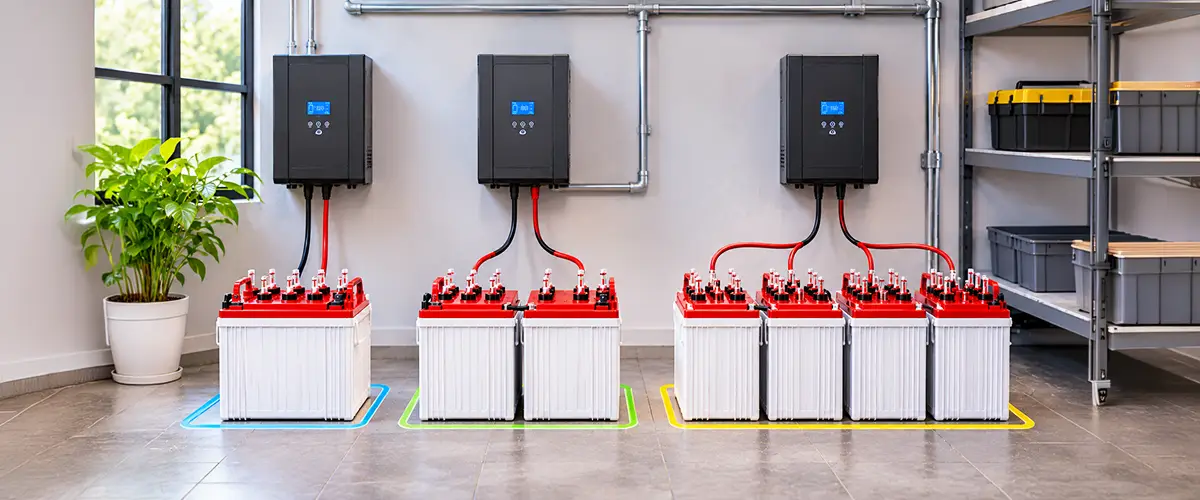
The battery-bank voltage must match the UPS manufacturer’s specified DC input range. A UPS designed for 24V cannot normally operate using a single 12V tubular battery.
Common nominal lead-acid arrangements include:
| UPS Battery Voltage | Typical Configuration |
| 12V | One 12V tubular battery |
| 24V | Two matching 12V batteries in series |
| 48V | Four matching 12V batteries in series |
Connecting batteries in series increases voltage while maintaining the same Ah rating. Larger battery banks may use approved parallel strings to increase total capacity.
However, batteries should be matched by type, rating, age and condition. The 12V vs 24V vs 48V battery system and batteries series vs parallel guides explain the wider electrical considerations.
Tubular Battery Charging Requirements
Proper charging is essential for maintaining tubular battery performance. Most flooded tubular batteries require a compatible lead-acid charging profile involving bulk, absorption and float stages.
During bulk charging, the charger supplies current within approved limits. During absorption, voltage is regulated while charging current gradually decreases. Float charging then maintains the battery at an appropriate standby level.
Charging voltage and current should follow the manufacturer’s specifications rather than generic UPS settings. Incorrect charging can cause excessive gassing, heating, incomplete charging or premature aging.
The bulk absorption float charging guide explains these stages, while battery charging voltage and battery charging current cover the related electrical limits. An undersized UPS charger may also take a long time to recharge a large tubular battery after an extended outage.
Tubular Battery Advantages and Limitations for UPS
Tubular batteries offer useful characteristics for longer backup applications, but they also have practical limitations.
| Advantages | Limitations |
| Designed for repeated charging cycles | Heavy and relatively bulky |
| Lower initial cost than many lithium systems | Flooded models require maintenance |
| Available in several Ah capacities | More limited usable discharge capacity |
| Suitable for approved external battery banks | Charging can be slow near full capacity |
| Familiar lead-acid charging technology | Performance affected by heat and deep discharge |
Tubular batteries are especially relevant when a household already has a compatible lead-acid inverter or UPS system. However, households with frequent deep cycling may also consider lithium battery for UPS or LiFePO4 battery for UPS. The wider selection criteria are covered in best battery for UPS.
How to Maintain a Tubular UPS Battery
Flooded tubular batteries require periodic inspection because water can be lost from the electrolyte during charging. The frequency depends on battery usage, charging conditions and temperature.
Follow these maintenance practices:
- Check electrolyte levels according to the manufacturer’s schedule.
- Use approved distilled or deionized water when needed.
- Maintain suitable ventilation around the battery bank.
- Keep terminals clean and inspect for corrosion.
- Avoid repeated discharge beyond recommended limits.
- Check charging performance after extended outages.
- Protect the battery from excessive heat and direct sunlight.
For flooded batteries, water is normally adjusted after charging. If the plates are exposed before charging, follow the manufacturer’s procedure for adding only enough water to cover them before completing the charge. Never add acid as routine maintenance.
Battery acid and electrical fault currents are hazardous, so electrolyte servicing and connection work should be performed by trained personnel. Proper battery maintenance principles also apply to tubular batteries used for solar-compatible UPS systems.
How Long Does a Tubular UPS Battery Last?
Tubular battery service life depends on charging frequency, depth of discharge, temperature and maintenance. A battery providing occasional backup may experience different aging conditions from one discharged deeply every day.
Frequent deep discharge and prolonged undercharging can accelerate deterioration. High temperatures may also increase water loss and reduce battery life.
Understanding depth of discharge and battery cycle life helps explain why proper sizing and charging are important.
If the UPS provides noticeably shorter backup under the same load, investigate charging performance, battery condition and connections before replacing equipment. The how long do UPS batteries last guide covers replacement considerations in detail.
When Should You Choose a Tubular Battery for UPS?
A tubular battery may be suitable when the UPS supports external lead-acid batteries, the desired backup duration is several hours and the household can accommodate the required maintenance.
It may be less suitable for compact desktop UPS equipment, restricted indoor installation spaces or systems that require a manufacturer-specific sealed battery cartridge.
Before purchasing, confirm:
- The UPS supports flooded tubular lead-acid batteries.
- Battery voltage matches the equipment requirements.
- The battery can supply the required continuous current.
- The UPS charger supports the recommended charging profile.
- The required capacity meets your backup-duration target.
- Installation space, ventilation and protection are adequate.
- The manufacturer provides warranty and maintenance instructions.
For a broader household backup comparison, review best battery for inverter. If your existing system uses sealed lead-acid batteries, do not assume a flooded tubular replacement is approved without checking the UPS documentation.
Conclusion
A tubular battery for UPS can provide reliable, extended backup when used with compatible equipment designed for external lead-acid battery storage.
Its suitability depends on battery-bank voltage, capacity, charging compatibility, discharge requirements and maintenance conditions. Tubular batteries are particularly practical for budget-conscious home backup systems, but they are not universal replacements for compact UPS battery cartridges. Choose the battery according to the UPS manufacturer’s specifications and your actual backup requirements rather than Ah capacity alone.
Frequently Asked Questions
Is a Tubular Battery Good for UPS?
Yes. A tubular deep-cycle battery can be suitable for compatible UPS and inverter systems designed for external lead-acid storage. It is not automatically suitable for compact desktop UPS units.
Can I Use a 200Ah Tubular Battery With My UPS?
Only if the UPS supports the battery’s voltage, capacity, charging current and discharge requirements. A higher Ah rating does not guarantee compatibility.
How Long Can a 200Ah Tubular Battery Provide Backup?
Runtime depends on battery voltage, usable capacity, connected load and inverter efficiency. Under illustrative assumptions, a 12V 200Ah battery may provide about 5.1 hours for a 200W load, but actual performance may be lower.
Is a Tubular Battery Better Than a Flat-Plate Battery for UPS?
Tubular deep-cycle batteries are generally designed for repeated cycling, making them relevant for extended backup. The better choice depends on actual battery specifications, charging conditions and application.
Can a Tubular Battery Work With a Computer UPS?
Only if the UPS manufacturer explicitly approves the battery arrangement. Most compact computer UPS systems are designed for specified sealed battery packs rather than large flooded tubular batteries.
Does a Tubular UPS Battery Need Distilled Water?
Flooded tubular batteries require periodic electrolyte maintenance using appropriate distilled or deionized water. Sealed battery designs must not be opened for water refilling.
Does a Tubular Battery Charge Automatically in a UPS?
A compatible UPS with a built-in charger can recharge the battery automatically when electricity is available. The charging voltage and current must match the battery manufacturer’s specifications.
Which Is Better for UPS: Tubular or Lithium Battery?
Tubular batteries often offer a lower initial cost, while suitable lithium batteries generally provide higher usable capacity and longer cycle-life potential. The UPS must support whichever chemistry is selected.
Can I Connect Two Tubular Batteries to One UPS?
Yes, if the UPS supports the intended configuration. Two matching 12V batteries in series provide a nominal 24V bank, but only a UPS designed for that voltage should use it.