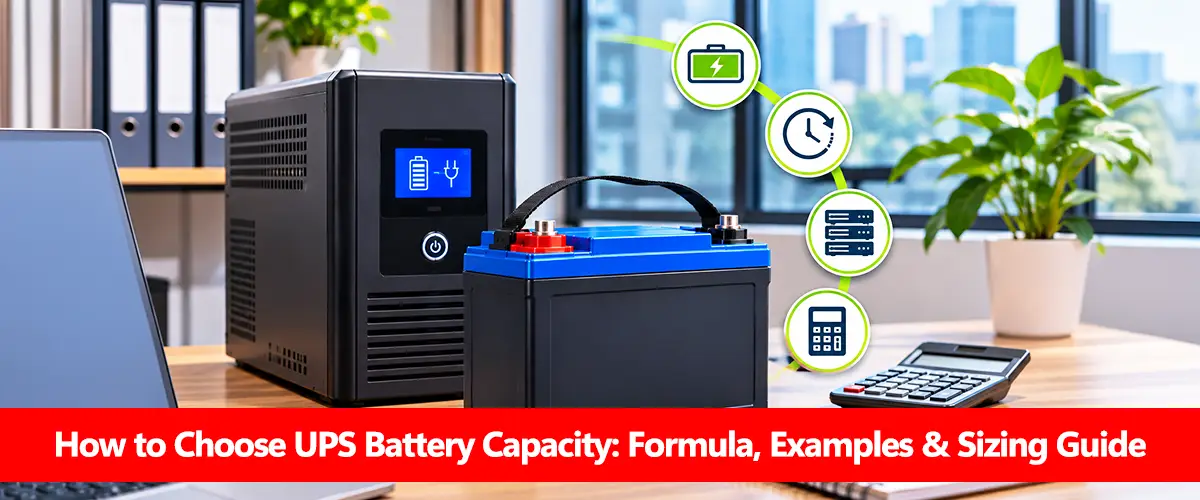
Learning how to choose UPS battery capacity starts with calculating the electricity your appliances need during a power outage. Add their power consumption in watts (W), multiply by the required backup hours, and account for inverter efficiency and usable battery capacity. The result helps determine the battery storage required in watt-hours (Wh) or amp-hours (Ah).
For example, appliances consuming 300W for three hours need 900Wh of AC energy. The battery must store more than 900Wh because some energy is lost during conversion and not all rated capacity should necessarily be discharged. Choosing a suitable UPS battery also requires checking the manufacturer’s supported voltage, chemistry and battery configuration.
Start With the Appliances You Want to Power
Before selecting battery capacity, identify the equipment that must operate during an outage. Include only the devices that will actually run on battery backup, rather than the electricity consumption of the entire building.
Consider this example of a home office setup:
| Appliance | Power Consumption |
| Desktop computer | 180W |
| Monitor | 50W |
| Internet router | 15W |
| LED lights | 30W |
| Other small devices | 25W |
| Total load | 300W |
The estimated continuous load is 300W. If the appliances consume different amounts of power during operation, use a realistic average for energy calculations and check their maximum demand separately.
The UPS must also support the combined load in watts and any applicable starting or surge demand. Understanding UPS vs inverter helps explain why the equipment’s power rating and the battery’s storage capacity are different specifications.
Decide How Many Hours of Backup You Need
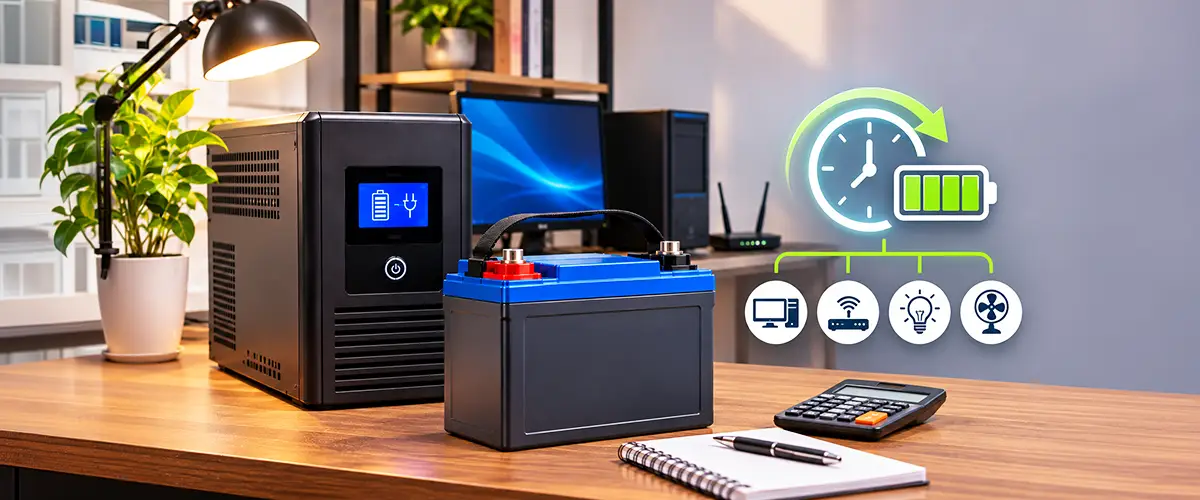
The next step is setting the required backup duration. A computer used only for safe shutdown may need a few minutes, while networking equipment or essential household appliances may require several hours.
Required AC Energy (Wh) = Total Load (W) × Backup Duration (Hours)
Using a 300W load:
| Required Backup | AC Energy Needed |
| 30 minutes | 150Wh |
| 1 hour | 300Wh |
| 2 hours | 600Wh |
| 3 hours | 900Wh |
| 4 hours | 1,200Wh |
These values represent the electricity required by the appliances, not the nominal battery size.
For a detailed runtime calculation using an existing battery, see how to calculate UPS backup time. When selecting a new battery, work backward from the energy requirement to determine the capacity needed.
UPS Battery Capacity Formula
For a compatible external-battery UPS, a simplified sizing formula is:
Required Battery Energy (Wh) = Load (W) × Backup Hours ÷ (Inverter Efficiency × Usable DoD)
Where:
- Load: Total AC power consumption in watts.
- Backup hours: Required operating duration.
- Inverter efficiency: Estimated fraction of battery energy delivered as AC power.
- Usable DoD: Permitted depth of discharge expressed as a decimal.
If battery capacity is required in amp-hours:
Required Battery Capacity (Ah) = Required Battery Energy (Wh) ÷ Nominal Battery Voltage (V)
Depth of discharge (DoD) determines how much rated capacity is intended for use. For example, 50% DoD is entered as 0.50, while 85% efficiency is entered as 0.85.
These formulas provide preliminary estimates. The actual battery capacity available during a UPS discharge can differ because of battery chemistry, discharge rate, temperature and aging.
Step-by-Step Example: Sizing a Battery for a 300W UPS Load
Suppose a household needs to power 300W of appliances for three hours using an external-battery UPS designed for a nominal 24V lead-acid bank.
Assume:
| Input | Value |
| Connected load | 300W |
| Required backup | 3 hours |
| Nominal battery-bank voltage | 24V |
| Assumed inverter efficiency | 85% |
| Planned depth of discharge | 50% |
Step 1: Calculate Energy Consumption
300W × 3 hours = 900Wh
The appliances need 900Wh of AC electricity.
Step 2: Account for Inverter Losses
900Wh ÷ 0.85 = 1,059Wh
The battery must supply approximately 1,059Wh of DC energy.
Step 3: Adjust for Depth of Discharge
1,059Wh ÷ 0.50 = 2,118Wh
The calculated nominal battery storage requirement is approximately 2.12kWh.
Step 4: Convert Wh to Ah
2,118Wh ÷ 24V = 88.25Ah
The preliminary requirement is approximately 24V 89Ah.
Two matching 12V 100Ah lead-acid batteries connected in series would form a nominal 24V 100Ah bank, providing approximately 2,400Wh nominal energy. Under the stated assumptions, estimated AC energy would be:
2,400 × 0.50 × 0.85 = 1,020Wh
That corresponds to approximately 3.4 hours at 300W in the simplified model. However, this leaves limited allowance for lead-acid high-rate discharge losses, aging or increased consumption. A higher approved capacity may be necessary, and the final choice should be checked against manufacturer discharge tables. For battery-bank arrangements, see batteries in series vs parallel and battery bank sizing.
How Battery Chemistry Changes Capacity Requirements
Lead-acid and lithium batteries can require different nominal capacities for the same UPS load because their permitted discharge limits and efficiency characteristics differ.
Consider the same 300W load for three hours:
| Sizing Assumption | Lead-Acid | LiFePO4 |
| Required AC energy | 900Wh | 900Wh |
| Assumed inverter efficiency | 85% | 90% |
| Assumed usable DoD | 50% | 80% |
| Minimum nominal energy | 2,118Wh | 1,250Wh |
These are illustrative operating assumptions, not universal chemistry limits. The exact battery model and UPS specifications take priority.
The example shows that LiFePO4 may require less nominal storage to deliver the same energy. However, a lithium battery must still meet UPS charging, voltage and discharge-current requirements.
Our LiFePO4 battery for UPS and tubular battery for UPS guides explain the practical differences between these technologies. Buyers can also compare 100Ah vs 200Ah battery for UPS when evaluating common external-battery capacities.
Why UPS Voltage Matters When Choosing Ah
Amp-hours alone do not describe how much energy a battery stores. The nominal battery voltage must also be considered.
For example:
| Battery Bank | Nominal Energy |
| 12V 100Ah | 1,200Wh |
| 24V 100Ah | 2,400Wh |
| 48V 100Ah | 4,800Wh |
All three examples have the same Ah rating, but their nominal stored energy is different.
The meaning of battery Ah ratings and the conversion between Ah and Wh are important when selecting a battery bank.
A UPS requiring 24V should not be connected to a 12V or 48V bank unless that configuration is explicitly supported. Use the manufacturer’s operating voltage range rather than selecting voltage only to obtain a preferred Ah figure.
Check UPS VA and Watt Ratings Separately
Battery capacity determines potential runtime, but the UPS output rating determines which appliances it can support. A UPS advertised as 1,000VA may have a maximum output of 600W, 800W or another manufacturer-defined value. It cannot necessarily supply a 1,000W load. For the 300W example, a UPS should have adequate continuous watt capacity and allowance for expected power peaks. Adding a larger battery does not increase its approved output watts.
This distinction is especially important for devices with motors, compressors or other high starting-surge requirements. Selecting the best battery for UPS is useful only after confirming that the UPS itself can power the connected equipment.
Small Computer UPS vs External-Battery UPS
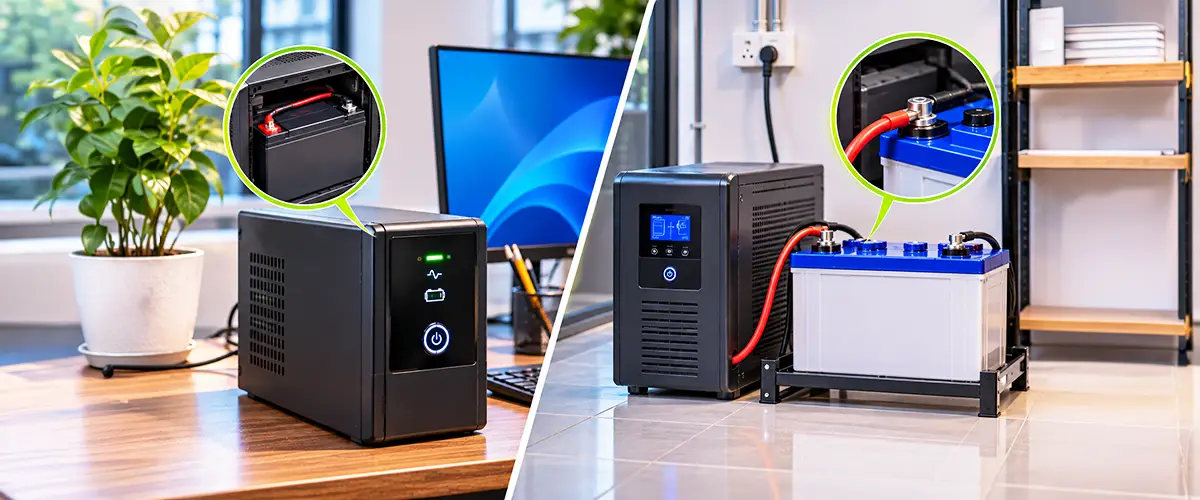
Not every UPS allows users to choose or increase battery capacity. A compact computer UPS may contain a fixed internal battery cartridge, such as a manufacturer-approved 12V or 24V sealed lead-acid arrangement. Its runtime should be checked using the exact manufacturer’s runtime chart.
An external-battery UPS or compatible inverter battery system may support a wider range of capacities, but the charger and battery connections still have specified limits. For compact UPS equipment, do not select a larger Ah battery simply because it fits physically. The approved replacement configuration, charger capability and protective design must all be respected. Schneider Electric and Eaton provide model-specific UPS runtime information that is generally more reliable than a simplified energy formula for short-duration, high-current operation.
Allow for Battery Aging, Temperature and Discharge Rate
The calculated battery capacity is only a starting point. Batteries gradually lose capacity as they age, and operating conditions can reduce the energy available during an outage.
Lead-acid batteries are especially affected by discharge rate. A battery advertised at 100Ah under a 20-hour test may deliver significantly less energy when discharged over a much shorter period.
Important factors include:
- Battery aging: Reduces available capacity over time.
- High discharge current: Can reduce effective lead-acid capacity.
- Temperature: Changes battery performance and aging behavior.
- UPS standby consumption: Uses additional battery energy.
- Depth of discharge: Determines how much capacity is intended for use.
- Future load changes: May increase the energy requirement.
The effects of discharge rate are covered in battery C-rate, while depth of discharge explains the relationship between usable energy and battery cycling.
Allowing a sensible design reserve can improve reliability, but the final capacity must remain within the UPS manufacturer’s approved limits.
Confirm Charging Compatibility Before Buying
An external-battery UPS needs a charger capable of replenishing the selected battery bank safely.
A larger battery may take longer to recharge if the UPS has limited charging current. Some compact UPS products are not designed to charge large external battery banks at all.
The battery chemistry must also match the charging profile. Conventional sealed lead-acid batteries and lithium batteries do not necessarily use the same charging settings.
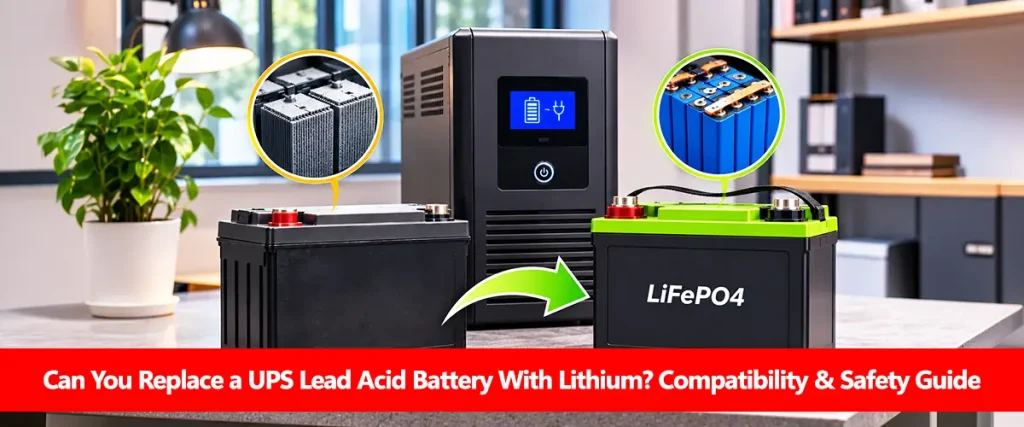
Before purchasing, check the UPS’s supported voltage, maximum charging current, approved chemistry and battery expansion limits. Lithium configurations may require a compatible battery management system. If replacing lead-acid with lithium, review replace UPS lead acid battery with lithium rather than assuming a matching Ah or voltage rating is sufficient.
Common UPS Battery Sizing Mistakes
Incorrect assumptions can produce an undersized battery bank or an incompatible setup.
Avoid these mistakes:
- Calculating battery capacity from UPS VA instead of actual appliance watts.
- Ignoring inverter efficiency and usable depth of discharge.
- Treating Ah as equivalent to Wh.
- Assuming a higher Ah rating increases UPS power output.
- Ignoring battery discharge-current limits.
- Connecting unsupported battery configurations.
- Choosing lithium without verifying charger compatibility.
- Using nominal battery capacity as guaranteed output energy.
- Overlooking aging, temperature and future load requirements.
UPS battery capacity should be based on real equipment demand and manufacturer specifications, not an arbitrary battery size.
For existing systems with unexpectedly short backup, UPS battery draining fast may help identify other causes. How long UPS batteries last explains when aging becomes a replacement consideration.
Final UPS Battery Capacity Selection Checklist
Before ordering a UPS battery, confirm these requirements:
- Measure load: Identify the total running watts and relevant surge loads.
- Choose backup duration: Decide how many minutes or hours are essential.
- Calculate AC energy: Multiply watts by operating hours.
- Estimate nominal storage: Adjust for approved depth of discharge and conversion efficiency.
- Convert to Ah: Use the battery bank’s required nominal voltage.
- Check real runtime: Compare the estimate with the manufacturer’s discharge or runtime data.
- Verify compatibility: Confirm approved chemistry, charger settings and battery configuration.
- Include a reserve: Allow for aging and realistic operating conditions where supported.
- Review installation requirements: Ensure proper protection, cabling and professional support.
For a conventional UPS, manufacturer-approved battery options should determine the final selection. For long-duration household backup, the requirements may differ from the short-runtime applications of a standard desktop UPS.
Conclusion
Understanding how to choose UPS battery capacity requires calculating the load in watts, multiplying by the desired backup duration and accounting for conversion losses and usable battery energy.
In the worked example, a 300W load for three hours requires approximately 2.12kWh of nominal lead-acid storage under the stated 50% DoD and 85% efficiency assumptions. The final battery bank should also allow for real discharge performance and comply with UPS manufacturer limits. Choose capacity by usable Wh or kWh, supported voltage, charging compatibility and verified runtime—not Ah or VA ratings alone.
Frequently Asked Questions
How Do I Calculate UPS Battery Capacity?
Multiply the connected load in watts by the desired backup hours, then divide by inverter efficiency and the permitted depth of discharge. Convert the resulting Wh into Ah using the required battery-bank voltage.
What Battery Capacity Is Needed for a 1,000VA UPS?
A 1,000VA rating does not determine battery capacity. You must know the UPS watt rating, actual connected load and required runtime. Some 1,000VA UPS models only support specific internal batteries.
Is a 100Ah Battery Enough for UPS Backup?
It may be sufficient for some loads and backup durations. Its stored energy depends on voltage, while actual runtime depends on discharge limits, UPS efficiency and battery condition.
How Much Battery Capacity Is Needed for Four Hours of Backup?
Multiply the total load by four hours and adjust for efficiency and usable discharge capacity. A 200W load, for example, requires 800Wh of AC energy before accounting for battery and conversion losses.
Does a 200Ah Battery Last Twice as Long as 100Ah?
At the same voltage, chemistry and operating conditions, 200Ah represents approximately twice the nominal stored energy. Actual runtime may not increase proportionally because of discharge rate, efficiency and other limitations.
Should I Use Wh or Ah for UPS Battery Sizing?
Wh or kWh is generally more useful for comparing total stored energy across different voltages. Ah becomes useful after the required battery-bank voltage is known.
Can I Install a Larger Battery in My Existing UPS?
Only if the manufacturer supports the larger battery or approved external expansion. An unsupported upgrade can exceed charging or electrical protection limits.
Is Lithium Better Than Lead-Acid for UPS Capacity?
A compatible lithium battery may provide more usable energy from the same nominal capacity. However, charger and BMS compatibility are essential, and not every UPS supports lithium.
Why Is My UPS Runtime Shorter Than the Calculation?
Real runtime may be reduced by battery age, high discharge current, temperature, equipment losses and UPS shutdown thresholds. Manufacturer runtime charts are usually the better reference for compact UPS systems.