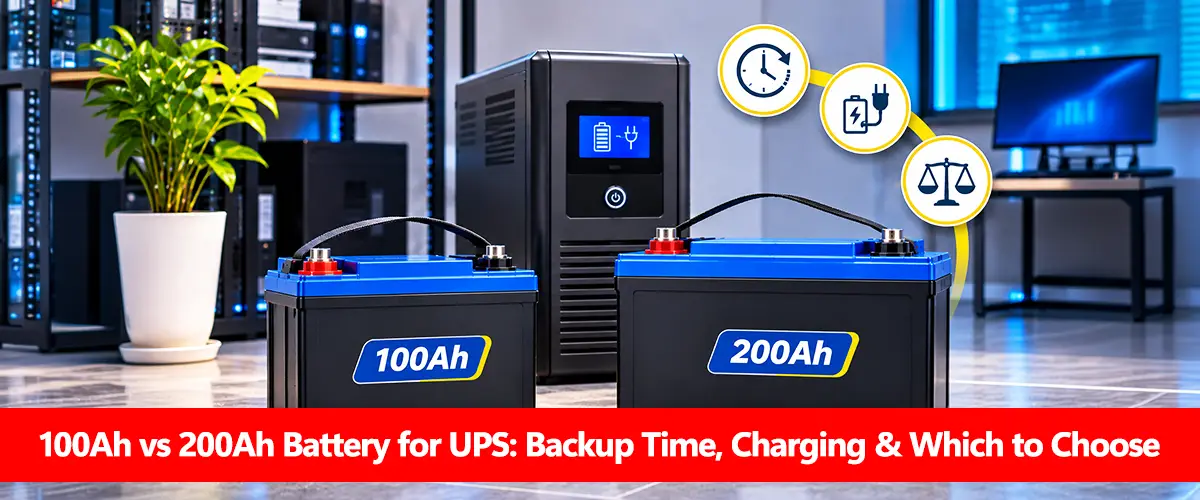
The 100Ah vs 200Ah battery for UPS comparison mainly comes down to energy storage capacity, backup duration, charging requirements and cost. At the same voltage and battery chemistry, a 200Ah battery stores twice the nominal energy of a 100Ah battery and can generally provide longer backup for the same electrical load.
However, a larger battery is not automatically the better choice. Your UPS must support its charging requirements, discharge current and battery configuration. Understanding UPS battery capacity helps explain why the correct selection depends on both stored energy and the appliances connected during a power outage.
What Is the Difference Between 100Ah and 200Ah?
Amp-hours (Ah) describe a battery’s rated charge capacity under specified testing conditions. A 100Ah battery has half the nominal Ah capacity of a comparable 200Ah battery at the same voltage.
For example, consider two nominal 12V lead-acid batteries:
| Specification | 100Ah Battery | 200Ah Battery |
| Nominal voltage | 12V | 12V |
| Rated capacity | 100Ah | 200Ah |
| Nominal energy | 1,200Wh | 2,400Wh |
| Assumed usable DoD | 50% | 50% |
| Usable DC energy | 600Wh | 1,200Wh |
| Weight and space | Generally lower | Generally higher |
| Initial cost | Generally lower | Generally higher |
These figures assume identical chemistry and discharge limits. The actual capacity available at different loads depends on the manufacturer’s specifications. Understanding what Ah means on a battery and Ah vs Wh helps clarify why voltage must always be considered alongside battery capacity.
Does a 200Ah Battery Give Twice the UPS Backup?
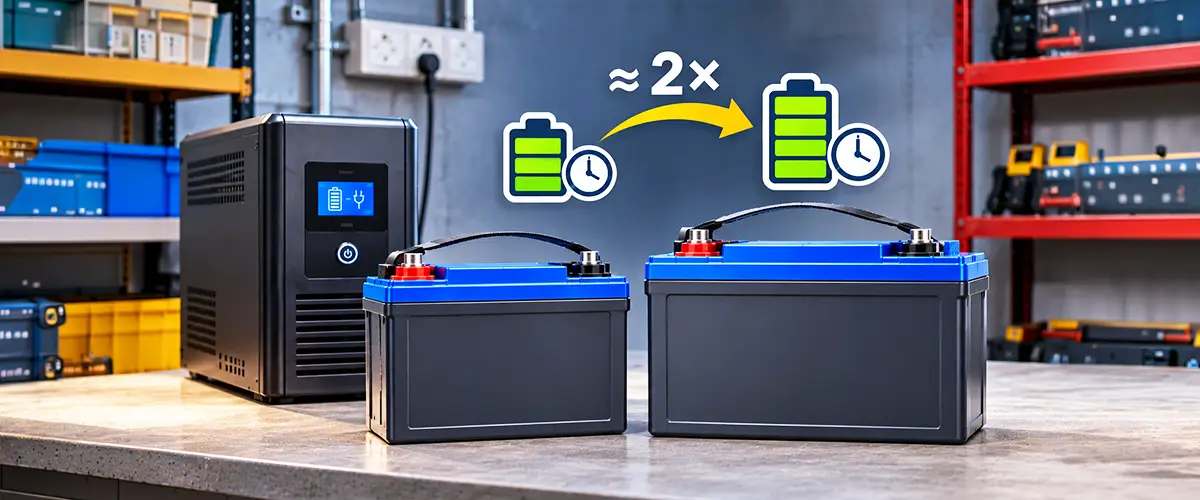
A 200Ah battery contains approximately twice the nominal energy of a comparable 100Ah battery at the same voltage. Under idealized conditions, this can translate into roughly twice the backup duration.
In real UPS operation, runtime may not increase in exactly the same proportion. Lead-acid batteries are affected by discharge rate, meaning their available capacity decreases when electricity is drawn at higher currents.
A larger battery supplying the same load operates at a lower relative discharge rate, which can improve effective capacity. Battery age, temperature and inverter losses also affect runtime. For an accurate estimate, our how to calculate UPS backup time guide explains the calculation, while battery C-rate covers discharge-rate effects.
100Ah vs 200Ah UPS Backup Time Comparison
Consider a compatible 12V UPS or inverter system using lead-acid batteries. Assume both batteries operate at 50% depth of discharge with 85% inverter efficiency.
The simplified formula is:
Backup Time (Hours) = Voltage × Ah × Depth of Discharge × Inverter Efficiency ÷ Load (W)
Using these assumptions:
| Connected Load | 12V 100Ah Battery | 12V 200Ah Battery |
| 100W | 5.1 hours | 10.2 hours |
| 200W | 2.55 hours | 5.1 hours |
| 300W | 1.7 hours | 3.4 hours |
| 400W | 1.28 hours | 2.55 hours |
These are illustrative energy-based estimates, not guaranteed runtimes. They exclude UPS standby consumption, battery aging and high-rate discharge losses.
For example, at a continuous 200W load:
100Ah Backup = 12 × 100 × 0.50 × 0.85 ÷ 200 = 2.55 hours
200Ah Backup = 12 × 200 × 0.50 × 0.85 ÷ 200 = 5.1 hours
The results demonstrate how battery capacity affects expected backup duration. However, actual lead-acid runtime should be checked against manufacturer discharge data, particularly at higher loads. For broader runtime considerations, review how to calculate battery runtime and depth of discharge.
Which Battery Is Better for Different Household Loads?
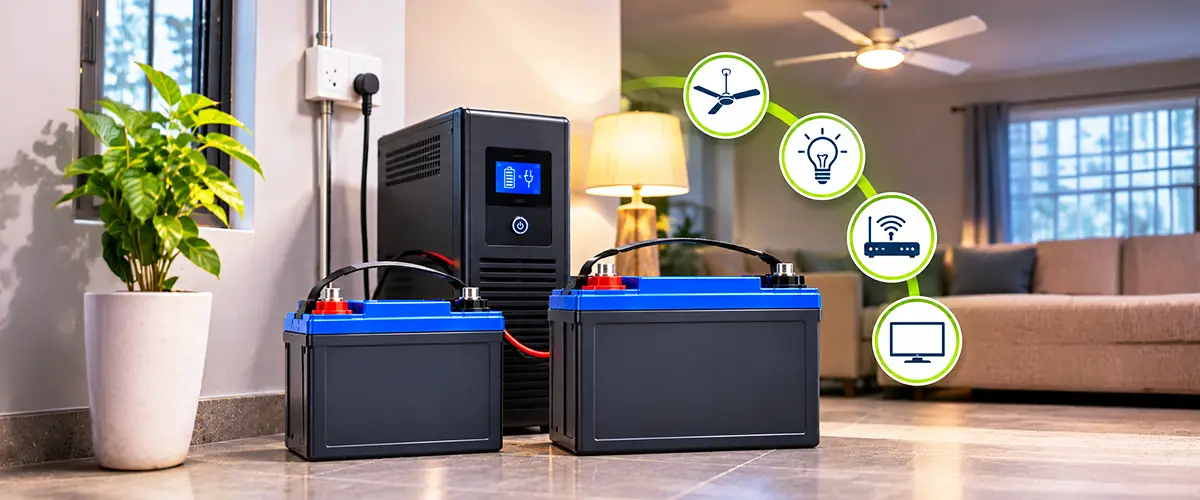
The appropriate battery depends on how much electricity your appliances consume and how long they need to operate during load-shedding.
A small backup system powering LED lights, a router and one fan may not need a 200Ah battery. A household operating several fans, lighting and additional devices for extended periods may benefit from the larger capacity.
| Backup Requirement | Battery to Consider |
| Short power outages | Compatible 100Ah battery |
| Router, lights and light loads | 100Ah may be sufficient |
| Longer household backup | 200Ah may be more suitable |
| Multiple fans and appliances | Size according to total watts |
| Frequent extended load-shedding | Larger compatible deep-cycle capacity |
| Compact UPS with fixed battery cartridge | Manufacturer-approved replacement only |
These are general selection guidelines, not fixed recommendations. The actual requirement should be based on the power consumed by connected devices.
Our how to choose UPS battery capacity guide provides the complete sizing process, while home backup batteries covers longer-duration residential applications.
Charging Time: Is a 200Ah Battery Slower to Recharge?
A 200Ah battery generally requires more charging energy than a 100Ah battery when both are discharged by the same percentage. If the same charger is used, the larger battery will usually take longer to recharge.
For example, after a 50% discharge:
| Charging Factor | 100Ah Battery | 200Ah Battery |
| Charge removed | 50Ah | 100Ah |
| Example charging current | 10A | 10A |
| Ideal minimum replenishment time | 5 hours | 10 hours |
These estimates exclude charging losses and current reduction during later charging stages. Actual charging times will usually be longer, especially for lead-acid batteries approaching full charge.
A UPS charger designed for a small battery may not be suitable for a much larger external battery. The correct battery charging current and battery charging time depend on the specific battery and charger. For lead-acid systems, bulk, absorption and float charging also influences how quickly a battery becomes fully charged.
Does a 200Ah Battery Work With Every UPS?
No. A larger Ah rating does not guarantee that a battery is compatible with the UPS.
Many compact UPS models use fixed internal battery cartridges and are not designed for larger external battery banks. Other UPS and inverter systems support external storage but have specific voltage, charging-current and battery-capacity restrictions.
Before upgrading, check:
- Required battery voltage.
- Approved battery chemistry.
- Charger output current.
- Continuous discharge capability.
- Supported battery-bank configuration.
- Cable and protection requirements.
- Manufacturer-approved expansion options.
A UPS battery designed for a desktop computer may have very different requirements from an external inverter battery used for household backup. The comparison in UPS vs inverter helps explain why the same battery upgrade is not suitable for every backup system.
12V, 24V and 48V Battery Banks
Battery voltage changes the total energy stored in a battery bank. A 24V 100Ah system contains approximately twice the nominal energy of a 12V 100Ah system, even though both have a 100Ah rating.
For example:
| Battery-Bank Configuration | Nominal Capacity |
| One 12V 100Ah battery | 1.2kWh |
| One 12V 200Ah battery | 2.4kWh |
| Two 12V 100Ah batteries in series | 24V 100Ah / 2.4kWh |
| Two 12V 200Ah batteries in series | 24V 200Ah / 4.8kWh |
Connecting batteries in series increases voltage, not Ah capacity. Connecting compatible batteries in parallel increases available Ah capacity while maintaining nominal voltage.
The correct battery bank sizing arrangement must match the UPS design. Our 12V vs 24V vs 48V battery system and batteries series vs parallel guides cover these configurations separately.
Lead-Acid vs Lithium: Does 100Ah Mean the Same Backup?
Two batteries rated at 100Ah do not necessarily provide the same practical backup time when their chemistries differ.
A conventional lead-acid battery may be operated with a conservative discharge limit to protect cycle life, while a compatible LiFePO4 battery often permits a larger usable portion of nominal capacity.
For illustration, compare batteries at the same nominal voltage and capacity:
| Operating Factor | Lead-Acid Example | LiFePO4 Example |
| Rated capacity | 100Ah | 100Ah |
| Assumed usable DoD | 50% | 80% |
| Usable share of nominal energy | 50% | 80% |
| Charging profile | Lead-acid-specific | Lithium-specific |
| Protection requirements | Battery and UPS controls | BMS and UPS controls |
These are example operating assumptions, not universal limits. Actual usable capacity depends on the manufacturer and battery design.
A tubular battery for UPS and a lithium battery for UPS should therefore be compared using usable energy and approved charging requirements rather than Ah ratings alone. If an existing UPS uses lead-acid batteries, replacing UPS lead acid battery with lithium requires explicit compatibility verification.
Which Battery Lasts Longer Over Its Service Life?
A 200Ah battery does not automatically have twice the lifespan of a 100Ah battery. Service life depends on chemistry, battery quality, depth of discharge, temperature and charging conditions.
However, a larger battery supplying the same daily energy requirement may experience shallower discharge cycles. Under suitable conditions, this can reduce cycling stress.
For example, removing 600Wh from a 12V 100Ah battery represents approximately 50% of nominal energy. The same amount from a 12V 200Ah battery represents approximately 25%.
This difference may influence battery cycle life, but manufacturer ratings and actual operating conditions determine long-term performance. Our how long do UPS batteries last guide covers battery aging, while state of charge vs state of health explains how remaining charge differs from battery condition.
Cost, Space and Maintenance Differences
A 200Ah battery usually costs more, occupies more space and weighs more than a comparable 100Ah battery of the same chemistry and construction.
However, it may provide better value where longer backup is genuinely needed. Purchasing a larger battery than necessary can increase initial cost without improving the performance of the connected appliances.
Flooded lead-acid batteries also require appropriate ventilation and electrolyte maintenance. AGM and other sealed batteries have different maintenance needs, while lithium systems require compatible electronic protection.
For buyers comparing battery technologies, best battery for UPS provides wider selection criteria. Pakistan-specific cost comparisons are covered in UPS battery price in Pakistan.
How to Decide Between 100Ah and 200Ah for UPS
Choosing between these capacities should start with your actual backup requirements rather than assuming bigger is always better.
Use this practical decision process:
- Calculate the total running load in watts.
- Decide how many hours of backup are required.
- Confirm the UPS output rating in watts and VA.
- Check the required battery-bank voltage.
- Estimate usable energy after discharge limits and efficiency losses.
- Verify whether the UPS supports 100Ah, 200Ah or both.
- Compare recharge time with the frequency of power outages.
- Review battery chemistry, warranty and expected maintenance.
- Check installation space and electrical protection.
For short outages and light loads, 100Ah may be sufficient. For longer backup, 200Ah may be more practical when the UPS supports it. If an existing battery unexpectedly provides less backup than expected, review UPS battery draining fast before purchasing a larger replacement.
Conclusion
The 100Ah vs 200Ah battery for UPS comparison shows that a 200Ah battery stores twice the nominal energy of a comparable 100Ah battery at the same voltage. It can provide substantially longer backup, but actual runtime depends on the load, chemistry, discharge rate and UPS efficiency.
A 100Ah battery may be enough for light loads and shorter power outages, while 200Ah is worth considering for longer household backup. The larger battery also requires more charging energy and must be supported by the UPS. Choose the capacity that meets your backup duration, charging and compatibility requirements rather than selecting by Ah rating alone.
Frequently Asked Questions
Is a 200Ah Battery Better Than a 100Ah Battery for UPS?
A 200Ah battery stores more nominal energy at the same voltage, making it useful for longer backup. However, a 100Ah battery may be sufficient for light loads or shorter outages.
Does a 200Ah Battery Give Double Backup Time?
Under simplified assumptions, it can provide approximately twice the backup of a comparable 100Ah battery. Real runtime may differ because of discharge rate, temperature, battery age and efficiency.
How Long Will a 100Ah Battery Last on a UPS?
With a nominal 12V lead-acid battery, 50% usable DoD and 85% inverter efficiency, a 200W load gives a simplified estimate of about 2.55 hours. Actual runtime depends on battery specifications and operating conditions.
How Long Will a 200Ah Battery Last on a UPS?
Under the same assumptions, a 12V 200Ah battery could provide approximately 5.1 hours at 200W. Real runtime may be lower or higher depending on the system.
Can I Replace a 100Ah UPS Battery With a 200Ah Battery?
Only if the UPS manufacturer supports the larger battery’s voltage, charging requirements, discharge characteristics and connection arrangement.
Does a 200Ah Battery Take Longer to Charge?
Generally, yes, when both batteries are discharged by the same percentage and use the same charger. Actual charging time depends on charging current, chemistry and charging stages.
Will a 200Ah Battery Increase UPS Power?
No. Battery capacity affects available energy and potential backup duration. The UPS watt and VA ratings still determine its maximum supported electrical load.
Is a 100Ah Lithium Battery Better Than a 200Ah Lead-Acid Battery?
Not automatically. The answer depends on nominal voltage, usable DoD, output-current limits and charging compatibility. Compare usable Wh rather than Ah alone.
Is 100Ah Enough for Home UPS Backup?
It may be enough for essential lights, fans or networking equipment, depending on their combined wattage and the required backup duration. Calculate the load before choosing a battery.