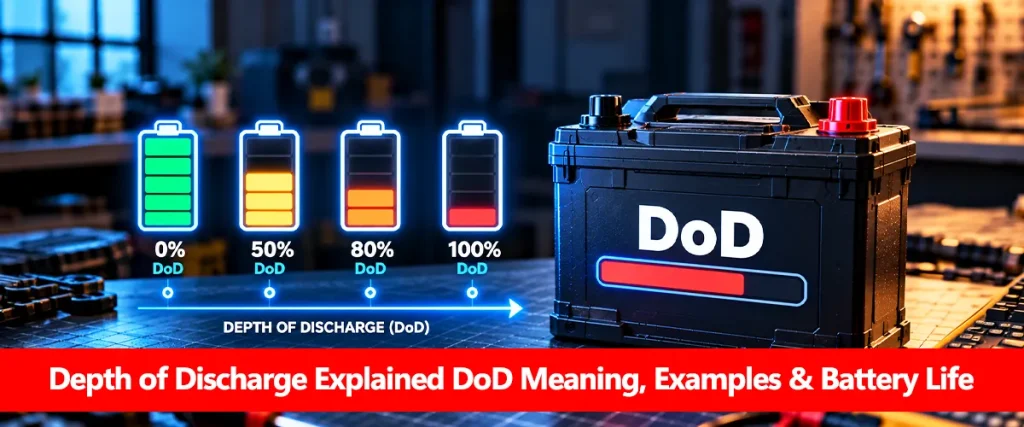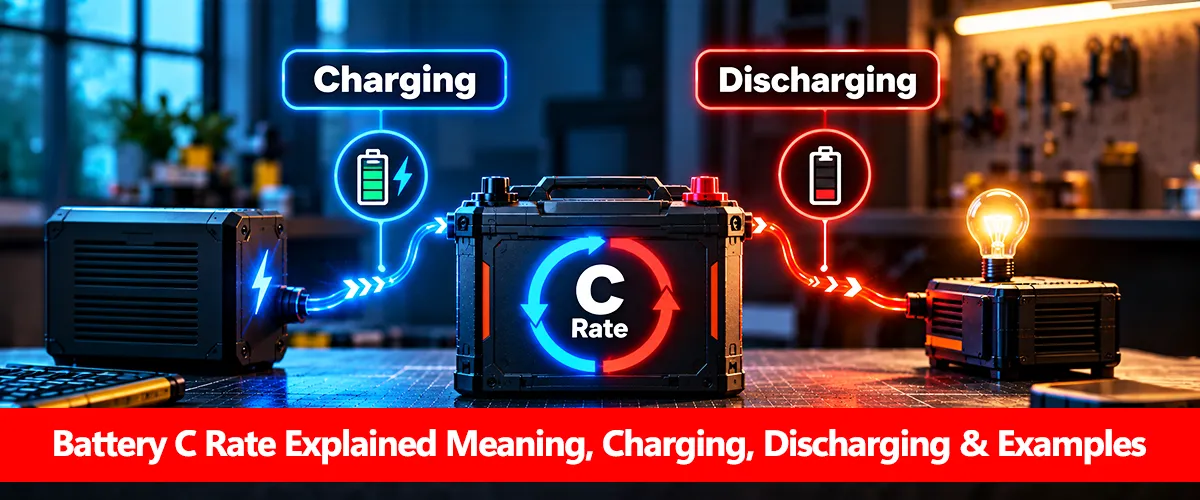
Battery C rate describes how quickly a battery charges or discharges compared with its rated capacity. A 100Ah battery operating at 1C carries 100 amps of current, while the same battery at 0.5C carries 50 amps. This simple measurement helps explain why some batteries can handle powerful equipment or rapid charging while others require slower operation.
Whether you are using a lithium-ion battery, a solar storage system, or a household UPS, understanding C-rate helps you interpret manufacturer specifications and avoid placing excessive demands on a battery.
In this guide, you’ll learn:
- What 0.5C, 1C, 2C, and other C-rate ratings mean.
- How charging and discharging C-rates differ.
- Why higher discharge rates affect heat, capacity, and battery life.
- How C-rate matters in smartphones, electric vehicles, and backup power.
What Does C Rate Mean on a Battery?
The letter C represents a rate based on the battery’s rated charge capacity, typically expressed in ampere-hours (Ah). Instead of describing current as a fixed number, C-rate expresses it relative to the size of the battery. This allows a small rechargeable cell and a large solar battery to be compared using the same measurement.
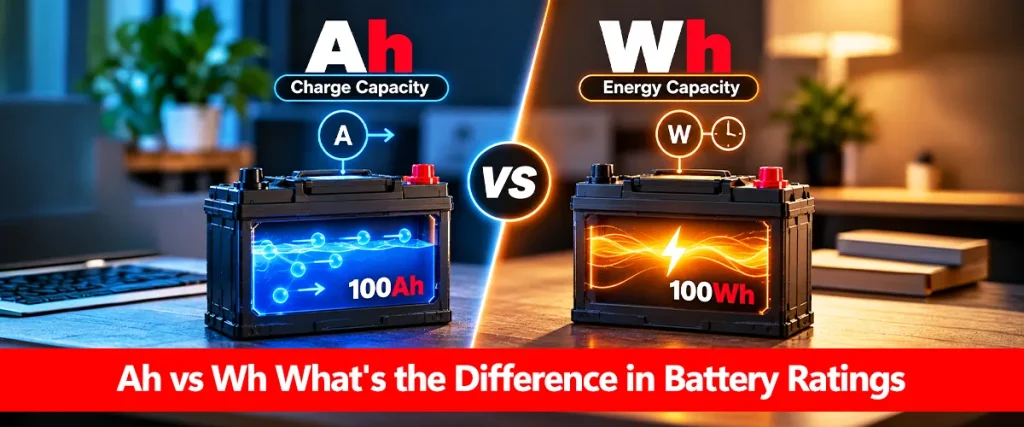
For example, 1C on a 10Ah battery represents 10A, while 1C on a 200Ah battery represents 200A. Both operate at the same relative discharge rate, even though their actual currents are very different. If you’re unfamiliar with capacity ratings, our guide to what Ah means on a battery explains the terminology.
Understanding 0.5C, 1C and 2C With One Battery
Imagine a fully charged 100Ah battery supplying a steady electrical load. Its discharge current changes according to the selected C-rate, which also changes its ideal discharge duration.
- 0.2C: Represents 20A, with a theoretical discharge duration of five hours.
- 0.5C: Represents 50A, with a theoretical duration of two hours.
- 1C: Represents 100A, with a theoretical duration of one hour.
- 2C: Represents 200A, with a theoretical duration of 30 minutes.
These figures assume the full rated capacity remains available at each discharge rate. In practice, higher currents may cause additional voltage drop, internal losses, and earlier discharge cutoff. A battery must also be specifically designed to support the current being drawn. A higher C-rate therefore means faster energy delivery, not greater energy storage. For a related explanation of charge capacity and electrical energy, see Ah vs Wh.
How Does Battery C Rate Work?
A battery produces electrical energy through electrochemical reactions involving its anode, cathode, and electrolyte. During discharge, electrons travel through the external circuit while ions move through the electrolyte. The current flowing through the circuit determines how quickly the battery’s stored charge is being used.
At higher discharge rates, the battery must support faster electrochemical processes and greater current flow. Internal resistance causes power losses and heat, while limitations in ion transport and electrode reactions can contribute to voltage drop. These effects vary considerably across battery chemistries and cell designs. C-rate helps describe these demands using a consistent reference. It does not, however, reveal everything about battery voltage, watt-hours, energy capacity, or maximum output power.
Charging C Rate vs Discharging C Rate
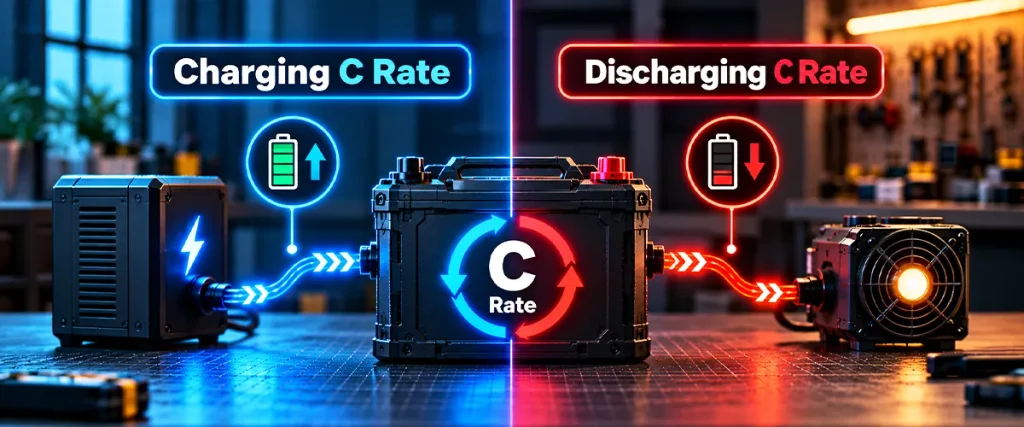
Charging and discharging are different operating processes, so batteries often have separate current limits for each. A battery that can deliver a relatively high discharge current may still require a much lower charging current to maintain safe operating conditions.
- Charging C-rate describes how quickly electric charge is supplied to the battery. Fast charging can increase heat generation and battery stress, particularly when temperature or state of charge (SoC) is outside the preferred operating range. Charging also slows during certain stages, so a theoretical one-hour rate does not guarantee a complete charge in one hour.
- Discharging C-rate describes how quickly the connected load draws charge from the battery. High-power equipment may require substantial current, which can increase voltage drop and reduce the usable energy available before the battery reaches its cutoff limit.
Always distinguish between the manufacturer’s recommended charging rate, maximum continuous discharge rate, and short-duration peak current. These ratings are not interchangeable.
Why Does a High C Rate Affect Battery Performance?
Increasing C-rate can help a battery support demanding equipment, but operating at high current creates trade-offs. A battery designed for energy storage may behave differently from one optimized for short bursts of power.
Three important effects deserve attention:
- Heat generation: Higher current increases resistive heating within the cell and its connections. Excessive temperature can reduce efficiency and require protective current limits.
- Available capacity: Rapid discharge can cause voltage to reach its cutoff sooner, especially in lead-acid batteries. Consequently, the delivered amp-hours and watt-hours may be lower than expected.
- Battery degradation: Repeated high-current operation can accelerate wear under certain conditions. Temperature, depth of discharge, and chemistry all influence the impact on battery cycle life.
A high C-rate is not automatically harmful when the battery is engineered for it. The main concern is exceeding the cell or battery management system’s specified operating limits.
Does Battery Chemistry Change the C Rate?
Yes. Different battery chemistries and constructions have different current-handling capabilities. Even batteries from the same chemistry family may have very different discharge limits because manufacturers optimize them for different applications.
- Lead-acid batteries often experience a notable reduction in effective capacity at high discharge currents. Their Ah capacity may be specified using a 10-hour or 20-hour test, which makes understanding the rating conditions especially important.
- Lithium-ion batteries vary widely. High-energy cells prioritize energy stored per unit of weight or volume, while high-power cells are designed to tolerate greater charge or discharge currents. Lithium iron phosphate (LiFePO4) batteries also have product-specific charging and discharging limits.
This relationship helps explain the difference between current-handling performance and battery energy density. A battery with excellent energy density does not necessarily have the highest C-rate capability.
Where Does C Rate Matter in Everyday Life?
C-rate becomes particularly important when an electrical system demands substantial current over a short period. It provides useful context for judging whether the battery can support the load without exceeding its operating limits.
Consider these practical applications:
- Electric vehicles: Acceleration and regenerative braking can require relatively high discharge or charging currents, depending on the vehicle and battery management system.
- Smartphones and laptops: Charging controls manage battery current according to temperature, state of charge, and cell specifications.
- Drones and power tools: Motors may demand high currents, making discharge capability especially important.
- UPS and solar batteries: Inverter loads and charging equipment must remain within the battery’s allowable current limits.
In Pakistan, where batteries commonly support UPS and solar backup systems during load shedding, checking the discharge-current rating is especially useful. A battery may contain sufficient nominal energy yet still be unsuitable for an inverter demanding more current than its battery management system permits.
What Should You Check Before Using a High C Rate?
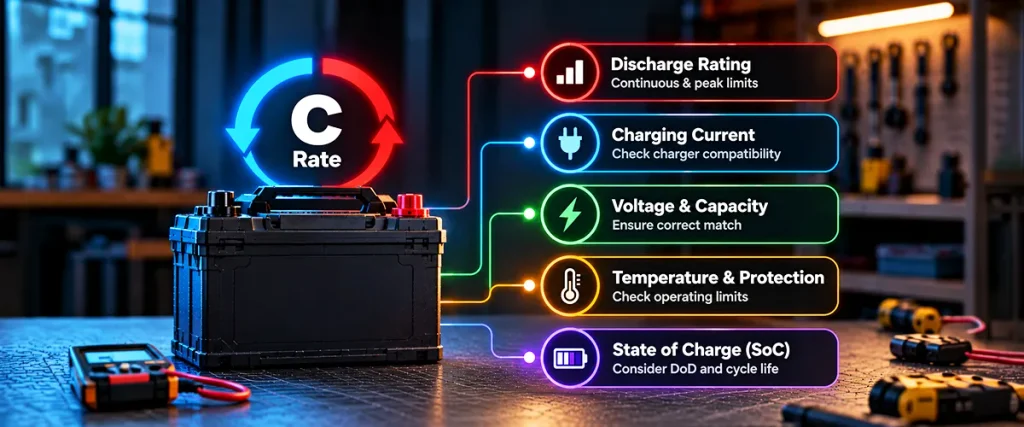
A published C-rate is meaningful only alongside the rest of the manufacturer’s specifications. Before connecting a battery to a charger, inverter, or high-current load, review its operating limits rather than assuming every battery of the same Ah capacity behaves identically.
Pay attention to:
- Continuous and peak discharge ratings: Peak output may be allowed only briefly.
- Maximum charging current: Confirm compatibility with the charger or solar charge controller.
- Nominal voltage and rated capacity: These help establish electrical compatibility and approximate energy requirements.
- Temperature limits and protection: A battery management system may reduce or interrupt current under unsafe conditions.
- State of charge and depth of discharge: Operating limits can change with the battery’s condition and remaining charge.
The permitted depth of discharge and overall cycle-life expectations also matter when planning regular backup operation.
Final Thoughts
Battery C rate provides a practical way to understand charging and discharging speed relative to battery capacity. Ratings such as 0.5C, 1C, and 2C help explain how much current a battery is expected to carry and why high-current operation affects heat, voltage, and available capacity.
The most important lesson is to match the battery’s permitted current to the application’s requirements. C-rate should be considered alongside capacity, voltage, chemistry, safety protections, and expected cycle life—not as a standalone performance score. Continue exploring the Battery Fundamentals collection for related guides on battery energy density, depth of discharge, and battery cycle life, or visit Batteries Hub for more practical battery education.
FAQs About Battery C Rate
Is a Higher C Rate Always Better?
Not necessarily. A higher supported C-rate is useful for applications demanding rapid charging or high output current, but it does not automatically indicate greater stored energy, better efficiency, or longer battery life. The appropriate rating depends on the application’s electrical requirements.
What Is 1C for a 200Ah Battery?
For a 200Ah battery, 1C corresponds to 200A of charging or discharging current. This is a theoretical reference, not confirmation that the battery can safely sustain that current. Always consult the manufacturer’s stated limits.
Does C Rate Affect Battery Runtime?
Yes. Higher discharge rates increase current demand and shorten operating duration. They can also reduce the capacity delivered before cutoff, particularly with lead-acid chemistry. Actual runtime additionally depends on battery voltage, load power, discharge limits, and conversion efficiency.
Is C Rate the Same as Battery Capacity?
No. Battery capacity describes the amount of electric charge or energy available, while C-rate describes current relative to rated charge capacity. Our introductory guide, what is a battery, provides additional background on how batteries store and supply energy.
Can I Charge Any Lithium Battery at 2C?
No. Some lithium cells support high charging currents, but others have considerably lower limits. Charging at 2C without manufacturer approval can cause excessive heat, accelerated degradation, or safety problems. Follow the specified charging profile and temperature restrictions.