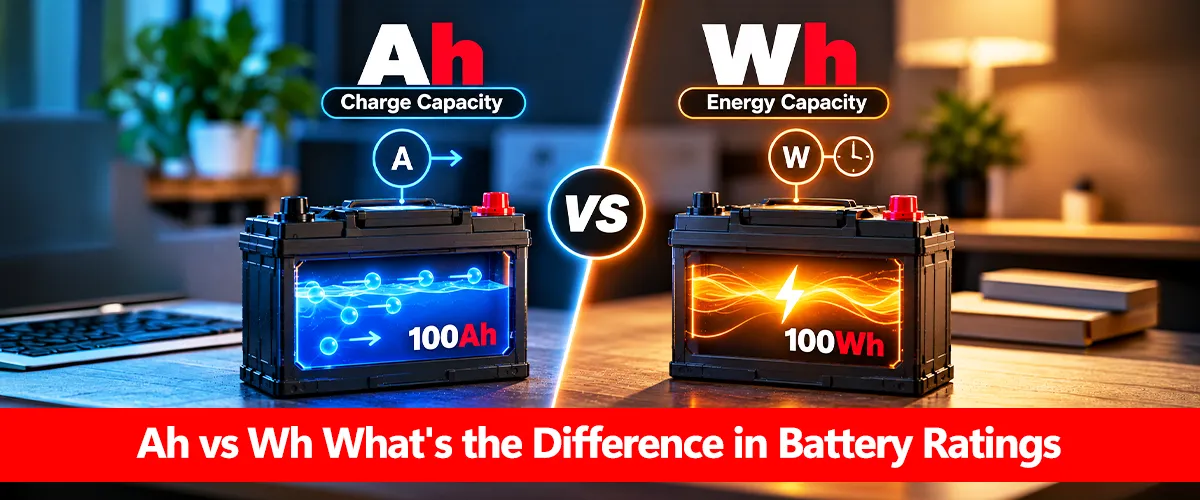
Ah vs Wh comes down to one important difference: amp-hours (Ah) measure electric charge, while watt-hours (Wh) measure electrical energy. A battery rated at 100Ah does not necessarily store the same energy as another 100Ah battery because their voltages may differ. Watt-hours account for that difference, making them more useful when comparing energy capacity across battery systems.
Both ratings appear on batteries used in smartphones, power banks, UPS systems, solar storage, and electric vehicles. Understanding which measurement to use helps you compare products correctly and avoid mistaking charge capacity for usable energy.
Key Takeaways
- Ah measures charge capacity, while Wh measures energy capacity.
- Two batteries with the same Ah rating can have different Wh ratings if their voltages differ.
- Wh is usually better for comparing stored energy, especially across different battery voltages.
- Ah remains useful for interpreting battery labels and charge capacity within comparable systems.
Ah vs Wh: Quick Comparison
| Feature | Ah (Ampere-Hour) | Wh (Watt-Hour) |
| Measures | Electric charge | Electrical energy |
| Unit symbol | Ah | Wh |
| Depends directly on voltage? | No | Yes, when calculated from charge capacity |
| Commonly displayed on | Car, UPS, and deep-cycle batteries | Laptops, power stations, and solar batteries |
| Best used for | Comparing charge capacity under similar conditions | Comparing nominal stored energy |
| Tells you exact runtime? | No | No |
| Related smaller/larger unit | mAh | kWh |
The practical rule: Use Ah when comparing charge capacity under comparable conditions. Use Wh when you need to know how much nominal electrical energy different batteries store.
What Does Ah Mean?

Ah stands for ampere-hour, a unit of electric charge. It indicates how much charge a battery can deliver under specified discharge conditions.
For example, a 100Ah battery has a rated charge capacity of 100 amp-hours. That does not guarantee it can supply 100A continuously for one hour, because discharge rate and battery chemistry affect available capacity.
Ah ratings are especially common on automotive, lead-acid, UPS, and deep-cycle batteries. For a complete explanation of the rating, read what Ah means on a battery.
What Does Wh Mean?
Wh stands for watt-hour, a unit of energy. It describes how much electrical energy a battery is rated to deliver. A 500Wh battery has a nominal energy capacity of 500 watt-hours. This does not mean it can necessarily deliver 500W of power, because maximum output power is a separate specification.
Watt-hours are commonly used for laptops, portable power stations, and residential energy storage systems. Our guide to battery watt-hours explains how to interpret these ratings in everyday applications.
Why Does Voltage Matter When Comparing Ah and Wh?
Voltage is the key reason Ah and Wh are not interchangeable. Two batteries may have identical charge capacities but different nominal voltages. The higher-voltage battery then has more nominal electrical energy, assuming the same Ah rating.
Consider these examples:
| Battery | Nominal Voltage | Capacity | Nominal Energy |
| Battery A | 12V | 100Ah | 1,200Wh |
| Battery B | 24V | 100Ah | 2,400Wh |
| Battery C | 12V | 200Ah | 2,400Wh |
Battery A and Battery B have the same Ah rating, but Battery B stores twice the nominal energy. Battery B and Battery C have different Ah ratings and voltages, yet their nominal energy ratings are equal. This demonstrates why Ah alone cannot establish which battery stores more energy.
How Are Ah and Wh Related?
Amp-hours and watt-hours are connected through battery voltage.
For a nominal energy estimate:
Wh = V × Ah
A 12V 100Ah battery, for example, has approximately 1,200Wh of nominal energy.
The reverse relationship is:
Ah = Wh ÷ V
These equations are useful for interpreting battery specifications. Actual delivered energy can differ because voltage changes during discharge and the battery operates within defined limits. For detailed worked calculations, see our dedicated Ah to Wh and Wh to Ah guides.
Which Is Better for Comparing Batteries: Ah or Wh?

Neither unit is inherently better. The right choice depends on what you are comparing.
Use Ah When Comparing Similar Battery Systems
Ah is useful when two batteries have the same nominal voltage, similar chemistry, and comparable capacity test conditions.
For example, comparing two 12V lead-acid batteries rated at 100Ah and 150Ah provides a straightforward indication of their relative charge capacities.
The 150Ah model has 50% more rated charge capacity, although its practical performance also depends on discharge conditions and battery condition.
Use Wh When Comparing Different Voltages
Wh is generally the better choice when batteries operate at different nominal voltages. A 12V 100Ah battery and a 24V 100Ah battery cannot be compared fairly using Ah alone. Their nominal energy capacities are 1,200Wh and 2,400Wh, respectively. This is particularly relevant for portable power stations, lithium battery packs, and solar storage systems.
Use Both When Evaluating a Complete Battery System
A battery’s Ah and Wh ratings are only part of its specifications. The system must also support the battery’s voltage, charging requirements, current limits, and operating conditions.
For example, two batteries may have the same Wh rating but different maximum discharge currents. They could store similar amounts of energy while supporting very different electrical loads. The correct battery is therefore determined by the application’s requirements, not by one rating alone.
Ah vs Wh in Common Battery Applications
| Application | Most Useful Rating | Why |
| Smartphone battery | mAh and Wh | mAh is commonly advertised; Wh helps compare energy |
| Power bank | Wh | Accounts for internal battery voltage |
| Car battery | Ah, plus starting-current ratings | Charge capacity and starting performance matter |
| Home UPS | Wh or kWh, alongside Ah and voltage | Helps evaluate stored energy |
| Solar battery storage | kWh | Useful for comparing storage energy across systems |
| Portable power station | Wh | Indicates nominal energy available |
| Electric vehicle battery | kWh | Describes large-scale battery energy capacity |
For small portable devices, mAh is simply a smaller unit of charge capacity. Read what mAh means on a battery for examples involving smartphones and power banks.
Does Ah or Wh Determine Battery Runtime?
Wh is more directly related to runtime because it measures energy, but neither rating guarantees a specific operating duration. Runtime also depends on the connected device’s power consumption, the battery’s usable energy, temperature, and conversion efficiency.
For example, two batteries with identical nominal Wh ratings may provide different practical runtimes if one has a stricter discharge limit or is connected through a less efficient inverter. Ah is also relevant, particularly when working with DC loads and known system voltages. However, comparing Ah without considering voltage can lead to incorrect conclusions.
Do Ah and Wh Affect Charging, Lifespan, or Safety?
Ah and Wh are measurements, not battery chemistries or technologies. Neither unit directly determines charging speed, lifespan, or safety. A battery’s charging requirements depend on its chemistry, voltage limits, charge current, and management system. Its lifespan depends on factors such as cycle life, temperature, depth of discharge, and operating conditions.
Likewise, battery safety depends on design, protection equipment, correct charging, and installation—not whether the label uses Ah or Wh. Two batteries with the same energy rating may have very different charging characteristics and service lives. For more detail on discharge capability, see our guide to battery C-rate.
How Do Ah and Wh Relate to Energy Density?
Energy density describes the amount of energy stored relative to a battery’s mass or volume. It is commonly expressed in Wh/kg or Wh/L. Wh is used in these measurements because energy density concerns stored energy rather than electric charge alone.
A battery with a high Ah rating is not necessarily lightweight or compact. Voltage, chemistry, and physical construction all affect the relationship between capacity and size. Our guide to battery energy density explores this topic further.
Common Mistakes When Comparing Ah and Wh
| Mistake | Better Approach |
| Comparing Ah ratings across different voltages | Compare nominal Wh ratings |
| Assuming higher Wh means higher maximum power | Check output power and current limits separately |
| Treating Ah and Wh as interchangeable | Remember that Ah measures charge and Wh measures energy |
| Ignoring discharge limits | Check usable energy and manufacturer specifications |
| Assuming identical Wh means identical performance | Consider chemistry, efficiency, and discharge capability |
These distinctions are particularly useful when comparing batteries for UPS and solar systems in Pakistan, where products may be advertised using Ah, Wh, or kWh depending on the manufacturer.
Conclusion
Ah vs Wh is a comparison of charge capacity and energy capacity—not two different battery technologies. Ah tells you how much electric charge a battery can deliver, while Wh tells you how much nominal electrical energy it stores. When comparing batteries at the same voltage and under similar conditions, Ah can be useful. When comparing different voltages or evaluating stored energy, Wh provides a clearer basis.
For a deeper understanding, read our guides to battery watt-hours, Ah to Wh conversion, and battery energy density. Explore more educational content in the Battery Fundamentals category at Batteries Hub.
Frequently Asked Questions About Ah vs Wh
Is Ah the Same as Wh?
No. Ah measures electric charge, while Wh measures electrical energy. Battery voltage is needed to relate the two.
Is 100Ah Better Than 1,000Wh?
You cannot compare these ratings directly without knowing the battery voltage. A 12V 100Ah battery has approximately 1,200Wh of nominal energy, while a 24V 100Ah battery has approximately 2,400Wh.
Which Is More Important for a Solar Battery, Ah or Wh?
Wh or kWh is generally more useful for comparing nominal stored energy. Ah and voltage remain important for understanding the battery’s electrical specifications and compatibility.
Why Do Some Batteries Show Ah While Others Show Wh?
Manufacturers use different labeling conventions based on battery type and application. Automotive and lead-acid batteries commonly show Ah, while laptops, power stations, and energy storage systems often display Wh or kWh.
Can Two Batteries Have the Same Wh but Different Ah?
Yes. Different combinations of voltage and charge capacity can produce the same nominal energy rating.
Does Higher Wh Mean Longer Battery Life?
A higher Wh rating generally means more nominal energy, but actual runtime also depends on the connected load, usable capacity, and efficiency. It does not necessarily mean a longer service lifespan.
Which Rating Should I Check for a UPS Battery?
Check the battery voltage required by the UPS, the rated Ah capacity, and the corresponding usable energy. Also consider chemistry, discharge limits, and the manufacturer’s compatibility requirements.