
Wh to Ah conversion means dividing a battery’s energy in watt-hours (Wh) by its nominal voltage (V) to find its capacity in amp-hours (Ah). The formula is Ah = Wh ÷ V. For example, a 1,200Wh battery operating at 12V has a nominal charge capacity of approximately 100Ah. This calculation is useful when a portable power station, solar battery or other device displays its energy rating in Wh, but you need to understand the equivalent Ah rating. However, the same watt-hour value produces different amp-hour results at different voltages.
This guide walks through the calculation, provides ready-to-use examples and explains when a simple conversion may not represent actual battery performance.
Wh to Ah Formula: What You Need
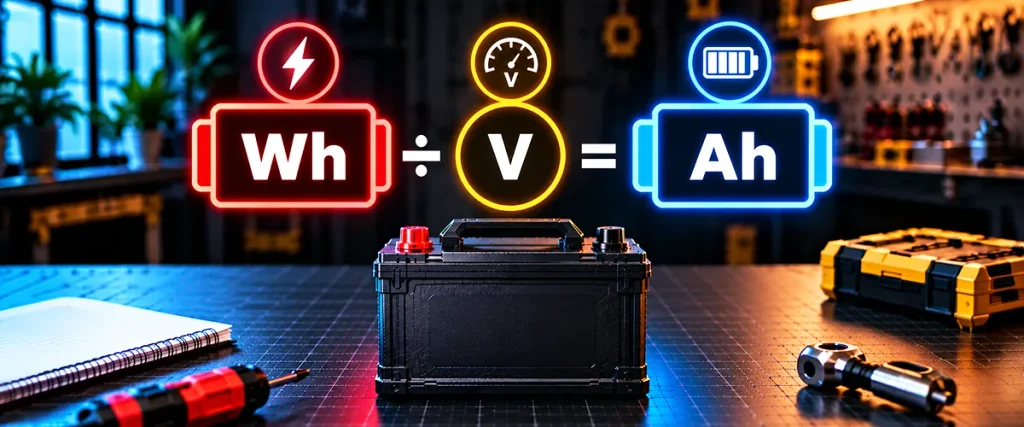
Converting watt-hours into amp-hours requires two values: the battery’s energy capacity and its nominal voltage. Watt-hours describe electrical energy, while amp-hours describe electric charge. Voltage connects these measurements, which is why a Wh rating cannot be converted accurately into Ah without knowing the relevant voltage.
The basic formula is:
Amp-hours (Ah) = Watt-hours (Wh) ÷ Voltage (V)
Before calculating, identify the following:
- Wh: The battery’s rated energy capacity.
- V: Its nominal voltage, preferably from the manufacturer’s datasheet.
- Ah: The charge capacity you want to estimate.
- kWh: If the energy rating is in kilowatt-hours, multiply it by 1,000 first.
The result is an approximate nominal Ah value because battery voltage changes during actual discharge. For a deeper distinction between the measurements, see Ah vs Wh.
Convert Wh to Ah in Three Simple Steps
Imagine a battery label showing 2,400Wh and 24V. Instead of assuming that 2,400Wh represents a particular Ah rating, divide the energy by the battery’s nominal voltage.
- Identify the energy rating: 2,400Wh.
- Find the nominal voltage: 24V.
- Divide watt-hours by voltage: 2,400 ÷ 24 = 100Ah.
Result: 2,400Wh at 24V equals approximately 100Ah.
If the same 2,400Wh were stored at 12V, the calculated capacity would be 200Ah. This difference demonstrates why battery voltage matters when interpreting charge capacity.
Quick Wh to Ah Conversion Chart
Use this chart for common battery energy ratings at nominal system voltages of 12V, 24V and 48V. Values are rounded to two decimal places where necessary.
| Energy Capacity | 12V Battery | 24V Battery | 48V Battery |
| 500Wh | 41.67Ah | 20.83Ah | 10.42Ah |
| 1,000Wh | 83.33Ah | 41.67Ah | 20.83Ah |
| 1,200Wh | 100Ah | 50Ah | 25Ah |
| 2,000Wh | 166.67Ah | 83.33Ah | 41.67Ah |
| 2,400Wh | 200Ah | 100Ah | 50Ah |
| 4,800Wh | 400Ah | 200Ah | 100Ah |
The chart is a convenient reference, not a substitute for manufacturer data. Battery chemistry affects nominal voltage, and a product advertised for a 12V system may actually use a different rated voltage.
Worked Examples for Common Battery Systems
The same conversion formula applies to different rechargeable batteries, but the voltage must match the specific product. These examples illustrate how Wh-to-Ah results change across common applications.
Example 1: 1,200Wh at 12V
A 12V battery with 1,200Wh nominal energy has:
1,200Wh ÷ 12V = 100Ah
This could represent the nominal energy rating of a 12V 100Ah battery. Its usable capacity may be lower under real operating conditions.
Example 2: 2,560Wh at 25.6V
A LiFePO4 battery rated at 25.6V and 2,560Wh has:
2,560Wh ÷ 25.6V = 100Ah
The result illustrates why using 24V for every battery marketed as a 24V model may produce an inaccurate estimate.
Example 3: 5,120Wh at 51.2V
A 51.2V lithium battery with 5,120Wh nominal energy has:
5,120Wh ÷ 51.2V = 100Ah
Although this battery has the same Ah rating as the previous example, it stores twice the nominal electrical energy because its voltage is higher.
Why Is Nominal Voltage Important?
Nominal voltage is the rated reference voltage used to describe a battery’s operating system. It differs from the changing terminal voltage measured during charging or discharging, which depends on temperature, load current and the battery’s state of charge.
For example, lithium iron phosphate batteries commonly use these nominal pack voltages:
- 12.8V: Often marketed for 12V applications.
- 25.6V: Often marketed for 24V applications.
- 51.2V: Frequently used in 48V-class energy storage systems.
Using the correct voltage is especially important when checking lithium battery specifications. A manufacturer-provided Wh and Ah rating should take priority over an estimate based on the voltage category used in advertising.
Can You Convert Usable Wh to Ah?
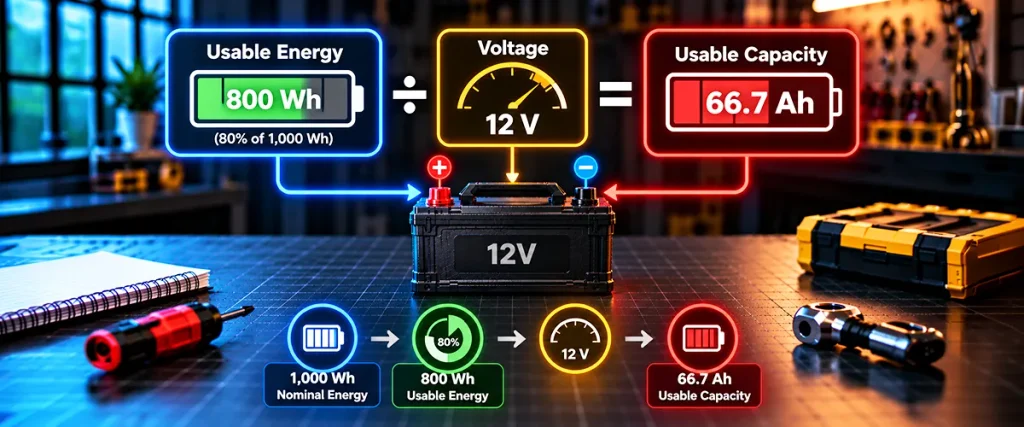
Yes, but first identify what the watt-hour figure represents. Nominal energy describes the battery’s rated storage capacity, while usable energy describes what can be withdrawn within specified operating limits.
Suppose a battery has 1,000Wh nominal energy and an allowed depth of discharge of 80%. Its estimated usable battery-side energy is 800Wh. At a nominal voltage of 12V, that corresponds to approximately 66.7Ah of usable charge under simplified assumptions.
Keep these distinctions clear:
- Nominal Ah: Based on the battery’s rated Wh and nominal voltage.
- Usable Ah: Estimated from the energy available within operating limits.
- AC output energy: May be lower because of inverter conversion losses.
- Actual delivered capacity: Can change with temperature, discharge rate and aging.
Do not divide an AC output rating by battery voltage and assume the result is the original rated battery capacity. Energy losses and the measurement reference must be considered.
When Does the Formula Need Extra Caution?
The equation Ah = Wh ÷ V works well for interpreting nominal battery ratings, but real batteries do not operate at constant voltage. Their discharge curves, internal resistance and electrochemical characteristics influence the energy delivered to a load.
Manufacturer specifications become particularly important in these situations:
- High discharge currents: Effective capacity or delivered energy may decrease.
- Low temperatures: Available capacity can fall below the rated value.
- Aging batteries: Actual capacity declines as the battery deteriorates.
- Power banks: Advertised energy may refer to internal cells rather than USB output.
- Battery packs: A pack’s nominal voltage may differ from individual cell voltage.
For complete battery sizing based on electrical load and system losses, use our guide to how to calculate battery capacity.
Common Wh to Ah Conversion Mistakes
Most conversion errors come from mixing units or using the wrong voltage. Even a mathematically correct answer can be misleading if the input value describes a different part of the electrical system.
Avoid these mistakes:
- Treating watts as watt-hours: Watts measure power, not stored energy.
- Ignoring voltage: Wh alone does not establish an Ah rating.
- Using maximum charging voltage: Use the specified nominal voltage for nominal capacity estimates.
- Forgetting kWh conversion: Convert kilowatt-hours into watt-hours before dividing.
- Confusing rated and usable energy: Battery-side and appliance-side energy may differ.
- Assuming exact results: Real discharge behavior can differ from nominal calculations.
If you need the opposite conversion, our Ah to Wh guide explains how to estimate energy from amp-hour capacity.
Conclusion
Wh to Ah conversion uses a straightforward formula: Ah = Wh ÷ V. With the battery’s rated watt-hours and correct nominal voltage, you can estimate its charge capacity and interpret battery specifications more confidently. Always distinguish nominal energy from usable energy, particularly when evaluating UPS, solar and lithium battery systems. Where exact performance matters, rely on the manufacturer’s rated capacity and discharge specifications rather than a simplified calculation alone.
Continue exploring Ah to Wh conversion, battery capacity calculations and battery runtime calculations. Find more tutorials in Battery Calculations and Sizing at Batteries Hub.
Frequently Asked Questions
How Many Ah Is 1,000Wh?
At 12V, 1,000Wh equals approximately 83.33Ah. At 24V, it equals 41.67Ah. The result depends on the battery’s nominal voltage.
How Do You Convert 5kWh to Ah?
First convert 5kWh into 5,000Wh. Then divide by nominal voltage. At 48V, 5,000Wh ÷ 48V equals approximately 104.17Ah.
Can Wh Be Converted to Ah Without Voltage?
No. Voltage is required because watt-hours measure energy and amp-hours measure electric charge. Different voltages produce different Ah values for the same energy capacity.
Is Wh to Ah Conversion Exact?
The formula provides a nominal estimate when using rated energy and nominal voltage. Actual delivered charge depends on the battery’s voltage behavior and discharge conditions.
Does Higher Ah Mean More Energy?
Only when comparing batteries with comparable nominal voltages. A battery with fewer amp-hours may store more energy if its voltage is sufficiently higher.
Will a 100Ah Battery Always Deliver Its Full Capacity?
Not necessarily. Battery chemistry, discharge rate, temperature, aging and the manufacturer’s discharge endpoint affect delivered capacity. See how long a 100Ah battery lasts for application-specific context.