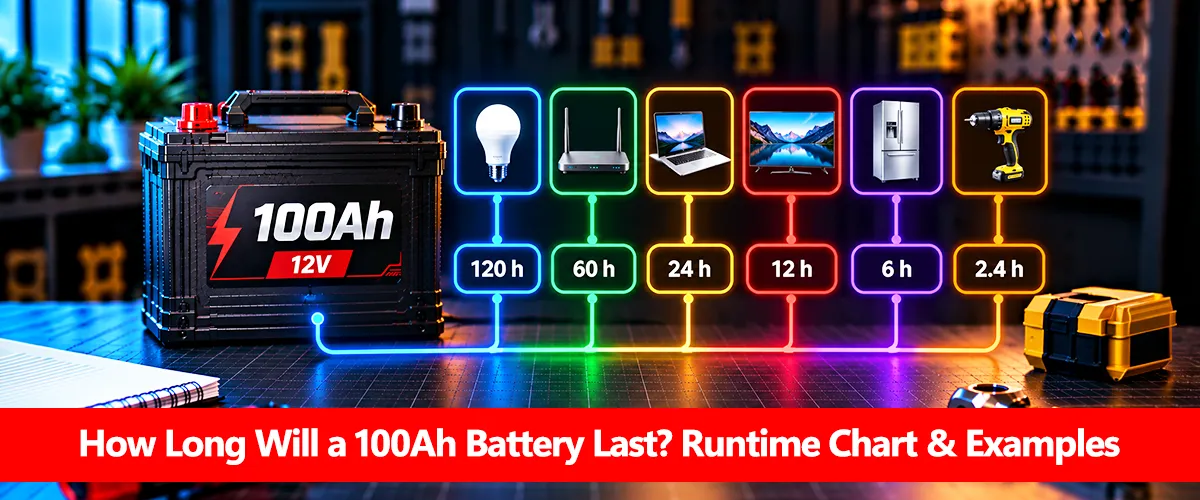
How long will a 100Ah battery last? A 12V 100Ah lead-acid battery could theoretically power a constant 100W AC load for approximately 5.1 hours when allowing 50% depth of discharge and 85% inverter efficiency. A 12.8V 100Ah lithium iron phosphate (LiFePO4) battery could provide approximately 9.2 hours under an 80% discharge allowance and 90% inverter efficiency.These are illustrative estimates, not guaranteed backup times. Actual results depend on battery voltage, chemistry, electrical load, discharge rate, temperature, age, and system losses.
If you’re planning backup for fans, lights, a Wi-Fi router, or other household equipment, the examples below will help you understand what a 100Ah battery can realistically support.
100Ah Battery Runtime Chart for Different Loads
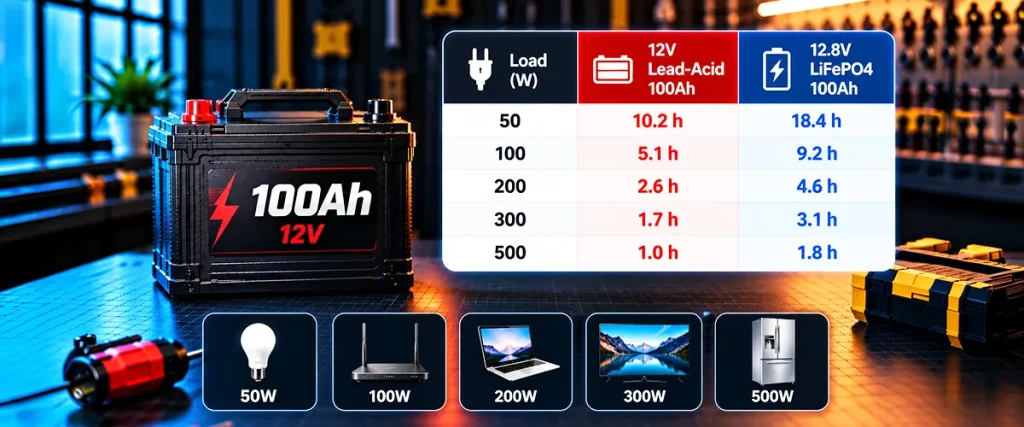
A 100Ah rating describes electric charge capacity, not a fixed number of operating hours. The same battery lasts much longer with a 50W load than with a 300W load because higher-power appliances consume stored energy more quickly.
The following chart compares two illustrative battery systems at various constant AC loads.
| AC Load | 12V Lead-Acid 100Ah | 12.8V LiFePO4 100Ah |
| 50W | 10.2 hours | 18.4 hours |
| 100W | 5.1 hours | 9.2 hours |
| 150W | 3.4 hours | 6.1 hours |
| 200W | 2.6 hours | 4.6 hours |
| 300W | 1.7 hours | 3.1 hours |
| 500W | 1.0 hour | 1.8 hours |
Assumptions: Lead-acid uses 50% DoD and 85% inverter efficiency. LiFePO4 uses 80% DoD and 90% inverter efficiency. Both are assumed healthy and fully charged initially.
These are energy-based mathematical estimates. At high currents, lead-acid capacity may fall significantly below its rated value. Actual inverter efficiency and standby consumption also vary.
What Determines How Long a 100Ah Battery Runs?
Several electrical and operating factors determine how long a 100Ah battery can power equipment. The amp-hour rating is only the starting point because it does not reveal how much energy the connected appliances will actually receive.
The most important factors include:
- Battery voltage: A 24V 100Ah battery stores approximately twice the nominal energy of a 12V 100Ah battery.
- Electrical load: Higher wattage increases energy consumption and reduces operating time.
- Battery chemistry: Lead-acid and lithium batteries have different usable discharge characteristics.
- Depth of discharge: The permitted discharge percentage limits how much stored energy can be used.
- Inverter efficiency: Converting DC battery power into AC electricity consumes some energy.
- Battery condition: Age, temperature, and discharge current affect available capacity.
For a deeper explanation of the rating itself, see what Ah means on a battery.
How to Calculate Runtime for a 100Ah Battery
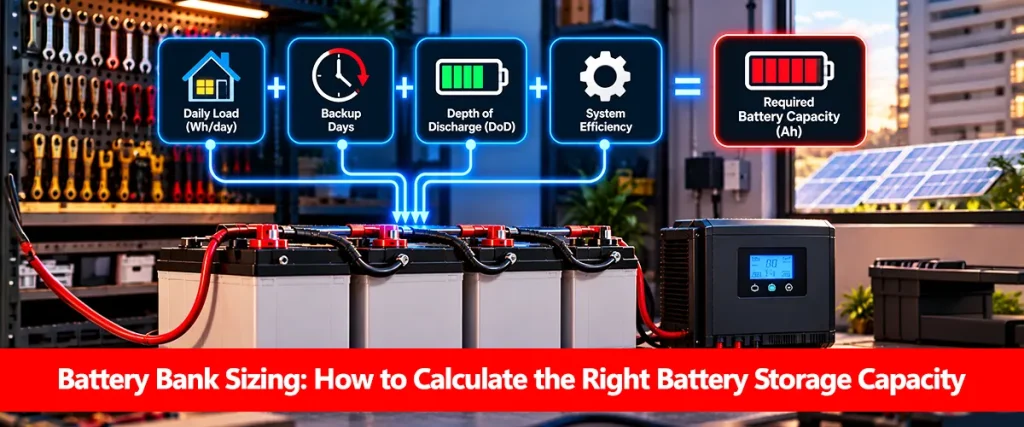
You can estimate runtime by converting battery capacity into watt-hours, accounting for usable energy and dividing by the connected load. This method works well as a starting estimate for constant-power equipment.
Runtime (hours) ≈ (Voltage × 100Ah × DoD × Efficiency) ÷ Load (W)
Use these steps:
- Find the battery’s nominal voltage.
- Multiply voltage by 100Ah to estimate nominal energy.
- Apply the permitted depth of discharge as a decimal.
- Apply inverter efficiency if powering AC equipment.
- Divide the resulting usable energy by the appliance load in watts.
For example, a 12V 100Ah battery with 50% DoD, 85% efficiency, and a 100W load gives:
(12 × 100 × 0.50 × 0.85) ÷ 100 = 5.1 hours
This calculation assumes the battery can deliver the estimated energy under the operating conditions. Our broader battery runtime calculation guide covers other battery sizes and electrical setups.
How Long Will a 100Ah Battery Run Household Appliances?
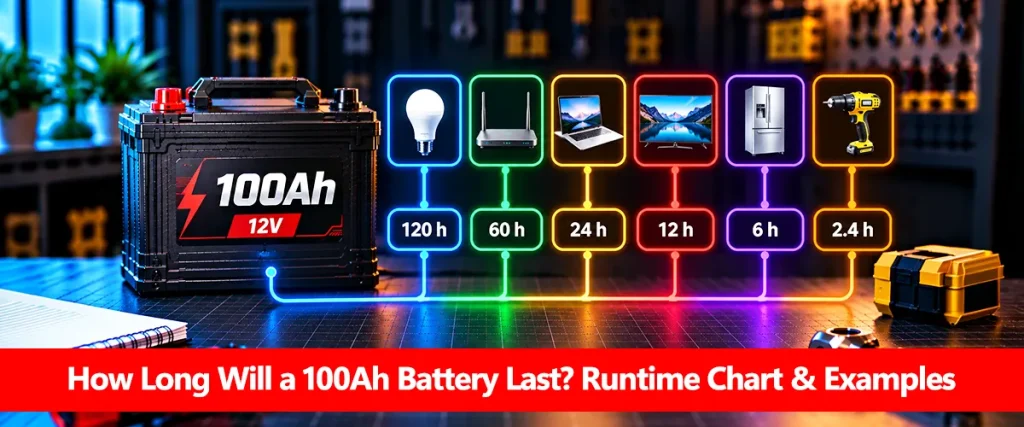
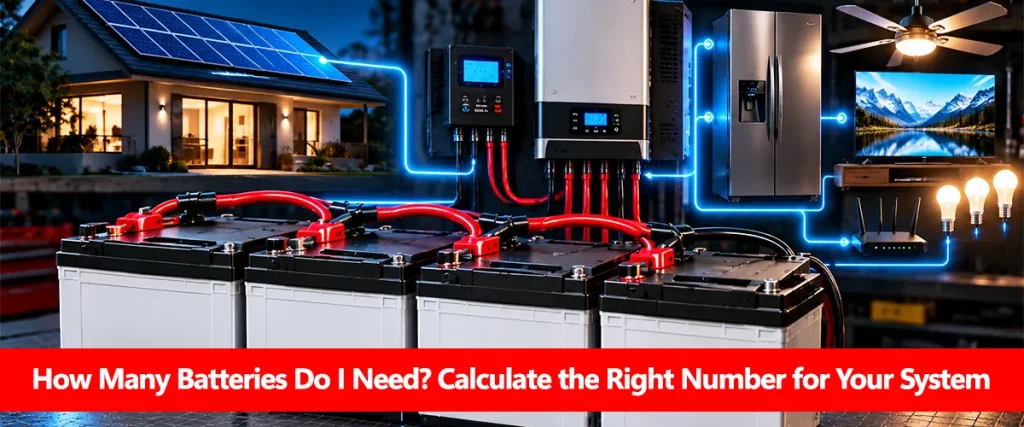
Household backup requirements depend on the number of appliances running simultaneously. In Pakistan, a small inverter system may power fans, LED lights, and a router during load shedding, but connecting additional equipment increases the electrical load.
Consider this example using a 12.8V 100Ah LiFePO4 battery:
- Two efficient fans consuming 45W each = 90W.
- Three LED lights consuming 10W each = 30W.
- One Wi-Fi router consuming 10W = 10W.
- Total connected load = 130W.
With 80% DoD and 90% inverter efficiency, the estimated usable AC energy is 921.6Wh.
Estimated runtime = 921.6Wh ÷ 130W = approximately 7.1 hours.
Actual backup may be shorter because of inverter standby consumption, changing appliance power, battery condition, and other losses. Measure your appliances’ real consumption when accuracy matters.
Lead-Acid vs Lithium: Why Does Runtime Differ?
A 100Ah lead-acid battery and a 100Ah LiFePO4 battery have the same rated charge capacity, but their practical energy delivery can differ. Their nominal voltages, discharge limits, and response to high-current loads influence the result. Lead-acid batteries are often operated with a conservative discharge limit to preserve service life. Their effective capacity can also decrease substantially at higher discharge currents, especially when their rating is based on a slow 20-hour discharge test.
LiFePO4 batteries frequently permit deeper discharge and can maintain capacity better across suitable discharge rates. However, their battery management system imposes current and voltage limits that must be respected. For a detailed chemistry comparison, see our planned guide to LiFePO4 vs lead-acid batteries.
Why Might Your 100Ah Battery Last Less Than Expected?
A real battery does not always deliver its nominal capacity under everyday conditions. Discharge performance changes with current demand, temperature, age, and the battery’s internal resistance.
Common reasons for shorter runtime include:
- High discharge rate: Especially important for lead-acid batteries, where usable capacity can decrease at higher currents.
- Battery aging: An older battery may have less remaining capacity than its original 100Ah rating.
- Incomplete charging: Starting at a lower state of charge reduces available backup.
- Temperature extremes: Cold conditions can reduce capacity, while excessive heat accelerates deterioration.
- Inverter losses: Conversion efficiency may be lower than assumed, particularly under light loads.
- Unexpected consumption: Appliance starting surges, changing workloads, and inverter standby draw affect results.
When precise performance is important, check the manufacturer’s discharge curves and capacity ratings instead of relying on a simplified energy formula alone.
Is a 100Ah Battery Enough for Your Backup Needs?
A 100Ah battery may be suitable for modest backup loads, but suitability depends on the required operating time and the actual system voltage. A battery that can comfortably power lighting and a router may not provide sufficient backup for several fans or high-power equipment.
Before selecting a battery, determine:
- The total wattage of appliances operating together.
- The number of backup hours required.
- Whether the system uses 12V, 24V, or another voltage.
- The battery chemistry and recommended discharge limit.
- The inverter’s compatibility, efficiency, and current requirements.
If your energy requirement exceeds what a 100Ah battery can supply, you may need a different battery capacity or system configuration. Our guide to how to calculate battery capacity explains how to estimate the required size.
Conclusion
How long will a 100Ah battery last? The answer depends primarily on nominal voltage, usable battery energy, and electrical load. A 100W appliance might run for approximately five hours from a conservatively discharged 12V lead-acid battery or around nine hours from a suitable 12.8V LiFePO4 battery under the stated example conditions. Use these estimates as planning references, not guaranteed performance figures. Check manufacturer specifications, account for energy losses, and measure actual appliance consumption before relying on a battery for essential backup.
Explore 12V 100Ah battery energy and watts, battery runtime calculations, and more tutorials in Battery Calculations and Sizing at Batteries Hub.
Frequently Asked Questions
How Long Will a 100Ah Battery Last With a 100W Load?
A 12V 100Ah lead-acid battery may provide approximately 5.1 hours under the example assumptions of 50% DoD and 85% inverter efficiency. A 12.8V LiFePO4 model may provide approximately 9.2 hours at 80% DoD and 90% efficiency.
How Long Will a 100Ah Battery Last With a 500W Load?
Under the same assumptions, the theoretical estimates are approximately one hour for lead-acid and 1.8 hours for LiFePO4. High discharge current can make actual lead-acid runtime substantially shorter.
Can a 100Ah Battery Last 24 Hours?
Yes, if the connected load is sufficiently small and the battery has enough usable energy. For example, a suitable low-power DC device may operate much longer than a household fan or inverter-powered appliance.
Does a 24V 100Ah Battery Last Longer Than a 12V 100Ah Battery?
At the same load and under otherwise comparable conditions, a 24V 100Ah battery has approximately twice the nominal stored energy. It can therefore potentially deliver longer runtime.
Is a 200Ah Battery Twice as Long-Lasting?
A 200Ah battery has twice the rated charge capacity of a 100Ah battery at the same voltage and under comparable rating conditions. Actual runtime will still depend on chemistry, discharge limits, and load. See how long a 200Ah battery lasts.
Does Battery Runtime Mean Battery Lifespan?
No. Runtime means how long a battery powers equipment during one discharge. Lifespan means how long the battery remains useful over months or years. Our guides to car battery lifespan and motorcycle battery lifespan cover different questions.