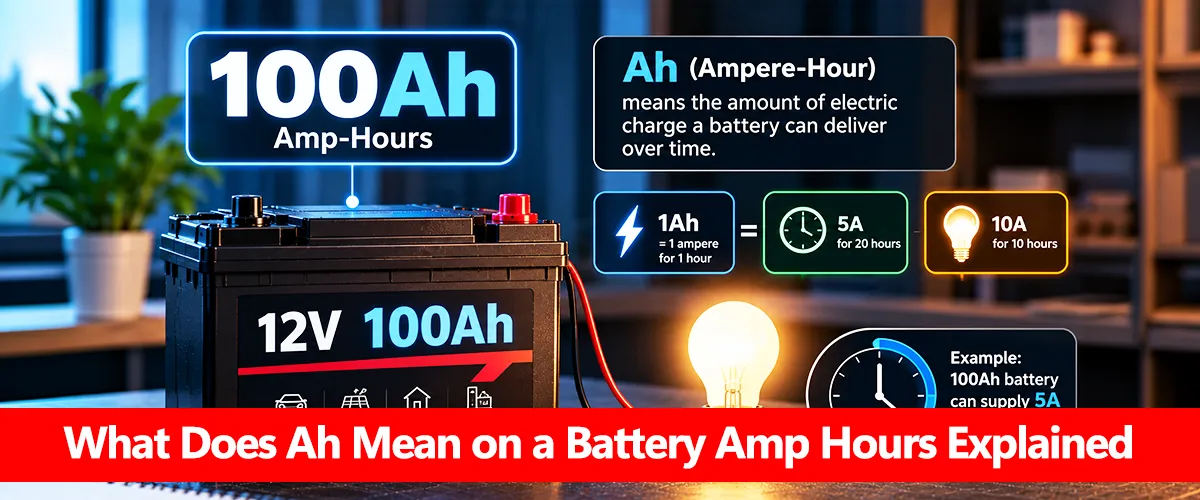
What does Ah mean on a battery, and does a higher number really mean longer backup time? Ah stands for ampere-hour, a unit that measures the amount of electric charge a battery can deliver. A 100Ah battery, for example, has a rated charge capacity of 100 amp-hours, but that does not mean it will always supply 100 amps for one hour.
The Ah rating helps you understand how much charge a battery can provide under defined conditions. However, actual performance depends on discharge current, battery chemistry, temperature, and operating limits. This guide explains how to read common Ah ratings, what they tell you about a battery, and what they cannot tell you on their own.
Key Takeaways
- Ah means ampere-hour, a measurement of electric charge capacity.
- 100Ah does not guarantee 100 amps for one hour because actual capacity depends on discharge conditions.
- Higher Ah generally means greater charge capacity when comparing batteries with similar voltage, chemistry, and test ratings.
- Ah alone cannot tell you battery energy or backup runtime. Voltage, load, and usable capacity also matter.
What Does Ah Mean on a Battery Label?

Ah stands for ampere-hour, which describes the electric charge a battery can deliver during discharge. The rating is commonly printed on car batteries, UPS batteries, deep-cycle batteries, and solar storage products.An ampere (A) measures electric current, while an hour (h) measures time. Multiplying current by time gives electric charge in ampere-hours.
For example, a battery rated at 50Ah has a nominal charge capacity of 50 amp-hours under its specified test conditions. It might deliver 2.5A for 20 hours during a suitable capacity test, but a different discharge current can change the total charge delivered.The Ah figure is useful for comparing batteries, provided their ratings are based on comparable conditions. It does not describe the voltage or total energy stored.For the broader concept, see our guide to battery capacity.
What Do 50Ah, 100Ah, and 200Ah Mean?
The numbers before Ah indicate the rated amount of electric charge a battery can deliver. A larger number represents more rated charge capacity, but it does not guarantee proportional runtime under every load.
| Battery Rating | Meaning | Illustrative Discharge at 20-Hour Rate |
| 50Ah | Rated capacity of 50 amp-hours | 2.5A for 20 hours |
| 75Ah | Rated capacity of 75 amp-hours | 3.75A for 20 hours |
| 100Ah | Rated capacity of 100 amp-hours | 5A for 20 hours |
| 150Ah | Rated capacity of 150 amp-hours | 7.5A for 20 hours |
| 200Ah | Rated capacity of 200 amp-hours | 10A for 20 hours |
These examples illustrate a 20-hour capacity rating, commonly used for some lead-acid batteries. They are not guaranteed discharge times for every chemistry or operating condition. A 200Ah battery has twice the rated charge capacity of a 100Ah battery when both ratings use the same measurement basis. Whether it provides twice the useful backup time depends on the system and the batteries’ operating characteristics.
How Is an Ah Rating Determined?
Manufacturers determine amp-hour capacity by discharging a fully charged battery under controlled conditions. The test measures how much electric charge the battery delivers before reaching its specified cutoff voltage. The discharge current, test temperature, and cutoff voltage affect the result. This is why reputable manufacturers provide capacity ratings alongside test conditions or discharge-rate specifications.
What Does C20 Mean on a Battery?
C20 indicates a capacity rating measured over a 20-hour discharge period. For a 100Ah battery rated at C20, the corresponding test current is 5A. Some batteries also display ratings such as C10 or C5, which refer to 10-hour and 5-hour discharge tests. The capacity measured at these rates can differ, particularly for lead-acid batteries.
When comparing Ah ratings, check whether the products use the same discharge test. Two batteries labeled 100Ah may not perform identically if their ratings were determined under different conditions.
Does Higher Ah Mean a Better Battery?

A higher Ah rating means greater rated charge capacity, but it does not automatically make one battery better than another. Consider two batteries with the same nominal voltage and chemistry. If one is rated 100Ah and the other 150Ah under comparable conditions, the 150Ah model generally offers more charge capacity. That may support a longer runtime with the same electrical load.
However, battery quality also depends on cycle life, internal resistance, discharge capability, construction, warranty, and suitability for the intended equipment. A larger-capacity battery can also be heavier, more expensive, and slower to charge with the same charger. The best choice is the one that meets the electrical system’s requirements, not simply the battery with the highest Ah figure.
Why Doesn’t a 100Ah Battery Always Deliver 100A for One Hour?
An Ah rating is determined under particular discharge conditions. Drawing current much faster than the rated test can reduce the charge available before the battery reaches its cutoff voltage. This effect is especially important in lead-acid batteries, where higher discharge currents can significantly reduce effective capacity. Lithium-based batteries often maintain capacity better across moderate discharge rates, but they also have current limits and performance losses.
For example, a 100Ah lead-acid battery rated at the 20-hour rate is not necessarily capable of delivering 100A continuously for one hour. The actual result depends on its discharge characteristics and manufacturer specifications. The battery’s condition, temperature, and state of charge also influence how much current it can supply.
Is Ah the Same as Battery Voltage or Watt-Hours?
No. Ah, volts, and watt-hours measure different electrical quantities.
| Measurement | What It Means | Unit |
| Current | Rate of electric charge flow | Ampere (A) |
| Charge capacity | Total electric charge delivered | Ampere-hour (Ah) |
| Voltage | Electrical potential difference | Volt (V) |
| Energy | Amount of electrical energy | Watt-hour (Wh) |
| Power | Rate of energy transfer | Watt (W) |
A 12V 100Ah battery and a 24V 100Ah battery have the same rated charge capacity in Ah, but the 24V battery has twice the nominal energy. This distinction matters when comparing batteries for different voltage systems. Read our guides to battery voltage, battery watt-hours, and Ah vs Wh for a closer comparison. For step-by-step conversions, see our dedicated Ah to Wh guide.
What Affects the Actual Ah You Can Use?
The rated Ah value describes battery capacity under test conditions. The amount available in everyday use may be lower because of several factors.
Discharge Rate
Drawing a higher current can reduce the capacity delivered before the cutoff voltage is reached. The effect varies by chemistry and battery design.
Depth of Discharge (DoD)
Depth of discharge describes the percentage of rated capacity removed during use. Some systems limit discharge to protect the battery and extend service life.
For example, a 100Ah battery operated with a 50% depth-of-discharge limit allows roughly 50Ah of charge withdrawal under the assumed conditions.
Temperature and Battery Condition
Cold temperatures can reduce available capacity, while high temperatures accelerate aging. As a battery deteriorates, it may no longer deliver the Ah capacity shown on its original label.
System Efficiency
In UPS and inverter applications, some stored energy is lost during DC-to-AC conversion. These losses affect the energy reaching appliances, even though inverter efficiency does not directly change the battery’s Ah rating.
Why Is Ah Important for UPS and Solar Batteries in Pakistan?
In Pakistan, Ah ratings are frequently used when comparing batteries for UPS systems, solar installations, and backup electricity during load shedding.
A household may compare 100Ah, 150Ah, and 200Ah batteries when planning backup power for lights, fans, or other essential appliances. The Ah rating provides a starting point, but it cannot determine backup duration without considering the system voltage, electrical load, discharge limits, and inverter efficiency.
For example, a 12V 100Ah battery and a 12V 200Ah battery operate at the same nominal voltage, but the 200Ah model has twice the rated charge capacity. Whether that translates into twice the practical backup time depends on the chemistry and operating conditions.
Important: A higher Ah rating does not mean the battery is suitable for every UPS or inverter. Voltage compatibility, charging requirements, and the manufacturer’s specifications must also be checked. For application-specific guidance, read how to choose UPS battery capacity and how long a 100Ah battery lasts.
What Are Common Misconceptions About Ah Ratings?
| Misconception | Correct Explanation |
| 100Ah always means 100A for one hour | Actual discharge performance depends on rating conditions |
| Higher Ah always means more stored energy | Voltage must also be considered |
| Two batteries with the same Ah rating perform identically | Chemistry, discharge rate, and condition can differ |
| Ah tells you exactly how long a UPS will run | Runtime also depends on load and usable energy |
| A battery’s Ah rating never changes | Available capacity decreases with aging |
Understanding these differences helps you interpret battery labels without overestimating their performance.
Conclusion
What does Ah mean on a battery? It means ampere-hour, the unit used to describe how much electric charge a battery can deliver under its rated conditions. A higher Ah value generally indicates greater charge capacity, but it does not automatically guarantee longer runtime or better overall performance.
When comparing batteries for cars, UPS systems, or solar storage, consider the Ah rating alongside voltage, chemistry, discharge rate, and usable energy. For the next step, explore our guides to battery capacity, Ah vs Wh, and 100Ah battery runtime. Find more educational resources in the Battery Fundamentals category at Batteries Hub.
Frequently Asked Questions About Battery Ah
What Is the Full Form of Ah in a Battery?
Ah stands for ampere-hour, a unit of electric charge commonly used to describe battery capacity.
What Does 100Ah Mean on a 12V Battery?
It means the battery has a rated charge capacity of 100 amp-hours at a nominal voltage of 12V. Its nominal energy is approximately 1,200Wh, although the usable amount depends on operating conditions.
Is a 200Ah Battery Better Than a 100Ah Battery?
A 200Ah battery offers more rated charge capacity when both are measured under comparable conditions. It is not automatically better because size, cost, chemistry, charging compatibility, and application requirements also matter.
What Is the Difference Between Ah and mAh?
Both measure electric charge. One Ah equals 1,000mAh, so a 5Ah battery has the same charge capacity as a 5,000mAh battery. Learn more in our guide to what mAh means on a battery.
Does Ah Affect Battery Charging Time?
Yes. A higher-capacity battery generally requires more charge to reach the same state of charge. With the same suitable charger and starting charge level, a larger Ah rating usually means a longer charging period. Actual charging time also depends on charging current, battery chemistry, temperature, and charging stages.
Can Two Batteries Have the Same Ah but Different Voltages?
Yes. A 12V 100Ah battery and a 24V 100Ah battery have the same rated charge capacity but different nominal energy capacities.
How Long Will a 100Ah Battery Run a Fan?
The answer depends on the fan’s power consumption, battery voltage, usable capacity, and inverter efficiency. Ah alone is not enough to determine runtime.