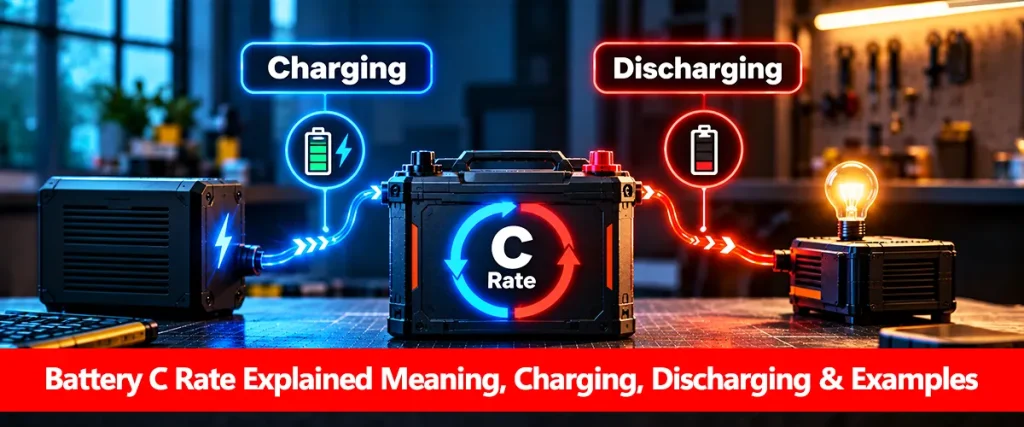
Depth of discharge (DoD) is the percentage of a battery’s capacity that has been used since it was fully charged. If a battery has delivered 60% of its rated capacity, its depth of discharge is 60%, leaving approximately 40% of its capacity remaining. This measurement helps you understand battery usage, available backup energy, and the impact of repeated charging cycles.
Depth of discharge is particularly important for rechargeable batteries used in solar energy storage, UPS systems, electric vehicles, and portable electronics. Although deeper discharge provides more energy during a single cycle, it can also increase battery wear, depending on chemistry and operating conditions.
What You’ll Learn
- The meaning of 20%, 50%, 80%, and 100% DoD.
- How depth of discharge relates to state of charge.
- Why discharge limits affect battery lifespan.
- How lead-acid and LiFePO4 batteries behave differently.
- Practical ways to manage DoD in backup power systems.
What Does Depth of Discharge Mean?
Depth of discharge describes how much of a battery’s available charge capacity has been removed during a discharge cycle. It is expressed as a percentage, making it easier to understand battery usage regardless of the battery’s size, voltage, or amp-hour rating.
A 100Ah battery discharged by 40Ah has reached approximately 40% DoD, assuming the rated capacity is available under those conditions. The remaining 60Ah represents about 60% state of charge. In real systems, available capacity varies with battery age, temperature, and discharge current. Understanding DoD begins with the basic concept of how a battery works: chemical reactions release electrical energy, and rechargeable batteries restore their charge through an external charging source.
Understanding 20%, 50%, 80% and 100% DoD
The percentage shown as DoD tells you how deeply a battery has been discharged. A smaller value indicates less capacity has been used, while a larger value indicates that more stored charge has been withdrawn.
Consider a battery with 100Ah of available capacity:
- 20% DoD: Approximately 20Ah has been used, leaving 80Ah.
- 50% DoD: Approximately 50Ah has been used, leaving 50Ah.
- 80% DoD: Approximately 80Ah has been used, leaving 20Ah.
- 100% DoD: The full defined discharge capacity has been used, reaching the manufacturer’s specified discharge endpoint.
These examples assume ideal capacity measurement conditions. Importantly, 100% DoD does not mean a battery has reached zero volts. It means the battery has reached the endpoint of its defined usable discharge range.
Depth of Discharge vs State of Charge
Depth of discharge (DoD) and state of charge (SoC) describe opposite aspects of battery capacity. DoD indicates the portion already used, while SoC indicates the portion remaining. Together, they provide a useful picture of battery usage.
For a battery measured against the same capacity reference, the relationship is:
DoD (%) = 100% − SoC (%)
For example, a battery displaying 30% SoC has approximately 70% DoD relative to a fully charged starting point. Battery management systems estimate these values using electrical measurements and algorithms, so displayed percentages are not always perfectly precise. DoD and SoC should not be confused with battery health. A fully charged, heavily aged battery may show 100% SoC despite storing less energy than when it was new. Our guide to state of charge vs state of health explains that distinction.
Why Does Depth of Discharge Affect Battery Life?
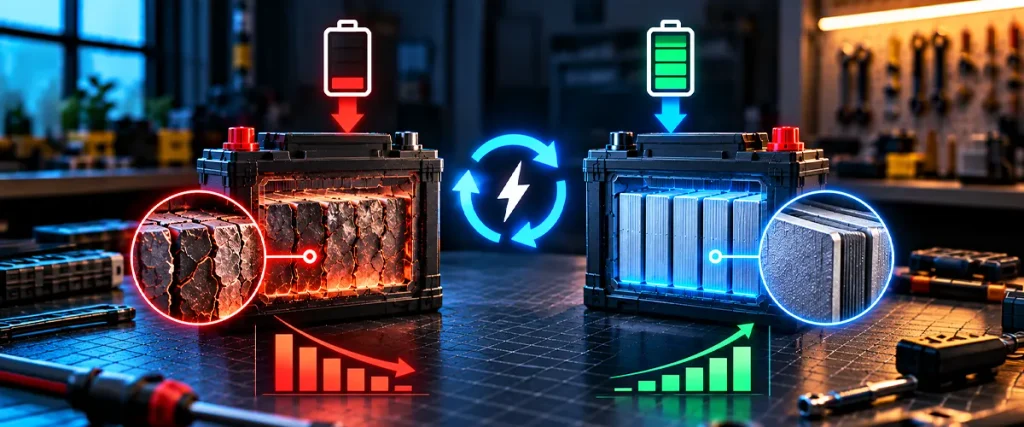
Rechargeable batteries gradually deteriorate through repeated chemical and physical changes inside their cells. Their anode, cathode, and electrolyte experience stress during charging and discharging, and deeper cycles can increase that stress. Over time, batteries may lose capacity and develop greater internal resistance.
Repeatedly using a battery close to its full discharge limit can shorten cycle life, although the effect differs by chemistry. Shallower cycling often improves longevity, but it also means less energy is used during each cycle. That trade-off matters when designing reliable storage systems.
Factors That Influence the Impact of DoD
- Battery chemistry: Lead-acid and lithium-based cells tolerate discharge differently.
- Temperature: Heat accelerates degradation, while cold can reduce available capacity.
- Discharge rate: High current may increase voltage drop and operating stress.
- Charging conditions: Inappropriate charging can accelerate battery aging.
- Cycle frequency: Frequent deep cycles increase total battery usage over time.
For a detailed explanation of degradation and expected service life, explore battery cycle life and battery C-rate.
How Does DoD Differ Between Lead-Acid and LiFePO4 Batteries?
Not every battery should operate at the same discharge depth. The appropriate limit depends on its chemistry, construction, manufacturer specifications, and intended service life. Lead-acid batteries generally experience stronger capacity and longevity penalties from frequent deep discharge than many modern lithium-based designs.
- Lead-acid batteries: A 50% DoD limit is a common planning approach for some deep-cycle applications seeking longer service life. However, this is not a universal maximum; different lead-acid products have different cycling capabilities.
- LiFePO4 batteries: Many lithium iron phosphate systems support a greater usable discharge range, sometimes around 80–90% DoD or more under specified conditions. Their battery management system protects against excessive discharge, but the approved operating range must come from the manufacturer.
For chemistry-specific details, read our guides to LiFePO4 batteries and LiFePO4 vs lead-acid batteries.
How Does Depth of Discharge Affect Usable Energy?
Depth of discharge influences how much of a battery’s nominal energy is available within the selected operating range. A higher permitted DoD allows more energy to be withdrawn per cycle, provided the battery can safely operate at that level.
For example, a battery storing 2,000Wh of nominal energy with a 50% usable discharge allowance provides approximately 1,000Wh before downstream losses. At an 80% allowance, the corresponding figure is approximately 1,600Wh. These examples are simplified and assume the energy rating and discharge limits refer to the same capacity basis.
This distinction matters when comparing backup batteries with different voltage and capacity ratings. Battery energy density is a separate measurement describing energy relative to weight or volume, not the amount permitted for discharge.
Managing DoD in Solar and UPS Systems in Pakistan

For households using solar storage or UPS systems during load shedding, discharge depth influences both backup availability and battery replacement frequency. Using most of a battery’s stored energy may extend backup during a long outage, but repeatedly reaching a deep discharge level can increase wear.
A suitable discharge setting depends on the expected outage duration, connected electrical load, battery chemistry, and manufacturer’s recommended limits. Rather than setting one percentage for every system, homeowners should choose settings consistent with their equipment.
Practical Ways to Control Deep Discharge
- Configure the inverter cutoff: Use the battery manufacturer’s recommended discharge or voltage settings.
- Monitor remaining capacity: Check SoC readings when supported by the system.
- Avoid unnecessary loads: Reduce nonessential appliance use during extended outages.
- Maintain proper charging: Ensure the charger follows the battery’s approved charging profile.
- Review battery condition: Aging batteries may provide less backup than their original rating suggests.
For related planning guidance, see how to calculate battery runtime and how long solar batteries last.
Common Misunderstandings About Depth of Discharge
DoD is sometimes mistaken for a direct measurement of battery quality or a fixed safety limit. In reality, it describes how much capacity has been used, while battery quality and safe operation depend on multiple technical specifications.
Common misconceptions include:
- 100% DoD means zero voltage: It normally refers to reaching the defined discharge endpoint, not complete electrical depletion.
- All batteries should stop at 50% DoD: Appropriate discharge limits vary by chemistry and manufacturer.
- Higher DoD always damages a battery: Deep cycling may increase wear, but approved discharge ranges are designed around a battery’s capabilities.
- DoD determines exact backup time: Runtime also depends on watt-hours, electrical load, and conversion efficiency.
- DoD and battery health are identical: DoD describes usage during discharge; health describes the battery’s condition relative to its original performance.
Conclusion
Depth of discharge shows how much of a battery’s capacity has been used during a discharge cycle. Understanding DoD helps explain the relationship between available backup energy, daily usage, and long-term battery wear. There is no single ideal DoD for every battery. Lead-acid, lithium-ion, and LiFePO4 systems have different operating characteristics, making manufacturer-approved discharge limits essential for safe and reliable performance.
Explore more topics in our Battery Fundamentals category, including battery cycle life and state of charge vs state of health. For additional educational resources, visit Batteries Hub.
Frequently Asked Questions
Is 80% Depth of Discharge Good?
An 80% DoD operating limit is common for some lithium battery applications. Whether it is appropriate depends on chemistry, manufacturer ratings, and expected cycle life. It should not automatically be applied to every battery.
What Does 50% DoD Mean?
It means half of the battery’s defined capacity has been discharged. A 100Ah battery at 50% DoD has used approximately 50Ah under the assumed rating conditions.
Is 100% DoD Safe?
Some batteries are rated to reach 100% of their specified usable discharge range. That does not mean they can safely be discharged below their protective cutoff voltage. Always follow the manufacturer’s limits.
Does Lower DoD Increase Battery Lifespan?
Shallower discharge cycles often improve cycle life, particularly for lead-acid and many lithium-based batteries. Actual improvement depends on temperature, charging practices, chemistry, and how the cycles are measured.
Can Depth of Discharge Change With Battery Age?
The DoD percentage is measured relative to a capacity reference, but the battery’s actual available capacity can decrease as it ages. Therefore, the amount of energy represented by a particular DoD percentage may change over the battery’s lifespan.