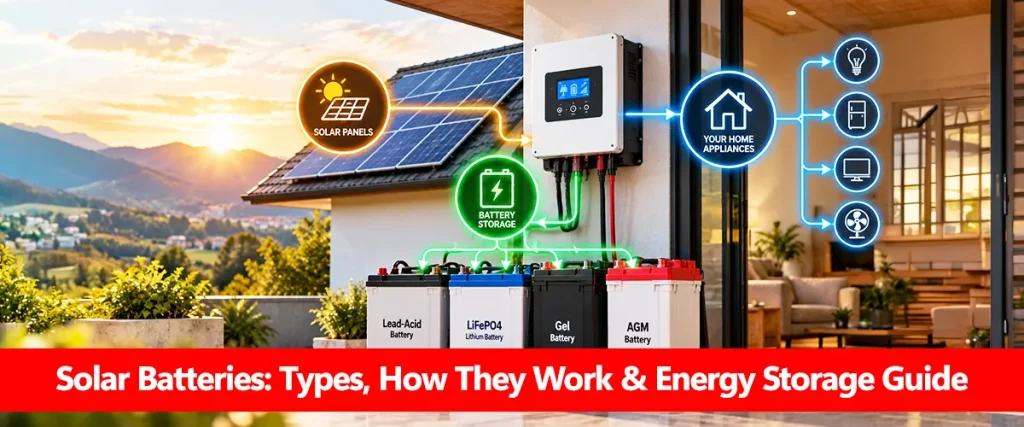
How long do solar batteries last? Lithium-ion solar batteries commonly have an estimated service life of around 10–15 years, while lead-acid solar batteries may last approximately 5–10 years under suitable conditions. These are broad estimates rather than guaranteed lifespans, and frequent deep cycling can significantly reduce the service life of some lead-acid batteries.
Battery longevity depends on chemistry, charging cycles, depth of discharge, temperature and maintenance. The lifespan of solar batteries should also be distinguished from backup runtime, which measures how many hours a battery can power appliances on a single charge.
Solar Battery Lifespan by Battery Type
Different battery chemistries have different aging characteristics. Lithium iron phosphate (LiFePO4) is widely used for frequent solar cycling, while lead-acid batteries include flooded, tubular, AGM and gel designs with varying service-life ratings.
| Solar Battery Type | Indicative Service Life | Important Consideration |
| LiFePO4 | Commonly around 10–15 years | Cycle life and temperature |
| Other lithium-ion | Often around 10–15 years | Chemistry and operating conditions |
| Tubular lead-acid | Varies widely; often shorter with daily deep cycling | Maintenance and discharge depth |
| AGM | Varies by standby or cycling application | Charging and temperature |
| Gel | Varies by battery design | Charging profile and discharge conditions |
These ranges are general planning references, not guarantees for individual products. Lead-acid batteries may achieve longer service in suitable standby applications but deteriorate considerably faster under repeated deep discharge.
The difference is particularly relevant when comparing lithium vs tubular battery for solar or considering a wider lead acid vs lithium solar battery comparison.
Battery Cycle Life vs Calendar Life
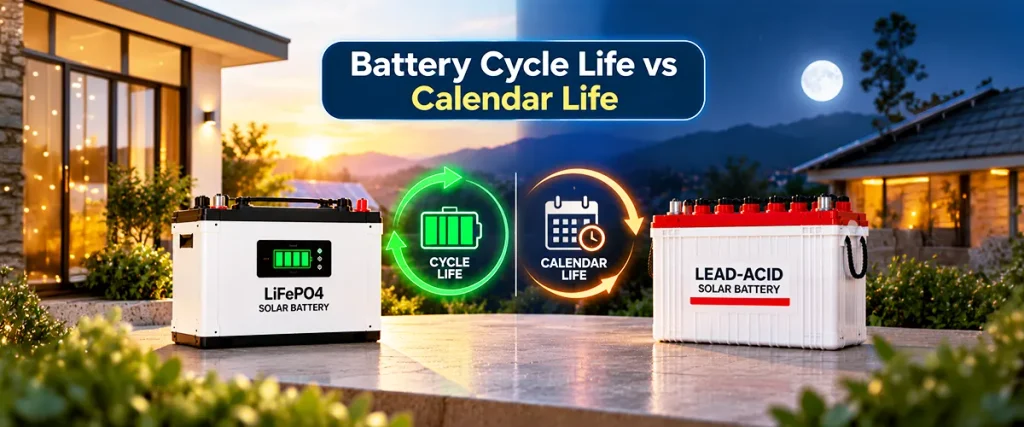
Solar battery lifespan depends on two important aging processes: calendar aging and cycle aging. Calendar aging occurs gradually over time, even when the battery is not used frequently, while cycle aging results from repeated charging and discharging.
Battery cycle life represents the number of charge-discharge cycles a battery can complete before reaching a specified remaining-capacity threshold. A manufacturer might rate a battery for 4,000 cycles under particular test conditions, but this does not guarantee a fixed number of years in every installation.
For illustration, 4,000 cycles at one full equivalent cycle per day correspond to approximately 11 years of cycling. Actual lifespan may be shorter because of temperature, calendar aging and other operating conditions. Our battery cycle life guide explains how these ratings should be interpreted.
How Depth of Discharge Affects Solar Battery Life
Depth of discharge (DoD) measures the percentage of battery capacity used during a discharge cycle. Repeatedly using a greater percentage of stored energy generally increases battery wear, although the effect varies by chemistry. Lead-acid batteries are particularly sensitive to frequent deep discharge. LiFePO4 batteries generally tolerate deeper cycling more effectively, but their recommended operating limits should still follow manufacturer specifications.
For this reason, battery selection should consider usable energy rather than nominal storage alone. Understanding depth of discharge and proper solar battery sizing helps reduce unnecessary battery stress.
What Shortens Solar Battery Lifespan?
Several operating conditions can accelerate battery deterioration, even when the battery is relatively new.
The main factors include:
- High temperatures: Accelerate chemical aging and capacity loss.
- Frequent deep discharge: Increases cycling stress, particularly in lead-acid batteries.
- Incorrect charging voltage: Can cause overcharging or incomplete charging.
- High charging or discharge current: May increase heat and electrical stress.
- Poor maintenance: Can reduce the life of flooded lead-acid batteries.
- Long periods of unsuitable charge levels: Can contribute to degradation depending on chemistry.
- Incompatible equipment: May expose the battery to unsuitable operating conditions.
Proper charging is especially important because repeated battery overcharging or prolonged undercharging can shorten service life. Solar installations also need compatible battery charging voltage settings and suitable temperature protection.
How Long Does a Solar Battery Last on One Charge?
Solar battery backup time depends on usable stored energy, appliance power consumption and inverter efficiency. A battery that lasts 12 years as a product may provide only a few hours of backup per charge if connected to high-power appliances.
For a simplified estimate:
Backup Time (Hours) = Battery Capacity (kWh) × Usable DoD × Inverter Efficiency ÷ Load (kW)
Consider a 5.12kWh LiFePO4 battery with 80% usable depth of discharge and 90% inverter efficiency.
| Average AC Load | Estimated Backup Time |
| 400W | 9.2 hours |
| 600W | 6.1 hours |
| 800W | 4.6 hours |
| 1,200W | 3.1 hours |
These are illustrative calculations assuming a constant load, a healthy battery and sufficient inverter power capacity. They exclude additional standby consumption and temperature-related losses.
Actual backup time can vary because of battery aging, discharge rate, equipment efficiency and fluctuating appliance loads. A detailed method is available in how to calculate battery runtime, while how solar batteries work explains how daytime charging and nighttime discharge interact.
Does Battery Voltage Affect Backup Time?
Battery voltage affects current requirements and system compatibility, but voltage alone does not determine runtime. Total stored energy depends on both voltage and amp-hour capacity.
For example, a 12V 200Ah battery and a 24V 100Ah battery each have approximately 2.4kWh of nominal energy. Their actual usable backup may differ because of battery chemistry, discharge limits and conversion losses.
The 12V vs 24V vs 48V battery system guide explains voltage selection, while battery watt-hours provides the energy-capacity basics.
How to Make Solar Batteries Last Longer
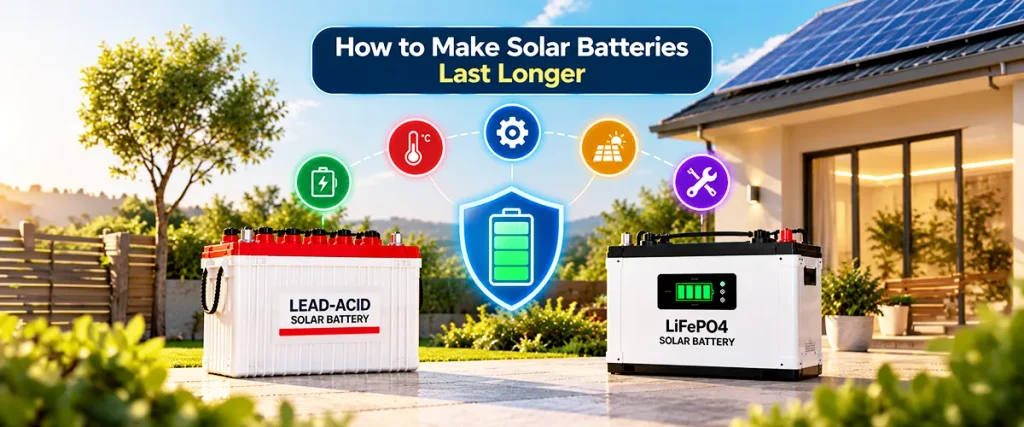
Extending solar battery life depends on controlling operating conditions rather than relying on a single maintenance practice. The correct approach varies between lithium and lead-acid technologies.
Recommended practices include:
- Follow manufacturer-approved charging settings.
- Avoid repeated discharge beyond permitted limits.
- Keep batteries within recommended temperature ranges.
- Use a compatible hybrid inverter and charge controller.
- Inspect terminals, wiring and protection equipment.
- Maintain electrolyte levels where required for flooded batteries.
- Monitor battery performance and respond to unusual faults.
Many lithium batteries use a battery management system to monitor cell voltage, current and temperature, but this does not eliminate the need for correct system configuration. Regular solar battery maintenance helps maintain both safety and reliability.
How Do You Know When a Solar Battery Needs Replacement?
A solar battery may need replacement when its usable capacity falls significantly, backup duration becomes insufficient or the system repeatedly reports battery-related faults.
Common indicators include:
- Noticeably shorter backup time under similar loads.
- Reduced usable energy compared with earlier performance.
- Unexpected shutdowns or repeated protection alerts.
- Abnormal heating during charging or discharging.
- Physical damage, swelling or leakage.
- Battery health falling below manufacturer-defined limits.
However, reduced backup time can also result from increased household consumption or inverter problems. Comparing state of charge vs state of health helps distinguish available charge from permanent battery deterioration.
For households planning replacement, the required capacity may have changed since installation. Reviewing how many batteries for solar and best battery type for solar can help reassess storage requirements.
Solar Battery Warranty vs Actual Lifespan
A battery warranty and its expected service life are not the same. A warranty may specify years of coverage, permitted energy throughput, operating conditions and the remaining capacity guaranteed at the warranty endpoint.
When comparing solar battery storage products, check warranty terms alongside cycle-life ratings and expected usage. A ten-year warranty does not necessarily mean the battery will stop working after ten years, nor does it guarantee unchanged capacity throughout that period.
Conclusion
How long do solar batteries last? Many lithium-ion solar batteries have an indicative lifespan of around 10–15 years, while lead-acid batteries may last approximately 5–10 years under suitable conditions. Actual service life can be shorter or longer depending on battery design, cycling frequency, temperature and maintenance.
Backup duration is different from total lifespan. It depends on usable battery energy, connected load and inverter efficiency. Correct battery sizing, compatible charging and appropriate operating conditions help improve both everyday performance and long-term reliability.
Frequently Asked Questions
How Many Years Does a Solar Battery Last?
Lithium-ion solar batteries commonly last around 10–15 years, while lead-acid batteries may last approximately 5–10 years under suitable conditions. Actual lifespan varies by battery model and usage.
Can Solar Batteries Last 20 Years?
Some battery systems may remain usable for extended periods, but a 20-year lifespan should not be assumed. Manufacturer cycle-life, calendar-life and warranty specifications provide a better basis for expectations.
How Long Does a 5kWh Solar Battery Last at Night?
Backup time depends on the usable capacity and connected load. A 5kWh battery may provide several hours of backup, but high-power appliances can reduce runtime substantially.
Does Using Solar Batteries Every Day Reduce Their Lifespan?
Daily cycling contributes to battery wear, but suitable deep-cycle batteries are designed for repeated use. The effect depends on discharge depth, temperature and chemistry.
Which Solar Battery Has the Longest Lifespan?
LiFePO4 commonly offers strong cycle-life performance for residential solar storage. Actual longevity should be compared using manufacturer specifications rather than chemistry alone.
Do Solar Batteries Lose Capacity Over Time?
Yes. Rechargeable batteries gradually lose capacity through calendar aging and charging cycles, reducing the amount of energy available as they age.
Can Solar Panels Work After the Battery Stops Working?
It depends on the inverter and system configuration. Some installations can operate without battery storage, while others require a functioning battery for certain operating modes. Learn more about solar panels without batteries and adding batteries to an existing solar system.