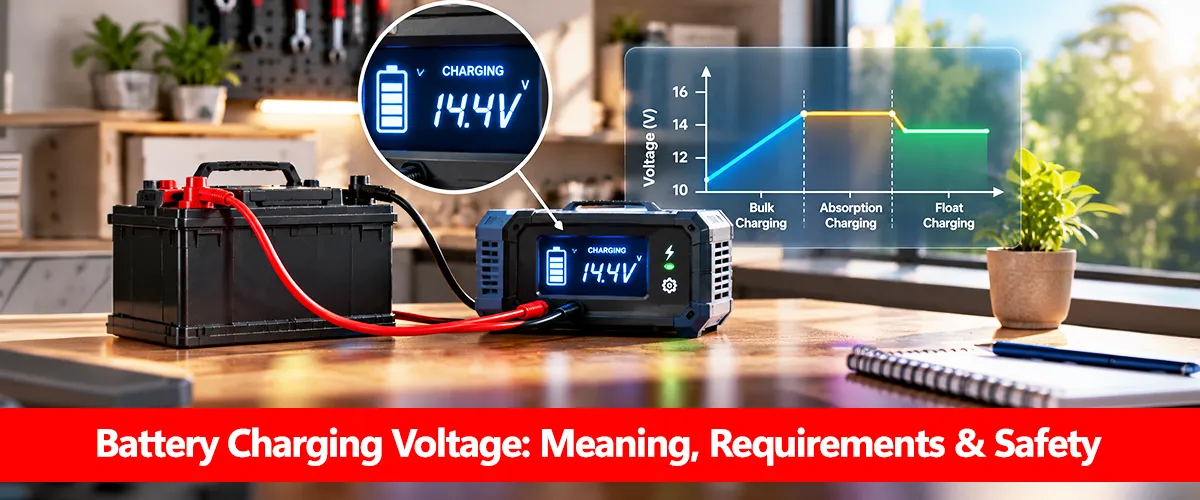
Battery charging voltage is the electrical potential applied by a charger to recharge a battery. It must be suitable for the battery’s chemistry, cell configuration, temperature, and current charging stage. Charging voltage is usually higher than the battery’s nominal voltage because the charger must provide enough electrical potential to drive the electrochemical reactions that restore stored energy.
However, excessive charging voltage can damage a battery, while insufficient voltage may prevent it from reaching its intended state of charge. Understanding the correct charging voltage helps improve battery performance, charging efficiency, and service life. For a broader introduction, read our how battery charging works guide.
What Is Battery Charging Voltage?
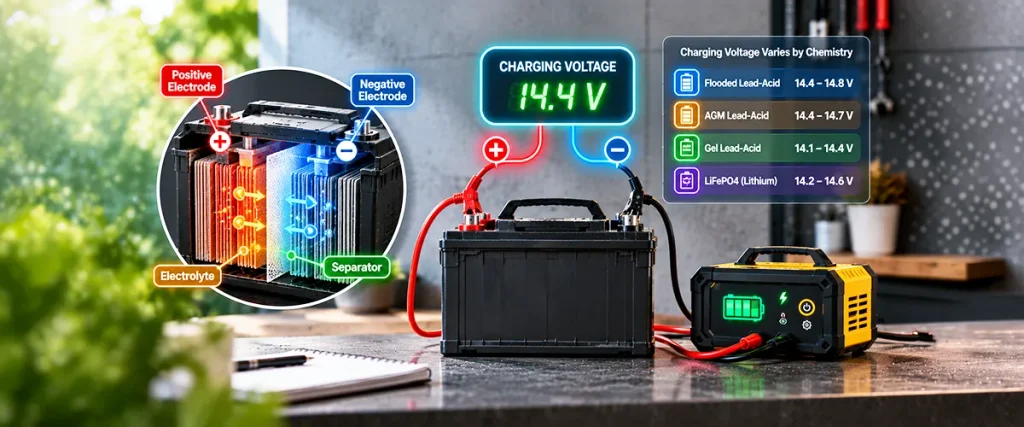
Battery charging voltage is the voltage supplied across a rechargeable battery’s terminals during charging. It is measured in volts (V) and controlled according to the battery’s charging requirements.
A battery contains electrochemical cells with positive and negative electrodes, an electrolyte, and other internal components. During charging, the applied voltage helps reverse the chemical reactions that occurred during discharge.
The appropriate voltage depends on the battery chemistry and the number of cells connected in series. For a basic explanation of electrical potential, explore our battery voltage explained article.
Nominal Voltage vs Charging Voltage
Nominal voltage is the approximate reference voltage used to identify a battery, while charging voltage is the voltage applied during the charging process.
These values are not necessarily the same.
| Battery Type | Nominal Voltage | Illustrative Charging Voltage |
| 12V flooded lead-acid | 12V | Around 14.4V during absorption |
| 12V AGM | 12V | Around 14.4V during absorption |
| 12V gel | 12V | Often around 14.1V during absorption |
| 4-cell LiFePO4 | 12.8V | Often around 14.2–14.6V near full charge |
| 3-cell NMC lithium-ion | Approximately 11.1V | Up to 12.6V for cells rated at 4.20V maximum |
Important: These are representative values, not universal charging recommendations. Actual limits vary by manufacturer, temperature, battery construction, and charging profile. A 12V battery label does not mean the battery must always be charged at exactly 12 volts.
How Battery Charging Voltage Works
During charging, a charger regulates its output so electrical energy can enter the battery safely. In many charging systems, battery terminal voltage rises as the battery approaches full charge. The charger then adjusts its output according to the required charging profile.
Charging behavior depends on several factors:
- Battery chemistry: Different electrochemical systems have different voltage limits.
- Cell count: More cells in series generally require a higher pack charging voltage.
- State of charge (SoC): Battery voltage changes as stored charge increases.
- Charging current: Current affects charging behavior and voltage response.
- Temperature: Charging limits may change with battery temperature.
- Charge termination: The charger must recognize when to reduce or stop charging.
Voltage and current work together during charging, but they represent different electrical quantities. Learn more about the relationship in our battery charging current guide.
Battery Charging Voltage for Different Chemistries
Different rechargeable batteries need different voltage limits and charging methods.
Lead-Acid Battery Charging Voltage
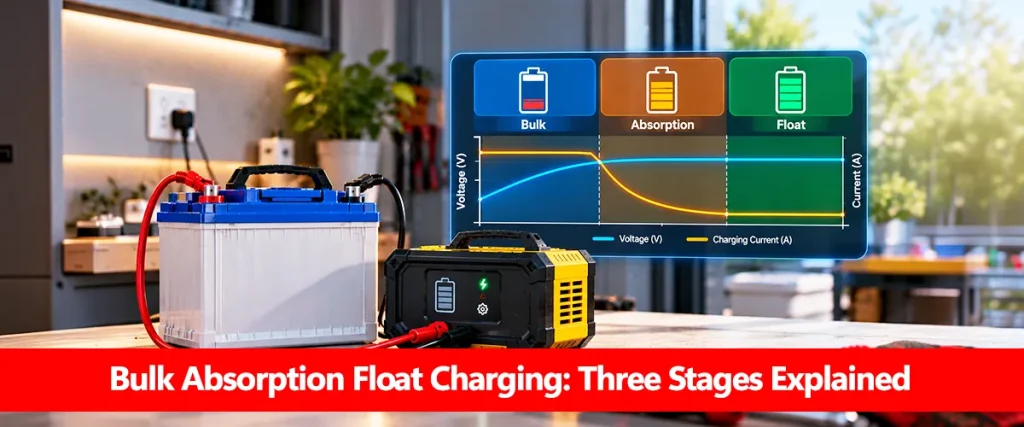
Lead-acid batteries commonly use bulk, absorption, and float charging stages. During bulk charging, the charger delivers controlled current while battery voltage rises. During absorption, voltage is maintained at a specified level as current decreases.
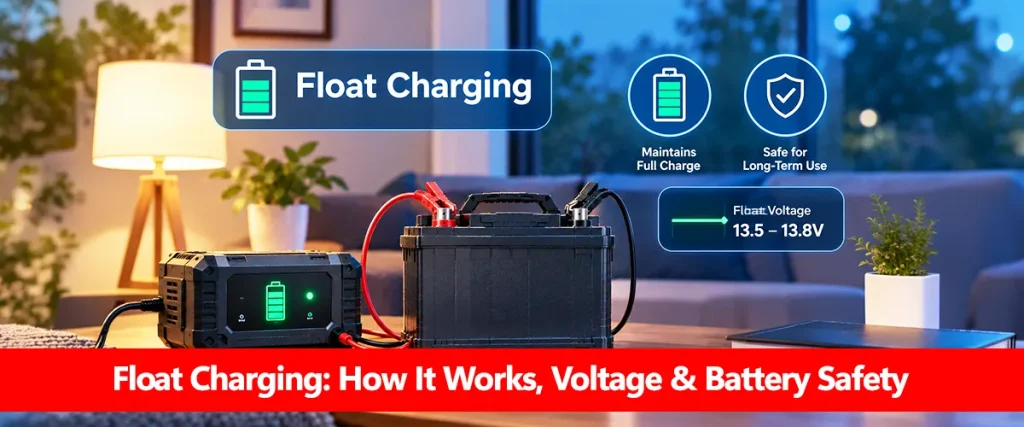
In standby applications, the charger may then use a lower float voltage. Flooded, AGM, and gel batteries can have different charging requirements even when their nominal voltage is the same. Our bulk absorption float charging guide explains these stages in detail.
Lithium-Ion Battery Charging Voltage
Lithium-ion batteries commonly use constant-current and constant-voltage charging. During the constant-current stage, the charger regulates current as battery voltage increases. When the specified upper voltage limit is reached, the charger maintains that voltage while current gradually decreases.
Charging generally terminates when the manufacturer-defined conditions are met. Different lithium-ion chemistries have different cell voltage limits. For example, LiFePO4 and NMC batteries cannot automatically share the same charging profile. For a clearer chemistry comparison, read LiFePO4 vs lithium ion.
What Is Constant Voltage Charging?
Constant voltage (CV) charging is a method in which the charger maintains a specified voltage across the battery. As the battery approaches its charging endpoint, charging current typically decreases. Constant voltage is commonly used during the later stage of lithium-ion charging and during the absorption stage of many lead-acid charging profiles.
However, the correct voltage level, duration, and termination conditions depend on battery chemistry. A charger should not maintain a battery indefinitely at its maximum charging voltage unless the battery manufacturer explicitly supports that operating mode.
How Temperature Affects Charging Voltage
Battery temperature influences electrochemical reactions, internal resistance, charging efficiency, and safety. Lead-acid batteries often require temperature compensation, where charging voltage is adjusted according to battery temperature. In general, lead-acid charging voltage requirements decrease as temperature increases and rise as temperature decreases, within the manufacturer’s approved operating range.
Lithium-ion batteries have different temperature-related limitations. Many lithium batteries restrict or prevent charging at low temperatures, particularly below 0°C, unless approved heating or other protective controls are provided. For lithium battery packs, a battery management system may monitor cell voltages and temperature to help maintain safe operation.
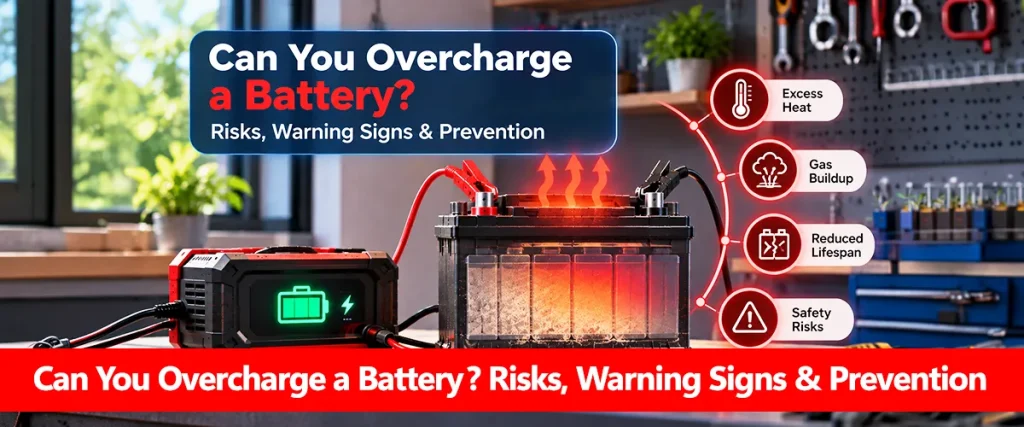
What Happens If Charging Voltage Is Too High?
Excessive charging voltage can increase heat generation, accelerate battery degradation, and create safety risks. In lead-acid batteries, overvoltage can cause excessive gassing, water loss, and plate damage. In lithium-ion batteries, charging beyond the specified cell voltage limit can damage cells and potentially lead to hazardous failures.
Possible consequences include:
- Excessive battery heating.
- Reduced battery capacity.
- Shortened service life.
- Electrolyte degradation or gas generation.
- Increased risk of battery failure.
For more information, explore our battery overcharging guide.
What Happens If Charging Voltage Is Too Low?
Charging voltage that is too low may prevent a battery from reaching its intended full charge. In lead-acid batteries, repeated undercharging can contribute to sulfation and declining battery performance. For lithium-ion batteries, a lower charging voltage may intentionally limit maximum state of charge, but voltage that is too low for the intended charging process can leave the battery partially charged.
The result depends on the chemistry, charging profile, and operating conditions. Our state of charge vs state of health guide explains the difference between stored charge and overall battery condition.
Why Charger Compatibility Matters
A battery charger must match more than the nominal voltage printed on the battery label. It should support the correct chemistry, cell configuration, charging voltage limits, current limits, and charging termination requirements. For example, a lead-acid charger may have float or equalization settings that are inappropriate for a LiFePO4 battery.
Before using a charger, verify its supported charging profiles against the battery manufacturer’s specifications. Read our how to choose battery charger guide for additional compatibility considerations.
Common Misconceptions About Battery Charging Voltage
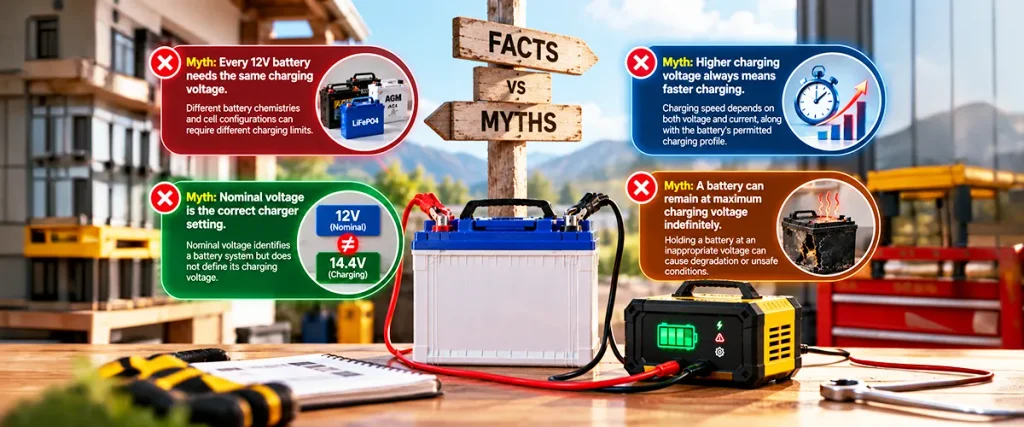
Myth: Every 12V battery needs the same charging voltage.
Different battery chemistries and cell configurations can require different charging limits.
Myth: Higher charging voltage always means faster charging.
Charging speed depends on both voltage and current, along with the battery’s permitted charging profile.
Myth: Nominal voltage is the correct charger setting.
Nominal voltage identifies a battery system but does not define its charging voltage.
Myth: A battery can remain at maximum charging voltage indefinitely.
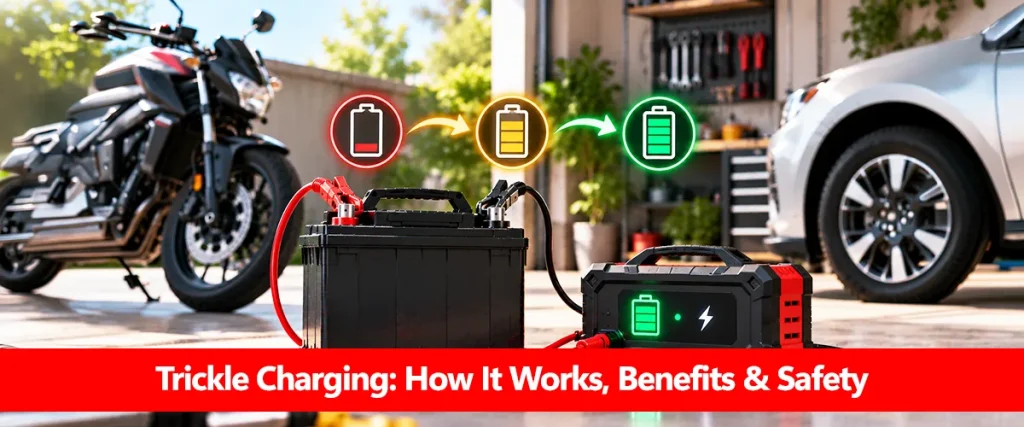
Holding a battery at an inappropriate voltage can cause degradation or unsafe conditions. For practical connection and charging instructions, read our how to charge a battery guide.
Battery Charging Voltage Safety Tips
Correct charging voltage is essential for reliable operation.
- Use manufacturer-approved charging voltage settings.
- Match the charger to the battery chemistry and cell count.
- Follow temperature-related charging restrictions.
- Never bypass lithium battery voltage protection.
- Avoid using lead-acid equalization settings on lithium batteries.
- Check charger compatibility before replacing a battery with a different chemistry.
- Stop charging if the battery overheats or shows signs of damage.
If a battery does not accept charge even with suitable equipment, our battery not charging guide covers common causes.
Conclusion
Battery charging voltage determines the electrical potential applied to a battery during charging. The correct voltage depends on battery chemistry, cell count, temperature, and charging stage. Lead-acid batteries commonly use bulk, absorption, and float stages, while lithium-ion batteries generally use controlled constant-current and constant-voltage charging.
Using the correct voltage settings helps prevent overcharging, undercharging, and premature battery degradation. Explore more educational articles in the Battery Charging category at Batteries Hub.
Frequently Asked Questions
What Is Battery Charging Voltage?
Battery charging voltage is the electrical potential applied by a charger to restore energy in a rechargeable battery. It must match the battery’s chemistry and charging requirements.
What Is the Charging Voltage of a 12V Battery?
It depends on the chemistry. A 12V lead-acid battery may use an absorption voltage around 14.4V under specified conditions, while other battery types may require different settings.
Is Charging Voltage Higher Than Battery Voltage?
Charging voltage is generally above the battery’s present voltage during active charging,