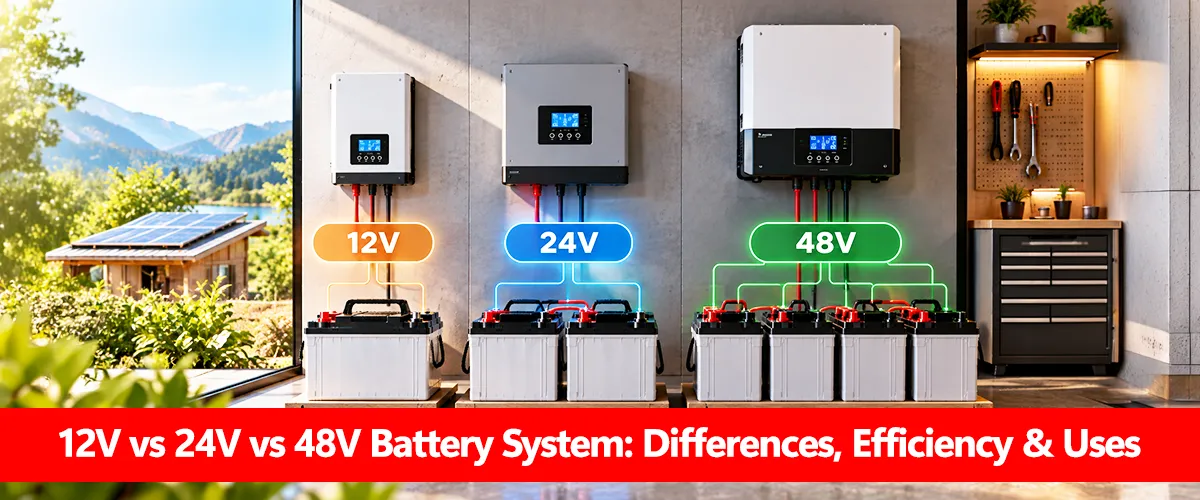
12V vs 24V vs 48V battery system is an important comparison when choosing an electrical setup for solar energy storage, home inverters, UPS systems, and off-grid power. The main difference is the system’s nominal voltage, which influences current requirements, wiring, equipment compatibility, and installation costs.
A 12V system is commonly used for smaller loads, while 24V and 48V systems are often preferred as power requirements increase. Higher voltage can reduce current for the same power, helping limit cable losses when the system is properly designed. However, a higher-voltage battery system does not automatically store more energy or provide longer backup time. Actual energy storage depends on voltage and amp-hour capacity together. For a better understanding of these concepts, read our battery voltage explained guide.
What Is a 12V Battery System?
A 12V battery system operates at a nominal voltage of approximately 12 volts. It is commonly used in vehicles, small UPS installations, portable power equipment, and compact solar setups. A 12V system may use a single 12V battery or a suitable combination of cells and batteries.
Its main advantages include widespread equipment availability and relatively simple installation for low-power applications. However, larger loads require higher current, which increases wiring and connection requirements.
What Is a 24V Battery System?
A 24V battery system operates at a nominal voltage of approximately 24 volts. It is commonly used in medium-sized inverter systems, off-grid installations, and selected industrial applications. A 24V system can be built using compatible batteries connected in series or a battery pack designed for the required nominal voltage.
Compared with a 12V system delivering the same power, a 24V system generally requires about half the current, assuming comparable operating conditions.
What Is a 48V Battery System?
A 48V battery system operates at a nominal voltage of approximately 48 volts. It is widely used in larger solar energy storage systems, home inverters, telecommunications, and other higher-power applications. A 48V system can reduce current requirements compared with 12V and 24V systems delivering the same power. However, equipment must be specifically rated for the battery system’s voltage range. A nominal 48V battery bank can operate above or below 48V depending on chemistry and state of charge.
12V vs 24V vs 48V Battery System: Quick Comparison
| Feature | 12V System | 24V System | 48V System |
| Nominal voltage | 12V | 24V | 48V |
| Current for same power | Highest | Lower | Lowest |
| Cable loss potential | Higher at equal cable resistance | Lower | Lowest |
| Wiring requirements | More demanding at high power | Moderate | Often easier to manage at high power |
| Typical application | Small systems | Medium systems | Larger systems |
| Inverter compatibility | Requires 12V inverter | Requires 24V inverter | Requires 48V inverter |
| Installation complexity | Often simpler | Moderate | Requires greater attention to protection |
| Equipment cost | Depends on size | Depends on size | Depends on size and design |
| Energy storage | Depends on voltage × Ah | Depends on voltage × Ah | Depends on voltage × Ah |
The correct system voltage depends on power demand, equipment ratings, cable length, and overall installation design.
How Voltage Affects Current and Efficiency
For the same electrical power, increasing voltage reduces the current required.
The basic relationship is:
Power (W) = Voltage (V) × Current (A)
For a 1,200W DC load under ideal conditions:
| Battery System | Approximate Current |
| 12V | 100A |
| 24V | 50A |
| 48V | 25A |
These figures are simplified. Actual battery current depends on operating voltage, inverter efficiency, and load conditions. Lower current can reduce resistive losses in wiring and connections. This is one reason larger systems commonly use higher nominal battery voltages. However, overall efficiency also depends on the inverter, charger, battery chemistry, and installation quality. For additional background, explore our battery C-rate guide.
Does a 48V Battery Last Longer Than a 12V Battery?
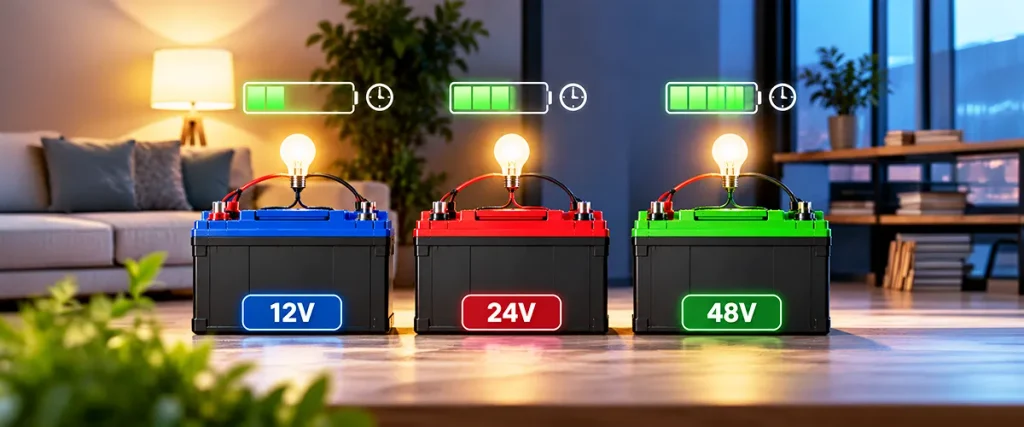
A 48V battery does not automatically provide longer backup time than a 12V battery. Battery runtime depends mainly on stored energy, usable capacity, load power, and system losses.
For example, a 12V 100Ah battery stores approximately 1,200Wh of nominal energy, while a 48V 25Ah battery also stores approximately 1,200Wh.
Their actual usable energy may differ because of battery chemistry, discharge limits, and efficiency. Understanding battery watt-hours and Ah vs Wh helps compare batteries with different voltage ratings.
Battery Chemistry and Voltage Compatibility
System voltage and battery chemistry are separate considerations. A 12V, 24V, or 48V system may use lead-acid or lithium-based batteries, provided the battery pack and equipment are designed for the required operating voltage range.
For example, a nominal 48V lead-acid bank and a commonly marketed 48V-class LiFePO4 battery may have different actual operating voltage ranges.
This means charging equipment and inverter settings must match the battery chemistry, not just the nominal voltage label. For chemistry-specific differences, read LiFePO4 vs AGM battery and tubular vs lithium battery.
12V vs 24V vs 48V Battery Charging
Each battery system requires charging equipment compatible with its voltage and chemistry. A 12V charger cannot directly charge a 24V or 48V battery bank unless it is specifically designed to support those voltage ranges. Likewise, a 48V charger must match the battery bank’s actual charging voltage requirements.
Important charging considerations include:
- Match the charger to the battery system voltage.
- Follow manufacturer charging voltage and current limits.
- Use chemistry-compatible charging profiles.
- Confirm inverter and solar charge-controller compatibility.
- Ensure suitable protection against overcharging and overcurrent.
- Follow battery balancing and monitoring requirements where applicable.
For systems using lithium batteries, a battery management system may provide additional protection and cell monitoring.
Battery Lifespan: Does Voltage Make a Difference?
Nominal system voltage alone does not determine battery lifespan. A 48V system is not automatically more durable than a 12V system. Battery longevity depends on chemistry, temperature, charging practices, depth of discharge, and cell quality.
Higher-voltage systems may operate with lower current for the same power, which can reduce stress on some wiring and electrical components. However, battery degradation still depends on the actual current relative to battery capacity and its operating conditions. Our battery cycle life and depth of discharge guides explain these factors.
Safety and Wiring Requirements
Electrical safety becomes increasingly important as battery voltage and available fault current increase. Lower-voltage systems can still deliver extremely high currents, creating risks of overheating, damaged cables, and electrical fires.
Higher-voltage systems require components with suitable voltage ratings and careful attention to insulation, disconnection, and electrical protection.
Important safety considerations include:
- Use appropriately rated cables and connectors.
- Install suitable fuses or circuit breakers.
- Follow correct battery polarity.
- Avoid mixing incompatible batteries.
- Use equipment rated for the system voltage.
- Follow manufacturer installation and ventilation requirements.
A properly designed 48V system can be practical and efficient, but it is not inherently safer than a properly designed 12V system.
12V vs 24V vs 48V Battery System Cost
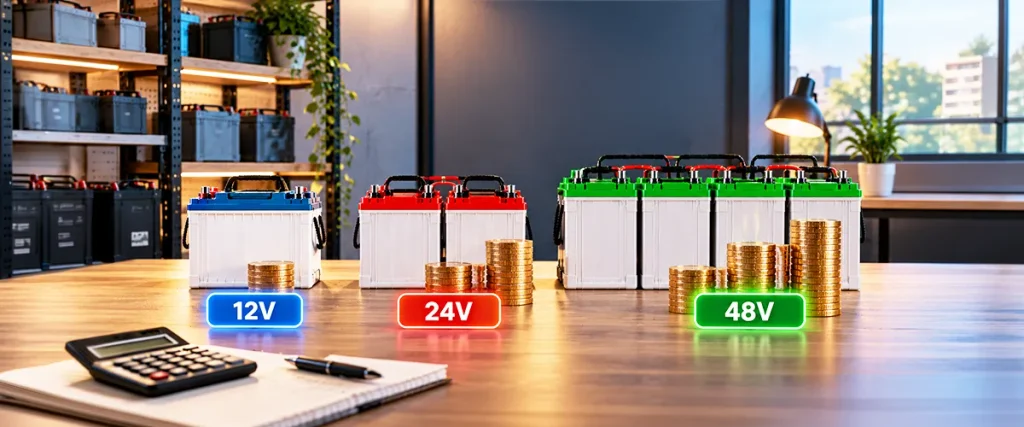
System cost depends on battery capacity, inverter size, wiring, protection devices, and charging equipment. A 12V system may be economical for small loads because compatible components are widely available.
For higher-power applications, 24V or 48V systems may reduce cable current and associated wiring requirements. However, higher-voltage equipment can introduce different installation and protection costs.
Total system cost includes:
- Batteries and battery management equipment.
- Inverter and charging equipment.
- Cables, connectors, and protection devices.
- Installation and maintenance.
- Expected battery replacement costs.
The lowest-cost system depends on the complete installation rather than nominal voltage alone.
Which Is Better: 12V, 24V or 48V?
The most suitable system voltage depends on the required power and equipment compatibility.
| Application | Practical Recommendation |
| Small portable power system | 12V often suitable |
| Vehicle accessories | 12V commonly used |
| Medium off-grid inverter | 24V may be practical |
| Larger home solar storage | 48V often preferred |
| Higher-power inverter installation | 48V commonly suitable |
| Existing 12V equipment | Retain 12V unless redesign is justified |
| Long cable runs | Higher voltage may reduce current-related losses |
These recommendations are general. Actual selection should follow equipment specifications and electrical design requirements.
How to Choose the Right Battery System Voltage
Choosing between 12V, 24V, and 48V requires evaluating the complete electrical system.
Consider these factors:
- Power demand: Determine the maximum continuous and surge loads.
- Inverter compatibility: Select a battery voltage supported by the inverter.
- Battery capacity: Compare energy storage in watt-hours rather than amp-hours alone.
- Cable requirements: Consider current, cable length, and voltage drop.
- Charging equipment: Confirm charger and solar controller compatibility.
- Battery chemistry: Match voltage ranges and charging profiles.
- Total system cost: Compare installation, efficiency, and maintenance requirements.
Battery banks can use series or parallel connections to achieve required voltage and capacity, but the configuration must follow manufacturer specifications. Our batteries series vs parallel guide explains these connection methods in detail.
Related Battery Comparisons
System voltage affects electrical design, while battery chemistry affects energy density, charging behavior, and lifespan. For lead-acid and lithium differences, explore lithium vs lead acid battery. Users comparing sealed lead-acid technologies can read AGM vs gel battery. For battery bank planning, our battery bank sizing guide covers capacity requirements and configuration considerations.
Conclusion
The 12V vs 24V vs 48V battery system comparison shows that higher voltage reduces current requirements for the same electrical power, which can improve wiring efficiency in properly designed installations.
A 12V system is commonly suitable for smaller applications, 24V offers a practical option for medium-sized installations, and 48V is often preferred for larger inverter and solar storage systems. However, higher voltage does not automatically increase stored energy, backup time, or battery lifespan.
The best choice depends on power demand, equipment compatibility, wiring requirements, safety, and total system cost. Explore more guides in the Battery Comparisons category at Batteries Hub.
Frequently Asked Questions
What Is the Main Difference Between 12V, 24V and 48V Battery Systems?
The main difference is nominal operating voltage. Higher-voltage systems require less current to deliver the same electrical power, which can reduce wiring losses.
Is a 48V Battery Better Than a 12V Battery?
A 48V system can be advantageous for higher-power applications, but it is not automatically better for every installation. Equipment compatibility and power requirements determine suitability.
Does a 48V Battery Last Longer Than a 12V Battery?
Not necessarily. Backup time depends on usable stored energy and load demand, while battery lifespan depends on chemistry, charging, temperature, and operating conditions.
Which Battery Voltage Is Best for Solar?
12V is often suitable for small systems, 24V for medium installations, and 48V for larger solar storage systems. The final choice depends on inverter and charge-controller specifications.
Can I Connect 12V Batteries to Make a 24V or 48V System?
Compatible 12V batteries can sometimes be connected in series to achieve higher nominal voltages. The batteries and charging equipment must support the configuration.
Is a 48V Battery System More Efficient?
A 48V system can reduce current-related wiring losses for the same power, but overall efficiency also depends on the inverter, battery, charger, and installation design.
Can I Use a 24V Battery With a 12V Inverter?
No, not directly. A 12V inverter requires a compatible input voltage. Using an incompatible battery voltage can damage equipment or create safety hazards.