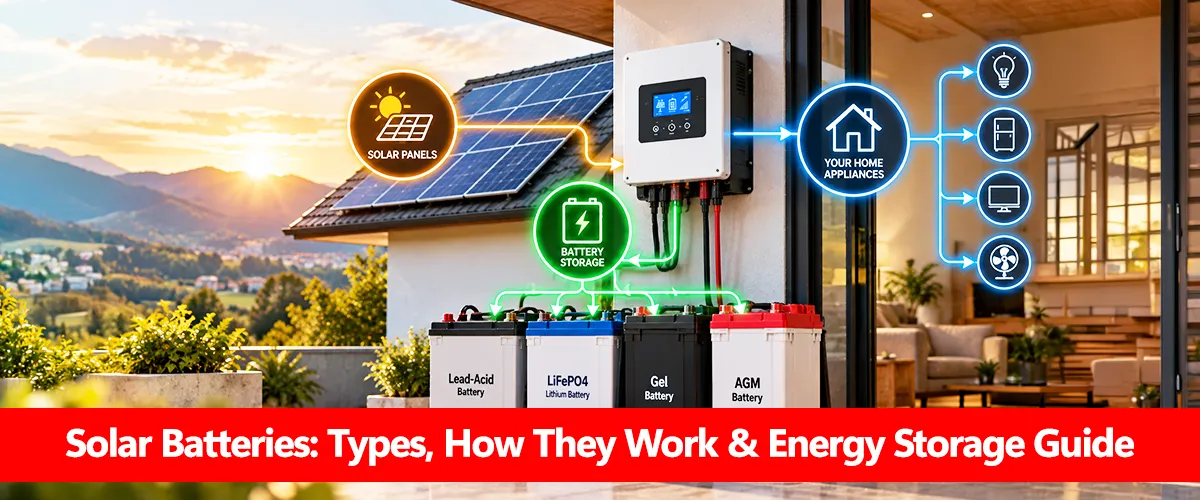
Solar batteries are rechargeable energy storage devices that store electricity generated by solar panels for later use. They allow homes and businesses to use stored solar energy at night, during periods of low sunlight or during power outages when the system supports backup operation.
Solar battery storage is an important component of many hybrid and off-grid photovoltaic (PV) systems. However, battery performance depends on chemistry, usable capacity, charging efficiency and inverter compatibility. Understanding these factors helps determine how batteries support a solar installation.
How Do Solar Batteries Work?
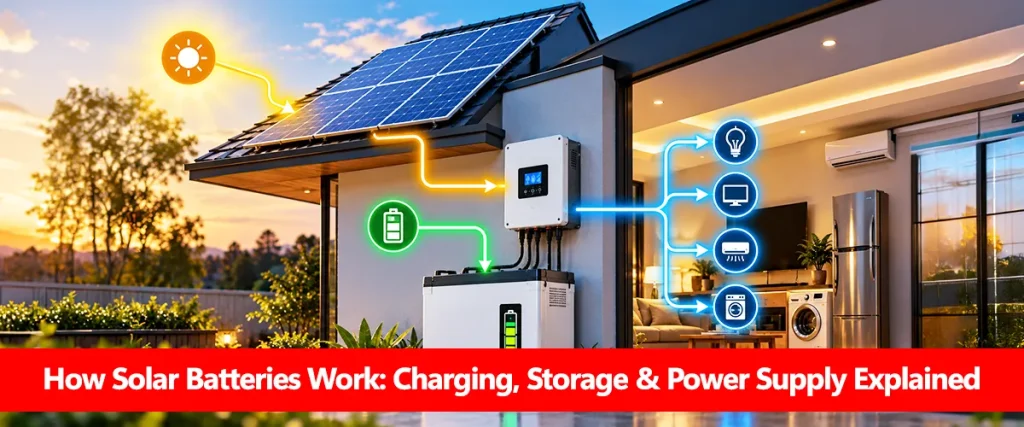
Solar panels convert sunlight into direct current (DC) electricity. Depending on the system design, this electricity can power connected loads or charge a battery through suitable charging and conversion equipment. When solar generation is insufficient, stored energy can be discharged to supply the loads.
A solar battery does not generate electricity itself; it stores energy produced by another source. The charging and discharging process depends on the battery’s electrochemical design and control equipment. Our how solar batteries work guide explains the complete energy flow between panels, batteries and connected equipment.
Main Components of a Solar Battery System
A solar storage installation combines batteries with equipment that manages electricity generation, charging and power delivery. Some components are integrated into a single unit, particularly in modern hybrid inverter systems.
| Component | Main Function |
| Solar panels | Generate DC electricity from sunlight |
| Solar battery | Stores electrical energy |
| Hybrid or battery inverter | Manages power conversion and system operation |
| Charge controller | Regulates charging where required |
| Battery management system | Monitors and protects compatible battery packs |
| Monitoring system | Displays energy production, consumption and battery status |
A battery’s battery management system is especially important in lithium storage packs, while the inverter must support the battery’s operating voltage and charging requirements. These components work together to maintain reliable energy storage and delivery.
Types of Solar Batteries
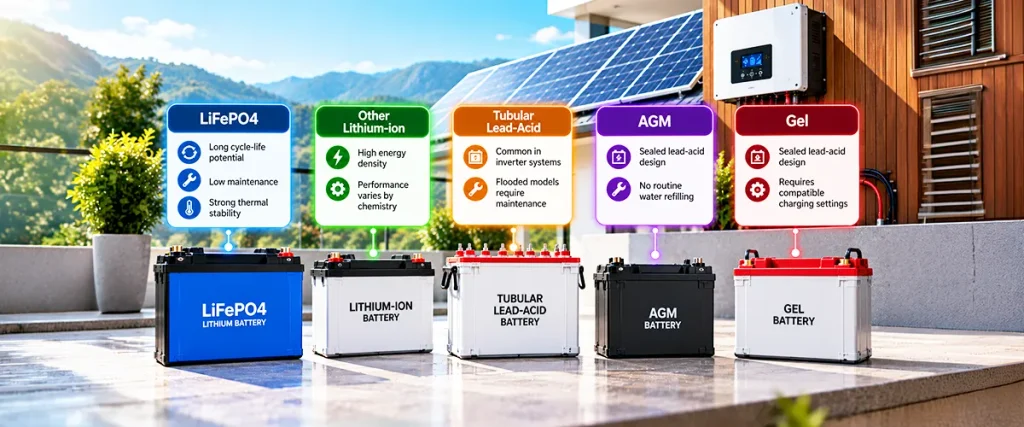
Solar installations use different rechargeable battery technologies. Lithium-ion and lead-acid batteries are widely used, although they differ in energy density, maintenance requirements, lifespan and usable capacity.
| Battery Type | Main Characteristics |
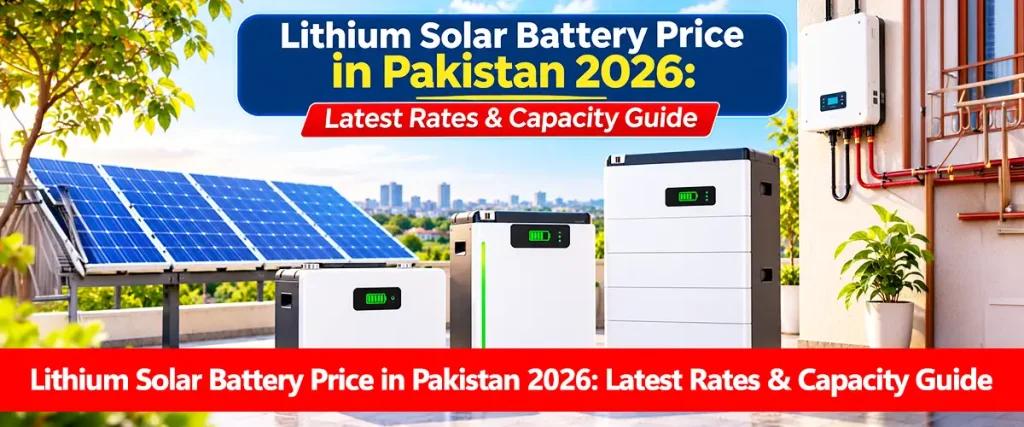
| LiFePO4 | Long cycle-life potential, low maintenance and strong thermal stability |
| Other lithium-ion | High energy density; performance varies by chemistry |
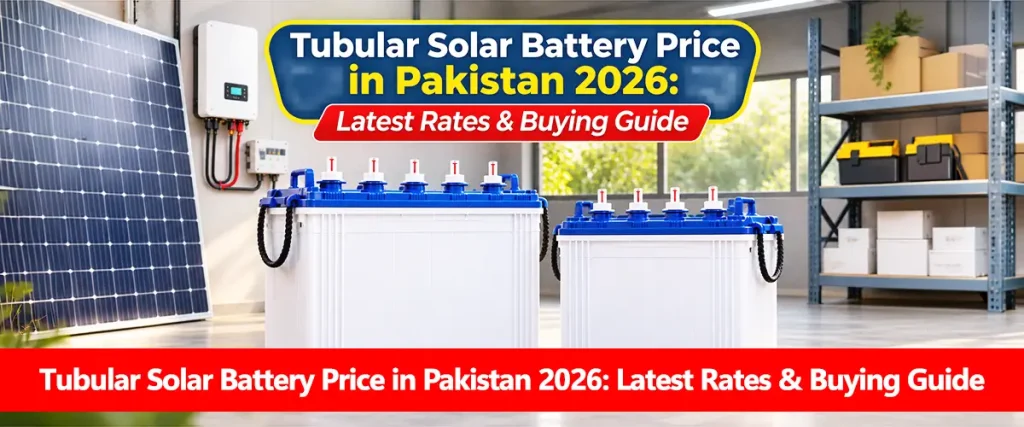
| Tubular lead-acid | Common in inverter systems; flooded models require maintenance |
| AGM | Sealed lead-acid design with no routine water refilling |
| Gel | Sealed lead-acid design requiring compatible charging settings |
LiFePO4 batteries are commonly selected for frequent cycling, while tubular lead-acid batteries remain relevant in installations where initial cost is a major consideration. Our lithium vs tubular battery for solar and lead acid vs lithium solar battery guides cover these differences in detail. The most suitable chemistry depends on the installation rather than a single battery feature. See best battery type for solar for a dedicated technology comparison.
Understanding Solar Battery Capacity and Storage
Solar battery capacity indicates how much energy a battery can store. Residential solar storage systems commonly express this capacity in kilowatt-hours (kWh), while individual batteries may also use amp-hours (Ah) and nominal voltage. Usable capacity is particularly important because the full rated capacity may not be available during normal operation. Depth of discharge, battery chemistry and system limits affect how much stored energy can actually be used.
Important solar battery specifications include:
- Rated capacity (kWh): Total nominal stored energy.
- Usable capacity (kWh): Energy available within permitted operating limits.
- Power rating (kW): Amount of power the battery system can deliver.
- Depth of discharge (DoD): Portion of capacity used during discharge.
- Round-trip efficiency: Percentage of input energy recovered after charging and discharging.
Energy capacity and power output serve different purposes. A battery may store sufficient energy but still lack the power rating needed to operate certain appliances simultaneously.
Correct solar battery sizing considers daily electricity consumption, required backup duration and system losses. The number of units needed is covered separately in how many batteries for solar.
Solar Batteries in On-Grid, Hybrid and Off-Grid Systems
Solar batteries can operate in different types of photovoltaic systems, but their role depends on the inverter and electrical configuration.
- On-grid systems: Conventional grid-connected solar installations may operate without batteries and generally shut down during grid outages unless designed for backup operation.
- Hybrid systems: Combine solar generation, battery storage and grid interaction using compatible equipment.
- Off-grid systems: Depend on solar generation and stored energy, sometimes supported by another backup source.
Solar storage may be connected through AC-coupled or DC-coupled arrangements. The appropriate design depends on existing equipment and compatibility. Homeowners considering adding batteries to an existing solar system should verify inverter support before making changes. It is also worth understanding whether solar panels can work without batteries, since storage is not necessary for every solar installation.
Benefits and Limitations of Solar Battery Storage
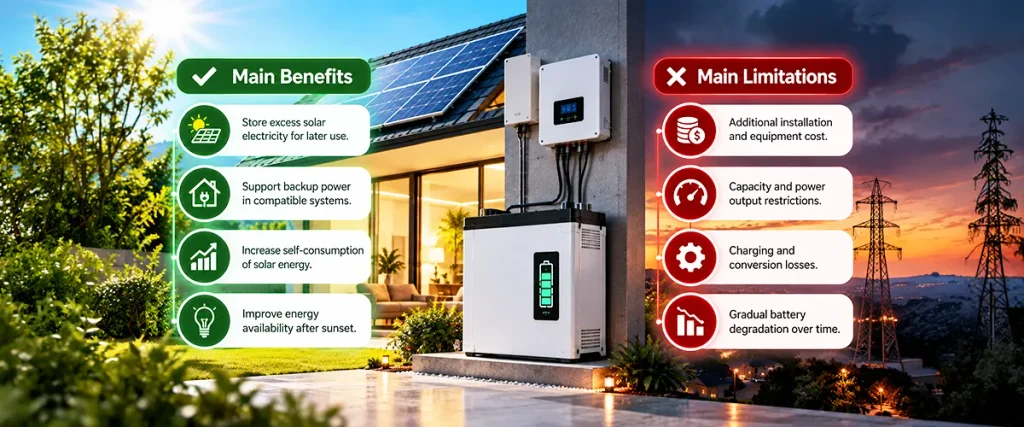
Solar batteries allow electricity generated during sunny periods to be used when solar production is reduced. In suitable systems, they can also provide backup power and reduce dependence on grid electricity during selected hours.
However, batteries add equipment costs, require installation space and experience energy losses during charging and discharging. Their useful lifespan also depends on operating temperature, battery chemistry and cycling conditions.
Main benefits:
- Store excess solar electricity for later use.
- Support backup power in compatible systems.
- Increase self-consumption of solar energy.
- Improve energy availability after sunset.
Main limitations:
- Additional installation and equipment cost.
- Capacity and power output restrictions.
- Charging and conversion losses.
- Gradual battery degradation over time.
For homes primarily concerned with electricity outages, home backup battery requirements may differ from those of a system designed mainly for daily solar energy storage.
Solar Battery Lifespan and Maintenance
Solar battery lifespan depends on chemistry, cycle life, depth of discharge, temperature and charging practices. Lithium-based batteries generally require less routine maintenance than flooded lead-acid batteries, but all storage systems need appropriate operating conditions.
Regular monitoring, compatible charging equipment and protection against extreme temperatures can help maintain performance. Our how long do solar batteries last and solar battery maintenance guides cover longevity and care in more detail.
Solar Batteries in Pakistan
In Pakistan, solar battery storage is commonly considered for household backup, hybrid solar installations and reducing dependence on grid electricity. Battery selection often involves choosing between tubular lead-acid and lithium technologies based on energy requirements, inverter compatibility and budget.
Product specifications, warranty support and local availability should be evaluated before purchasing. Readers comparing local options can explore best solar battery in Pakistan, while solar battery price in Pakistan covers the cost-related search intent separately.
Conclusion
Solar batteries make it possible to store electricity generated by solar panels and use it when needed. They support energy storage, backup power and solar self-consumption in properly designed systems.
The right solar battery depends on usable capacity, chemistry, inverter compatibility, efficiency and expected lifespan. Understanding these fundamentals provides a starting point for evaluating solar energy storage without confusing battery capacity, power output and backup requirements.
Frequently Asked Questions
What Are Solar Batteries?
Solar batteries are rechargeable batteries used to store electricity generated by solar panels for later consumption.
How Do Solar Batteries Store Energy?
They store electrical energy through reversible electrochemical reactions. A compatible charging system transfers energy into the battery, which can later discharge to supply connected equipment.
Which Battery Is Commonly Used for Solar Storage?
LiFePO4 and lead-acid batteries are common options. The appropriate technology depends on cycling requirements, budget, maintenance and system compatibility.
How Much Solar Battery Capacity Do I Need?
Required capacity depends on electricity consumption, desired backup duration, usable battery capacity and system losses. A proper sizing assessment is needed for an accurate recommendation.
Can Solar Batteries Power a House at Night?
Yes, if the battery has sufficient usable energy and the inverter supports the household’s electrical loads. Backup duration depends on energy consumption and battery capacity.
Can I Install Solar Panels Without Batteries?
Yes. Many grid-connected solar systems operate without battery storage, although conventional systems generally cannot provide power during grid outages without suitable backup equipment.
Do Solar Batteries Need Maintenance?
Maintenance depends on battery chemistry. Flooded lead-acid batteries may require electrolyte checks, while lithium batteries generally need less routine servicing but still require suitable monitoring and operating conditions.