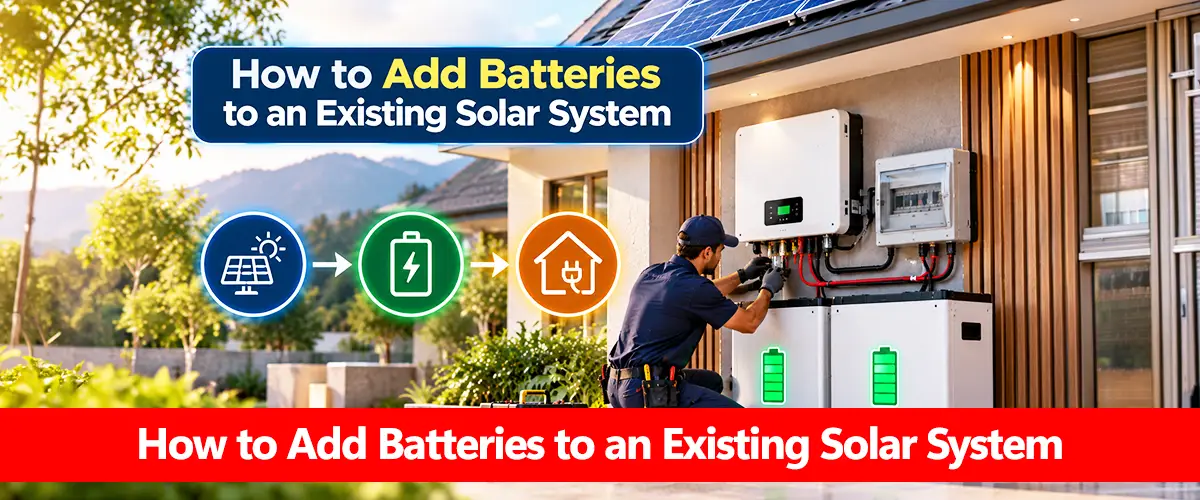
You can add batteries to an existing solar system to store surplus electricity, reduce nighttime grid consumption or provide backup power during outages. However, the installation method depends on whether your current system uses an on-grid inverter, a hybrid inverter or an off-grid configuration.
Many existing photovoltaic (PV) systems can accommodate solar battery storage without replacing the solar panels. Some require only compatible battery equipment, while others need an additional inverter or an upgrade to the existing system.
Can You Add Batteries to Any Solar System?
Most existing solar installations can be evaluated for battery storage, but adding a battery is not always a direct connection. The inverter must either support battery charging and discharging or work alongside separate battery conversion equipment.
For example, a hybrid inverter with a compatible battery connection may support storage directly. A conventional grid-tied inverter generally requires an AC-coupled battery system or an inverter replacement. This distinction matters because solar panels without batteries operate differently from systems designed for energy storage and backup.
Three Ways to Add Batteries to Existing Solar Panels
The appropriate upgrade depends primarily on the inverter already installed and the purpose of adding storage.
| Existing Solar Setup | Possible Battery Upgrade | Main Consideration |
| Battery-ready hybrid inverter | Add a manufacturer-compatible battery | Voltage and BMS compatibility |
| Standard on-grid inverter | Install AC-coupled battery storage | Additional battery inverter and controls |
| Older or incompatible inverter | Upgrade to a compatible hybrid inverter | Equipment replacement and installation work |
| Existing off-grid system | Expand an approved battery bank | Charging capacity and connection limits |
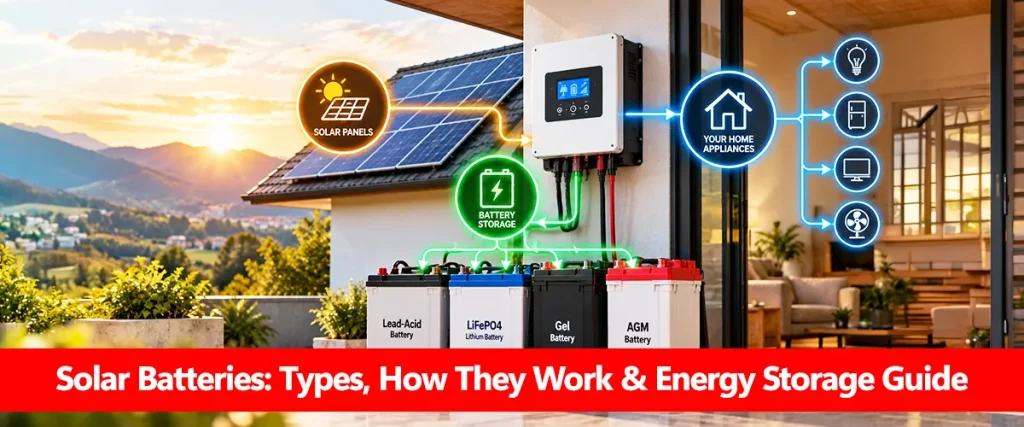
A suitable upgrade should preserve safe system operation while meeting the household’s storage requirements. Understanding how solar batteries work helps explain how electricity moves between solar panels, the inverter and battery storage.
AC-Coupled vs DC-Coupled Battery Storage
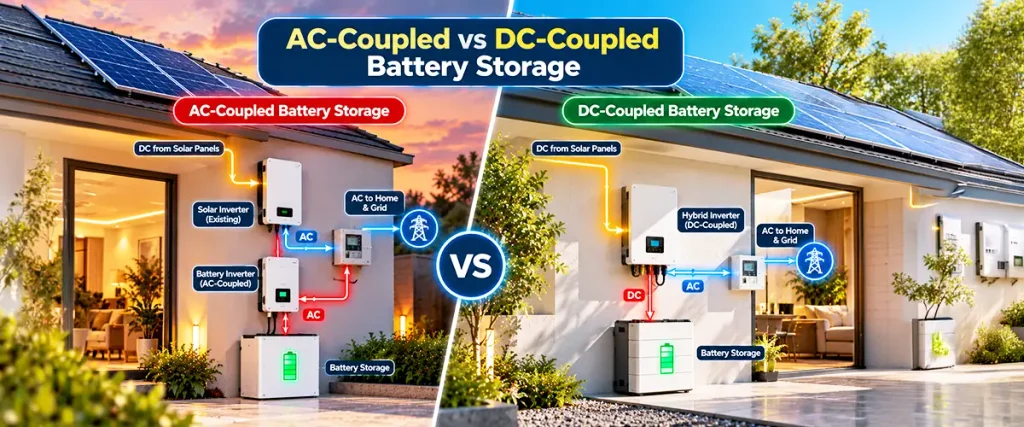
AC-coupled and DC-coupled systems are two common approaches to integrating storage with solar panels.
AC-Coupled Battery Storage
An AC-coupled installation adds battery storage with its own compatible inverter. The existing solar inverter continues converting photovoltaic electricity into AC power, while the battery system manages charging and discharging through the AC electrical system.
This approach can be useful when the current solar inverter is functioning properly and replacing it would be unnecessary. However, AC coupling introduces additional conversion stages, and backup functionality depends on the equipment’s grid-isolation and control capabilities.
DC-Coupled Battery Storage
A DC-coupled system connects solar generation and battery storage through compatible DC-side equipment, commonly a hybrid inverter. Solar electricity can charge the battery before being converted into AC for household use.
This arrangement may reduce conversion losses, but retrofitting an existing installation can require replacing the solar inverter or modifying the electrical configuration.
Neither approach is automatically better. The correct choice depends on equipment compatibility, installation requirements, efficiency and long-term plans.
What Should You Check in Your Existing Inverter?
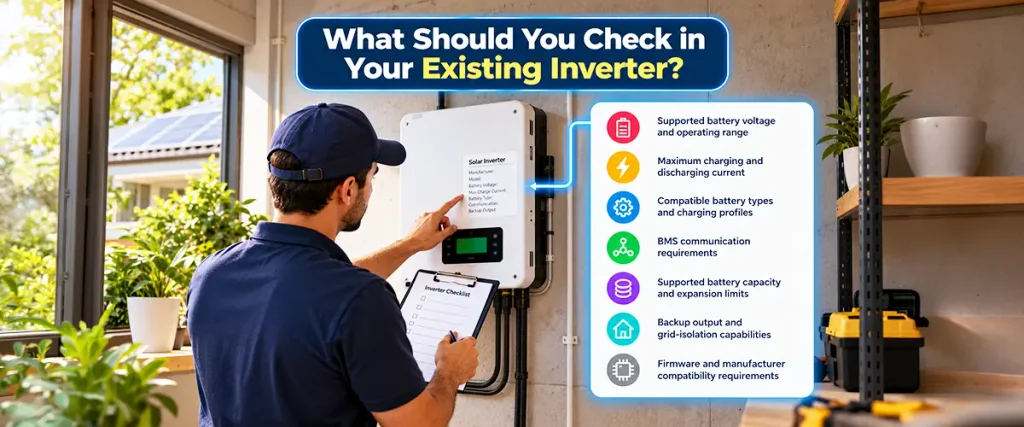
Before purchasing a battery, identify the inverter’s manufacturer, model and electrical specifications. An inverter described as hybrid does not necessarily support every battery chemistry or brand.
Important compatibility checks include:
- Supported battery voltage and operating range.
- Maximum charging and discharging current.
- Compatible battery types and charging profiles.
- Battery management system communication requirements.
- Supported battery capacity and expansion limits.
- Backup output and grid-isolation capabilities.
- Firmware and manufacturer compatibility requirements.
Lithium batteries may require communication between the inverter and battery management system. Matching voltage alone is insufficient, particularly when upgrading from lead-acid to lithium storage. The lead acid charger for lithium battery guide explains these charging compatibility concerns.
Will Adding a Battery Provide Backup During Load-Shedding?
Adding battery storage does not automatically mean your existing solar system will supply electricity during a grid outage.
A conventional on-grid inverter normally disconnects when the utility supply fails. For battery backup, the installation needs a compatible backup-capable inverter, approved isolation equipment and correctly configured circuits.
Backup requirements depend on what you want to power:
- Essential-load backup: Lights, fans, internet equipment and selected appliances.
- Extended household backup: More appliances operating for longer periods.
- Whole-home backup: Requires sufficient battery power, inverter output and appropriate electrical design.
For households that mainly need electricity during load-shedding, choosing a suitable home backup battery and identifying essential loads is more useful than adding storage capacity without checking power requirements.
How Much Battery Storage Should You Add?
The required battery size depends on daily electricity consumption, nighttime usage and desired backup duration. Solar panel capacity alone does not determine how much storage is needed.
For example, a household requiring 5kWh of usable backup electricity must select enough nominal battery capacity to account for the permitted depth of discharge and inverter losses. A lithium battery with 5kWh nominal capacity may not deliver the full 5kWh to household appliances.
Correct solar battery sizing considers usable energy, daily load and system efficiency. After estimating storage requirements, how many batteries for solar helps determine the number of individual battery units.
Which Battery Type Works Best for an Existing Solar System?
Battery selection depends on the inverter, available space, charging requirements and expected usage. LiFePO4 is commonly used for modern solar storage because of its long cycle-life potential, relatively high usable capacity and low routine maintenance.
Tubular lead-acid batteries may be suitable for existing compatible systems, particularly where initial budget is a major consideration. However, battery chemistry changes should not be made without confirming charger and inverter compatibility.
The best battery type for solar guide covers the wider selection criteria, while lithium vs tubular battery for solar explains the practical trade-offs between two common storage options.
What Does It Cost to Add Batteries to Solar?
The cost of adding batteries depends on the battery chemistry, usable capacity, inverter compatibility and installation requirements.
A battery-ready hybrid inverter may need fewer additional components than an on-grid system requiring separate storage equipment. Upgrades can also involve electrical protection, monitoring equipment and dedicated backup circuits.
Main cost factors include:
- Battery capacity and chemistry.
- Additional inverter or inverter replacement.
- Battery protection and communication equipment.
- Electrical wiring and backup configuration.
- Installation, testing and commissioning.
- Warranty and after-sales support.
For local cost considerations, solar battery price in Pakistan covers battery pricing, while actual retrofit quotations should include all equipment and installation work.
Practical Steps Before Upgrading Your Solar System
Before making changes, have a qualified solar installer assess the existing equipment and determine whether storage can be added safely.
A practical upgrade checklist includes:
- Identify your existing inverter model and specifications.
- Decide whether storage is needed for nighttime use, backup or both.
- Calculate the required usable battery capacity.
- Select a compatible AC-coupled or DC-coupled arrangement.
- Verify battery voltage, charging profile and BMS requirements.
- Confirm backup circuits, electrical protection and grid isolation.
- Review equipment warranties and required utility approvals.
- Have the system installed, tested and commissioned professionally.
Do not connect batteries directly to an inverter or photovoltaic circuit unless that configuration is explicitly supported. Battery systems can supply substantial fault currents even when the solar panels are not generating electricity.
After installation, appropriate solar battery maintenance and performance monitoring help maintain reliability. Battery chemistry and usage also affect how long solar batteries last.
Conclusion
You can add batteries to an existing solar system, but the correct upgrade depends on the inverter and the purpose of installing storage. Battery-ready hybrid inverters may support a compatible battery directly, while conventional on-grid installations may require AC-coupled storage or an inverter replacement.
Before upgrading, confirm usable capacity, battery chemistry, inverter compatibility and backup requirements. A professionally designed system can increase solar self-consumption and provide backup power when the necessary equipment is installed.
Frequently Asked Questions
Can I Add Batteries to My Existing On-Grid Solar System?
Yes. An on-grid solar system can often be upgraded using compatible AC-coupled battery equipment or a suitable hybrid inverter replacement. The installation depends on the existing inverter and electrical configuration.
Do I Need to Replace My Solar Inverter to Add Batteries?
Not always. A battery-ready inverter may support storage directly, while an AC-coupled system may allow the original solar inverter to remain in place.
Can I Add Lithium Batteries to an Existing Solar System?
Yes, if the battery, inverter and charging equipment are compatible. Lithium batteries require suitable voltage settings, charging controls and protection systems. Our lead acid vs lithium solar battery comparison explains the chemistry differences.
Will Solar Batteries Work During Load-Shedding?
They can provide backup when the system includes a suitable backup-capable inverter, appropriate grid isolation and sufficient usable battery capacity.
Can I Add More Batteries Later?
Some storage systems support additional battery modules or parallel battery banks. Expansion depends on manufacturer-approved configurations, battery compatibility and electrical system limits.
Is AC-Coupled Battery Storage Better for Existing Solar Panels?
AC coupling can be practical when retaining a working solar inverter. DC coupling may offer different efficiency and integration advantages, but can require more equipment changes.
Is Adding Batteries to Solar Worth It?
It depends on how often you need backup power, how much solar electricity is available for storage and the total installation cost. A system designed primarily for nighttime use may need different storage capacity from one intended for extended outages.
Can I Install Solar Batteries Myself?
Battery storage should be installed by a qualified professional familiar with inverter compatibility, electrical protection and applicable installation requirements. Incorrect connections can cause equipment damage or serious safety hazards.