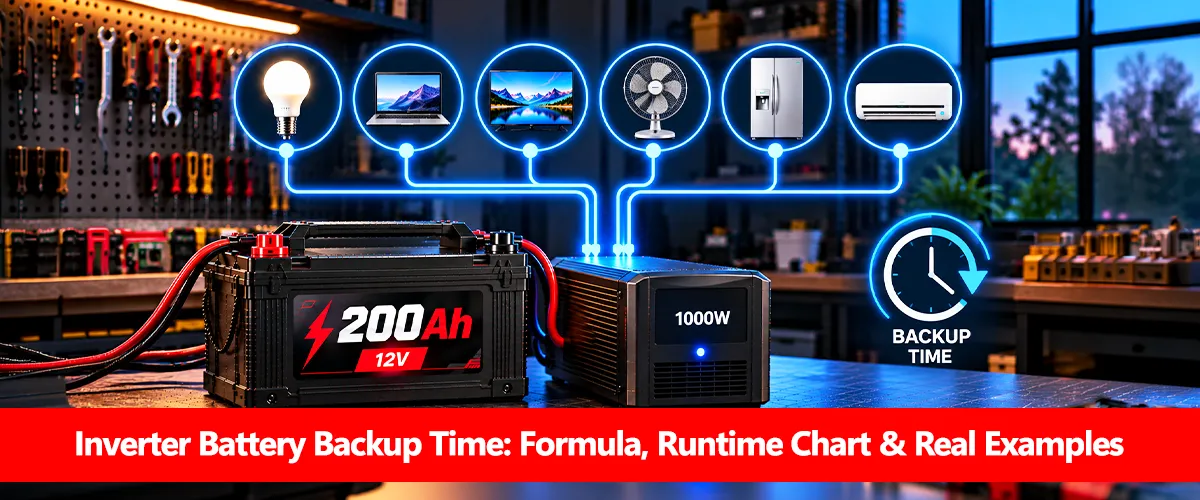
Inverter battery backup time depends on the battery’s usable energy, connected appliance load, and inverter efficiency. For example, a 24V 100Ah battery bank could theoretically provide around 10.8 hours of backup for a constant 160W AC load, assuming 80% depth of discharge and 90% conversion efficiency. However, actual runtime may be shorter because an inverter consumes electricity while operating, battery voltage changes during discharge, and available battery capacity varies with temperature, age, and current demand. Whether you’re running ceiling fans, LED lights, or essential home appliances during load shedding, understanding these factors will help you estimate backup time more accurately.
Key Takeaways
- Inverter backup time depends on usable battery energy and appliance wattage.
- Battery Ah alone cannot determine how many backup hours you will get.
- Inverter conversion efficiency and internal power consumption affect runtime.
- Battery-bank voltage, chemistry, and discharge limits influence available energy.
- Solar charging can extend backup, but only when sufficient generation is available.
What Determines Inverter Battery Backup Time?
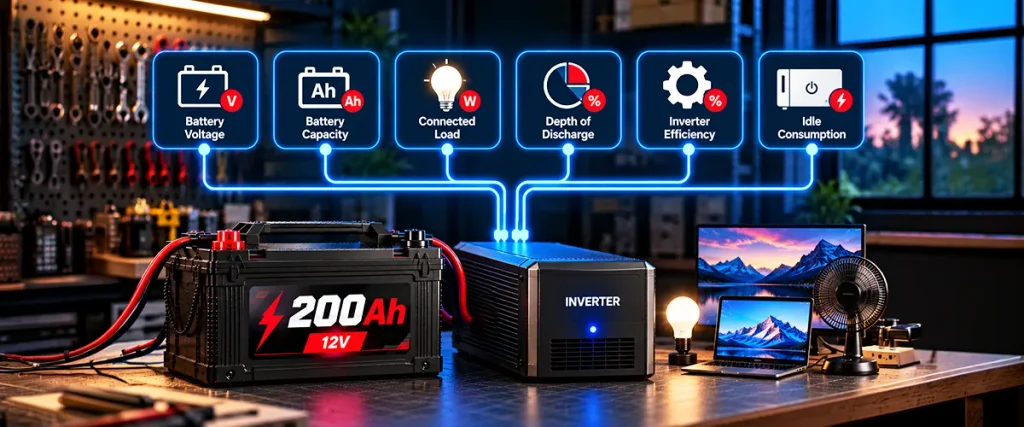
An inverter draws direct-current (DC) energy from a battery and converts it into alternating current (AC) for connected appliances. Backup duration depends on how much usable battery energy is available and how quickly the complete system consumes it. Unlike a simple battery rating, inverter runtime must account for electrical conversion and the inverter’s own operating requirements. The most important specifications are:
- Battery voltage: Nominal voltage of the complete battery bank.
- Battery capacity: Rated amp-hours (Ah) or watt-hours (Wh).
- Connected load: Total running power of appliances in watts.
- Depth of discharge: Portion of the battery’s capacity permitted for use.
- Inverter efficiency: Energy retained during DC-to-AC conversion.
- Idle consumption: Electricity used by the inverter’s internal electronics.
These values provide the foundation for a realistic backup-time estimate.
Inverter Battery Backup Time Formula
The most useful basic calculation starts with the battery’s nominal energy, adjusts for usable capacity and conversion efficiency, and divides the result by the connected AC load.
Basic formula:
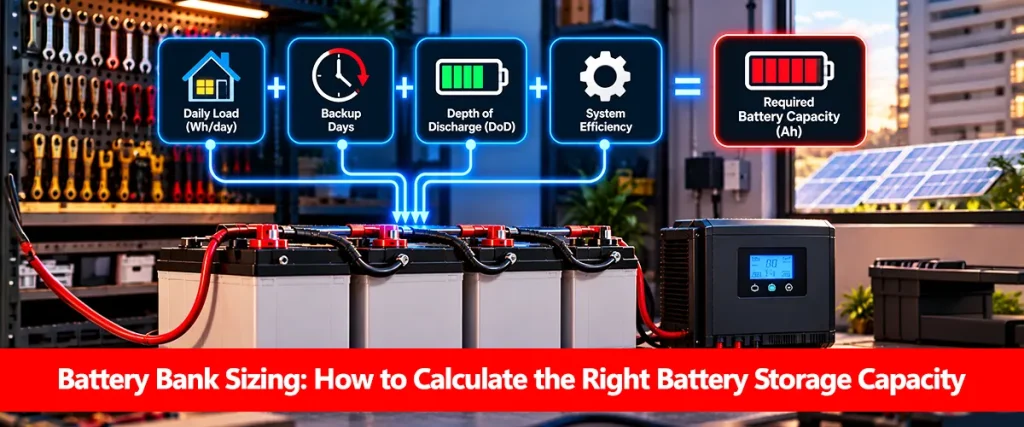
Backup Time (hours) ≈ (Battery Voltage × Ah × DoD × Inverter Efficiency) ÷ Load (W)
For a more detailed estimate that treats inverter idle power as an additional DC-side consumption, use:
Backup Time ≈ (Battery Voltage × Ah × DoD) ÷ [(AC Load ÷ Conversion Efficiency) + Idle Power]
The second formula is appropriate only when conversion efficiency and idle consumption are represented separately. Some manufacturer efficiency measurements already account for operating losses, so avoid counting the same losses twice.
For battery capacity calculations beyond inverter applications, read how to calculate battery capacity.
Practical Example: Inverter Backup for a Pakistani Home
Imagine a household using a 24V 100Ah lithium battery bank with an inverter during load shedding. The family wants to operate two fans, three LED lights, and a Wi-Fi router until electricity returns.
First, identify the appliance load:
| Appliance | Quantity | Total Power |
| Ceiling fans, 60W each | 2 | 120W |
| LED lights, 10W each | 3 | 30W |
| Wi-Fi router | 1 | 10W |
| Total | 160W |
Assume the battery has an 80% usable discharge allowance and the inverter operates at 90% conversion efficiency.
Step 1 — Nominal battery energy
24V × 100Ah = 2,400Wh
Step 2 — Usable battery-side energy
2,400Wh × 0.80 = 1,920Wh
Step 3 — Estimated energy delivered to appliances
1,920Wh × 0.90 = 1,728Wh
Step 4 — Theoretical backup duration
1,728Wh ÷ 160W = 10.8 hours
This is a simplified estimate before separately accounting for inverter idle consumption. Real performance will depend on the equipment and battery specifications.
How Much Does Inverter Idle Consumption Affect Backup?
An inverter consumes electricity even when connected appliances require little power. Its internal electronics, controls, and power conversion circuits draw energy from the battery, which can become significant during long backup periods.
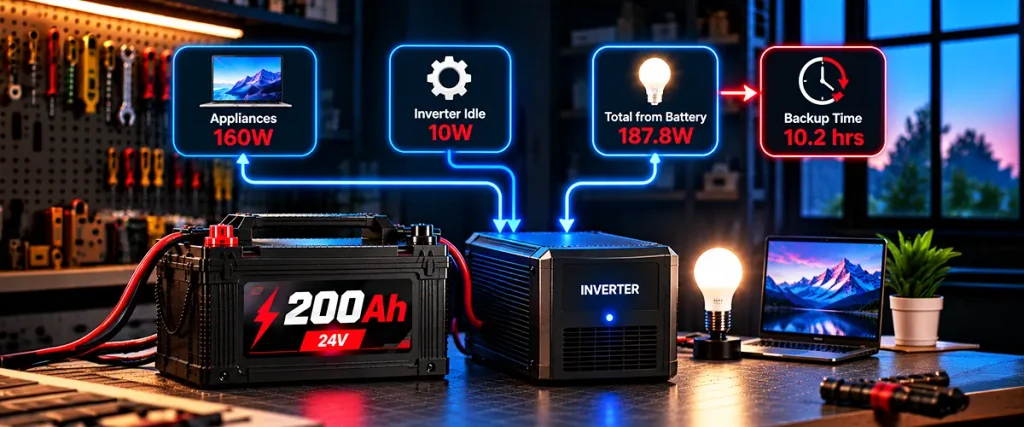
For example, consider the previous 24V battery bank with 1,920Wh of usable battery-side energy. If the 160W AC load requires approximately 177.8W from the battery at 90% conversion efficiency, and the inverter additionally consumes 10W of DC idle power:
- Appliance-related DC demand: approximately 177.8W.
- Additional inverter idle consumption: 10W.
- Total battery power demand: approximately 187.8W.
- Estimated backup time: 1,920Wh ÷ 187.8W = 10.2 hours.
This illustrates why actual inverter specifications matter. Idle consumption and efficiency vary by model, operating mode, and load level.
Inverter Battery Backup Time Chart
The following chart shows theoretical runtime for a 24V 100Ah battery bank at different constant AC loads. It assumes 80% usable battery capacity and 90% inverter efficiency, without separately adding idle consumption.
| AC Load | Estimated Backup |
| 100W | 17.3 hours |
| 150W | 11.5 hours |
| 200W | 8.6 hours |
| 300W | 5.8 hours |
| 400W | 4.3 hours |
| 500W | 3.5 hours |
These values are mathematical estimates, not guaranteed runtimes. Actual results may differ because of inverter losses, discharge characteristics, and battery condition. For a general explanation of runtime calculations across battery types, see how to calculate battery runtime.
Does a 12V, 24V or 48V Inverter Change Backup Time?
Battery-bank voltage affects nominal stored energy when the amp-hour rating remains unchanged. For example, a 24V 100Ah bank stores approximately twice the nominal energy of a 12V 100Ah battery. At a given output power, higher battery-bank voltage also generally reduces DC current. Lower current may reduce resistive losses in appropriately designed wiring, although actual system efficiency depends on the equipment.
Common configurations include:
- 12V systems: Often used for smaller battery-powered applications.
- 24V systems: Used for various residential and medium-power installations.
- 48V systems: Common in larger inverter and solar-storage arrangements.
The correct voltage is determined by the inverter’s approved battery-input specifications. Never connect a battery bank with an unsupported voltage.
Lead-Acid vs Lithium: Which Provides More Usable Backup?
Battery chemistry changes how much of the nominal energy can be withdrawn during everyday operation. Lead-acid batteries are particularly sensitive to high discharge rates, while many LiFePO4 batteries maintain capacity better under suitable conditions. For example, some lead-acid installations use conservative discharge limits to support longer battery life. Many lithium systems permit deeper discharge, although the permitted percentage depends on the manufacturer’s specifications.
Other differences affecting backup include:
- Effective capacity at high discharge currents.
- Battery management system and cutoff settings.
- Temperature-related performance.
- Battery age and state of health.
- Maximum permitted discharge current.
To understand battery-specific performance, explore how long a 100Ah battery lasts and how long a 200Ah battery lasts.
Can Solar Panels Extend Inverter Battery Backup Time?
Yes. In a compatible solar inverter system, solar panels can supply part of the electrical demand and potentially charge the battery while appliances operate. This reduces the amount of energy withdrawn from storage and may extend backup duration. However, solar production changes throughout the day. Cloud cover, panel orientation, weather, and available sunlight determine how much power reaches the system.
For realistic planning:
- Estimate solar generation during the expected outage.
- Identify whether solar power directly supports the load.
- Consider charging and conversion losses.
- Account for changing sunlight and household consumption.
- Avoid assuming daytime solar generation continues overnight.
Battery-only runtime calculations remain useful because they show what the system can support when solar generation is unavailable.
Why Does an Inverter Give Less Backup Than Expected?
A calculated backup duration can differ from actual performance when real operating conditions depart from the assumptions. This is particularly common when appliance power changes or the battery has deteriorated.
Check the following:
- Battery health: An aging battery may no longer deliver its original capacity.
- Unexpected loads: Additional appliances can increase power consumption.
- Inverter efficiency: Efficiency varies with output power and operating conditions.
- Discharge current: Higher current may reduce usable lead-acid capacity.
- Battery cutoff: Protective settings may stop operation before all nominal energy is used.
- Starting charge: A partially charged battery cannot deliver its full rated backup.
If the system frequently shuts down under high loads, check its approved current and power ratings rather than assuming a larger Ah rating will resolve the issue.
Conclusion
Inverter battery backup time depends on how much usable energy the battery can supply and how efficiently the inverter delivers that energy to connected appliances. Battery voltage, Ah capacity, load wattage, depth of discharge, and inverter consumption all influence the final result.
For reliable estimates, use measured appliance power and manufacturer-specific inverter and battery ratings. A theoretical runtime calculation is a helpful starting point, but it should never replace real equipment specifications.
Explore more practical guides on battery capacity calculations, battery runtime, and UPS backup time. Browse Battery Calculations and Sizing or visit Batteries Hub for more battery education.
Frequently Asked Questions
How Do I Calculate Inverter Battery Backup Time?
Multiply battery-bank voltage by Ah capacity, apply the permitted discharge fraction and inverter efficiency, then divide by the AC load in watts. Include inverter idle consumption where appropriate.
How Long Will a 150Ah Battery Last on an Inverter?
It depends on battery voltage, chemistry, usable discharge allowance, inverter efficiency, and appliance load. A 150Ah rating alone cannot provide a reliable backup-time estimate.
Does a Bigger Inverter Provide Longer Backup?
Not necessarily. A larger inverter has greater potential power-output capability, but backup duration depends mainly on usable battery energy and total system consumption. Some larger inverters also consume more power while idle.
Can an Inverter Run Without a Battery?
Some hybrid and grid-tied inverter designs can operate without a battery under supported conditions. Traditional battery-based inverters generally require a suitable DC source. Always follow the specific manufacturer’s operating requirements.
Is Inverter Backup Time the Same as UPS Backup Time?
Both depend on stored battery energy and electrical load, but their efficiency, operating modes, and battery configurations may differ. Read how to calculate UPS backup time for a UPS-specific calculation.