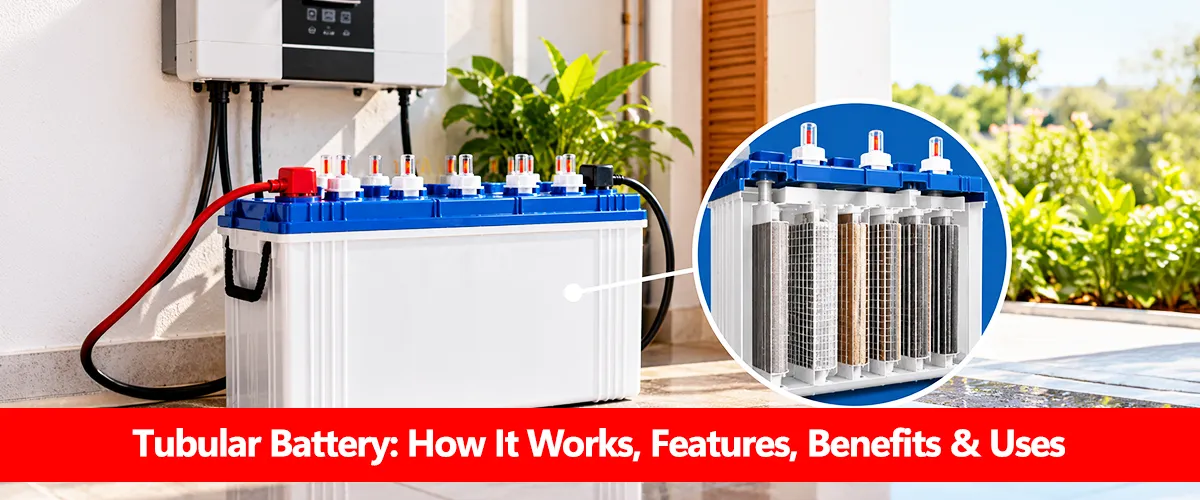
`A tubular battery is a type of lead-acid battery that uses specially designed tubular positive plates to improve durability during repeated charging and discharging. `Unlike conventional flat-plate designs, tubular plates hold their active material within porous tubes, helping reduce material shedding.
Tubular batteries are widely used in UPS, inverter, and solar backup systems, particularly where frequent power interruptions require repeated battery cycling. Their performance depends on plate construction, battery capacity, charging conditions, and maintenance.
How Does a Tubular Battery Work?
A tubular battery operates through the same basic electrochemical reactions as other lead-acid batteries. During discharge, the positive and negative active materials react with sulfuric acid, producing electrical energy. Charging reverses these reactions and restores the battery’s stored energy.
The distinguishing feature is its tubular positive plate construction.
Main components include:
- Tubular positive plates: Hold active material within porous tubes.
- Negative plates: Typically use pasted lead-based active material.
- Electrolyte: Sulfuric acid solution supporting electrochemical reactions.
- Separators: Prevent direct contact between positive and negative plates.
- Battery container: Houses the internal components.
- Terminals: Connect the battery to the electrical system.
Most household tubular batteries use flooded lead-acid construction, although tubular plate designs can also be found in certain valve-regulated batteries. For the underlying chemistry, read our lead acid battery guide.
Key Features of Tubular Batteries
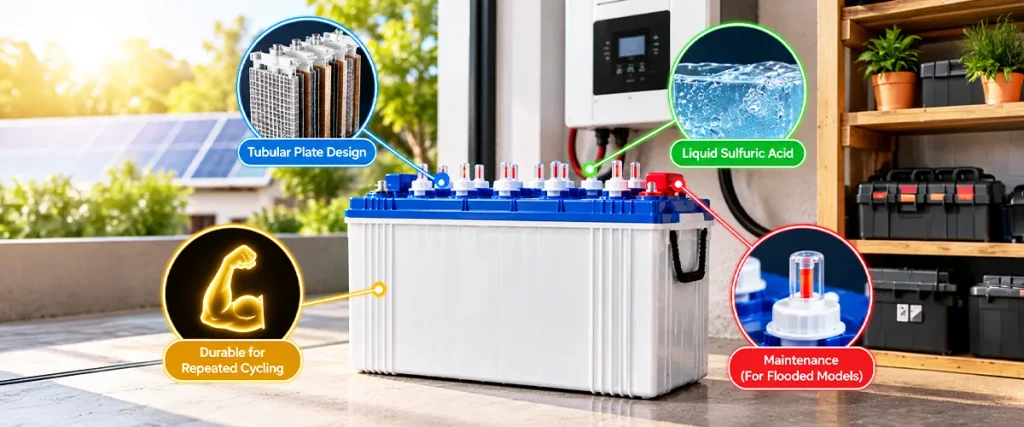
Tubular batteries are designed to withstand repeated cycling while maintaining structural stability.
| Feature | Description |
| Battery chemistry | Lead-acid |
| Positive plate design | Tubular |
| Rechargeability | Rechargeable |
| Common electrolyte | Liquid sulfuric acid |
| Maintenance | Required for many flooded models |
| Common applications | UPS, inverter and solar backup |
| Main strength | Durability during repeated cycling |
Actual performance varies according to battery design, manufacturer specifications, and operating conditions.
Common Applications of Tubular Batteries
Tubular batteries are commonly selected for applications requiring repeated discharge and recharge cycles.
Common uses include:
- Home UPS systems: Providing backup electricity during outages.
- Inverter systems: Supporting household electrical loads.
- Solar energy storage: Storing electricity for later use.
- Commercial backup systems: Supporting essential equipment.
- Deep-cycle applications: Delivering energy through repeated discharge cycles.
A tubular battery must still be correctly sized for the intended load and backup duration. For application-specific guidance, explore tubular battery for UPS.
Advantages of Tubular Batteries
The tubular positive plate design provides several practical benefits.
Main advantages:
- Designed for repeated charging and discharging.
- Reduced positive active-material shedding compared with many flat-plate designs.
- Suitable for many deep-cycle applications.
- Established lead-acid charging technology.
- Widely available for UPS and inverter systems.
- Can provide good service life under suitable operating conditions.
These advantages make tubular batteries useful for applications involving regular backup power demands.
Limitations of Tubular Batteries
Despite their durability, tubular batteries have limitations associated with lead-acid technology.
Important limitations include:
- Heavy compared with many lithium batteries.
- Lower energy density.
- Many models require periodic water replenishment.
- Charging can take considerable time.
- Excessive discharge reduces cycle life.
- Poor charging practices can contribute to sulfation.
- Flooded models require suitable ventilation.
Tubular construction improves certain durability characteristics but does not eliminate the need for proper charging and maintenance.
Tubular Battery Maintenance
Regular maintenance is important for serviceable flooded tubular batteries.
Recommended practices:
- Check electrolyte levels according to manufacturer instructions.
- Use distilled water when replenishment is required.
- Follow recommended charging voltage and current limits.
- Keep terminals clean and connections secure.
- Avoid prolonged undercharging and excessive discharge.
- Protect the battery from excessive heat.
- Ensure adequate ventilation during charging.
Never add acid as part of routine water replenishment. Do not open sealed tubular batteries unless the manufacturer specifically permits servicing.
Tubular Battery vs Flat Plate Battery
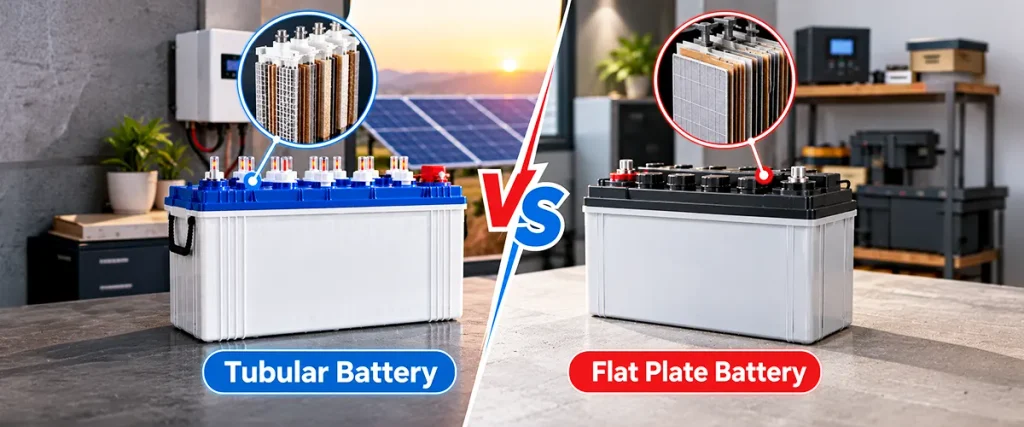
The main difference is positive plate construction. Tubular batteries use porous tubes to retain active material, while conventional flat-plate batteries use pasted active material on grid structures. Tubular designs are commonly associated with cyclic applications, but actual durability and performance depend on the complete battery design. Read the dedicated tubular vs flat plate battery comparison for more information.
Important Tubular Battery Specifications
Understanding battery ratings helps assess compatibility with UPS, inverter, and solar systems.
Key specifications include:
- Nominal voltage: Commonly 12V for household battery units.
- Rated capacity (Ah): Charge capacity under specified conditions.
- State of charge (SoC): Estimated remaining charge.
- Depth of discharge (DoD): Percentage of capacity removed.
- Cycle life: Number of cycles under defined operating conditions.
- Internal resistance: Influences voltage drop and current delivery.
Battery performance also depends on discharge rate, temperature, and charging conditions.
Conclusion
A tubular battery is a rechargeable lead-acid battery designed with tubular positive plates to improve durability during repeated cycling. It is commonly used in UPS, inverter, and solar backup applications. Its suitability depends on battery capacity, charging compatibility, maintenance requirements, and expected discharge conditions. Explore types of batteries, tubular vs lithium battery, and the Battery Types and Chemistries category. Visit Batteries Hub for more battery education.
Frequently Asked Questions
What Is a Tubular Battery?
A tubular battery is a lead-acid battery that uses tubular positive plates designed to retain active material and support repeated cycling.
Is a Tubular Battery Rechargeable?
Yes. Tubular batteries are rechargeable lead-acid batteries.
Does a Tubular Battery Need Water?
Many flooded tubular batteries require periodic distilled-water replenishment. Maintenance requirements depend on the specific design.
Is a Tubular Battery Suitable for Solar Systems?
Yes. Appropriately rated tubular batteries can be used in compatible solar energy storage systems.
How Long Does a Tubular Battery Last?
Service life depends on plate construction, charging conditions, temperature, depth of discharge, and maintenance.
Is a Tubular Battery a Deep-Cycle Battery?
Many tubular batteries are designed for deep-cycle use, but cycle-life performance must be confirmed through manufacturer specifications. Learn more about deep-cycle batteries.