Car battery CCA stands for Cold Cranking Amps, a rating that measures how much electrical current a battery can deliver when starting an engine in extremely cold conditions. Under the SAE standard, CCA represents the current a fully charged 12V lead-acid battery can supply for 30 seconds at −18°C (0°F) while maintaining at least 7.2 volts.
A battery rated at 550 CCA has greater standardized cold-starting capability than a comparable 400 CCA battery tested under the same standard. However, higher CCA does not automatically mean better battery life or compatibility with every vehicle. The correct rating depends on the engine, vehicle manufacturer and electrical system.
Why Does CCA Matter for Starting a Car?
Starting an engine requires considerably more current than operating accessories such as dashboard lights or a radio. When the ignition activates the starter motor, the battery must deliver enough electrical current to turn the engine until combustion begins.
Cold weather makes this process harder because battery chemical reactions slow down and engine oil becomes thicker. This combination reduces the battery’s available output while increasing the effort required to crank the engine. That is why cold-starting performance is measured through CCA.
A battery with insufficient starting-current capability may cause slow cranking or repeated clicking even when it appears reasonably charged. Our how a car battery works guide explains the relationship between the battery, starter motor and alternator.
CCA vs Ah vs Voltage: What’s the Difference?
CCA, amp-hours and voltage describe different battery characteristics. They should not be treated as interchangeable specifications when selecting a replacement.
| Specification | What It Measures | Example |
| CCA | Cold-starting current capability | 550 CCA |
| Ah | Rated charge capacity | 60Ah |
| Voltage | Electrical potential | 12V |
| RC | Reserve capacity under a defined load | 100 minutes |
For example, a 12V 60Ah battery rated at 550 CCA provides information about its electrical system, rated storage capacity and cold-starting capability. The 550 CCA figure does not mean the battery continuously supplies 550A during normal operation.
Similarly, increasing Ah does not automatically provide a proportional increase in CCA. Different battery designs can have different starting-current ratings despite having similar capacities. For additional context, see what Ah means on a battery and battery voltage explained.
How Much CCA Does Your Car Need?
There is no single CCA rating suitable for every vehicle. Starting requirements depend on engine size, engine design, fuel type, temperature and manufacturer specifications.
A diesel engine may require greater starting current than a smaller petrol engine, but the exact rating cannot be determined reliably from engine displacement alone.
When selecting a replacement battery:
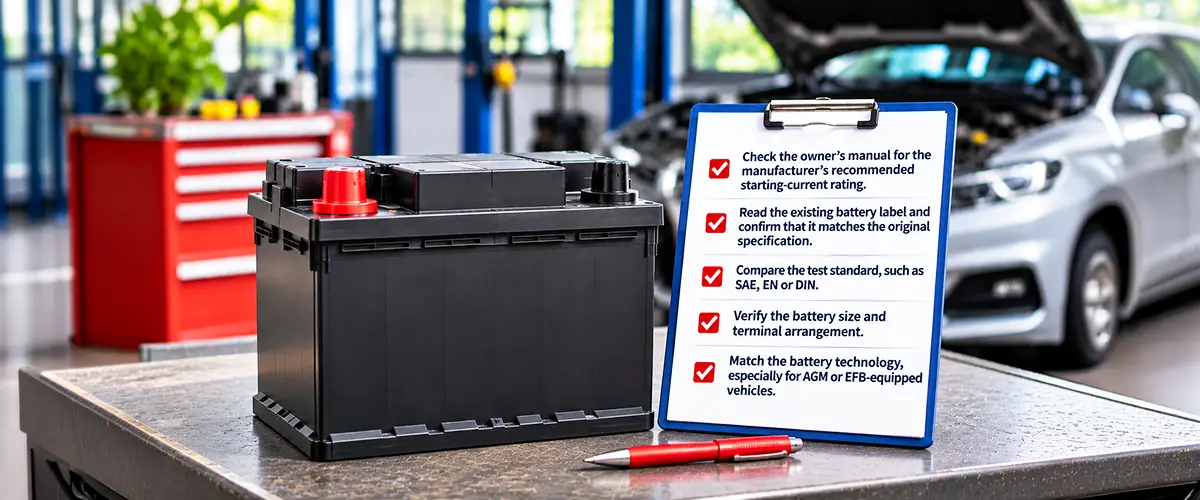
- Check the owner’s manual for the manufacturer’s recommended starting-current rating.
- Read the existing battery label and confirm that it matches the original specification.
- Compare the test standard, such as SAE, EN or DIN.
- Verify the battery size and terminal arrangement.
- Match the battery technology, especially for AGM or EFB-equipped vehicles.
A replacement should meet the manufacturer’s required CCA rather than simply offering the highest number available. Our car battery size guide explains why physical fitment and electrical ratings must be considered together.
Is Higher CCA Better in Pakistan?
Higher CCA can provide additional starting-current capability, particularly in colder areas. This may be relevant in northern Pakistan, where winter temperatures can be considerably lower than in many southern cities. However, vehicles operating in Lahore, Karachi or other warmer regions still need the manufacturer’s specified starting performance. Buying an unnecessarily high-CCA battery provides no guaranteed improvement in service life. High temperatures also accelerate lead-acid battery aging. Therefore, warranty, battery freshness, correct chemistry and suitable installation remain important alongside CCA.
For locally available battery options, refer to best car battery in Pakistan. Current dealer pricing is covered separately in car battery price in Pakistan.
Are SAE, EN and DIN CCA Ratings the Same?
Not exactly. Automotive battery manufacturers use different testing standards, including SAE, EN and DIN. These standards can differ in their testing procedures and voltage requirements. A battery advertised with 500A under one standard should not automatically be considered equivalent to a battery labeled 500A under another. Manufacturers such as Yuasa provide technical guidance explaining these distinctions. When comparing batteries, use ratings measured under the same standard or consult an approved manufacturer cross-reference.
This is especially important when replacing imported vehicle batteries with locally available alternatives.
How Can You Tell if Your Battery Has Low CCA?
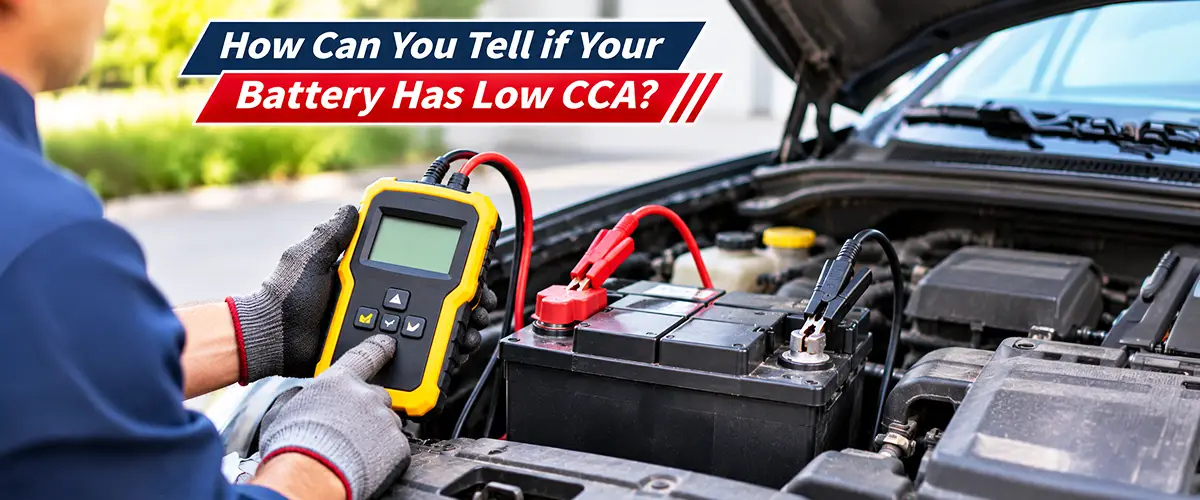
A battery’s starting-current performance can deteriorate as it ages. Internal resistance may increase, limiting the current available to the starter motor.
Common symptoms include:
- Slow engine cranking, particularly after parking.
- Clicking sounds when attempting to start.
- Difficulty starting despite an apparently normal resting voltage.
- Repeated starting problems in cold weather.
These symptoms are not proof of low CCA because faulty starter motors and poor electrical connections can create similar problems.
A professional automotive battery analyzer can estimate starting capability and compare it with the battery’s labeled rating. Conventional voltage measurements alone cannot establish CCA. The how to test a car battery guide explains the difference between voltage checks and performance testing.
Does AGM Battery Technology Affect CCA?
Yes. AGM, EFB and conventional flooded lead-acid batteries can have different starting-current and cycling characteristics. Two batteries with identical physical dimensions and Ah ratings may therefore carry different CCA specifications.
However, the battery technology must match the vehicle’s requirements. Installing a flooded battery in a car designed for AGM technology may create charging or durability problems, even if the advertised CCA appears sufficient.
Our AGM battery guide explains its construction, while how to replace a car battery covers the compatibility checks required during installation.
Conclusion
Car battery CCA tells you how much starting current a battery can provide under standardized cold-temperature conditions. It is an important measure of engine-starting capability, but it is different from Ah capacity, voltage and overall battery health.
For reliable starting, choose a battery that meets the vehicle manufacturer’s CCA requirements and matches its size, terminal arrangement and technology. Compare ratings under the same test standard, and arrange professional testing if starting performance becomes weak.
Frequently Asked Questions
What Does CCA Mean on a Car Battery?
CCA means Cold Cranking Amps. It measures a battery’s ability to deliver starting current at a specified cold temperature.
Is 500 CCA Good for a Car Battery?
It may be suitable for many vehicles, but the correct rating depends on the manufacturer’s specifications. A 500 CCA battery is not automatically suitable for every engine.
Is Higher CCA Always Better?
No. A higher CCA rating provides greater standardized starting-current capability, but unnecessary extra CCA does not guarantee longer battery life.
What Is the Difference Between CCA and Ah?
CCA measures cold-starting current capability, while Ah measures rated charge capacity over a specified discharge period.
Can a Battery Have Good Voltage but Low CCA?
Yes. A battery may show normal resting voltage but struggle to supply sufficient starting current because of internal deterioration.
Does CCA Matter in Hot Weather?
Yes. Adequate starting-current capability remains necessary in warm climates, although the extreme cold conditions used for CCA testing may not occur locally.
Can I Replace a 450 CCA Battery With a 600 CCA Battery?
Potentially, if the replacement meets the vehicle manufacturer’s requirements for chemistry, physical dimensions, terminals and charging compatibility.
How Do I Check My Car Battery’s CCA?
Check the battery label for its rated CCA and testing standard. A professional automotive battery analyzer can assess its present starting capability.