
Learning how to test car battery starts with measuring its voltage using a digital multimeter. A fully charged, rested 12V lead-acid car battery typically reads around 12.6–12.8 volts. A lower reading may indicate insufficient charge, while a battery that struggles under starting load may require professional testing or replacement.
A proper battery check involves three different observations: resting voltage, starting performance and charging-system behavior. These help distinguish a discharged battery from an aging battery or alternator problem. Our car battery guide explains general battery maintenance, while this article focuses on practical testing.
What Do You Need to Test a Car Battery?

For a basic voltage check, you need a digital multimeter capable of measuring DC voltage. A professional automotive battery tester is also useful when you need to evaluate starting-current capability or the battery’s internal condition.
| Equipment | Purpose |
| Digital multimeter | Measures battery voltage |
| Protective eyewear | Protects against accidental splashes |
| Suitable protective gloves | Helps protect hands during inspection |
| Vehicle owner’s manual | Identifies approved test points and procedures |
| Automotive conductance tester | Assesses battery health and starting capability |
| Professional load tester | Checks performance under a controlled electrical load |
Most basic voltage measurements do not require disconnecting the battery. However, modern vehicles may have electronic battery monitoring systems, remote test terminals or specific service instructions. Always follow the vehicle manufacturer’s guidance before accessing the battery.
Step 1: Inspect the Battery Before Testing
Before connecting any equipment, park the vehicle safely, switch off the engine and electrical accessories, and ensure the transmission is in Park or neutral with the parking brake applied. Inspect the battery visually without touching damaged components. Look for cracks, swelling, leaks, loose-looking terminals or heavy corrosion. These conditions may affect battery operation or make testing unsafe.
Do not test, charge or jump-start a battery that is swollen, leaking, cracked, unusually hot or producing a strong abnormal odor. Arrange professional assistance instead.
Minor terminal corrosion can interfere with electrical connections and affect test results. The causes and servicing considerations are explained in car battery corrosion. If no visible safety problem exists, proceed with the manufacturer’s approved voltage-testing method.
Step 2: Let the Battery Rest Before Measuring Voltage
A battery that has recently been charged or used may show a temporary surface-charge reading. For a more useful open-circuit voltage measurement, switch off the engine and allow the battery to rest for at least an hour, preferably longer if practical. reading taken immediately after driving may appear higher than the battery’s settled resting voltage.
Make sure electrical accessories are switched off and allow the vehicle’s electronics to enter their normal resting state where appropriate. This measurement gives an initial indication of battery state of charge, rather than its complete starting performance.
Step 3: Test Car Battery Voltage With a Multimeter
Once the vehicle is safely parked and the battery has rested, follow this procedure for a conventional accessible 12V lead-acid battery.
- Set the multimeter to DC volts (V⎓).
- Choose the 20V range if your meter is not auto-ranging.
- Connect the black lead to the meter’s COM socket and the red lead to its voltage socket.
- Place the red probe on the battery’s positive (+) test point.
- Place the black probe on the negative (−) test point.
- Read and record the displayed voltage.
Keep the probes separated and avoid contact with surrounding metal components.
Never place a multimeter set to amperes directly across the battery terminals. This can create a dangerous short circuit and damage the meter.
How to Interpret Car Battery Voltage
| Resting Voltage | General Interpretation |
| 12.6–12.8V | Generally well charged |
| 12.4–12.5V | Partially discharged |
| 12.2–12.3V | Significantly discharged |
| 12.0–12.1V | Low charge; investigate |
| Below 12.0V | Very low charge or possible battery problem |
These are approximate values for conventional 12V lead-acid batteries at moderate temperatures. AGM, temperature conditions and manufacturer specifications can affect readings.
For example, a reading of 12.7V suggests that a conventional battery is well charged. A reading of 12.2V indicates a need to investigate its charge level, but does not automatically prove that replacement is necessary.
Our detailed car battery voltage guide covers voltage interpretation, while how to test a battery with a multimeter explains multimeter principles for other battery types.
Step 4: Check Battery Voltage During Engine Starting
A resting voltage reading does not establish whether the battery can supply enough current to start the engine. During cranking, the starter motor draws substantial current, causing battery voltage to decrease temporarily. For a reasonably charged conventional lead-acid battery at moderate temperature, voltage remaining around 9.6V or higher during cranking is a commonly used screening reference.
A significantly lower reading may indicate insufficient charge, battery deterioration, excessive starter demand or electrical connection problems.
| Cranking Observation | Possible Meaning |
| Voltage dips moderately and engine starts normally | Often normal |
| Voltage falls substantially below about 9.6V | Further testing needed |
| Voltage appears normal but starter does not operate | Starter circuit or connection fault possible |
| Engine cranks slowly despite adequate charge | Battery health or starting-system issue |
The approximate 9.6V threshold is not a universal pass/fail rule. Temperature, engine design, test method and manufacturer specifications matter.
Because testing during cranking involves a running engine, use securely positioned rated test leads only when the vehicle procedure permits it. Keep hands, tools and cables away from moving parts. If probes cannot be secured safely, have a technician perform the test. A professional car battery CCA assessment is more informative than relying on one voltage reading.
Step 5: Check Whether the Alternator Is Charging
If battery voltage is low or the vehicle repeatedly needs charging, the alternator and charging system should also be checked. In many conventional vehicles, battery-terminal voltage increases when the engine starts because the alternator supplies charging power. Typical running-voltage readings may be approximately 13.7–14.7V, depending on vehicle design and operating conditions.
However, modern smart-charging systems can intentionally use lower or variable charging voltages. Therefore, a reading outside this range does not automatically indicate failure.
| Observation | Possible Explanation |
| Resting voltage around 12.6V | Battery is likely well charged |
| Running voltage near 14V | Charging may be occurring normally |
| Battery remains undercharged after regular driving | Charging-system or battery issue possible |
| Battery warning light stays on | Charging-system diagnosis needed |
| Unusually high running voltage | Charging regulation requires assessment |
A running-voltage check must only be performed using approved test points and safely secured test leads, with all personnel clear of belts, fans and moving components. For additional details, see how a car battery works and battery charging voltage.
Step 6: Confirm Battery Health With a CCA or Load Test
A car battery can show 12.6V at rest and still fail to start the engine. This happens because voltage indicates charge condition, while starting performance depends on the battery’s ability to deliver high current. Professional automotive testers evaluate this using conductance measurements or controlled load testing. Cold cranking amps (CCA) is a standardized measure of starting-current capability. A tester may compare its assessment with the battery’s labeled CCA rating.
For example, a battery labeled 550 CCA should be evaluated using the correct standard and manufacturer-approved test settings.
Professional testers may return results such as:
| Test Result | Typical Action |
| Good Battery | Continue normal use |
| Good — Recharge | Recharge if required |
| Charge and Retest | Recharge before deciding |
| Replace Battery | Replace with approved equivalent |
| Charging-System Fault | Diagnose alternator and associated components |
These categories resemble those used in GS Yuasa’s battery-testing guidance.
Do not attempt to measure hundreds of starting amperes through a standard multimeter’s current input. A suitable automotive battery analyzer is required. For a broader explanation of these measurements, see how to check battery health.
Practical Example: What Do Different Test Results Mean?
Consider three vehicles experiencing different starting conditions.
| Vehicle | Resting Voltage | Starting Behavior | Recommended Next Step |
| Car A | 12.7V | Starts normally | Continue routine monitoring |
| Car B | 12.2V | Slow cranking | Recharge correctly, then retest |
| Car C | 12.7V | Struggles to crank | Professional CCA and starting-system test |
Car B may simply have insufficient charge because of short trips or extended parking.
Car C presents a different situation. Despite a reasonably high resting voltage, its battery may not deliver adequate starting current. Poor connections or a starter fault are also possible.
These examples show why testing should consider both the battery’s charge level and its electrical performance. The signs of a bad car battery guide covers related symptoms in more detail.
How to Test Flooded, AGM and EFB Car Batteries
The basic DC-voltage test is useful for conventional flooded, enhanced flooded (EFB) and AGM automotive batteries. However, their charging characteristics and recommended testing settings can differ. A properly charged AGM battery may show a slightly higher resting voltage than some conventional flooded batteries. Professional battery analyzers should be configured for the actual battery technology and its labeled performance standard. Lithium starter batteries have different electrical characteristics and protection systems, so conventional lead-acid voltage tables should not be applied to them.
Always confirm the battery type before testing or charging. The general characteristics of an AGM battery and flooded lead-acid battery can help explain these differences. This article concerns conventional low-voltage starter batteries, not the high-voltage traction battery of an electric or hybrid vehicle.
What If the Battery Tests Low?
A low voltage reading should lead to further checking, not immediate replacement. If the battery appears physically safe and the vehicle manufacturer permits charging, use a compatible charger to restore its charge. Then allow the battery to rest and repeat the measurement. If voltage returns to the expected range and the battery passes its starting-performance test, replacement may not be necessary. If the battery repeatedly becomes discharged, investigate whether the alternator is charging properly or the vehicle is consuming excessive electricity while parked.
Our how to charge a car battery guide explains safe charging, while car battery keeps dying and car battery draining overnight address repeated discharge problems.
Common Mistakes When Testing a Car Battery
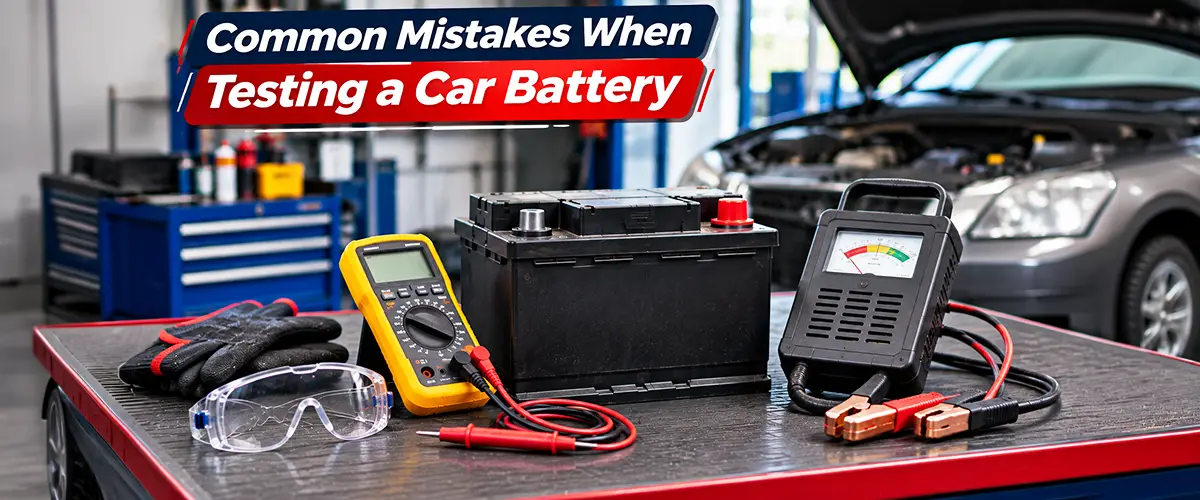
Several testing errors can produce misleading results or create unnecessary electrical risks. Avoid measuring voltage immediately after charging, interpreting low charge as confirmed battery failure or judging battery health from resting voltage alone. Do not use an automotive load tester without appropriate training. Incorrectly performed load tests can create high currents, sparks and overheating. Never disconnect the battery while the engine is running to test the alternator. That practice can damage modern vehicle electronics.
Also avoid opening sealed batteries or touching damaged components. If the battery is leaking, swollen or excessively hot, stop testing and seek professional assistance.
When Should You Replace Your Car Battery?
Replacement is appropriate when a properly charged battery fails an approved starting-performance test, cannot reliably hold charge or has physical damage that makes continued operation unsafe. Battery age also provides context. Conventional car batteries commonly last around three to five years, although extreme temperatures and charging problems may shorten their useful life. A battery that is three years old does not automatically need replacement, but regular testing becomes increasingly valuable as it ages. Our how long car batteries last guide discusses aging factors, while car battery size guide explains how to identify a compatible replacement.
If replacement is necessary, follow the vehicle manufacturer’s procedure or arrange professional installation. Some vehicles require electronic battery registration, as discussed in how to replace a car battery.
Conclusion
Understanding how to test car battery requires more than checking one voltage reading. A useful assessment begins with safe visual inspection, followed by resting-voltage measurement, starting-performance evaluation and charging-system checks.
A fully charged conventional 12V lead-acid battery generally measures around 12.6–12.8V at rest. However, normal resting voltage does not guarantee adequate CCA or overall battery health.
When the results are uncertain, professional conductance or load testing is the most reliable next step. Always follow the vehicle manufacturer’s testing instructions and replace batteries based on verified condition rather than voltage alone.
Frequently Asked Questions
How Do You Test a Car Battery With a Multimeter?
Set the multimeter to DC volts, place the red probe on the positive terminal and the black probe on the negative terminal, and read the voltage with the engine switched off. A well-charged conventional 12V lead-acid battery commonly reads around 12.6–12.8V after resting.
Is 12.4V a Good Car Battery Reading?
A resting reading around 12.4V generally indicates partial charge in a conventional lead-acid battery. Recharge if appropriate and retest before deciding whether the battery is defective.
Can a Car Battery Show 12.6V and Still Be Bad?
Yes. A battery may show normal resting voltage but have insufficient starting-current capability. A professional conductance or load test can help confirm its condition.
What Should Battery Voltage Be When Starting a Car?
Voltage temporarily decreases during cranking. Approximately 9.6V is a commonly used screening threshold for certain conventional lead-acid test conditions, but the correct interpretation depends on temperature, charge level and manufacturer specifications.
How Do I Test My Car Alternator With a Multimeter?
A qualified person can compare resting and running voltage using the vehicle’s approved test points. Conventional charging systems often operate around 13.7–14.7V, but modern smart-charging systems may behave differently.
Can I Test Car Battery CCA With a Normal Multimeter?
No. A standard multimeter cannot directly perform a CCA test. Use an appropriate automotive battery tester or have a qualified technician conduct the assessment.
Should I Charge the Battery Before Testing It?
If the battery is significantly discharged, charging with suitable equipment before a health test helps avoid confusing low charge with permanent deterioration.
Is Battery Voltage Testing Different for AGM Batteries?
The basic DC-voltage measurement is similar, but voltage interpretation and battery-analyzer settings may differ. Follow AGM-specific manufacturer instructions.
Does Low Battery Voltage Mean I Need a New Battery?
Not necessarily. Low voltage may indicate an undercharged battery, electrical drain or charging-system problem. Recharge and test its condition before replacing it.