Car battery voltage measures the electrical potential between a battery’s positive and negative terminals. Most conventional passenger vehicles use a nominal 12V battery, but a fully charged lead-acid car battery normally measures approximately 12.6–12.8 volts with the engine off. When the engine is running and a conventional alternator is charging, voltage commonly increases to around 13.7–14.7 volts.
These readings help drivers understand battery charge and charging-system performance. However, voltage alone cannot confirm whether a battery is healthy enough to start the engine. Battery chemistry, temperature and vehicle charging technology also affect measurements. Our car battery guide covers the wider essentials, while this article explains what different voltage readings mean.
Car Battery Voltage Chart: Engine Off vs Running
A voltage reading is useful only when you know the conditions under which it was measured. A battery at rest, a battery starting the engine and a battery being charged can show very different readings.
| Battery Condition | Typical Voltage | What It Indicates |
| Engine off, fully charged | 12.6–12.8V | Normal resting charge |
| Engine off, partially charged | Around 12.4V | Some charge has been used |
| Engine off, significantly discharged | Around 12.2V | Charging may be needed |
| Engine off, deeply discharged | Around 12.0V or lower | Investigate promptly |
| Engine starting | Temporary voltage drop | High current supplied to starter |
| Engine running, conventional charging | Around 13.7–14.7V | Alternator may be charging |
These are approximate reference values for conventional 12V lead-acid systems at moderate temperatures. AGM batteries and modern smart-charging vehicles may operate differently.
Interstate Batteries provides the familiar 12.6V-or-higher resting reference and 13.7–14.7V conventional charging range. A voltage reading outside those values is a reason to investigate, not automatic proof of battery failure.
Why Is a Car Battery Called 12V When It Reads 12.6V?

A typical lead-acid car battery contains six electrochemical cells connected in series. Each cell has a nominal voltage of approximately 2V, giving the battery its 12V classification. When fully charged and rested, each cell produces approximately 2.1V. Six cells therefore provide around 12.6V in total.
The actual voltage changes as the battery charges and discharges because of its internal electrochemical reactions.
| Battery Property | Typical Value |
| Nominal system voltage | 12V |
| Number of lead-acid cells | 6 |
| Nominal voltage per cell | Approximately 2V |
| Fully charged resting voltage | Approximately 12.6–12.8V |
This is normal battery behavior rather than an electrical fault. The detailed chemistry is covered in how a car battery works, while battery voltage explained discusses voltage across different battery technologies.
What Should Car Battery Voltage Be With the Engine Off?
With the engine switched off, a rested battery’s voltage provides an approximate indication of its state of charge.
For a conventional flooded lead-acid battery, a reading around 12.6V usually indicates a high charge level. A reading around 12.4V suggests partial discharge, while values near 12.0V indicate that substantial charging may be required.
Resting Voltage and Approximate Charge Level
| Resting Voltage | Approximate State of Charge |
| 12.6–12.8V | Well charged |
| Around 12.4V | Approximately 75% |
| Around 12.2V | Approximately 50% |
| Around 12.0V | Approximately 25% |
| Below 12.0V | Very low charge |
These percentages are rough illustrations, not a universal voltage-to-charge formula. Temperature, battery design and manufacturer specifications can change the relationship.
A battery recently used or charged may also show a misleading reading due to surface charge or temporary voltage changes. Allowing it to rest before measurement improves interpretation. The difference between battery state of charge and state of health is particularly important: a high voltage reading does not guarantee strong starting performance.
What Is Normal Car Battery Voltage When the Engine Is Running?
When a conventional petrol or diesel engine is running, the alternator normally supplies electricity to the vehicle’s electrical system and recharges the battery. That is why voltage commonly rises above the resting battery level. For many conventional charging systems, approximately 13.7–14.7V is a useful reference range. However, some manufacturer testing procedures allow a wider range depending on equipment and operating conditions. Modern vehicles with intelligent alternator control may deliberately reduce, increase or vary charging voltage according to battery condition, electrical load and fuel-efficiency strategies.
This means an engine-running reading close to 12.6V does not always prove that the alternator has failed, especially in vehicles with smart charging.
For broader charging principles, see how battery charging works. If voltage readings remain abnormal alongside a battery warning light or repeated discharge, the vehicle’s charging system should be professionally evaluated.
What Happens to Battery Voltage While Starting a Car?
Starting the engine requires a large burst of electrical current. As the starter motor draws power, battery voltage temporarily drops. A healthy, sufficiently charged conventional lead-acid battery should normally recover after the engine starts or the starting attempt ends.
A commonly used cranking-voltage screening reference is approximately 9.6V, under specified battery-load and temperature conditions. However, that figure should not be applied as an absolute pass-or-fail limit to every vehicle.
A large voltage drop may indicate a discharged or deteriorated battery, excessive starter demand or a poor electrical connection.
| Starting Observation | Possible Interpretation |
| Brief voltage drop and normal starting | Expected behavior |
| Severe voltage drop with slow cranking | Battery or starting-circuit issue possible |
| Voltage remains adequate but engine does not crank | Starter or control-circuit issue possible |
| Repeated clicking and falling voltage | Low charge or poor connection possible |
The battery’s ability to deliver starting current is reflected partly in its cold cranking amps (CCA) rating. Our signs of a bad car battery guide explains how these symptoms differ from starter and alternator faults.
Does AGM Battery Voltage Differ From a Normal Battery?
Yes. A fully charged AGM lead-acid battery can have a slightly different open-circuit voltage from a conventional flooded battery.
Yuasa’s technical guidance lists approximately 12.8–13.0V for certain fully charged AGM batteries, compared with approximately 12.6V for conventional lead-acid batteries.
| Battery Technology | General Voltage Consideration |
| Flooded lead-acid | Common resting reference around 12.6V |
| AGM | May rest around 12.8–13.0V when fully charged |
| EFB | Follow manufacturer-specific lead-acid data |
| Lithium starter battery | Requires chemistry-specific voltage interpretation |
A reading of 12.6V may therefore indicate different charge conditions depending on the battery type.
This is particularly relevant to vehicles with automatic start-stop systems, which may require AGM or EFB batteries. The construction of an AGM battery differs from a conventional flooded lead-acid battery, and their manufacturer-approved charging settings should not automatically be treated as identical.
How to Measure Car Battery Voltage Correctly
A digital multimeter can measure car battery voltage, provided it is used safely and at manufacturer-approved test points.
For a basic resting-voltage check, switch off the engine and accessories, let the battery rest, and select DC volts on the multimeter. The red probe connects to the positive test point and the black probe to the negative test point.
Read the displayed value without allowing the probes to touch each other or nearby metal components.
The measurement should be made at approved battery terminals or remote test points, particularly in vehicles with battery-monitoring systems.
Do not use the meter’s current setting across battery terminals, and do not attempt a running-engine test with loose probes near moving belts or fans.
A full procedure is available in how to test a car battery. For multimeter settings and testing other battery types, see how to test a battery with a multimeter.
What Does Low Car Battery Voltage Mean?
Low resting voltage usually indicates that the battery has lost a significant amount of charge. However, the underlying reason may be temporary or ongoing.
For example, a car that has been parked for several weeks may develop a low voltage because vehicle electronics continue consuming small amounts of electricity.
Likewise, a vehicle used only for short trips may not receive enough charging time to replenish the energy used during starting.
Common causes include incomplete charging, excessive standby electrical consumption, an aging battery or a charging-system problem.
If voltage remains low after appropriate charging, further testing is needed. The car battery keeps dying and car battery draining overnight guides cover those symptoms separately. A battery that repeatedly becomes discharged should not simply be replaced without checking the vehicle’s charging and electrical systems.
Can High Car Battery Voltage Be Dangerous?
Excessively high charging voltage can damage lead-acid batteries and vehicle electrical components. Potential consequences include increased battery temperature, excessive gassing in flooded batteries and accelerated deterioration.
However, some modern charging systems legitimately operate above traditional charging-voltage ranges under manufacturer-controlled conditions. Yuasa notes that certain regenerative start-stop vehicles may use charging voltages around 15.2V.
Therefore, the correct interpretation depends on the vehicle’s charging strategy and specified limits. Persistently abnormal readings, visible battery swelling or unusual heating require professional assessment.
If a battery is leaking, cracked, swollen or producing a strong abnormal odor, do not attempt to charge or jump-start it. Seek qualified assistance. Our guides on battery overcharging and battery charging voltage explain the related risks.
Can a Car Battery Show 12.6V and Still Be Bad?
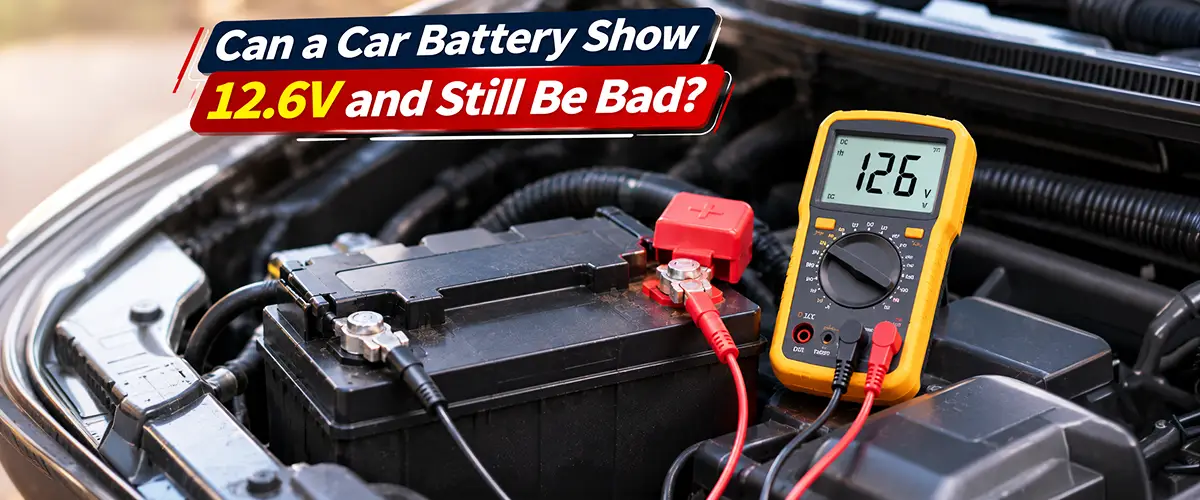
Yes. This is one of the most common misunderstandings about automotive battery voltage.
A battery can appear fully charged while having insufficient capacity or starting-current capability because of internal aging.
For example, a deteriorated battery may measure 12.6V with the engine off but experience an excessive voltage drop as soon as the starter motor engages.
A resting-voltage measurement estimates charge level. Battery health is more accurately evaluated through appropriate conductance testing, load testing and inspection of the complete starting system. Understanding battery internal resistance helps explain why voltage may collapse under high load. If the engine starts slowly despite reasonable voltage, consult how to check battery health for broader diagnostic considerations.
What Should You Do About an Abnormal Voltage Reading?
The correct response depends on when the reading was taken and whether the vehicle has other symptoms.
| Voltage Situation | Practical Next Step |
| Low resting voltage after long parking | Check charge condition and recharge appropriately |
| Normal resting voltage but slow starting | Arrange a battery CCA and starting-system test |
| Low voltage after repeated driving | Check the charging system |
| Unusual voltage while engine runs | Compare with vehicle manufacturer’s specification |
| Rapid voltage loss while parked | Investigate standby electrical consumption |
| Abnormal reading with physical battery damage | Stop use and seek professional assistance |
For a battery that is simply undercharged, using the correct charging equipment may restore normal performance.
Follow the procedures in how to charge a car battery rather than assuming a long drive will resolve every charging problem. If the vehicle will not start, consult how to jump-start a car for safe, vehicle-specific precautions.
Battery replacement should be considered when testing confirms deterioration or when the battery cannot reliably provide the required starting current. General replacement timing is covered in how long car batteries last.
Conclusion
Normal car battery voltage depends on whether the engine is off, starting or running. A conventional, fully charged 12V lead-acid battery typically measures around 12.6–12.8V at rest, while a traditional charging system commonly produces 13.7–14.7V with the engine running.
These values are useful reference points, but AGM construction, temperature and modern smart-charging systems can change expected readings.
Voltage helps estimate battery charge, not necessarily battery health. When readings are unusual or starting problems continue, combine voltage checks with manufacturer-approved battery and charging-system testing.
Frequently Asked Questions
What Is Normal Car Battery Voltage?
A fully charged conventional 12V lead-acid car battery commonly measures approximately 12.6–12.8V after resting. The correct reading depends on battery chemistry and temperature.
Is 12.4V a Good Car Battery Reading?
Around 12.4V generally indicates a partially discharged conventional lead-acid battery. It may still start the vehicle, but its charge condition should be checked.
Is 12.2V Too Low for a Car Battery?
A resting reading around 12.2V indicates significant discharge in many conventional lead-acid batteries. Appropriate recharging and further checks may be needed.
What Should Car Battery Voltage Be While Driving?
Many conventional charging systems operate around 13.7–14.7V. Modern smart-charging vehicles can intentionally vary their charging voltage.
Is 14.8V Too High for a Car Battery?
Not necessarily. The vehicle’s charging design, temperature and battery technology determine whether the reading is acceptable. Persistent abnormal voltage should be checked against manufacturer specifications.
Can a Car Battery Have 12.6V and Still Be Weak?
Yes. Resting voltage can indicate charge, while the battery may still lack sufficient starting-current capability. A conductance or load test can help establish its condition.
What Voltage Is Too Low to Start a Car?
There is no universal resting-voltage cutoff that guarantees starting failure. Actual starting ability depends on battery condition, temperature, starter demand and electrical connections.
What Is Normal Battery Voltage During Cranking?
Voltage drops during engine starting. Approximately 9.6V is a commonly used reference under specified testing conditions, but the correct limit depends on temperature and vehicle requirements.
Is AGM Car Battery Voltage Different?
Yes. Some fully charged AGM batteries rest closer to 12.8–13.0V, while conventional flooded lead-acid batteries commonly measure around 12.6V.
Does Low Car Battery Voltage Mean the Battery Must Be Replaced?
No. Low voltage may simply indicate insufficient charge. Recharge safely and perform an appropriate battery-health and charging-system assessment before replacing it.