This car battery size guide explains how to identify the correct battery dimensions, group size and electrical specifications for your vehicle. Car battery size refers primarily to the battery’s physical dimensions and terminal arrangement, not just its amp-hour (Ah) capacity.
Two batteries may both be rated at 12V and 60Ah but have different lengths, terminal positions or mounting arrangements. Installing the wrong size can prevent secure fitment or leave the battery cables unable to reach their terminals. Choosing the correct replacement means matching both physical fit and electrical performance.
What Determines the Correct Car Battery Size?
A battery must fit the vehicle’s tray, connect securely and provide enough starting power for the engine. Manufacturers specify these requirements according to vehicle design, engine type and electrical demand.
The main specifications to check are:
- Length, width and height: The battery must fit within the available space.
- Terminal position: Positive and negative posts must align with the cables.
- Terminal type: Post diameter and connector design must match.
- Hold-down arrangement: The battery must be secured correctly.
- Ah capacity: Indicates rated charge storage.
- CCA rating: Indicates standardized cold-starting capability.
- Battery chemistry: Flooded, EFB or AGM must meet vehicle requirements.
A larger battery is not automatically better. Even if it offers more capacity, it may not fit correctly or work with the vehicle’s charging system. For general battery specifications, see our car battery guide.
Understanding BCI, JIS and DIN Battery Sizes
Different vehicles use different battery sizing standards. Japanese vehicles commonly use JIS designations, while European vehicles often use DIN or EN codes. American vehicles frequently use BCI group sizes.
These systems describe battery dimensions and other characteristics, but their codes are not directly interchangeable without checking an approved cross-reference.
| Battery Standard | Example Code | What It Helps Identify |
| BCI | Group 35 | Battery case and terminal arrangement |
| JIS | 55B24L | Performance class, case dimensions and terminal layout |
| DIN/EN | H6 / LN3 | European battery case size and configuration |
| BCI | Group 48 | Common equivalent case designation to H6/LN3 |
A BCI Group 48 battery, for example, is commonly associated with the H6/LN3 case size. However, equivalent case dimensions do not guarantee identical CCA, Ah, chemistry or vehicle compatibility.
According to Battery Council International, group-size classifications account for physical dimensions, terminal arrangement and relevant performance characteristics. Always use the vehicle manufacturer’s fitment recommendation.
How to Read a JIS Car Battery Code
JIS battery codes are particularly useful to understand because many Japanese vehicle models use this naming system.
Consider the example 55B24L:
- 55: Performance ranking, not 55Ah.
- B: Battery width and height classification.
- 24: Approximate case length in centimetres.
- L: Terminal layout designation.
The code identifies a battery family, but exact dimensions and electrical ratings should still be checked on the manufacturer’s specification sheet. A common mistake is assuming the first number always represents battery capacity. For example, 55B24L does not necessarily mean a 55Ah battery.
Terminal orientation is especially important because reversing the positive and negative positions may prevent safe installation. Our how to replace a car battery guide explains why identifying the correct terminals matters during installation.
Car Battery Size vs Ah and CCA: What’s the Difference?
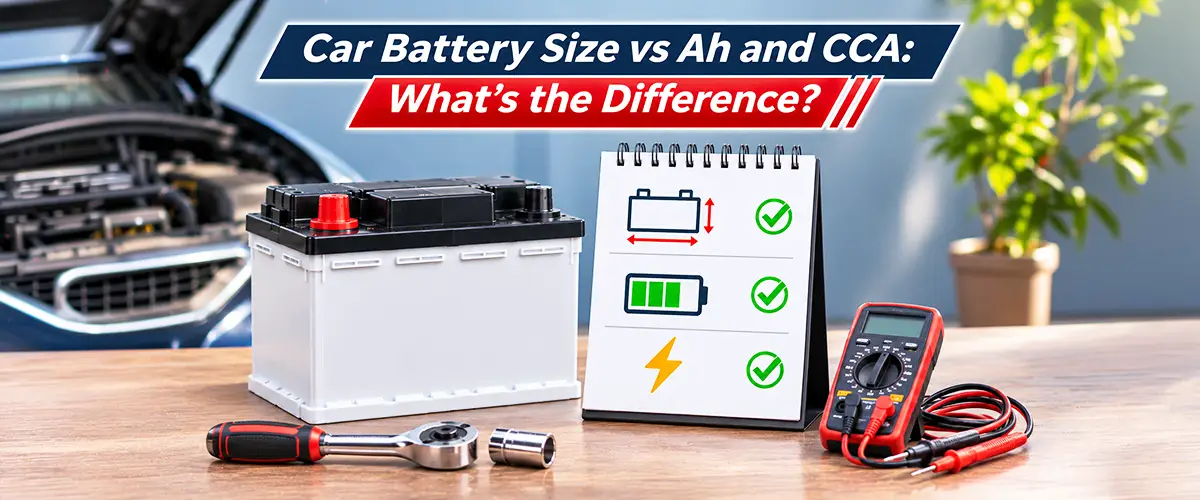
Battery size, Ah and CCA describe different characteristics. Physical size determines whether the battery fits. Amp-hours (Ah) indicate rated charge capacity, while cold cranking amps (CCA) indicate the ability to supply starting current under standardized cold conditions.
For example, two batteries may share the same external case size but offer different CCA ratings. One might provide adequate starting power for a smaller petrol engine, while another is designed for greater starting demand.
A higher Ah rating also does not guarantee higher CCA. These values should be checked independently against vehicle requirements. To understand these specifications, explore what Ah means on a battery and car battery CCA.
How to Find the Right Battery Size for Your Car
The easiest starting point is your vehicle owner’s manual or a reputable battery manufacturer’s fitment catalogue. The existing battery label can also help, provided the installed battery is already the correct specification.
Before purchasing a replacement:
- Identify your vehicle: Confirm its make, model, year and engine variant.
- Check the battery code: Look for BCI, JIS, DIN or EN markings.
- Verify dimensions: Confirm length, width and total height.
- Compare terminals: Check polarity, terminal position and connector type.
- Match electrical ratings: Confirm voltage, Ah and CCA requirements.
- Confirm chemistry: Use the manufacturer-approved battery technology.
- Check mounting: Make sure the battery can be secured with the original hold-down.
For example, if your existing battery is marked 55B24L, do not purchase a similar-looking 55B24R without confirming compatibility. A different terminal layout can make installation unsuitable even when the case dimensions are similar.
If the battery tray or cable connections show damage, have them inspected before installing the replacement. Severe car battery corrosion can also affect the reliability of electrical connections.
Does Battery Size Change for AGM and Start-Stop Cars?
Yes. Some modern vehicles require AGM or EFB batteries because their electrical systems demand greater cycling performance than ordinary flooded batteries provide. An AGM battery may have similar dimensions to a conventional battery, but that does not make the two technologies interchangeable.
Vehicles originally equipped with AGM batteries should generally receive manufacturer-approved AGM replacements. Some start-stop vehicles also require electronic battery registration after installation.
Our AGM battery guide explains its construction, while how a car battery works covers the relationship between starting power and vehicle electronics.
Common Car Battery Sizing Mistakes

Choosing a replacement based only on price, battery weight or the largest available Ah rating can create unnecessary problems.
Avoid these mistakes:
- Buying a battery that fits the tray but has reversed terminals.
- Ignoring battery height and bonnet clearance.
- Choosing insufficient CCA for the engine.
- Replacing an AGM battery with ordinary flooded technology without manufacturer approval.
- Installing a battery that cannot be secured properly.
A correctly sized battery should sit securely, allow safe cable connections and meet the vehicle’s electrical requirements. For readers comparing available products rather than understanding dimensions, our best car battery in Pakistan guide covers local selection considerations.
Conclusion
A car battery size guide helps you understand why battery replacement requires more than matching voltage or Ah capacity. Physical dimensions, terminal arrangement, mounting design, CCA and battery chemistry must all meet vehicle specifications.
BCI, JIS and DIN/EN codes provide useful size references, but the safest approach is to confirm compatibility through the owner’s manual or an approved fitment catalogue. Choosing the correct battery size ensures secure installation, proper connections and dependable starting performance.
Frequently Asked Questions
How Do I Know My Car Battery Size?
Check the existing battery label, vehicle owner’s manual or an approved manufacturer fitment guide. Confirm physical dimensions, terminal layout and electrical specifications.
Does Car Battery Size Mean Ah?
No. Battery size usually refers to physical dimensions and fitment. Ah describes rated charge capacity.
What Does 55B24L Mean on a Car Battery?
It is a JIS-style designation describing performance rank, case-size class, approximate length and terminal orientation. The number 55 does not automatically mean 55Ah.
Can I Use a Bigger Battery in My Car?
Only if the vehicle manufacturer approves the alternative and it fits securely with correct terminals, mounting, chemistry and electrical specifications.
What Is the Difference Between BCI and JIS Battery Sizes?
BCI and JIS are different battery classification systems. Both help identify fitment requirements, but their codes require proper cross-referencing.
Do AGM Batteries Have Different Sizes?
AGM batteries are available in several standard case sizes. However, matching dimensions alone does not guarantee compatibility with the vehicle.
Can Two 60Ah Batteries Have Different Sizes?
Yes. Batteries with the same Ah rating can have different dimensions, terminal positions and starting-current capabilities.
Is a Higher CCA Battery Always Better?
Not necessarily. The battery should meet the vehicle’s specified starting requirements while matching its size, chemistry and charging system.