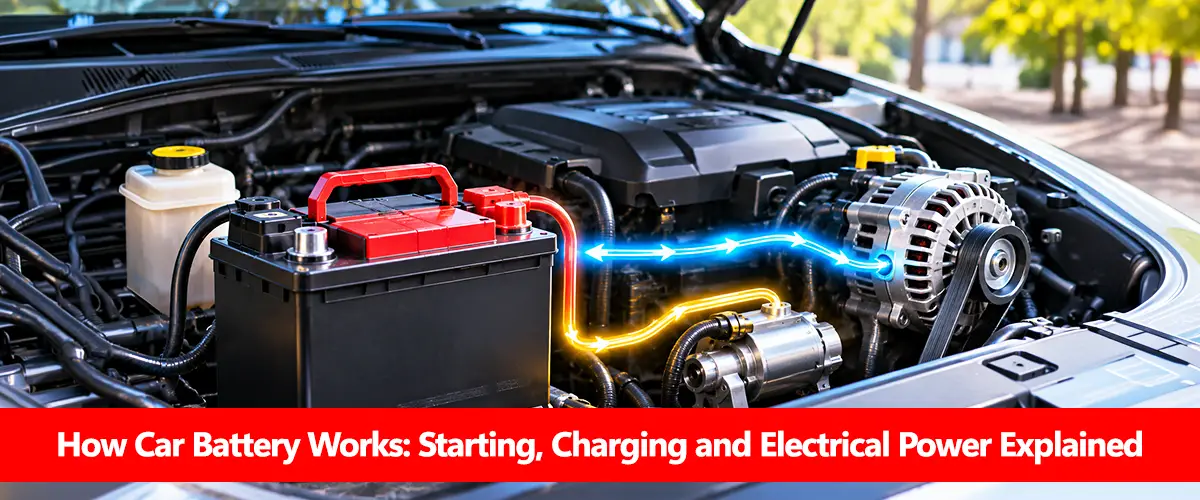
Understanding how car battery works starts with a simple principle: a car battery stores chemical energy and converts it into direct current (DC) electricity when the vehicle needs power. Its most important job is supplying a short burst of high electrical current to the starter motor, allowing the engine to begin running.
Most conventional petrol and diesel cars use a rechargeable 12V lead-acid battery. Once the engine starts, the alternator supplies electricity to the vehicle’s electrical system and replenishes energy used during starting. Our car battery guide covers the wider ownership essentials, while this article explains what actually happens inside the battery.
What Happens When You Start a Car?
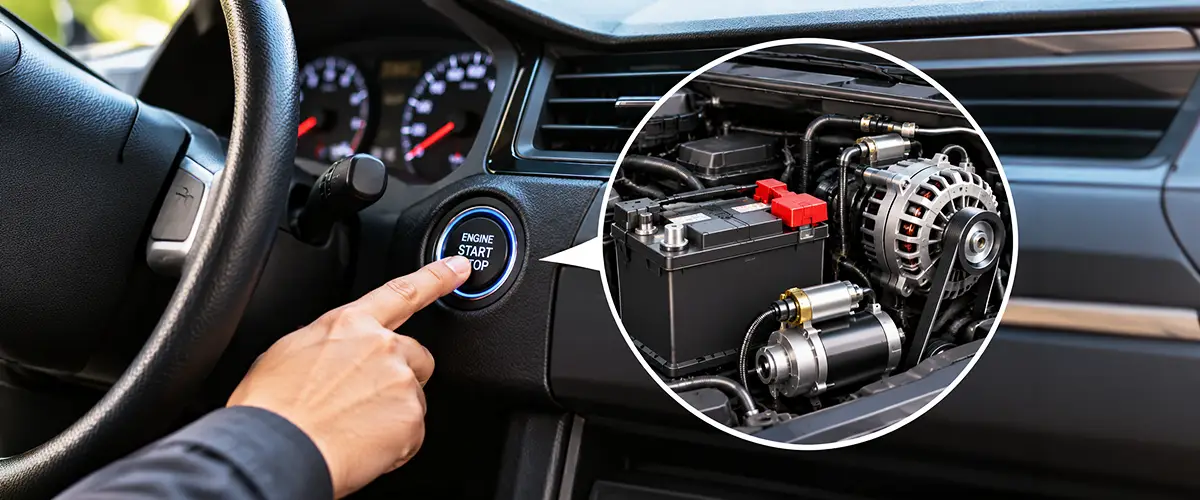
When you turn the ignition key or press the start button, the vehicle’s electrical system requests power from the battery. The starter motor needs substantial current to rotate the engine until it can run independently.
The starting process generally follows this sequence:
- Ignition is activated: The vehicle’s control circuit receives a start request.
- Battery supplies current: Stored chemical energy is converted into electrical energy.
- Starter motor engages: The starter rotates the engine’s crankshaft.
- Engine begins running: The fuel and ignition systems support combustion.
- Alternator generates electricity: The charging system begins supplying power and replenishing the battery.
A healthy starter battery can deliver high current for a short period, which is different from providing modest power continuously for several hours. This is why automotive starting batteries and deep-cycle batteries have different design priorities.
How Does a Car Battery Produce Electricity?
A conventional lead-acid car battery contains positive and negative plates surrounded by an electrolyte made from sulfuric acid and water. The positive plates contain lead dioxide, while the negative plates contain spongy lead. When an electrical load is connected, chemical reactions occur at both electrodes. During discharge, lead sulfate forms on the plates and water is produced as sulfuric acid participates in the reaction. Electrons flow through the external electrical circuit, supplying energy to the starter motor or other connected components. When the battery is recharged, the reaction reverses, restoring much of the original electrode material.
In simplified form:
Lead dioxide + Lead + Sulfuric acid ⇌ Lead sulfate + Water
The direction of the reaction depends on whether the battery is discharging or charging.
This reversible process is what makes a lead-acid battery rechargeable. For a broader explanation of stored chemical energy, see how batteries store energy.
Inside a 12V Car Battery: Main Components
A typical automotive lead-acid battery contains six electrochemical cells connected in series. Each cell produces approximately 2.1V when fully charged, giving a total resting voltage of roughly 12.6V.
| Component | Function |
| Positive plates | Participate in the lead-acid chemical reaction |
| Negative plates | Release electrons during discharge |
| Electrolyte | Supports ionic movement between electrodes |
| Separators | Keep plates apart while allowing ion movement |
| Cell connections | Connect individual cells in series |
| Terminals | Connect the battery to the vehicle |
| Battery case | Contains and protects internal components |
The battery produces DC electricity, which is appropriate for the vehicle’s low-voltage electrical system.
Although commonly called a 12V battery, its actual voltage varies with charging condition, temperature and electrical load. These differences are explained in car battery voltage and battery voltage explained.
How the Starter Motor Uses Battery Power
The starter motor converts electrical energy into mechanical rotation. When activated, it engages with the engine and turns the crankshaft until combustion can sustain engine operation. This process requires a relatively large electrical current for a short time. The exact starting current depends on engine design, temperature, starter condition and other factors. Car batteries are therefore rated using cold cranking amps (CCA), which measure starting-current capability under standardized cold-temperature conditions.
For example, a battery rated at 550 CCA is designed to deliver a specified high current during the CCA test. This does not mean the starter continuously consumes 550A whenever the vehicle starts. Understanding car battery CCA is important because a battery may have reasonable stored capacity yet struggle to supply sufficient starting current.
What Does the Alternator Do After the Engine Starts?
Once the engine is running, the alternator becomes the vehicle’s main electrical power source in a conventional combustion-engine car. The engine drives the alternator, which generates alternating current internally. Rectifier diodes convert that electricity into DC, while the charging system regulates output according to vehicle requirements.
The alternator supplies power to components such as headlights, vehicle electronics, ventilation fans and ignition-related systems. It also replenishes energy removed from the battery during starting.
| Operating Condition | Main Battery Role |
| Engine switched off | Supplies stored power to necessary electrical devices |
| Engine starting | Delivers high current to the starter motor |
| Engine running | Supports electrical demand and receives charge |
| Alternator output insufficient | May temporarily supplement the electrical system |
| Engine switched off again | Returns to supplying standby electrical loads |
The alternator does not necessarily recharge the battery completely after a very short journey. Repeated short trips can gradually leave the battery undercharged.
If a vehicle has recurring starting problems, the charging system should be checked alongside the battery. Our car battery keeps dying guide explores those causes.
How Does a Car Battery Recharge?
During charging, electrical energy supplied by the alternator or a suitable external charger reverses the chemical reaction inside the battery. Lead sulfate is converted back toward lead dioxide and spongy lead, restoring the chemical conditions needed for another discharge. A healthy charging system manages voltage and current to support battery charging without excessive overcharging. Conventional vehicles commonly show charging voltages above normal resting battery voltage, but modern smart-charging vehicles may intentionally vary their output.
Different battery designs also have different charging requirements. An AGM battery and a conventional flooded battery should not automatically be assumed to use identical charging settings. For practical charger selection and safety procedures, see how to charge a car battery.
Why Does a Car Battery Have Ah and CCA Ratings?
Car batteries have separate ratings because storing electrical energy and delivering starting current are different requirements.
Consider an illustrative 12V, 60Ah battery rated at 550 CCA:
| Rating | Value | Purpose |
| Nominal voltage | 12V | Identifies the electrical system |
| Capacity | 60Ah | Describes rated charge storage |
| Cold cranking amps | 550 CCA | Indicates standardized cold-starting capability |
| Nominal energy | About 720Wh | Approximate voltage × capacity |
The 720Wh figure represents nominal energy, not a recommended amount to withdraw during normal vehicle use.
Unlike a household backup battery, a conventional starter battery is designed for brief, high-current discharge followed by recharging. Repeated deep discharge can shorten its lifespan. For more on these specifications, read battery capacity and what Ah means on a battery.
How Does a Battery Power Electronics When the Engine Is Off?
A car battery continues supplying electricity even after the engine stops. This supports systems such as security alarms, clocks, central locking and selected vehicle computers.
Some electronic modules require a small standby current, commonly called parasitic draw. This is normal within manufacturer-defined limits.
However, an interior light left on, a faulty module or an incorrectly installed accessory can consume excessive power and leave the vehicle unable to start.
A weakened battery may also lose enough charge during normal parking to develop starting problems. If the vehicle repeatedly struggles after standing overnight, see car battery draining overnight for the dedicated diagnostic process.
Do All Car Batteries Work the Same Way?
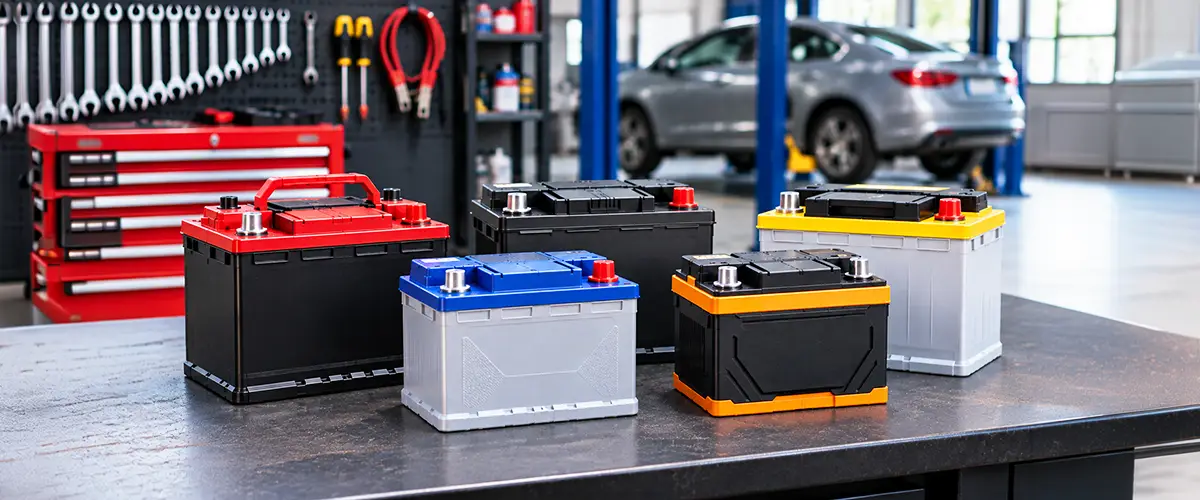
Most conventional petrol and diesel cars rely on a 12V lead-acid starter battery, but automotive battery designs differ. Flooded batteries contain liquid electrolyte, while AGM batteries absorb electrolyte into glass-fiber separators. Enhanced flooded batteries (EFB) are also used in selected vehicles with start-stop systems. These technologies use the same basic lead-acid electrochemistry but differ in construction and their ability to withstand particular operating conditions. Some vehicles use specialized lithium starter batteries, and many hybrid or electric vehicles have separate low-voltage batteries alongside their high-voltage traction systems. Replacement chemistry should always follow vehicle manufacturer requirements. The car battery size guide covers physical fitment, electrical ratings and compatibility.
Why Can a Fully Charged Car Battery Fail to Start the Engine?
A battery can indicate a relatively high resting voltage while still being unable to deliver adequate starting current. This can happen when the battery has deteriorated internally, developed excessive resistance or suffered from repeated undercharging. Loose terminals and corrosion may also restrict the current delivered to the starter. Alternatively, the problem may involve the starter motor or another part of the vehicle’s starting circuit.
Voltage alone is therefore not a complete measure of battery health. Professional conductance or load testing can help determine whether the battery can perform its starting function. Our guides on how to test a car battery and signs of a bad car battery cover these checks in greater detail.
What Helps a Car Battery Work Reliably?
Reliable starting depends on the battery, charging system and electrical connections working together. The battery should remain securely mounted, its terminals should be clean, and the alternator should recharge it correctly. Excessive heat, repeated deep discharge and prolonged undercharging can reduce its ability to supply starting current. Corroded terminals may interfere with charging and starting, while frequent short trips can contribute to insufficient recharge. For related maintenance concerns, see car battery corrosion. If the battery is already discharged, how to jump-start a car explains the appropriate precautions. However, repeated jump-starting is not a substitute for battery and charging-system testing.
A battery that can no longer deliver the required starting current may need replacement. Battery aging is covered separately in how long car batteries last.
Conclusion
Understanding how car battery works makes it easier to recognize the relationship between the battery, starter motor and alternator. A conventional car battery uses reversible lead-acid chemistry to store energy and provide DC electricity. It supplies high current during engine starting, supports electronics when the engine is off and receives charging energy once the engine runs.
Reliable operation depends on healthy battery cells, sufficient starting-current capability, proper charging and good electrical connections. The battery should be selected and maintained according to the vehicle manufacturer’s requirements.
Frequently Asked Questions
How Does a Car Battery Start the Engine?
The battery supplies high electrical current to the starter motor, which rotates the engine until combustion begins and the engine can operate independently.
Does a Car Battery Work Without the Alternator?
Yes, the battery can supply electricity temporarily without alternator output. However, it will eventually discharge because the alternator is responsible for replenishing charge while the engine runs.
Why Does a Car Battery Have Six Cells?
A conventional 12V lead-acid battery uses six cells connected in series. Each cell produces approximately 2.1V when fully charged, providing around 12.6V in total.
Does the Car Battery Charge While Driving?
Yes. In a conventional combustion-engine vehicle, the alternator normally supplies electrical power and recharges the battery while the engine runs. Actual charging depends on operating conditions.
Does a Car Battery Produce AC or DC?
A car battery produces direct current (DC). The alternator generates AC internally, which is rectified into DC for the vehicle’s electrical system.
Why Is a Car Battery 12V but Shows 12.6V?
Twelve volts is its nominal rating. A fully charged lead-acid battery normally produces approximately 2.1V per cell, resulting in about 12.6V across six cells.
Can a Battery Have Good Voltage but Still Be Bad?
Yes. A battery may show acceptable resting voltage but fail to deliver enough current for engine starting. Its health must be assessed through suitable performance testing.
Does a Car Battery Power the Vehicle While Driving?
The alternator normally provides most electrical power while the engine runs. The battery can supplement the system when demand temporarily exceeds charging-system output.
Why Does a Car Battery Lose Charge When Parked?
Vehicle electronics consume some standby electricity even when the engine is off. Excessive parasitic draw, internal self-discharge or a deteriorated battery can increase charge loss.
Is a Car Battery the Same as a UPS Battery?
Both may use lead-acid chemistry, but their designs can differ. Conventional car batteries prioritize high starting current, while many UPS batteries are intended for standby power or repeated backup discharge.