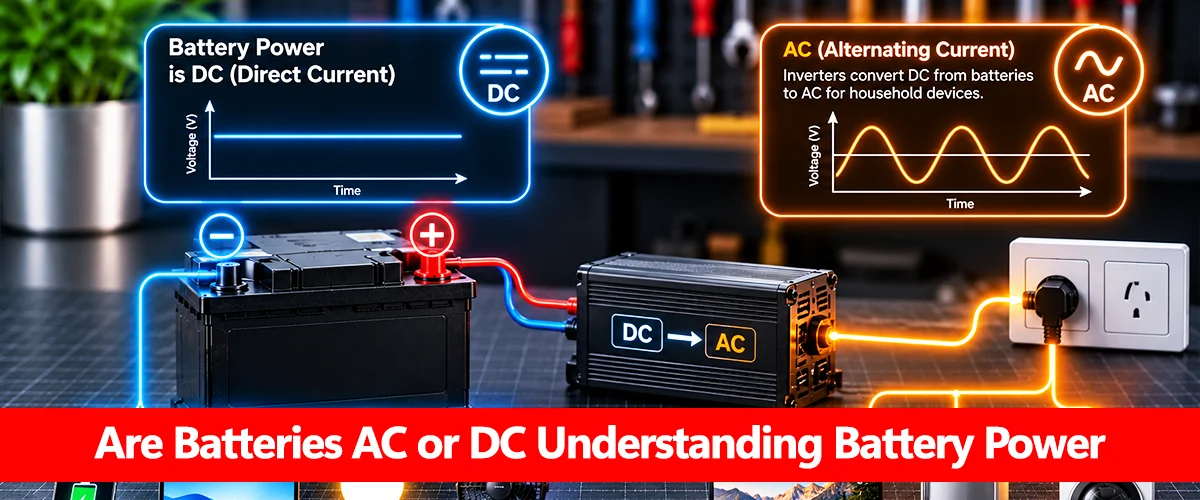
Are batteries AC or DC? The answer is DC (direct current), even when a battery powers an appliance that uses AC electricity. Every conventional electrochemical battery, from a small AA cell to a large solar battery bank, supplies direct current at its terminals. When AC power is needed, an inverter converts the battery’s DC output into alternating current.
This distinction matters when connecting batteries to UPS systems, solar inverters, chargers, and electrical appliances. Understanding where DC ends and AC begins helps prevent incorrect connections and explains how backup power systems operate.
Key Takeaways
- Batteries supply DC electricity, regardless of whether they use lead-acid, lithium-ion, or alkaline chemistry.
- DC flows in one direction, while AC reverses direction periodically.
- An inverter converts DC into AC for household appliances.
- A charger or rectifier converts AC into DC when charging a battery from the electricity grid.
Why Do Batteries Produce DC Instead of AC?
Batteries produce DC because their electrochemical reactions establish a consistent polarity between the positive and negative terminals during normal discharge. Electrons move through the external circuit from the negative terminal toward the positive terminal, while conventional current is defined in the opposite direction.
Inside the cell, the anode and cathode participate in oxidation and reduction reactions. The electrolyte allows ions to move between them, supporting the continuous flow of electrical current. These reactions create a voltage with a fixed polarity rather than the regularly reversing polarity found in AC electricity.
A battery’s voltage can decrease as it discharges, and the current can change with the connected load. It is still DC because its polarity does not alternate periodically. For the basic electrochemical principle, read what is a battery. Our guide to the parts of a battery explains the electrodes and electrolyte in greater detail.
What Is the Difference Between AC and DC Electricity?
The main difference is the direction of current flow. Direct current flows in one direction, while alternating current periodically reverses direction.
| Feature | DC (Direct Current) | AC (Alternating Current) |
| Current direction | One direction | Reverses periodically |
| Voltage polarity | Normally remains fixed | Alternates between positive and negative |
| Common sources | Batteries, solar panels, DC power supplies | Electricity grid, AC generators, inverters |
| Common applications | Electronics, battery storage, DC motors | Household appliances, commercial power systems |
| Frequency | No alternating frequency | Typically 50Hz or 60Hz |
| Conversion equipment | Inverter converts DC to AC | Rectifier converts AC to DC |
In Pakistan, the standard household electricity supply is approximately 230V AC at 50Hz. By comparison, batteries commonly provide DC voltages such as 1.5V, 12V, 24V, or 48V, depending on their chemistry and configuration. Neither current type is universally better. DC is essential for electrochemical storage and many electronic circuits, while AC is widely used for electricity distribution and household appliances.
Can a Battery Produce AC Electricity?
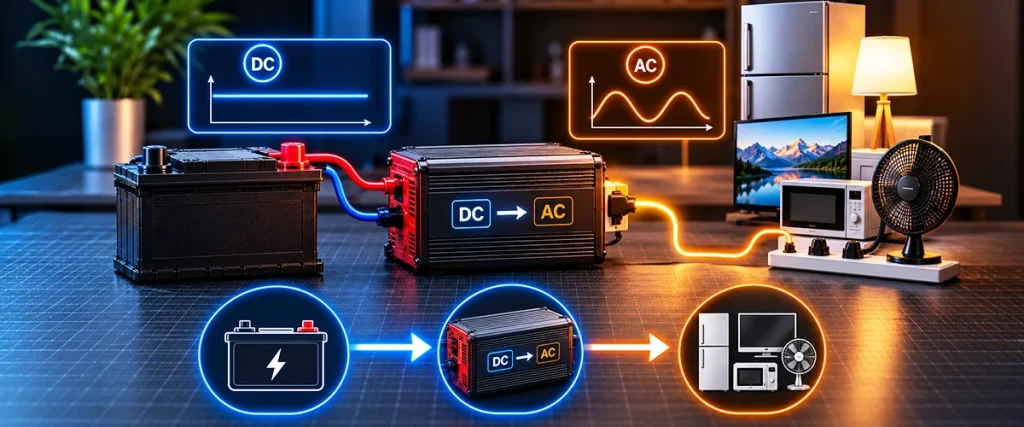
A battery cell does not directly produce alternating current. However, a battery-powered system can deliver AC electricity when it includes an inverter. An inverter uses electronic switching circuits to convert DC input into an alternating output. Suitable inverter designs also regulate the output voltage and frequency so that compatible AC equipment can operate.
For example, a home backup system may use a 12V or 24V DC battery bank and an inverter that provides approximately 230V AC at 50Hz. The battery itself remains a DC source. The inverter is responsible for producing the AC output.
How Does an Inverter Convert Battery DC to AC?
The conversion follows a straightforward electrical pathway:
- DC input: The battery supplies direct current to the inverter.
- Electronic conversion: Power electronics switch and regulate the DC input to create an alternating waveform.
- AC output: The inverter delivers AC electricity at the required voltage and frequency.
Power flow:
Battery (DC) → Inverter → AC Appliances
This conversion involves some energy loss, so the electrical energy delivered to appliances is lower than the energy drawn from the battery.
How Do AC and DC Work in UPS Systems?
A UPS (uninterruptible power supply) uses batteries to provide backup electricity when the main power source fails. Although the connected appliances may use AC, the battery inside the system supplies DC.
In a typical battery-backed UPS arrangement, a charging circuit converts incoming AC electricity into DC to charge the battery. During a power interruption, an inverter uses the stored energy to supply AC electricity to the connected equipment.
| UPS Component | Electrical Function |
| Grid input | Supplies AC electricity |
| Charger or rectifier | Converts AC to DC |
| Battery | Stores chemical energy and supplies DC |
| Inverter | Converts DC to AC |
| UPS output | Supplies AC to connected appliances |
The exact power path depends on whether the UPS uses standby, line-interactive, or online double-conversion technology. Some designs normally pass grid power to the load, while others continuously supply power through an inverter.
Are UPS Batteries AC or DC in Pakistan?
UPS batteries used in Pakistani homes and offices are DC batteries. Common systems use 12V, 24V, or 48V battery configurations, depending on the equipment.
During load shedding, the inverter converts stored DC power into AC electricity for fans, lights, computers, and other supported appliances. A UPS battery should never be connected directly to household AC wiring. The inverter, protection equipment, and system connections must be designed for the intended load.
Are Solar Batteries AC or DC?
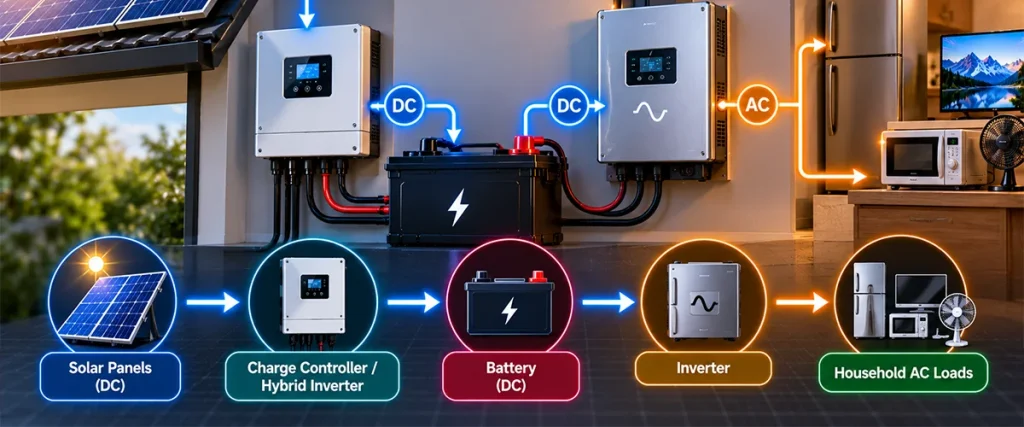
Solar batteries also operate on DC electricity. Solar panels generate DC power, which can be used to charge a battery through suitable charging electronics. An inverter converts DC electricity into AC when household appliances need it.
In a DC-coupled solar system, solar generation and battery storage are connected on the DC side of the system. In an AC-coupled arrangement, the battery system uses conversion equipment to exchange energy with an AC electrical network. Both configurations still use batteries that charge and discharge through DC electrical connections.
Typical solar power flow:
Solar Panels (DC) → Charge Controller / Hybrid Inverter → Battery (DC) → Inverter → Household AC Loads
The actual arrangement varies with the solar system design.
In Pakistan, hybrid solar inverters commonly manage solar generation, battery charging, grid input, and backup electricity. The battery chemistry may be lead-acid or lithium-based, but the underlying DC operation remains the same.
Are All Battery Types DC?
Yes. Common electrochemical battery chemistries supply DC electricity at their terminals during normal operation.
| Battery Type | Typical Nominal Voltage | Output |
| Alkaline AA cell | 1.5V | DC |
| Lead-acid car battery | 12V | DC |
| Lithium-ion cell | 3.6V or 3.7V | DC |
| LiFePO4 cell | 3.2V | DC |
| NiMH rechargeable cell | 1.2V | DC |
These values are nominal ratings. Actual terminal voltage changes with state of charge, load, and chemistry. For a more detailed explanation of nominal and operating voltage, read battery voltage explained.
What About Batteries Advertised as AC Batteries?
Some home energy storage products are marketed as AC batteries because they include an integrated inverter and connect to an AC electrical system. This describes the complete storage product, not the electrochemical cells inside it. The cells still operate using DC, while built-in electronics handle AC-to-DC and DC-to-AC conversion. Similarly, portable power stations may provide both AC sockets and DC ports. Their internal battery cells remain DC devices.
Does AC or DC Affect Battery Performance?
The battery’s DC output determines how it connects to chargers, inverters, and electrical equipment. Voltage and current ratings must match the requirements of the connected system.
For example, a 12V DC battery cannot directly replace a 230V AC household supply. It needs suitable conversion equipment, and the available power depends on the battery, inverter, and electrical load.
A battery’s rated capacity also does not tell you how long an AC appliance will run. Usable energy, discharge limits, inverter efficiency, and appliance consumption all influence runtime. Our battery capacity guide explains the difference between charge capacity and available energy.
What Are Common Misconceptions About AC and DC Batteries?
Several misunderstandings arise because batteries are frequently used inside systems that handle both AC and DC electricity.
| Misconception | Correct Explanation |
| A UPS battery produces AC | The battery supplies DC; the inverter produces AC |
| A solar battery stores AC electricity | The cells store chemical energy and charge/discharge through DC |
| A 12V battery always provides exactly 12V | Terminal voltage varies with operating conditions |
| A battery becomes AC when connected to an inverter | The inverter converts its DC output into AC |
| AC batteries use a different kind of electrochemical current | The term usually refers to integrated AC conversion equipment |
Recognizing the difference between the battery and the equipment connected to it helps prevent confusion when reading product specifications.
Conclusion
Are batteries AC or DC? Batteries are DC power sources. Their electrochemical reactions create a fixed-polarity electrical output, while inverters convert that DC into AC whenever household appliances or other AC equipment need it. This distinction is especially important for UPS and solar systems in Pakistan, where batteries provide backup power during electricity interruptions. Understanding the difference helps you interpret equipment specifications and avoid incorrect electrical connections.
To continue learning, explore our guides to battery voltage, battery capacity, and how batteries store energy. You can also browse the Battery Fundamentals category at Batteries Hub.
Frequently Asked Questions
Is a 12V Battery AC or DC?
A 12V battery supplies DC electricity. The 12V rating describes its nominal voltage, not alternating current. An inverter is required to power AC appliances from it.
Are Car Batteries AC or DC?
Car batteries supply DC electricity. They provide power for engine starting and vehicle electrical systems. The alternator generates electrical power that is rectified to DC for charging the battery and supporting the vehicle’s electrical loads.
Are Lithium-Ion Batteries AC or DC?
Lithium-ion batteries are DC devices. Their chemistry produces a fixed-polarity electrical output during normal discharge, whether they are used in phones, laptops, or large energy storage systems.
Can You Charge a DC Battery With AC Electricity?
Yes, but AC must first be converted into suitable DC charging power. A compatible battery charger or inverter-charger performs this conversion and controls the charging process.
Do Batteries Have a Frequency of 50Hz or 60Hz?
No. A battery’s normal DC output does not alternate at 50Hz or 60Hz. Those frequencies describe AC electricity. An inverter connected to the battery can generate AC at the required frequency.
Can You Connect an AC Appliance Directly to a Battery?
Not if the appliance requires AC electricity. A suitable inverter is needed to convert the battery’s DC output into the required AC supply. Some appliances have internal electronics or adapters that accept DC, but their input ratings must be checked.
Why Do Solar Inverters Use DC Batteries?
Solar panels and batteries operate with DC electrical connections. Inverters manage power conversion so stored energy can supply AC appliances. Some hybrid systems also manage battery charging and electricity from the grid.