
Battery capacity tells you how much electrical charge a battery can deliver, but the number printed on its label does not always reflect how much energy you can actually use. A 100Ah battery, for example, may provide different amounts of usable energy depending on its voltage, chemistry, discharge rate, and operating conditions.
This distinction matters when choosing batteries for UPS systems, solar storage, vehicles, and portable electronics. Understanding capacity helps you compare ratings correctly, estimate available energy, and avoid assuming that a higher Ah number always means better performance.
In this guide, you’ll learn what battery capacity means, how amp-hours and watt-hours differ, and why rated capacity is not always the same as usable capacity.
Key Takeaways
- Battery capacity measures the electric charge a battery can deliver and is commonly rated in amp-hours (Ah) or milliamp-hours (mAh).
- Watt-hours (Wh) describe energy capacity by accounting for both voltage and charge capacity.
- Rated capacity is measured under defined conditions, while usable capacity depends on operating limits and battery performance.
- Discharge rate, temperature, and aging can affect how much charge and energy a battery delivers.
What Is Battery Capacity?

Battery capacity is the amount of electric charge a battery can deliver during discharge, measured under defined test conditions. It is usually expressed in ampere-hours (Ah) for larger batteries and milliampere-hours (mAh) for smaller cells. One ampere-hour represents 3,600 coulombs of electric charge. In practical terms, a 100Ah rating indicates a charge capacity of 100 amp-hours at the manufacturer’s specified discharge conditions.
For example, a battery rated at 100Ah might theoretically supply 5A for 20 hours. Actual performance depends on the discharge rate, chemistry, temperature, and condition of the battery. Capacity is different from voltage. Voltage describes electrical potential difference, while capacity describes how much charge can be delivered. Both measurements are needed to understand the battery’s energy rating. For the electrical basics, read our guide to battery voltage.
How Is Battery Capacity Measured?
Battery capacity is measured by discharging a fully charged battery at a controlled current until it reaches a specified cutoff voltage. The total charge delivered during the test determines its amp-hour rating. Manufacturers follow defined testing procedures because capacity changes with discharge conditions. A battery tested at a low current may deliver more charge than the same unit discharged at a much higher current.
The most common capacity measurements are:
| Unit | Meaning | Common Use |
| Ampere-hour (Ah) | Electric charge capacity | Car, UPS, solar, and deep-cycle batteries |
| Milliampere-hour (mAh) | One-thousandth of an Ah | Phones, power banks, and small cells |
| Watt-hour (Wh) | Electrical energy capacity | Portable electronics and battery packs |
| Kilowatt-hour (kWh) | 1,000 watt-hours | Home storage and larger energy systems |
Although Ah and mAh measure charge, Wh and kWh measure energy. These values should not be treated as interchangeable.
What Is the Difference Between Ah and Wh?
Amp-hours measure charge capacity, while watt-hours measure energy capacity. A battery’s voltage determines how much electrical energy is associated with a given amount of charge.
A useful nominal relationship is:
Energy (Wh) = Nominal Voltage (V) × Capacity (Ah)
Consider two batteries:
| Battery | Rated Capacity | Nominal Energy |
| 12V battery | 100Ah | 1,200Wh |
| 24V battery | 100Ah | 2,400Wh |
Both have the same Ah rating, but the 24V battery has twice the nominal energy. This is why comparing batteries using Ah alone can be misleading when their voltages differ. Watt-hours provide a more useful basis for comparing stored electrical energy. For a closer explanation of the units, see what Ah means on a battery and our guide to battery watt-hours.
What Is Rated Battery Capacity?
Rated capacity is the charge a manufacturer states a battery can deliver under particular test conditions. Those conditions may include discharge current, temperature, cutoff voltage, and test duration.
For example, a lead-acid battery may carry a 100Ah rating at the 20-hour rate (C20). This means its rated capacity was determined over a 20-hour discharge period under the applicable test conditions. The rating does not guarantee that the same battery will deliver 100Ah at every discharge current. High-current operation, low temperatures, and aging can reduce the available capacity. When comparing products, check the rating conditions rather than relying on the Ah figure alone.
What Is Usable Battery Capacity?
Usable battery capacity is the portion of rated capacity that can be discharged within the system’s permitted operating limits. It depends on the battery chemistry, discharge cutoff, depth of discharge, and condition.
For example, if a 100Ah battery is operated with an 80% depth-of-discharge limit, the permitted charge withdrawal is approximately 80Ah under the assumed rating conditions.
The remaining capacity is not necessarily unavailable because of a defect. It may be intentionally reserved to protect the battery or meet its operating requirements.
Rated Capacity vs Usable Capacity
| Feature | Rated Capacity | Usable Capacity |
| Meaning | Charge delivered under the manufacturer’s test conditions | Charge available within permitted operating limits |
| Typical unit | Ah or mAh | Ah or mAh |
| Depends on | Test rate, temperature, cutoff voltage | Discharge limits, operating conditions, battery condition |
| Main purpose | Standardized product rating | Practical system planning |
Usable energy is a related but different measurement. It is expressed in Wh or kWh and accounts for the energy delivered over the usable discharge range.
How Does Discharge Rate Affect Battery Capacity?
Discharge rate describes how quickly current is drawn from a battery. It is often expressed using the C-rate, which relates discharge current to rated capacity.
For a 100Ah battery:
- 0.1C corresponds to a discharge current of 10A.
- 0.5C corresponds to 50A.
- 1C corresponds to 100A.
These values describe current relative to the rated capacity; they do not guarantee a specific runtime. Lead-acid batteries commonly deliver less usable charge at higher discharge currents because of their discharge characteristics. This behavior is often described using Peukert’s law.
Lithium-ion batteries generally show a different relationship between discharge rate and available capacity, although high current can still increase heat, voltage drop, and losses. The manufacturer’s discharge curves provide a more reliable indication of real-world performance than a simple Ah rating.
What Factors Affect Battery Capacity?
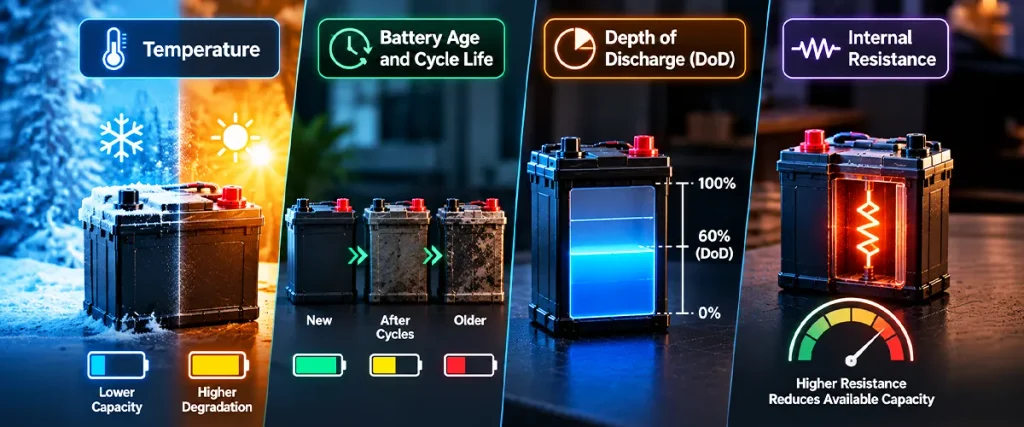
Several operating conditions influence how much charge and energy a battery can deliver.
Temperature
Low temperatures slow electrochemical reactions and can reduce available capacity, particularly under heavy loads. Excessive heat may temporarily change performance but accelerates degradation and shortens service life.
Battery Age and Cycle Life
Rechargeable batteries gradually lose capacity through chemical and structural changes. Repeated charging and discharging, high temperatures, and unsuitable operating conditions can accelerate this process.
A battery that originally delivered 100Ah may provide less charge after years of use, even if its nominal voltage rating remains unchanged.
Depth of Discharge (DoD)
Depth of discharge describes how much of a battery’s rated capacity has been used. A 60% DoD means 60% of the reference capacity has been discharged.
Permitted discharge limits vary by chemistry and product design. Using the correct limits helps balance available capacity with expected service life.
Internal Resistance
Internal resistance causes voltage drop and energy loss when current flows. As resistance increases, the battery may reach its discharge cutoff earlier under load, reducing the capacity available in that operating situation. These factors explain why a capacity rating should be interpreted alongside the manufacturer’s operating specifications.
How Does Battery Chemistry Affect Capacity?
Different battery chemistries offer different energy densities, discharge characteristics, and usable-capacity limits.
| Battery Chemistry | Capacity Characteristics | Common Applications |
| Flooded lead-acid | Available capacity can fall significantly at high discharge rates | UPS, backup systems |
| AGM lead-acid | Sealed construction with performance dependent on discharge rate and design | Vehicles, standby power |
| Lithium-ion | Generally higher energy density than lead-acid | Electronics, electric vehicles |
| LiFePO4 | Often supports deep cycling with long service life | Solar and backup storage |
| NiMH | Rechargeable with moderate energy density | Household electronics |
AGM is a lead-acid battery design, while LiFePO4 is part of the lithium-ion family. Capacity should not be judged by chemistry alone. Two products using the same chemistry may have different rated capacities, discharge limits, and expected lifespans.
Why Does Battery Capacity Matter for UPS and Solar Systems in Pakistan?
Battery capacity is particularly important for households and businesses in Pakistan that rely on backup electricity during load shedding.
A UPS or solar storage system must have enough usable energy to support the connected electrical load for the required period. A battery with insufficient capacity may reach its discharge limit before grid electricity returns or solar generation becomes available.
When evaluating a system, consider:
- Electrical load: The total power consumed by connected appliances.
- Required backup duration: How long the equipment needs to operate.
- Battery voltage: The voltage required by the inverter or UPS.
- Usable energy: The amount available within the battery’s operating limits.
- Conversion efficiency: Energy lost in the inverter and other equipment.
For example, a 12V 100Ah battery has approximately 1.2kWh of nominal energy. However, the usable AC energy available to household appliances will be lower because of discharge limits and inverter losses. For application-specific selection, see our guide on choosing UPS battery capacity.
What Are Common Misconceptions About Battery Capacity?
| Misconception | Correct Explanation |
| Higher Ah always means longer runtime | Voltage, load, and usable capacity also matter |
| Ah and Wh measure the same thing | Ah measures charge; Wh measures energy |
| Rated capacity is always fully usable | Operating limits and discharge conditions affect usable capacity |
| Two 100Ah batteries store equal energy | Their nominal voltages may differ |
| Capacity remains constant throughout battery life | Aging and operating conditions can reduce it |
Understanding these differences helps you compare battery specifications without confusing charge capacity, stored energy, and practical runtime.
Conclusion
Battery capacity describes how much electric charge a battery can deliver, while watt-hours indicate its stored electrical energy. Understanding the difference between rated capacity and usable capacity is essential for comparing batteries and estimating their practical performance.
For UPS and solar systems in Pakistan, choosing the right capacity means considering the electrical load, required backup duration, voltage, discharge limits, and inverter efficiency—not just the Ah rating printed on the label.
Next, explore our guides to battery watt-hours, battery runtime calculations, and UPS battery capacity selection. Find more battery education in the Battery Fundamentals category at Batteries Hub.
Frequently Asked Questions About Battery Capacity
What Does 100Ah Mean on a Battery?
A 100Ah battery has a rated charge capacity of 100 amp-hours under the manufacturer’s test conditions. It does not necessarily deliver 100A for one hour or provide the same runtime under every load.
Is a Higher Ah Battery Better?
Not always. A higher Ah rating indicates greater charge capacity under comparable conditions, but the correct choice also depends on voltage, chemistry, size, weight, and equipment compatibility.
What Is the Difference Between mAh and Ah?
Both measure electric charge capacity. One amp-hour equals 1,000 milliamp-hours, so a 5,000mAh rating equals 5Ah.
Read our guide to mAh on a battery for more detail.
Does Battery Capacity Affect Voltage?
Capacity and voltage are different specifications. A battery can lose usable capacity as it ages while retaining the same nominal voltage rating.
How Do You Calculate Battery Capacity?
Capacity in Ah can be determined from the discharge current and time under suitable test conditions. Energy capacity also depends on voltage. For step-by-step methods, see how to calculate battery capacity.
How Long Will a 100Ah Battery Last?
Runtime depends on the connected load, voltage, permitted discharge depth, and system efficiency. Two 100Ah batteries can provide different runtimes under different operating conditions. Our guide on calculating battery runtime explains the process with practical examples.
Does Battery Capacity Decrease Over Time?
Yes. Rechargeable batteries gradually lose capacity through aging and repeated cycling. Temperature, charging practices, and discharge conditions influence how quickly this happens.