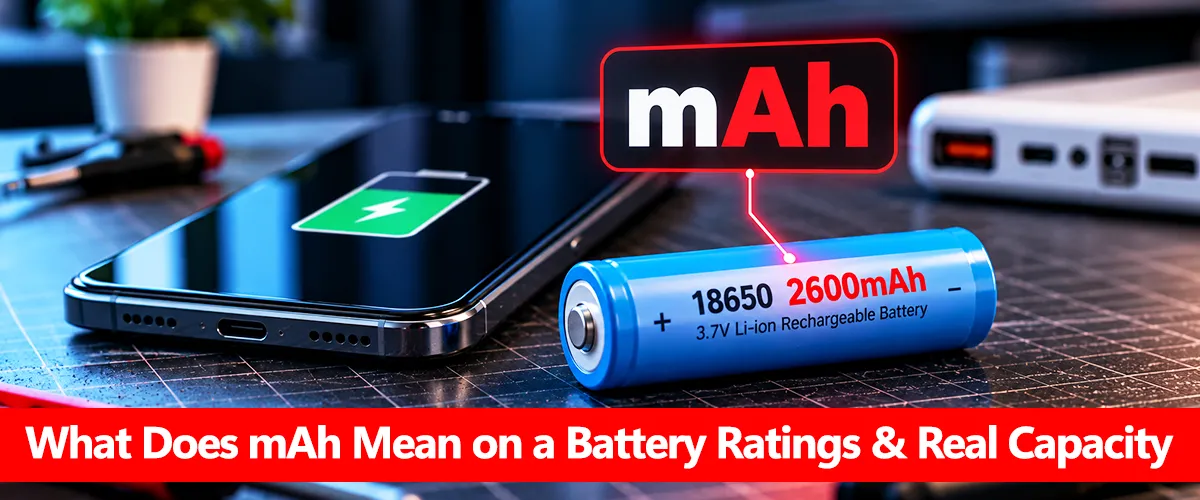
What does mAh mean on a battery? It stands for milliampere-hour, a unit used to measure a battery’s electric charge capacity. A smartphone battery labeled 5,000mAh has a rated capacity of 5,000 milliampere-hours, but that number alone cannot tell you exactly how long the phone will last.
You will find mAh ratings on smartphones, power banks, wireless earbuds, rechargeable batteries, and other portable devices. Understanding what those numbers represent makes it easier to interpret product specifications, compare similar batteries, and recognize why advertised capacity can differ from everyday performance.
Key Takeaways
- mAh stands for milliampere-hour, a measurement of electric charge capacity.
- 1,000mAh equals 1Ah. Both units measure the same quantity.
- Higher mAh generally means more charge capacity, provided the batteries have comparable voltage and rating conditions.
- Battery life depends on more than mAh, including device power consumption, voltage, battery age, and operating conditions.
What Does mAh Mean on a Battery Label?
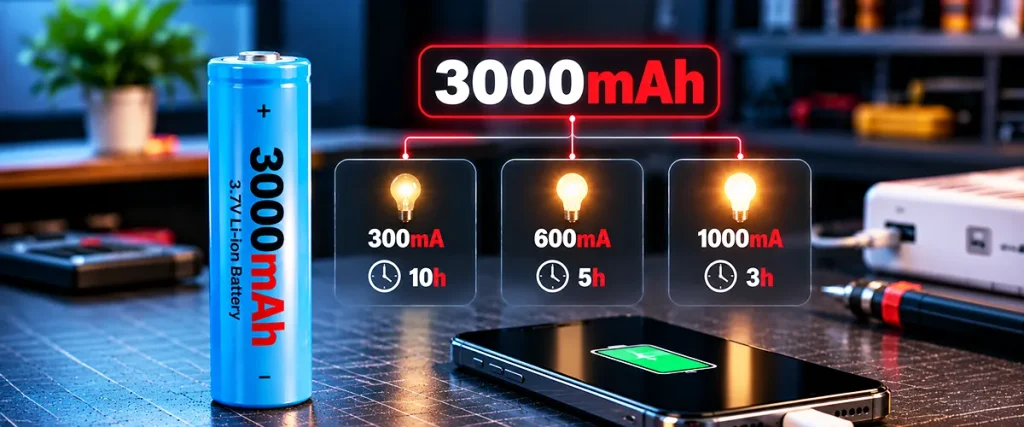
The abbreviation mAh combines two units: milliampere (mA), which measures electric current, and hour (h), which measures time. One milliampere-hour represents the electric charge delivered by a current of one milliampere over one hour.
For example, a battery rated at 3,000mAh could theoretically deliver:
- 300mA for 10 hours
- 600mA for 5 hours
- 1,000mA for 3 hours
These are simplified examples assuming constant current and full rated capacity. Real batteries do not always deliver their complete rating under every load, temperature, or discharge condition. The important point is that mAh describes charge capacity, not the speed of charging or the electrical power a battery can deliver.
What Do 3,000mAh, 5,000mAh, and 10,000mAh Mean?
The number before mAh tells you the battery’s rated charge capacity. Larger numbers represent greater capacity under comparable measurement conditions.
| Battery Rating | Equivalent in Ah | Typical Application |
| 500mAh | 0.5Ah | Small rechargeable devices |
| 1,000mAh | 1Ah | Compact electronics |
| 3,000mAh | 3Ah | Smartphone or individual lithium-ion cell |
| 5,000mAh | 5Ah | Smartphones and portable devices |
| 10,000mAh | 10Ah | Power banks |
| 20,000mAh | 20Ah | Higher-capacity power banks |
These examples show common uses, not fixed capacity standards for particular products. A 5,000mAh battery has more rated charge capacity than a 3,000mAh battery. If both operate at similar voltages and power the same device under identical conditions, the higher-capacity battery would generally provide longer operation.
That does not mean every phone with a 5,000mAh battery will outlast every phone with a 3,000mAh battery. Device efficiency and usage can make a substantial difference.
Does Higher mAh Mean Longer Battery Life?
Generally, yes, when comparing otherwise similar batteries and devices. More charge capacity gives a battery the potential to operate longer before recharging.
Consider two smartphones with identical processors, displays, software, and usage patterns. If one has a 4,000mAh battery and the other has a 5,000mAh battery at the same nominal voltage, the second phone has approximately 25% more rated charge capacity. Its actual battery life may not increase by exactly 25%, however. Power consumption changes throughout the day, and the usable capacity of each battery depends on its condition and discharge limits.
Why Can a Phone With Lower mAh Last Longer?
Battery size is only one part of smartphone efficiency. A phone with a smaller battery can sometimes last longer because it consumes less power. Factors include display brightness and refresh rate, processor efficiency, background applications, mobile network signal strength, camera use, gaming, and software optimization.
For example, a power-efficient phone with a 4,500mAh battery may outlast a less efficient device with a 5,000mAh battery. The capacity rating is useful, but it should not be treated as a complete battery-life prediction.
Why Is Power Bank Capacity Different From Its Advertised mAh?
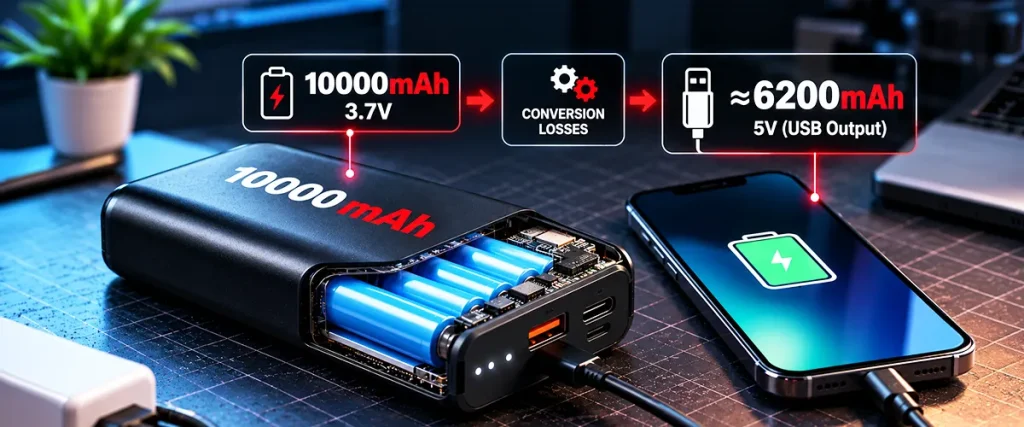
A 10,000mAh power bank does not necessarily deliver 10,000mAh through its USB output. This is one of the most common sources of confusion when reading battery specifications. Many lithium-ion power banks advertise the combined capacity of their internal cells at a nominal voltage of approximately 3.7V. Standard USB output may operate at 5V, while fast-charging systems can use higher voltages.
The power bank must convert the battery’s voltage to the required output. Because the voltage changes, the amount of charge measured in mAh at the USB output is not the same as the internal cell rating. Conversion also consumes some energy.
Example: A 10,000mAh Power Bank
Consider a power bank with a 10,000mAh internal battery rating at 3.7V. Its nominal stored energy is approximately 37Wh. At a 5V USB output, that energy would correspond to a theoretical maximum of 7,400mAh before conversion losses. If the conversion process were 85% efficient, the output would be approximately 6,290mAh at 5V.
This is an illustrative example, not a guaranteed output for every power bank. Actual results depend on its design, operating temperature, output voltage, current, and efficiency. A phone may receive even less usable energy because its own charging electronics also introduce losses.
Practical tip: When comparing power banks, check both the advertised mAh rating and the watt-hour (Wh) or rated USB output capacity, where provided.
What Is the Difference Between mAh and Ah?
mAh and Ah measure the same electrical quantity: charge capacity. The difference is the size of the unit.
1Ah = 1,000mAh
For example:
| mAh | Ah |
| 500mAh | 0.5Ah |
| 2,000mAh | 2Ah |
| 5,000mAh | 5Ah |
| 10,000mAh | 10Ah |
| 20,000mAh | 20Ah |
Small batteries are commonly labeled in mAh because it is a convenient way to express their capacity without decimals. Larger batteries, including UPS and solar batteries, are generally labeled in Ah. For a detailed explanation of the larger unit, read what Ah means on a battery.
Is mAh the Same as Watt-Hours?
No. mAh measures electric charge, while watt-hours measure energy. This distinction matters because two batteries with identical mAh ratings can store different amounts of energy if their voltages differ.
For example, a 5,000mAh battery rated at 3.7V has approximately 18.5Wh of nominal energy. A 5,000mAh battery rated at 7.4V has approximately 37Wh.
Both have the same charge capacity, but the second has twice the nominal energy. Watt-hours are therefore more useful when comparing the energy stored in batteries operating at different voltages. Our guides to battery watt-hours and Ah vs Wh explain this distinction further.
What Affects the Actual Capacity of a Battery?
The mAh rating printed on a battery represents capacity under defined conditions. The charge it can deliver in everyday use may change because of several factors.
- Battery age: Rechargeable batteries gradually lose capacity through chemical aging. An older 5,000mAh battery may no longer deliver its original rated charge.
- Temperature: Cold conditions can temporarily reduce available capacity, while excessive heat accelerates long-term deterioration.
- Discharge rate: Drawing a high current can increase voltage drop and reduce the capacity available before the battery reaches its discharge cutoff.
- Battery chemistry: Lithium-ion, nickel-metal hydride, and other chemistries have different discharge characteristics and operating limits.
- Protection systems: Battery management electronics may stop discharge before the cell reaches a damaging voltage level.
These factors explain why a battery’s real-world performance cannot be predicted from mAh alone.
How Should You Read mAh Ratings When Comparing Devices?
When looking at smartphone or power bank specifications, use mAh as a starting point rather than the only comparison. For smartphones, compare battery capacity alongside independent battery-life testing, processor efficiency, display specifications, and charging features.
For power banks, check the internal capacity, nominal voltage, watt-hour rating, output power, and supported charging standards. A power bank with a large mAh rating may still charge a laptop slowly—or not at all—if its USB output does not support the required power.
For replacement batteries, capacity is not enough to establish compatibility. Voltage, physical dimensions, connector design, chemistry, and manufacturer requirements must also match. In Pakistan, power banks can be particularly useful during electricity interruptions, but a large advertised capacity should not replace checking product specifications, safety protections, and warranty information.
Common Misconceptions About mAh
| Misconception | Correct Explanation |
| Higher mAh always means longer phone battery life | Device power consumption also matters |
| 10,000mAh means 10,000mAh delivered through USB | Output voltage and conversion losses affect delivered charge |
| mAh measures charging speed | Charging speed depends on voltage, current, and charging controls |
| Two batteries with equal mAh store equal energy | Their voltages may differ |
| A battery always retains its original mAh capacity | Available capacity generally decreases with aging |
Conclusion
What does mAh mean on a battery? It means milliampere-hour, the unit used to describe how much electric charge a battery can deliver under its rated conditions. A higher mAh rating generally indicates greater charge capacity, but it does not guarantee longer device runtime or faster charging.
When comparing smartphone batteries, power banks, and other portable devices, consider the mAh rating together with voltage, energy capacity, device efficiency, and battery condition. For more battery fundamentals, read our guides to battery capacity, ampere-hours, and battery watt-hours. You can also explore the Battery Fundamentals category and more educational articles at Batteries Hub.
Frequently Asked Questions
What Is the Full Form of mAh?
mAh stands for milliampere-hour, a unit of electric charge used to express battery capacity.
Is a 5,000mAh Battery Good for a Smartphone?
A 5,000mAh rating provides substantial charge capacity for many modern smartphones. Actual battery life depends on the phone’s efficiency, display, applications, connectivity, and usage patterns.
Is 10,000mAh Better Than 5,000mAh?
A 10,000mAh battery has twice the rated charge capacity of a 5,000mAh battery. When voltage and rating conditions are comparable, it also has approximately twice the nominal stored energy. Whether it is the better choice depends on device requirements, weight, size, and intended use.
Does Higher mAh Mean Faster Charging?
No. mAh measures capacity, not charging speed. A higher-capacity battery may actually require more time to charge when using the same charging power.
How Many Times Can a 10,000mAh Power Bank Charge a Phone?
There is no fixed answer. The number of charges depends on the phone battery’s energy capacity, the power bank’s output efficiency, charging losses, and whether the phone is being used while charging. A 10,000mAh power bank should not be assumed to provide exactly two complete charges to a 5,000mAh phone.
Is mAh More Important Than Voltage?
Neither measurement replaces the other. mAh describes charge capacity, while voltage describes electrical potential difference. Both are needed to understand a battery’s nominal energy.
Can You Replace a 2,000mAh Battery With a 3,000mAh Battery?
Only if the replacement is compatible with the device. A higher mAh rating alone does not establish compatibility. The voltage, chemistry, connector, dimensions, charging requirements, and safety specifications must also be suitable.