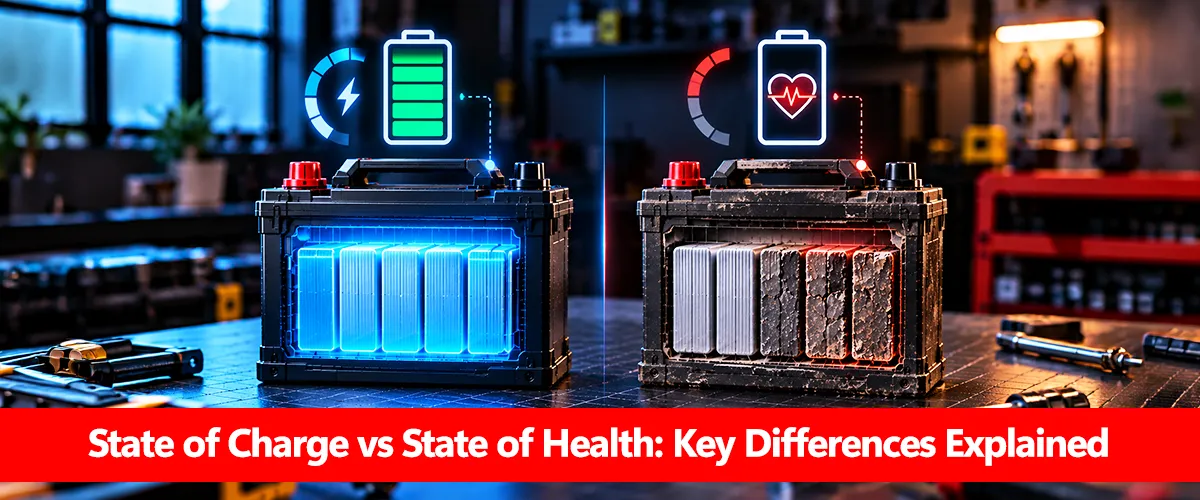
State of charge vs state of health describes two different aspects of battery performance: how much charge remains and how well the battery performs compared with its original condition. State of charge (SoC) indicates the current charge level, while state of health (SoH) reflects battery aging and overall condition.
For example, a smartphone can show 100% charge while its battery health is only 80%. The phone is fully charged relative to its current usable capacity, but that capacity has decreased since the battery was new. The same distinction applies to rechargeable batteries used in electric vehicles, solar storage, and UPS systems.
Understanding these measurements helps explain why a battery may appear fully charged yet provide disappointing runtime.
Key Takeaways
- SoC measures remaining charge, while SoH measures battery condition.
- A battery can display 100% SoC even after losing significant capacity.
- SoC changes during charging and discharging, while SoH generally declines gradually with aging.
- Battery management systems estimate both indicators, but accuracy varies.
- Monitoring SoC and SoH together provides a clearer picture of battery performance.
What Is State of Charge (SoC)?

State of charge represents the amount of charge remaining in a battery relative to its current usable capacity reference. It is normally displayed as a percentage, ranging from 0% at the defined discharge endpoint to 100% when the battery reaches its specified full-charge condition.
SoC changes as electricity enters or leaves the battery. During charging, the percentage generally increases; during discharge, it decreases. However, the reading is an estimate influenced by battery chemistry, temperature, current flow, and the monitoring system.
Common interpretations include:
- 100% SoC: The battery has reached its defined fully charged condition.
- 75% SoC: Approximately three-quarters of the referenced capacity remains.
- 50% SoC: About half of the referenced capacity remains.
- 20% SoC: The battery is approaching a relatively low charge level.
- 0% SoC: The defined usable discharge limit has been reached, not necessarily zero electrical energy.
What Is the State of Health (SoH)?
State of health describes a battery’s condition compared with a reference state, usually when it was new. A common capacity-based definition expresses current measured capacity as a percentage of the battery’s initial or rated capacity. If a battery originally stored 100Ah but now delivers 80Ah under comparable test conditions, its capacity-based SoH is approximately 80%. Some battery health systems also consider internal resistance, power capability, and other indicators, so SoH is not always calculated identically.
Battery health can be affected by:
- Chemical aging within the anode, cathode, and electrolyte.
- Repeated charging and discharging cycles.
- Prolonged exposure to excessive temperatures.
- Charging and discharging outside recommended limits.
- Increasing internal resistance or loss of active material.
Unlike SoC, reduced battery health generally cannot be restored simply by recharging the battery.
State of Charge vs State of Health: Main Differences
Although both are expressed as percentages, they answer different questions. SoC describes the battery’s present charge level, while SoH indicates how much its performance has changed with age and use.
| Feature | State of Charge (SoC) | State of Health (SoH) |
| Main meaning | Remaining charge | Overall battery condition |
| Common display | 0–100% | Percentage relative to a reference condition |
| Changes during normal use | Frequently | Usually gradually |
| Increases after charging | Yes | Not normally |
| Indicates battery aging | No | Yes |
| Helps predict | Remaining operation | Capacity loss and deterioration |
| Main influences | Charging, load, temperature | Age, cycles, heat, operating stress |
The easiest distinction: SoC is similar to a fuel gauge showing how full a tank is. SoH describes whether that tank can still hold as much as it originally could.
Can a Battery Have 100% SoC but Low SoH?
Yes, and this is one of the most important differences between the two measurements. A battery can reach its defined full-charge condition even after years of use have reduced its capacity. The charge indicator may still display 100%, but the battery cannot supply as much energy as it did when new.
Consider a battery originally rated at 100Ah. If aging reduces its measured capacity to 75Ah, its capacity-based SoH is approximately 75%. After charging completely, it may show 100% SoC, although only about 75Ah is available under comparable conditions.
This explains several common experiences:
- A smartphone reaches 100% but discharges faster than before.
- An older UPS battery shows full charge yet provides shorter backup.
- An electric vehicle reports a full battery but offers reduced driving range.
- A solar storage battery reaches full charge despite declining usable capacity.
How Do Battery Management Systems Estimate SoC and SoH?
A battery management system (BMS) monitors operating conditions and helps protect battery cells. Depending on its design, it may estimate charge level, battery health, temperature, current, and voltage. More advanced systems also track operating history and cell balance.
SoC estimation often combines current measurements, voltage behavior, and battery models. SoH estimation may involve capacity tracking, resistance measurements, and historical performance. Neither figure is necessarily measured directly, which means reported values can contain uncertainty.
Why Battery Readings Are Not Always Exact
- Voltage variation: Terminal voltage changes with load, temperature, and charging conditions.
- Measurement errors: Small current-sensor errors may accumulate over time.
- Battery aging: Changing capacity can make older battery models less accurate.
- Chemistry differences: Some chemistries have relatively flat voltage curves, complicating charge estimation.
- Limited monitoring: Basic systems may show SoC without calculating a reliable SoH value.
A voltage reading alone is therefore not enough to establish the battery’s complete health condition.
How Do SoC and SoH Affect Battery Runtime?
Both indicators influence battery runtime, but in different ways. SoC describes how much of the battery’s current usable capacity remains, while SoH helps indicate how much capacity has been lost compared with the original battery. A new battery and an aged battery may both display 80% SoC, yet the older battery can contain less usable electrical energy. Actual runtime also depends on load power, nominal voltage, discharge rate, temperature, and conversion efficiency.
For a complete runtime assessment, consider:
- Current state of charge and available battery capacity.
- Capacity-based state of health.
- Electrical energy available in watt-hours.
- The connected device’s power consumption.
- Inverter or conversion efficiency and discharge limits.
These measurements are especially important when estimating real-world backup performance rather than relying only on the battery percentage displayed.
How Are SoC, SoH and Depth of Discharge Connected?

SoC and depth of discharge (DoD) describe complementary aspects of the same charge reference. When a battery is at 70% SoC, it has approximately 30% DoD, assuming both measurements use the same capacity basis. SoH is different because it reflects the battery’s condition relative to its original state. Two batteries operating at the same DoD may deliver different amounts of electrical energy if their health levels differ.
Frequent deep cycling can also influence long-term degradation, making DoD relevant to battery health without being equivalent to it. Read our guide to depth of discharge for a dedicated explanation.
Why Do SoC and SoH Matter for UPS and Solar Systems?
For UPS and solar battery systems in Pakistan, SoC helps users monitor available backup during load shedding. SoH provides a longer-term indication of whether the storage system is maintaining its expected capacity as the battery ages.
For example, a home inverter may show a fully charged battery every morning, yet backup duration may gradually decrease over several years. The problem may not be insufficient charging; reduced battery health, increased electrical demand, or other system losses could be responsible.
A practical monitoring approach includes:
- Check SoC: Understand how much charge remains before and during an outage.
- Review capacity trends: Compare actual backup performance under similar loads.
- Monitor temperature: Avoid conditions that accelerate battery deterioration.
- Follow charging specifications: Use manufacturer-approved settings.
- Investigate unusual changes: Sudden runtime reductions may require professional battery or system testing.
These observations can help distinguish normal discharge from longer-term battery deterioration.
Does Battery Cycle Life Affect SoH?
Battery cycle life is closely connected to SoH because repeated charging and discharging gradually changes the battery’s electrochemical condition. Manufacturers often define cycle life as the number of cycles completed before capacity falls to a specified percentage, commonly 80%, under controlled conditions.
However, cycle count is not the only factor affecting health. Calendar aging, storage temperature, charging behavior, and operating stress can also reduce capacity. A battery with relatively few cycles may still deteriorate if stored or operated in unfavorable conditions. For more detail, explore our guide to battery cycle life.
Conclusion
State of charge vs state of health is the difference between knowing how much charge remains and understanding the battery’s overall condition. SoC changes as the battery charges and discharges, while SoH reflects the gradual effects of aging, repeated use, and operating conditions. For reliable battery monitoring, consider both indicators instead of relying on a full-charge percentage alone. Together, they provide a better understanding of available energy, expected performance, and long-term battery reliability.
Continue learning through our guides to depth of discharge and battery cycle life. Explore additional articles in the Battery Fundamentals category or visit Batteries Hub for more battery education.
Frequently Asked Questions
Is 80% State of Health Bad?
An 80% capacity-based SoH indicates that a battery retains approximately 80% of its reference capacity. Whether it requires replacement depends on the application, expected performance, manufacturer recommendations, and safety condition.
Can Battery SoH Increase After Charging?
Normal charging increases SoC, not the battery’s underlying health. An estimated SoH reading may change after recalibration, but that does not necessarily mean the battery has physically recovered lost capacity.
Is State of Charge More Important Than State of Health?
Both are important for different purposes. SoC helps assess immediate charge availability, while SoH helps assess long-term condition and whether the battery still meets performance requirements.
Does 100% SoC Mean Maximum Original Capacity?
No. A fully charged aged battery can have lower capacity than when it was new. Its SoC may still be 100% relative to its current usable capacity.
Can SoH Be Measured Using Voltage Alone?
No. Voltage can provide useful diagnostic information under controlled conditions, but reliable health assessment generally requires additional information such as capacity measurements, operating history, or electrical tests.