
Ah to Wh conversion is calculated by multiplying battery capacity in amp-hours (Ah) by battery voltage (V). The formula is Wh = Ah × V. For example, a 12V 100Ah battery has approximately 1,200 watt-hours (Wh) of nominal energy capacity, while a 24V 100Ah battery has approximately 2,400Wh.
This conversion is useful for understanding how much electrical energy a battery stores, especially when comparing UPS batteries, solar storage systems, lithium batteries, and portable power stations. Since amp-hours measure electric charge rather than energy, battery voltage is essential for getting a meaningful watt-hour value.
Below, you’ll find the formula, step-by-step examples, a quick conversion chart, and practical considerations that can affect the final result.
What Is the Formula to Convert Ah to Wh?
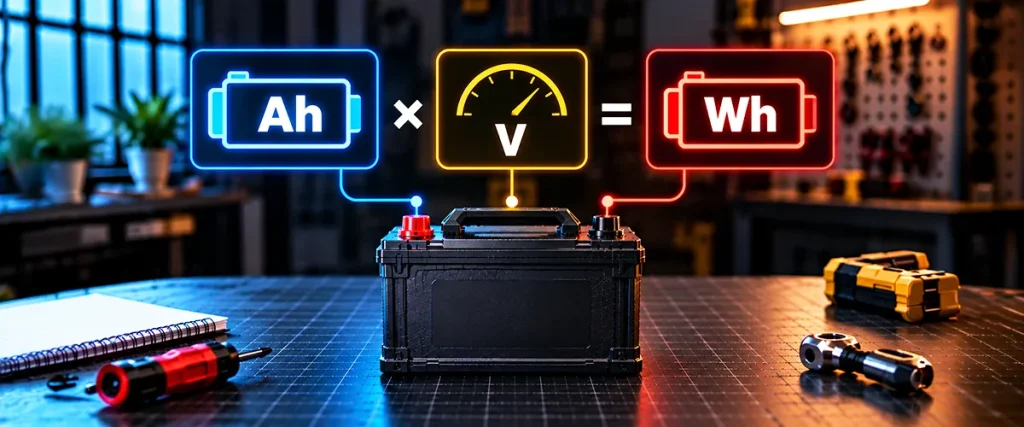
The Ah to Wh formula connects battery charge capacity with voltage to estimate stored electrical energy. It is straightforward when both values are available on the battery label or manufacturer datasheet.
Ah to Wh Formula:
[
\text{Watt-hours (Wh)}=\text{Amp-hours (Ah)}\times\text{Voltage (V)}
]
The three terms have different meanings:
- Amp-hours (Ah): Rated electric charge capacity.
- Voltage (V): Nominal electrical potential difference.
- Watt-hours (Wh): Estimated nominal energy capacity.
Use the battery’s nominal voltage, not its temporary charging voltage or a voltage reading taken while operating under load. Battery voltage varies throughout charging and discharging, so multiplying nominal values provides an estimate rather than an exact measurement of delivered energy.
How to Convert Ah to Wh in Three Steps
You only need two battery specifications to perform the conversion: its amp-hour rating and nominal voltage. Both usually appear on the product label or technical datasheet, although some manufacturers provide energy capacity directly in Wh or kWh.
Follow these steps:
- Find the Ah rating. For example, identify a battery labeled 100Ah.
- Check its nominal voltage. Suppose the battery is rated at 12V.
- Multiply both values. Calculate 100Ah × 12V = 1,200Wh.
Result: A 12V 100Ah battery has approximately 1,200Wh (1.2kWh) of nominal energy.
This result describes nominal storage capacity, not a guaranteed amount of energy reaching appliances. For more comprehensive sizing based on load and operating conditions, read how to calculate battery capacity.
Ah to Wh Conversion Chart for Common Batteries
The following chart shows estimated nominal energy for common battery voltages and capacity ratings. It can be used as a quick reference when checking specifications for 12V, 24V, or 48V battery systems.
| Battery Capacity | 12V | 24V | 48V |
| 10Ah | 120Wh | 240Wh | 480Wh |
| 20Ah | 240Wh | 480Wh | 960Wh |
| 50Ah | 600Wh | 1,200Wh | 2,400Wh |
| 100Ah | 1,200Wh | 2,400Wh | 4,800Wh |
| 150Ah | 1,800Wh | 3,600Wh | 7,200Wh |
| 200Ah | 2,400Wh | 4,800Wh | 9,600Wh |
These values assume the exact nominal voltages shown in the column headings. A lithium battery marketed as a 12V model may have a nominal voltage of 12.8V, which produces a different energy estimate.
Practical Ah to Wh Examples for Different Voltages
Battery voltage makes a major difference to the conversion. Two batteries with identical Ah ratings can store very different amounts of energy, so it is important to convert their capacities before comparing storage potential.
Example 1: 12V 150Ah UPS Battery
A 12V 150Ah battery has:
150 × 12 = 1,800Wh
Its nominal energy is approximately 1.8kWh. Actual backup energy may be lower depending on battery chemistry, discharge limits, and inverter losses.
Example 2: 24V 100Ah Battery Bank
A battery bank rated at 24V and 100Ah has:
100 × 24 = 2,400Wh
That equals 2.4kWh of nominal energy, twice the nominal energy of a 12V 100Ah battery.
Example 3: 48V 200Ah Solar Battery
A 48V 200Ah battery system has:
200 × 48 = 9,600Wh
The nominal energy capacity is approximately 9.6kWh. This figure describes energy storage and does not determine the inverter’s maximum output power.
Why Does LiFePO4 Voltage Change the Conversion?
Lithium iron phosphate (LiFePO4) batteries are often marketed using familiar system labels such as 12V, 24V, or 48V. However, their actual nominal pack voltages are commonly 12.8V, 25.6V, and 51.2V, respectively.
That difference matters when converting amp-hours into nominal watt-hours. For example, a 100Ah LiFePO4 battery rated at 12.8V has:
100Ah × 12.8V = 1,280Wh
Using 12V instead would produce 1,200Wh, an underestimate of the battery’s stated nominal energy. Always use the voltage published for the actual battery model rather than assuming all products in the same marketing category have identical specifications.
How Do You Estimate Usable Energy After Conversion?
Converting Ah to Wh gives an estimate of nominal energy, but not all nominal energy may be available during everyday operation. A battery management system or inverter can restrict discharge to protect the cells, while electrical conversion introduces additional losses.
Suppose a battery has 1,280Wh nominal energy, an allowed depth of discharge of 80%, and an inverter that operates at 90% efficiency.
- Nominal energy: 1,280Wh.
- Energy within the discharge allowance: 1,280 × 0.80 = 1,024Wh.
- Estimated AC energy delivered: 1,024 × 0.90 = 921.6Wh.
This is a simplified illustration. Actual performance depends on discharge rate, temperature, battery condition, inverter efficiency at the operating load, and other system losses.
What Mistakes Should You Avoid When Converting Ah to Wh?
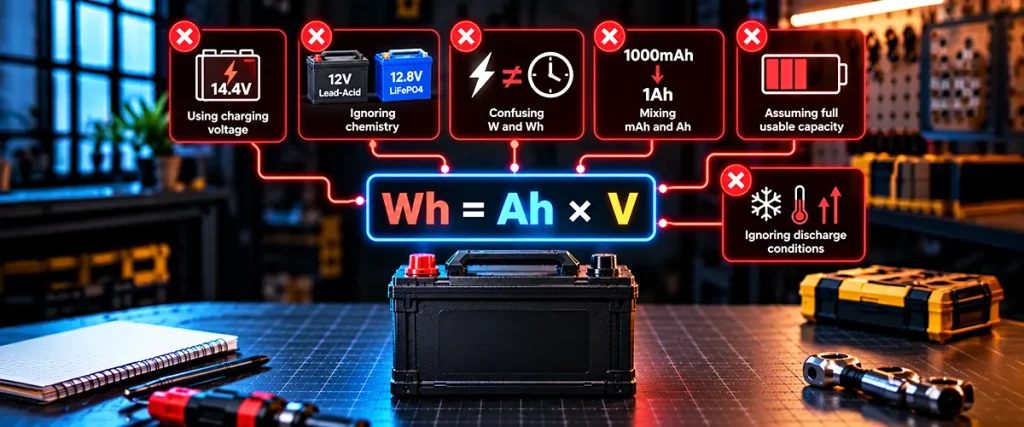
The formula is simple, but several input errors can produce misleading results. Most involve using an incorrect voltage or treating nominal capacity as energy that is fully available under all conditions.
Avoid these common mistakes:
- Using charging voltage: Use nominal battery voltage unless a calculation specifically requires measured operating conditions.
- Ignoring chemistry: Lead-acid and lithium-based packs can have different nominal voltages even when both are called 12V batteries.
- Confusing W and Wh: Watts measure power; watt-hours measure energy.
- Mixing mAh and Ah: Divide milliamp-hours by 1,000 before using the formula.
- Assuming full usable capacity: Account for discharge limits and conversion efficiency when estimating energy delivered to appliances.
- Ignoring discharge conditions: High current, low temperature, and battery aging can change actual delivered energy.
Manufacturer data should take priority when it supplies measured energy capacity under defined discharge conditions. If the goal is to estimate operating duration, use a dedicated battery runtime calculation instead.
When Should You Use Ah to Wh Conversion?
Converting Ah to Wh is particularly helpful when battery products use different voltage systems or display capacities in different units. It provides a common energy measurement that makes specifications easier to interpret.
Typical uses include:
- Comparing nominal energy in 12V, 24V, and 48V batteries.
- Understanding solar battery storage ratings in Wh or kWh.
- Checking the nominal energy of UPS battery banks.
- Interpreting portable power station specifications.
- Comparing batteries with different Ah and voltage combinations.
For a broader explanation of the difference between these measurements, see Ah vs Wh. If you need to convert energy back into charge capacity, follow our separate Wh to Ah guide.
Conclusion
Ah to Wh conversion helps translate battery charge capacity into nominal electrical energy using the formula Wh = Ah × V. With the correct amp-hour rating and nominal voltage, you can estimate how much energy a battery stores and compare products across different voltage systems. Remember that nominal watt-hours are not necessarily fully usable. Battery chemistry, depth of discharge, discharge current, temperature, and conversion efficiency all affect the energy available in real applications.
For additional calculations, explore battery capacity formulas, Wh to Ah conversion, and battery watt-hours explained. Find more resources in Battery Calculations and Sizing at Batteries Hub.
Frequently Asked Questions
How Many Wh Is a 100Ah Battery?
It depends on nominal voltage. A 12V 100Ah battery has approximately 1,200Wh, a 24V 100Ah battery has 2,400Wh, and a 48V 100Ah battery has 4,800Wh.
How Do You Convert 200Ah to Wh?
Multiply 200Ah by the battery’s nominal voltage. For example, 200Ah × 12V = 2,400Wh, while 200Ah × 24V = 4,800Wh.
Is Ah to Wh Conversion Accurate?
It provides a useful nominal energy estimate when the voltage and capacity ratings are correct. Actual energy delivered during discharge can differ because voltage changes with operating conditions.
Can You Convert Ah to Wh Without Voltage?
No. Amp-hours measure electric charge, while watt-hours measure electrical energy. Voltage is necessary to relate these quantities.
Is 1,000Wh Equal to 1kWh?
Yes. One kilowatt-hour equals 1,000 watt-hours. For example, 2,400Wh equals 2.4kWh.
Does a Higher Wh Rating Mean Longer Backup Time?
Higher usable energy generally supports longer runtime under the same load, but actual duration depends on discharge limits, battery condition, and system efficiency.