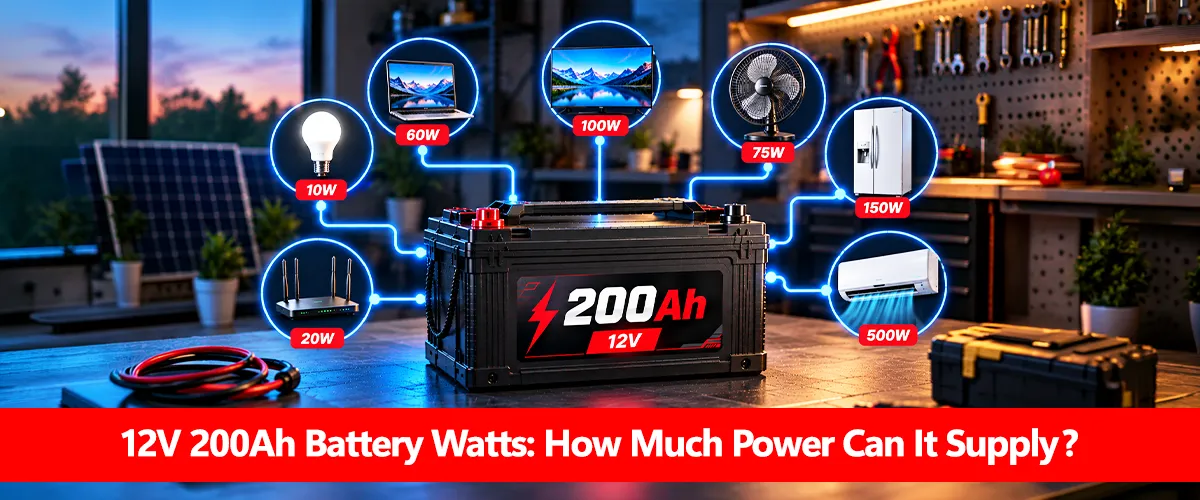
12V 200Ah battery watts depend on the amount of current the battery can safely deliver, while its nominal stored energy is approximately 2,400 watt-hours (Wh). This means a 12V 200Ah battery has around 2.4 kilowatt-hours (kWh) of rated energy, but it does not automatically provide 2,400 watts of continuous output power. The distinction matters when connecting batteries to inverters, solar systems, or household appliances. A battery may contain sufficient energy yet lack the discharge capability required for a powerful load.
This guide explains how to interpret a 200Ah battery’s wattage, estimate inverter current requirements, and understand the limits affecting real-world performance.
Quick Facts About a 12V 200Ah Battery
- Nominal voltage: 12V
- Rated charge capacity: 200Ah
- Nominal stored energy: 2,400Wh (2.4kWh)
- Power at 50A: Approximately 600W
- Power at 100A: Approximately 1,200W
- Power at 200A: Approximately 2,400W
- Maximum continuous output: Depends on the manufacturer’s discharge-current rating
Does a 12V 200Ah Battery Have 2,400 Watts?
A 12V 200Ah battery contains approximately 2,400Wh of nominal energy, not necessarily 2,400W of available continuous power. Watt-hours measure how much electrical energy is stored, while watts measure how quickly that energy is supplied to equipment.
The nominal energy calculation is straightforward:
Battery Energy (Wh) = Voltage (V) × Capacity (Ah)
12V × 200Ah = 2,400Wh
This figure provides a useful reference for understanding battery energy capacity. However, actual usable energy depends on depth of discharge, discharge rate, temperature, internal resistance, and battery condition. For a clearer explanation of the units, explore battery watt-hours and Ah vs Wh.
How Many Watts Can a 12V 200Ah Battery Deliver?
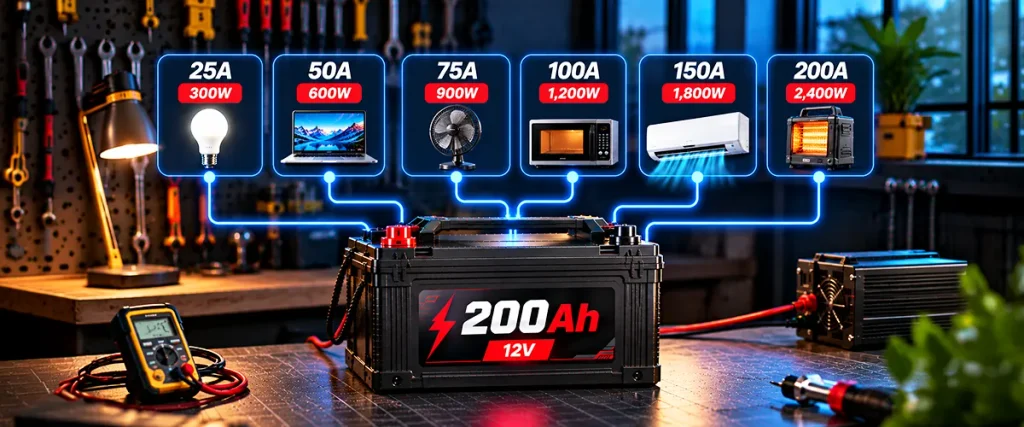
A battery’s electrical output power depends on its terminal voltage and the current flowing through the connected circuit. The basic relationship is Power (W) = Voltage (V) × Current (A). Therefore, increasing current increases the power delivered, provided the battery can safely sustain that current.
For a nominal 12V battery, typical mathematical examples include:
- 25A discharge: Approximately 300W.
- 50A discharge: Approximately 600W.
- 75A discharge: Approximately 900W.
- 100A discharge: Approximately 1,200W.
- 150A discharge: Approximately 1,800W.
- 200A discharge: Approximately 2,400W.
These figures are not guaranteed output capabilities. Some 200Ah batteries have continuous discharge limits below 200A, while others are designed for higher currents. Always check the approved current rating before connecting demanding equipment. The relationship between current and capacity is explained further in our battery C-rate guide.
How Much Battery Current Does an Inverter Need?
Inverters convert the battery’s direct current (DC) into alternating current (AC) for household appliances. Since conversion is not perfectly efficient, an inverter normally draws more electrical power from the battery than it delivers to connected AC equipment.
The following examples assume a 12V battery and 90% inverter efficiency.
| AC Output Load | Approximate Battery Current |
| 300W | 27.8A |
| 500W | 46.3A |
| 1,000W | 92.6A |
| 1,500W | 138.9A |
| 2,000W | 185.2A |
The estimates assume constant battery voltage and efficiency. Actual current may increase as battery voltage falls, and some inverters have additional standby consumption.
Important: An inverter’s wattage rating must not exceed what the complete battery system can safely support. Battery current limits, cable ratings, circuit protection, starting surges, and inverter specifications all matter.
Can a 12V 200Ah Battery Run a 2,000W Inverter?
A suitable 12V 200Ah battery may support a 2,000W inverter, but the answer depends on the battery’s continuous discharge rating and the actual connected load. A 2,000W inverter does not continuously draw 2,000W simply because that is its rated output.
Before operating high-power equipment, verify:
- Continuous discharge current: The battery must support the expected operating current.
- Peak discharge rating: Starting surges may require higher current for short periods.
- Inverter compatibility: Input voltage and protective cutoffs must match the battery system.
- Battery management system: Lithium battery protection may disconnect excessive loads.
- Installation requirements: Cables, connections, fuses, and protection devices must be appropriately engineered.
For high-current installations, follow the manufacturer’s instructions and use a qualified installer.
Lead-Acid vs LiFePO4: Does the Wattage Change?
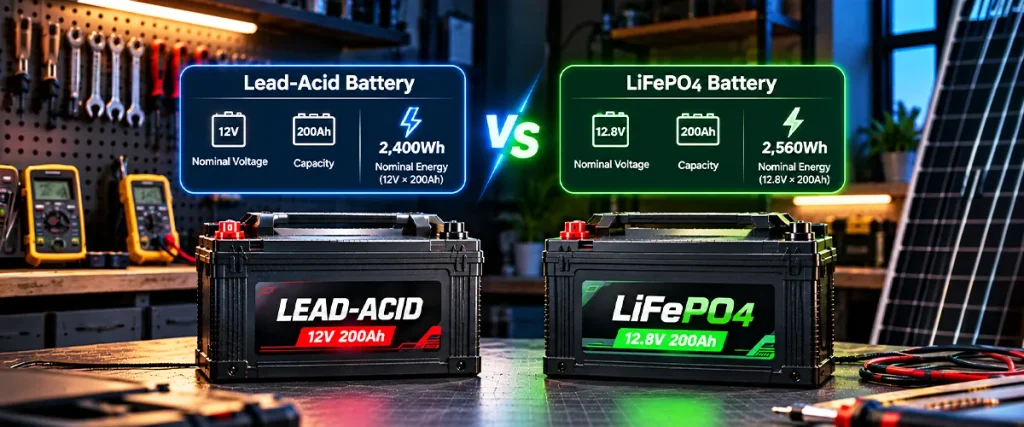
Lead-acid and lithium iron phosphate batteries can both be sold as 12V 200Ah products, but their actual nominal energy and discharge behavior may differ. A typical lead-acid battery is rated at 12V, whereas a four-cell LiFePO4 battery commonly has a nominal voltage of 12.8V.
That changes the nominal energy calculation:
- 12V 200Ah lead-acid: Approximately 2,400Wh.
- 12.8V 200Ah LiFePO4: Approximately 2,560Wh.
Lead-acid batteries may experience a substantial decrease in available capacity at high discharge rates. LiFePO4 batteries often maintain capacity better under suitable loads, but their battery management systems impose product-specific current limits.
For example, some 12.8V 200Ah lithium batteries are rated for a maximum continuous discharge of 200A, while others have different limits. Never assume that every battery with the same Ah rating supports identical power output.
What Appliances Can a 12V 200Ah Battery Power?
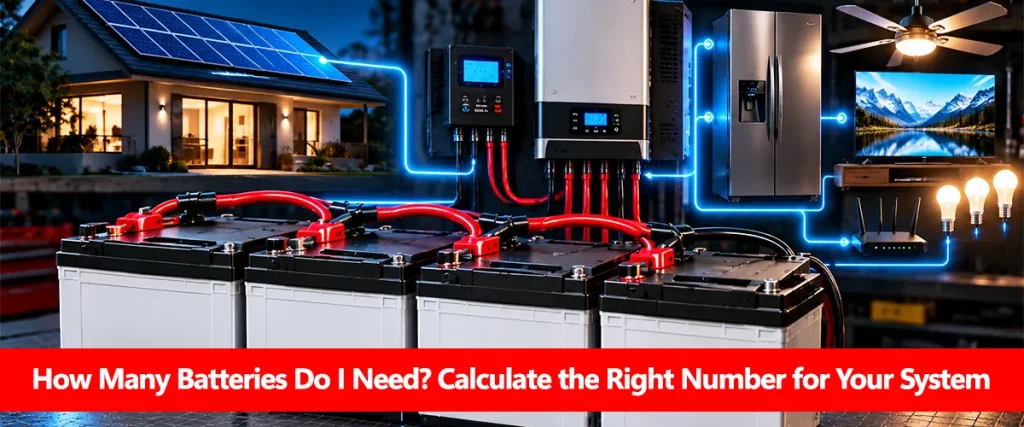
A 12V 200Ah battery may support lighting, fans, routers, televisions, and other electrical equipment when paired with an appropriately rated inverter or DC power system. Whether it can operate a particular appliance depends on its operating wattage, starting current, and the battery’s electrical limits.
For household backup in Pakistan, common applications include:
- LED lighting: Generally modest power demand.
- Ceiling fans: Power consumption depends on fan size and efficiency.
- Wi-Fi routers: Relatively low continuous electrical load.
- Televisions: Requirements vary by display technology and screen size.
- Refrigerators: Compressor starting current and cycling behavior must be considered.
- Large appliances: Pumps, heaters, and air conditioners require careful power and current checks.
The number of appliances running simultaneously matters more than the battery’s Ah rating alone. For operating-time estimates, read how long a 200Ah battery lasts.
Why Might Actual Output Be Lower Than Calculated Watts?
A simple voltage-and-current calculation assumes the battery maintains its stated voltage under load. In reality, terminal voltage can drop because of internal resistance, particularly when current demand becomes high.
Several factors influence available output:
- Battery age: Internal resistance may increase as the battery deteriorates.
- Low temperature: Some chemistries cannot safely supply the same current in cold conditions.
- State of charge: Output capability can change as the battery discharges.
- Battery chemistry: Different electrode materials have different current-handling characteristics.
- Discharge rate: High current can reduce effective capacity and usable energy.
- Protection settings: The BMS or inverter may interrupt power before the battery is fully discharged.
These differences explain why manufacturer specifications are more reliable than assuming all 200Ah batteries can provide the same number of watts.
How Does a 200Ah Battery Compare With a 100Ah Battery?
At the same nominal voltage, a 200Ah battery has twice the rated charge capacity of a 100Ah battery. Therefore, a 12V 200Ah battery stores approximately 2,400Wh compared with 1,200Wh for a 12V 100Ah battery. However, twice the capacity does not guarantee twice the maximum output wattage. Continuous power depends on discharge-current limits, which may not scale proportionally with capacity across different battery models.
If you are comparing smaller battery systems, our guide to 12V 100Ah battery watts explains their power and energy specifications.
Conclusion
12V 200Ah battery watts should be understood through two separate measurements: energy capacity and power output. A standard 12V 200Ah battery stores approximately 2,400Wh, while its actual output power depends on the current it can safely deliver. For UPS and solar systems, check the battery’s discharge ratings alongside inverter efficiency, equipment power requirements, and electrical protection. A larger battery capacity is useful, but safe power delivery always depends on the complete system design.
Explore more practical tutorials on battery capacity calculations, 200Ah battery runtime, and inverter battery backup time. Browse Battery Calculations and Sizing at Batteries Hub.
Frequently Asked Questions
Is a 12V 200Ah Battery 2,400 Watts?
No. A 12V 200Ah battery stores approximately 2,400Wh of nominal energy. Its maximum continuous wattage depends on its permitted discharge current.
Can a 12V 200Ah Battery Supply 1,500W?
Possibly. A 1,500W AC load requires approximately 139A from a 12V battery at 90% inverter efficiency. The battery and electrical system must be rated to support that current safely.
How Many Watts Is a 12.8V 200Ah Lithium Battery?
A 12.8V 200Ah battery has approximately 2,560Wh of nominal energy. Its maximum power output depends on its discharge-current rating and operating conditions.
Can a 12V 200Ah Battery Run a 3,000W Inverter?
Running a full 3,000W AC load from a 12V battery would require approximately 278A at 90% inverter efficiency, potentially more at lower battery voltage. Many individual batteries and 12V systems are unsuitable for such demands without specially rated equipment.
Does a 200Ah Battery Last Twice as Long as a 100Ah Battery?
Under comparable voltage, chemistry, and operating conditions, it has twice the rated charge capacity. Actual runtime may not double because of discharge behavior and system losses.