Battery charging time depends on the battery’s capacity, current state of charge, charger output current, and charging method. For example, a 100Ah battery starting at 50% charge theoretically requires at least 2.5 hours to replace 50Ah using a constant 20A charging current. In practice, charging can take longer as the charger reduces current near full charge. Understanding charging time is useful for UPS batteries, solar storage, car batteries, and portable power systems. It helps you estimate when a battery will be ready without assuming that every charger operates at its maximum rating throughout the charging process.
This guide explains the charging-time formula, practical examples, battery chemistry differences, and factors that affect real-world results.
How Do You Calculate Battery Charging Time?
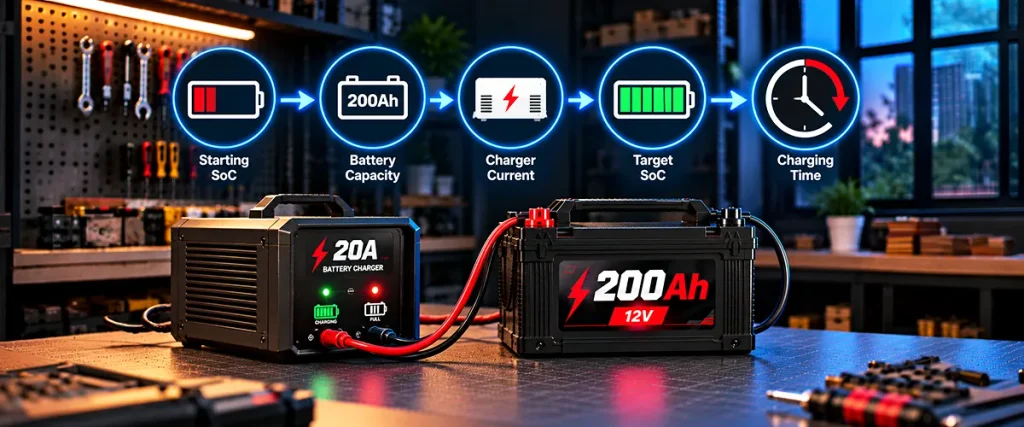
The basic charging-time formula divides the charge that must be restored by the current actually entering the battery. This works as a first approximation when charging current stays constant and the battery is within its approved operating range.
Basic Formula:
Charging Time (hours) ≈ Charge Required (Ah) ÷ Charging Current (A)
To account for the battery’s starting charge level:
Charge Required (Ah) ≈ Capacity (Ah) × (Target SoC − Starting SoC)
Use state of charge (SoC) percentages as decimals. For example, charging from 40% to 90% represents a 0.50 change in SoC.
Information You Need
- Battery capacity: Rated amp-hours, such as 100Ah or 200Ah.
- Starting SoC: How much charge the battery currently has.
- Target SoC: The charging level you want to reach.
- Charger current: Actual DC current supplied to the battery.
- Battery chemistry: Determines charging stages and current limits.
- Operating conditions: Temperature, battery age, and connected loads.
This formula calculates an idealized current-delivery period. It does not include all absorption-stage delays or losses.
Step-by-Step Example: Charging a 100Ah Battery
Suppose a 100Ah lithium battery starts at 30% SoC, and you want to charge it to 90% using a compatible 20A charger. First, determine the missing charge rather than assuming the battery is completely empty.
Step 1 — Calculate the charge required
100Ah × (0.90 − 0.30) = 60Ah
Step 2 — Divide by charging current
60Ah ÷ 20A = 3 hours
Step 3 — Consider the charging profile
Three hours is the ideal constant-current estimate. Actual charging may take longer if the charger limits current, the battery approaches its voltage limit, or the battery management system reduces charging.
This example highlights why the starting SoC matters. A battery at 30% requires considerably more charging than the same battery starting at 80%.
Battery Charging Time Chart: 10A, 20A and 30A Chargers
Charger amperage directly affects how quickly charge can be restored during a constant-current stage. The chart below estimates the time required to replace 50% of rated capacity, assuming the charger maintains its stated current throughout that period.
| Battery Capacity | 10A Charger | 20A Charger | 30A Charger |
| 50Ah | 2.5 hours | 1.25 hours | 0.83 hour |
| 100Ah | 5 hours | 2.5 hours | 1.67 hours |
| 150Ah | 7.5 hours | 3.75 hours | 2.5 hours |
| 200Ah | 10 hours | 5 hours | 3.33 hours |
These are ideal charge-replacement estimates, not guaranteed full-charge times. Each charging current must also be within the battery manufacturer’s approved limits.
Why Does Charging Slow Down Near 100%?
Most rechargeable batteries cannot maintain their maximum charging current throughout an entire charging cycle. Once the battery approaches a specified voltage limit, the charger may reduce current to complete charging safely. This behavior helps prevent excessive voltage, heat, and battery stress. As a result, the final portion of charging can take disproportionately longer than the initial portion.
Two common charging stages are:
- Bulk or constant-current charging: The charger supplies relatively high current while battery voltage increases.
- Absorption or constant-voltage charging: Voltage is held near the prescribed limit while charging current gradually decreases.
Some lead-acid chargers also use a float stage to maintain charge after completion. The appropriate charging process depends on battery chemistry.
Lead-Acid vs Lithium Battery Charging Time
Lead-acid and lithium-ion batteries have different charging characteristics, even when their amp-hour ratings are identical. The difference becomes particularly noticeable near full charge, where charging-current reduction affects total charging time.
Lead-Acid Battery Charging
Lead-acid batteries typically use bulk, absorption, and float charging stages. The absorption stage may take several additional hours, depending on discharge depth, battery condition, and charger settings.
For example, replacing 50Ah in a 100Ah battery using a 10A charger takes five hours at a constant current in theory. Reaching a true full charge may require additional absorption time.
Lithium-Ion and LiFePO4 Charging
Many lithium batteries can accept substantial charging current through much of their charging range, subject to manufacturer limits. Their constant-voltage finishing stage is often shorter than that of lead-acid batteries.
However, lithium batteries require chemistry-specific voltage limits and protection. A charger suitable for one lithium chemistry is not automatically compatible with another. Read our guide to battery C-rate for more information about safe charging-current ratings.
Does Battery Voltage Affect Charging Time?
Battery voltage influences the electrical power required to deliver a particular charging current. A 24V-class charger delivering 20A generally supplies more power than a 12V-class charger delivering the same current. However, two batteries with identical Ah capacities can have similar ideal charge-replacement times when both receive the same charging current.
For example:
- 12V 100Ah battery at 20A: Five ideal hours to replace 100Ah.
- 24V 100Ah battery at 20A: Also five ideal hours to replace 100Ah.
- Actual charging energy: Different because the batteries operate at different voltages.
Real charging time still depends on chemistry, charging stages, and current limits.For additional context, see Ah to Wh conversion.
What Factors Increase Battery Charging Time?
Even when charger specifications are correct, real charging performance can differ from the basic calculation. The battery may not accept the charger’s full rated current continuously, especially near its charging limit.
Important factors include:
- Low charging current: A smaller charger generally needs longer to replace the same amount of charge.
- Temperature restrictions: Some batteries reduce or prohibit charging outside approved temperature ranges.
- Battery aging: Increased internal resistance and deterioration can affect charge acceptance.
- Connected electrical loads: Equipment using electricity during charging can reduce current available to the battery.
- Charging stages: Absorption and balancing processes can extend completion time.
- Solar power variation: Changing sunlight affects charging current throughout the day.
The battery’s state of charge and state of health provide additional context when interpreting charging performance.
How Long Does a Solar Battery Take to Charge?
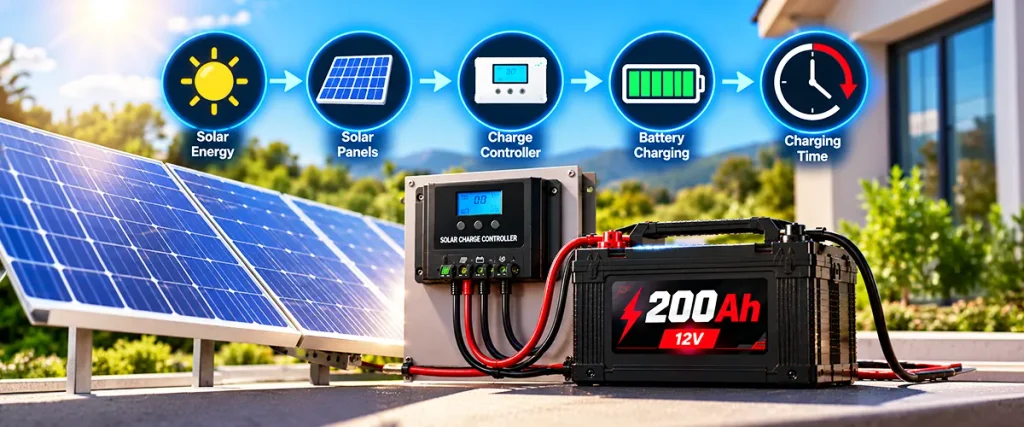
Solar battery charging time depends on available solar power rather than panel wattage alone. Weather, shading, panel orientation, controller limits, and household electricity consumption all affect how much current reaches the battery.
For example, a battery requiring 60Ah of charge could theoretically receive that amount in four hours if the solar charging system consistently supplies 15A to the battery.
Actual solar charging may take longer because:
- Solar production changes throughout the day.
- Appliances may consume part of the generated electricity.
- Charge controllers reduce current when necessary.
- Battery charging stages limit power acceptance.
- Clouds and seasonal conditions affect generation.
A solar panel’s advertised power rating therefore cannot guarantee a particular charging duration.
Battery Charging Time for UPS Systems in Pakistan
UPS batteries in Pakistan are often recharged between electricity outages. When load shedding occurs frequently, the time available for charging can be shorter than the time required for the battery to reach full charge.
For example, a 100Ah battery discharged to 50% SoC needs approximately 50Ah restored. At a constant net charging current of 10A, the ideal replacement time is five hours before additional charging-stage effects.
To improve charging reliability:
- Check the UPS’s supported battery chemistry.
- Verify its actual battery charging-current setting.
- Use manufacturer-approved charging voltages.
- Account for appliances operating during charging.
- Avoid exceeding the battery’s recommended charge current.
Our guides to UPS backup time and inverter battery backup time explain the discharge side of backup planning.
Common Battery Charging Time Mistakes
Charging-time calculations become misleading when the charger rating is treated as guaranteed battery current. Actual current may be lower because of temperature limits, voltage regulation, or electricity consumed by connected equipment.
Avoid these common mistakes:
- Assuming the battery starts empty: Use its estimated starting SoC.
- Ignoring charging stages: Constant-current estimates may underestimate full-charge time.
- Confusing charger watts with amps: Voltage is needed to relate power and current.
- Assuming faster is always better: Charging must remain within approved limits.
- Using the wrong charging profile: Lead-acid and lithium batteries require appropriate settings.
Manufacturer recommendations should always override simplified charging formulas.
Conclusion
Battery charging time can be estimated by dividing the amount of charge that needs to be restored by the charging current. This provides a practical starting point for understanding how long a battery may take to recharge. For realistic expectations, consider the battery’s starting state of charge, chemistry, charging stages, current limits, temperature, and connected loads. The charger’s output rating alone is not enough to guarantee a particular charging duration.
Explore more resources in Battery Calculations and Sizing, including battery capacity calculations and battery runtime calculations. Visit Batteries Hub for additional battery education.
Frequently Asked Questions
How Long Does a 100Ah Battery Take to Charge With a 10A Charger?
If the battery needs 50Ah restored, the ideal constant-current estimate is five hours. A complete charge can take longer because of charging stages, battery chemistry, and operating conditions.
Can a 20A Charger Charge a 200Ah Battery?
Yes, if the charger is compatible with the battery and its approved charging specifications. Replacing 100Ah would require at least five ideal constant-current hours, with possible additional finishing time.
Does a Higher-Amp Charger Charge Faster?
Generally, yes, provided the battery can safely accept the higher current. A charger with a higher output rating does not guarantee faster charging if the battery management system or charging profile limits current.
Can You Calculate Charging Time From Watt-Hours?
Yes, when suitable power and efficiency information is available. However, charging power changes during many charging cycles, so a simple watt-hour calculation provides an estimate rather than an exact completion time.
Does Depth of Discharge Affect Charging Time?
Yes. A battery discharged more deeply generally requires more charge to return to the same target SoC. Our depth of discharge guide explains the measurement