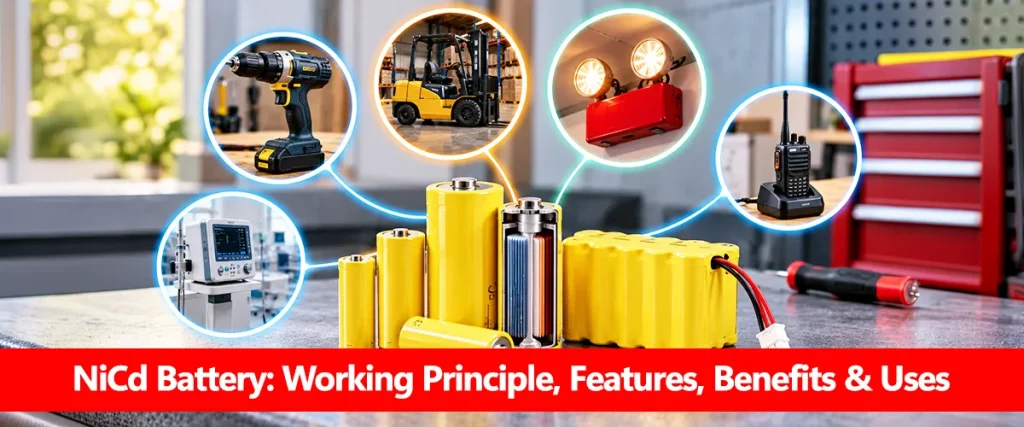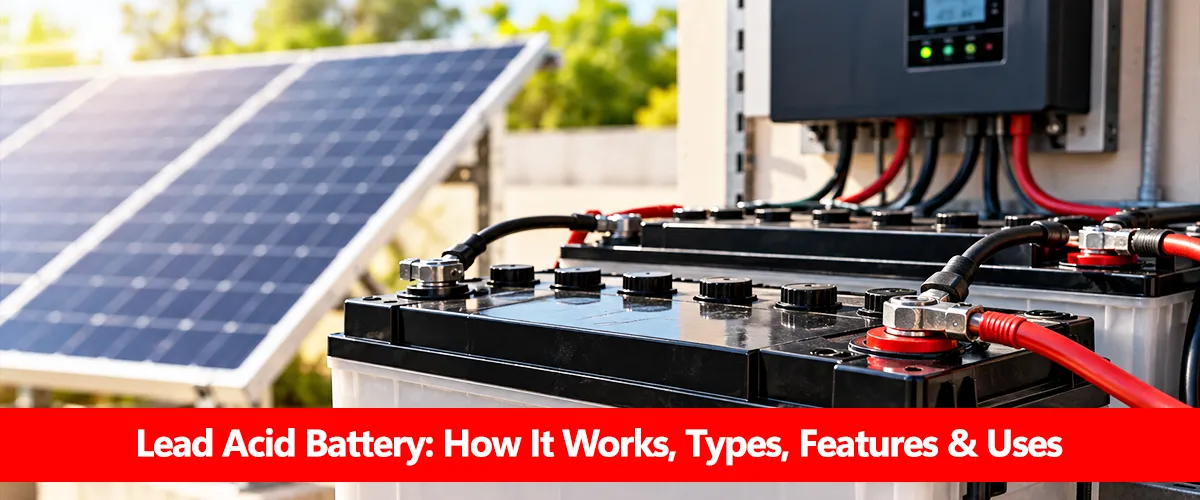
A lead acid battery is a rechargeable electrochemical battery that uses lead-based electrodes and a sulfuric acid electrolyte to store and release electrical energy. It is one of the most established battery technologies, widely used in vehicles, uninterruptible power supplies (UPS), and solar backup systems.
Lead-acid batteries are valued for their affordability, reliable power delivery, and established recycling infrastructure. However, they are relatively heavy, have lower energy density than many lithium batteries, and require appropriate charging and maintenance.
How Does a Lead Acid Battery Work?
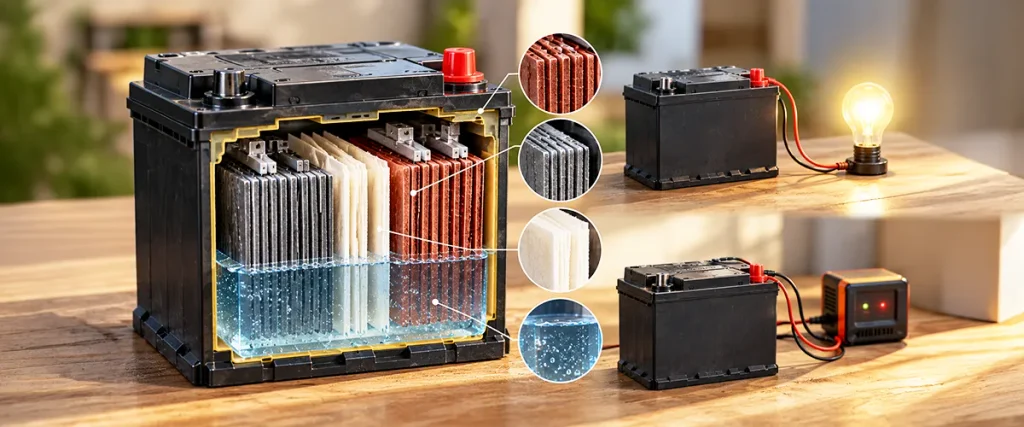
A lead-acid battery converts chemical energy into electrical energy through reversible electrochemical reactions. During discharge, lead dioxide at the positive plate and spongy lead at the negative plate react with sulfuric acid to form lead sulfate and water. Charging reverses these reactions, restoring the active materials and increasing the electrolyte’s sulfuric acid concentration.
Main components include:
- Positive plate: Contains lead dioxide during the charged state.
- Negative plate: Contains spongy lead during the charged state.
- Electrolyte: Sulfuric acid solution that supports ionic conduction.
- Separator: Prevents direct contact between positive and negative plates.
- Container and terminals: Protect internal components and provide electrical connections.
During discharge, oxidation occurs at the negative electrode (anode) and reduction occurs at the positive electrode (cathode). The electrode reaction roles reverse during charging.
Main Types of Lead Acid Batteries
Lead-acid batteries are available in different constructions to meet specific maintenance, discharge, and installation requirements.
| Battery Type | Main Characteristic | Common Application |
| Flooded lead-acid | Liquid electrolyte; may require maintenance | Automotive and backup systems |
| Sealed lead-acid | Valve-regulated designs with reduced maintenance | UPS and standby power |
| AGM | Electrolyte absorbed in glass-mat separators | Vehicles and backup systems |
| Gel | Gelled electrolyte | Selected cyclic and standby applications |
| Tubular | Tubular positive-plate construction | Inverters and deep-cycle applications |
For detailed information, explore flooded lead-acid batteries, sealed lead-acid batteries, AGM batteries, and gel batteries. Tubular describes a plate design rather than a separate battery chemistry. Learn more in our tubular battery guide.
Important Lead Acid Battery Specifications
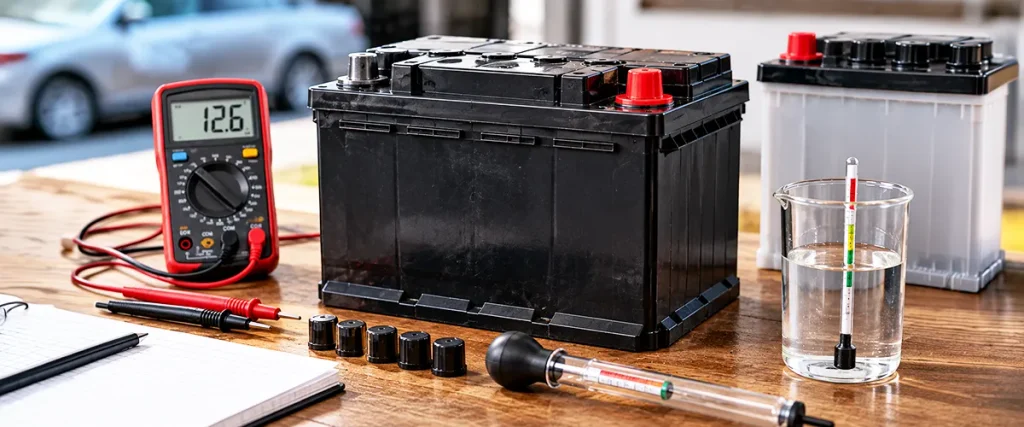
Understanding battery specifications helps determine whether a lead-acid battery is suitable for an intended application.
Key technical terms include:
- Nominal voltage: A lead-acid cell has approximately 2V nominal voltage; six cells commonly form a 12V battery.
- Rated capacity (Ah): Charge capacity measured under specified discharge conditions.
- State of charge (SoC): Estimated remaining charge.
- Depth of discharge (DoD): Percentage of rated capacity removed.
- Cycle life: Number of charge-discharge cycles under defined conditions.
- Internal resistance: Influences voltage drop, heating, and power delivery.
Actual performance depends on temperature, discharge rate, battery condition, and manufacturer specifications.
Common Applications of Lead Acid Batteries
Lead-acid technology remains widely used because it supports different power requirements through established battery designs.
Common applications include:
- Automotive starting: Delivering high current for engine starting.
- UPS systems: Providing temporary electricity during power interruptions.
- Solar energy storage: Storing electricity for later use.
- Inverter backup: Supporting essential household electrical loads.
- Industrial equipment: Supplying power to forklifts and other machinery.
- Emergency systems: Supporting alarms, lighting, and standby equipment.
Battery construction must match the application. Starting batteries and deep-cycle batteries are designed for different discharge patterns.
Advantages and Limitations
Lead-acid batteries offer practical benefits, but their performance characteristics should be considered before selecting them.
Advantages:
- Established and widely available technology.
- Generally lower initial cost than many lithium alternatives.
- Capable of delivering high starting currents.
- Mature manufacturing and recycling infrastructure.
- Available in multiple designs for different applications.
Limitations:
- Heavy compared with many lithium batteries.
- Lower energy density.
- Limited cycle life under repeated deep discharge.
- Charging and temperature sensitivity.
- Maintenance requirements for certain flooded designs.
For a dedicated chemistry comparison, read lithium vs lead-acid battery.
Lead Acid Battery Maintenance and Safety
Proper charging, storage, and inspection can improve battery reliability and reduce premature deterioration. Maintenance requirements vary between flooded and valve-regulated designs.
Important practices include:
- Use the manufacturer’s recommended charging voltage and current.
- Keep terminals clean and connections secure.
- Maintain appropriate ventilation during charging.
- Check electrolyte levels only in serviceable flooded batteries.
- Avoid unnecessary deep discharge.
- Protect batteries from excessive heat.
- Wear appropriate protection when handling battery acid.
Repeated undercharging can contribute to sulfation, where lead sulfate becomes increasingly difficult to reverse through normal charging. Explore battery sulfation for a focused explanation. Never open sealed batteries or add water unless the manufacturer explicitly permits servicing.
Conclusion
A lead acid battery is a rechargeable energy-storage technology used in automotive, UPS, solar, and industrial applications. Its established chemistry, availability, and relatively low initial cost make it useful across many electrical systems. However, weight, discharge limits, charging requirements, and maintenance needs must be considered when selecting a lead-acid battery. Explore types of batteries, primary vs secondary batteries, and the Battery Types and Chemistries category. Visit Batteries Hub for more battery education.
Frequently Asked Questions
Is a Lead Acid Battery Rechargeable?
Yes. Lead-acid batteries are secondary batteries designed for repeated charging and discharging within their specified limits.
What Is the Nominal Voltage of a Lead Acid Battery?
A single lead-acid cell has approximately 2V nominal voltage. A conventional 12V lead-acid battery typically contains six cells connected in series.
How Long Does a Lead Acid Battery Last?
Service life depends on battery construction, depth of discharge, temperature, charging conditions, and maintenance. There is no single lifespan applicable to every lead-acid battery.
What Is the Difference Between Flooded and Sealed Lead Acid Batteries?
Flooded batteries contain free liquid electrolyte, while sealed lead-acid designs commonly use valve-regulated construction with immobilized electrolyte and reduced routine maintenance requirements.
Are Lead Acid Batteries Suitable for Solar Systems?
Yes. Deep-cycle lead-acid batteries can be used in compatible solar storage systems, provided the battery bank and charging equipment are correctly designed.