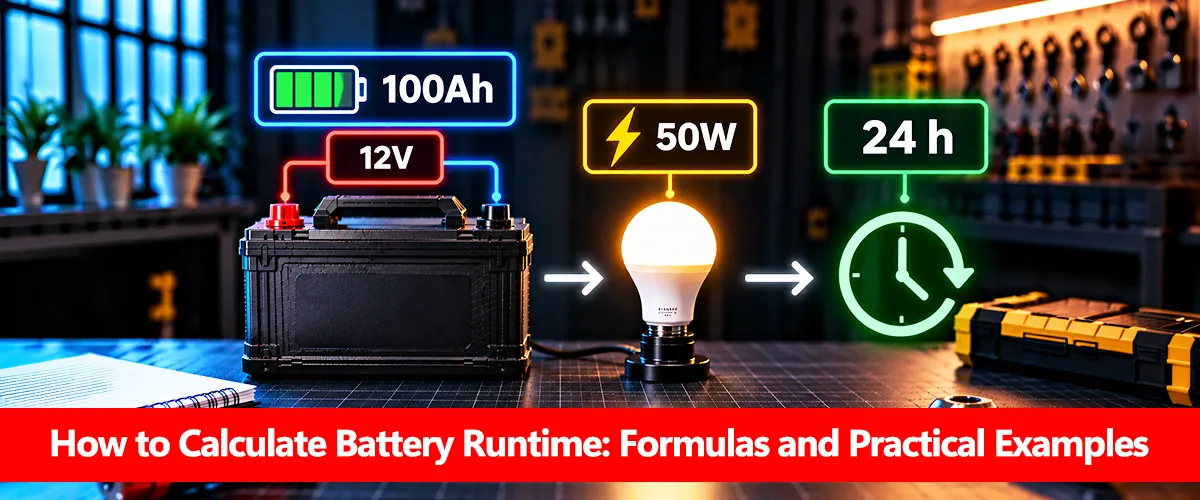
How to calculate battery runtime starts with dividing the battery’s usable energy in watt-hours (Wh) by the electrical load in watts (W). For example, a battery providing 600Wh of usable energy can theoretically power a constant 100W load for six hours. Actual runtime may be shorter because of discharge limits, inverter losses, temperature and battery condition.
This calculation is useful for solar batteries, UPS systems, portable power stations and other battery-powered equipment. Instead of relying only on the amp-hour rating printed on a battery, you can estimate how long it will support a specific electrical load. The steps below explain the formulas, required inputs and practical examples for both DC and AC applications.
What Is the Battery Runtime Formula?
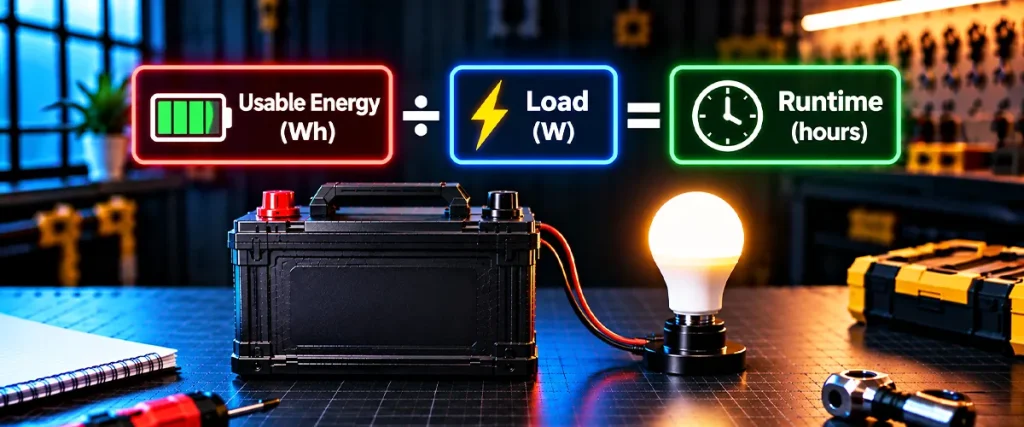
Battery runtime is the estimated amount of time a battery can supply a connected load before reaching its permitted discharge limit. The simplest formula uses available energy and the rate at which the equipment consumes it.
Basic formula:
[
\text{Runtime (hours)}=\frac{\text{Usable Energy (Wh)}}{\text{Load (W)}}
]
For a battery with rated capacity in amp-hours, a practical AC-load estimate is:
[
\text{Runtime} \approx \frac{\text{Voltage}\times\text{Ah}\times\text{DoD}\times\text{Efficiency}}{\text{Load (W)}}
]
- Voltage (V): Nominal battery voltage.
- Ah: Rated charge capacity in amp-hours.
- DoD: Allowed depth of discharge, expressed as a decimal.
- Efficiency: Inverter efficiency, expressed as a decimal.
- Load (W): Continuous power consumption of connected appliances.
This formula estimates runtime for a reasonably constant load. It does not guarantee the result because battery voltage, efficiency and available capacity can change during operation.
Step 1: Find Your Battery’s Energy Capacity
Start by checking the battery label or manufacturer specifications. Some products display their energy capacity directly in Wh or kWh, while others provide nominal voltage and amp-hour capacity. If the Wh rating is unavailable, multiply the two nominal values to estimate stored energy.
For example, a 12V 100Ah battery has approximately 1,200Wh of nominal energy. A 24V 100Ah battery has approximately 2,400Wh. The same Ah rating can therefore represent different amounts of energy at different voltages. If you need help with these units, read our guides to battery watt-hours and Ah to Wh conversion.
Step 2: Calculate the Total Electrical Load
The load is the combined power consumption of the equipment you want to operate. For a constant load, add the wattage of all devices running simultaneously. Use measured operating power where possible because appliance labels may show maximum rather than typical consumption.
Consider a small backup arrangement:
- Two LED lights at 10W each = 20W.
- One fan operating at 60W = 60W.
- One Wi-Fi router consuming 10W = 10W.
Total continuous load = 90W
If appliances operate intermittently, calculate energy usage over time instead of assuming all equipment runs continuously. Starting surges and the inverter’s own consumption can also affect the system.
Step 3: Account for Usable Battery Capacity
Not all nominal battery energy is necessarily available during normal operation. The permitted depth of discharge determines how much of the rated capacity the battery system allows you to use before reaching its cutoff.
For example, a battery containing 1,200Wh of nominal energy with an 80% usable discharge allowance provides approximately 960Wh of battery-side energy under simplified conditions.
Common considerations include:
- Lead-acid batteries: The chosen discharge limit may be conservative to support longer service life.
- Lithium batteries: Some products permit a larger usable discharge range.
- Battery aging: An older battery may store less energy than its original rating.
- Temperature: Available capacity can decrease outside preferred operating conditions.
The appropriate DoD must come from the manufacturer’s specifications. Learn more in our guide to depth of discharge.
Step 4: Include Inverter Efficiency for AC Appliances
When an inverter converts battery DC power into AC electricity, some energy is lost as heat and through the inverter’s internal operation. Therefore, the energy reaching an appliance can be lower than the energy withdrawn from the battery.
Suppose the usable battery energy is 960Wh and inverter efficiency is assumed to be 90%. The estimated energy available to AC equipment becomes:
960Wh × 0.90 = 864Wh
This is an illustrative estimate. Actual efficiency depends on inverter design, load level and operating conditions. Some inverters also consume standby power, which should be included when meaningful.
Worked Example: Runtime for a 12V 100Ah Battery
Let’s combine the previous steps into one calculation. Assume a 12V 100Ah battery, an 80% discharge allowance, 90% inverter efficiency and a continuous 90W AC load.
The calculation is:
Runtime = (12 × 100 × 0.80 × 0.90) ÷ 90
Estimated runtime = 9.6 hours
This is a theoretical estimate based on nominal battery energy. A real 12V lead-acid battery operating at this load may deliver a different amount of energy, particularly if its capacity was rated at a lower discharge current. For a dedicated explanation of this battery size, see how long a 100Ah battery lasts.
How to Calculate Runtime for a DC Load
Direct-current equipment can sometimes operate without an inverter, simplifying the calculation. If a battery supplies a constant current and the rated capacity remains available at that current, divide usable amp-hours by load current.
DC runtime = Usable capacity (Ah) ÷ Load current (A)
For example, a 20Ah battery with an 80% usable discharge allowance has 16Ah of estimated usable charge capacity. At a constant 4A discharge current, its theoretical runtime is:
16Ah ÷ 4A = 4 hours
The actual result depends on battery discharge characteristics, cutoff voltage and any DC converter losses. If a voltage converter is involved, an energy-based calculation is generally more appropriate.
Quick Battery Runtime Examples
The following examples illustrate how electrical load affects estimated runtime. They assume a constant load and the stated usable energy already available to the equipment.
| Usable Energy | Load | Estimated Runtime |
| 300Wh | 50W | 6 hours |
| 500Wh | 100W | 5 hours |
| 800Wh | 200W | 4 hours |
| 1,200Wh | 150W | 8 hours |
| 2,000Wh | 250W | 8 hours |
These estimates exclude additional unaccounted-for losses and changing power consumption. For larger systems, battery discharge curves and equipment specifications provide a more reliable assessment than a simplified table.
Why Is Actual Battery Runtime Sometimes Shorter?
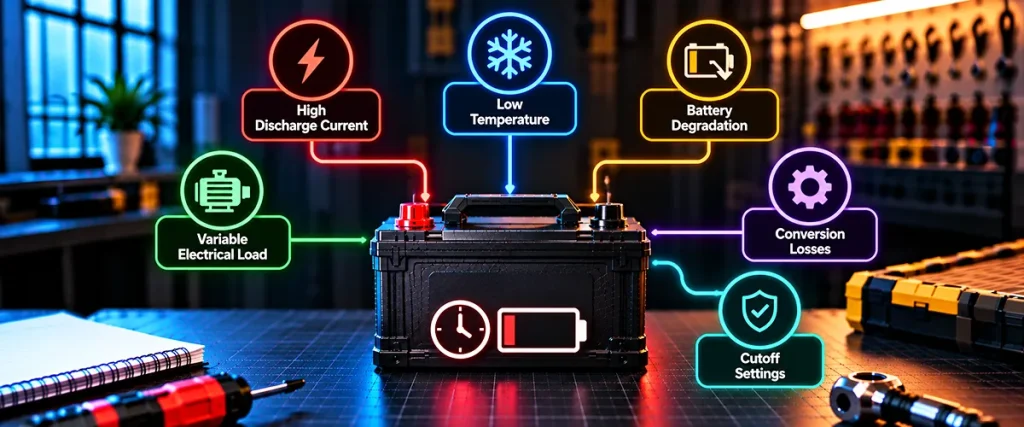
A runtime calculation provides a starting estimate, not an exact prediction. Battery discharge rate, internal resistance and temperature can affect the energy delivered before the system reaches its cutoff voltage.
Important factors include:
- High discharge current: Can reduce effective capacity, particularly in lead-acid batteries.
- Low temperature: May reduce available battery energy.
- Battery degradation: Reduces capacity with aging and repeated use.
- Variable electrical load: Motors and appliances may consume different power during operation.
- Conversion losses: Inverters and DC converters are not perfectly efficient.
- Cutoff settings: Battery protection systems may stop discharge before all nominal energy is used.
Manufacturer discharge data should override simplified estimates when accurate runtime is important. For a complete explanation of capacity-related measurements, explore how to calculate battery capacity.
Common Battery Runtime Calculation Mistakes
Incorrect runtime estimates often result from mixing electrical units or overlooking practical operating limits. These mistakes can lead to unrealistic expectations for backup equipment.
Avoid the following:
- Using Ah directly with a load measured in watts without accounting for voltage.
- Assuming all rated battery energy is usable.
- Ignoring inverter losses when powering AC equipment.
- Confusing watts with watt-hours.
- Using maximum appliance wattage without checking typical operating consumption.
- Assuming a new battery’s capacity remains unchanged throughout its service life.
For reverse unit calculations, our Wh to Ah guide explains how to interpret stored energy in amp-hours.
Conclusion
Understanding how to calculate battery runtime helps you estimate how long a battery can support a particular electrical load. The most practical method is to calculate usable energy in watt-hours and divide it by the equipment’s power consumption. For more realistic results, account for depth of discharge, conversion efficiency, discharge rate and battery condition. Where manufacturer data is available, use its applicable discharge specifications to refine the estimate.
Explore more tutorials in Battery Calculations and Sizing, including battery capacity calculations, UPS backup time and inverter backup time. Visit Batteries Hub for additional battery education.
Frequently Asked Questions
How Do You Calculate Battery Runtime From Ah?
Multiply nominal voltage by battery capacity in Ah to estimate Wh. Apply the usable discharge allowance and relevant efficiency, then divide by load power in watts.
How Long Will a 200Ah Battery Last?
It depends on voltage, electrical load, battery chemistry and usable capacity. A 200Ah rating alone cannot establish runtime. See our dedicated 200Ah battery runtime guide.
Does Higher Battery Voltage Increase Runtime?
Not automatically. Higher voltage increases nominal energy when Ah remains the same, but runtime still depends on the usable energy and connected load.
Can I Calculate UPS Backup Time Using This Formula?
Yes, the same basic energy principles apply. However, UPS systems may require additional considerations, including inverter losses and battery discharge behavior. See how to calculate UPS backup time and inverter battery backup time.
Is Battery Runtime the Same as Charging Time?
No. Runtime describes how long a battery supplies power during discharge. Charging time describes how long it takes to replenish stored energy.