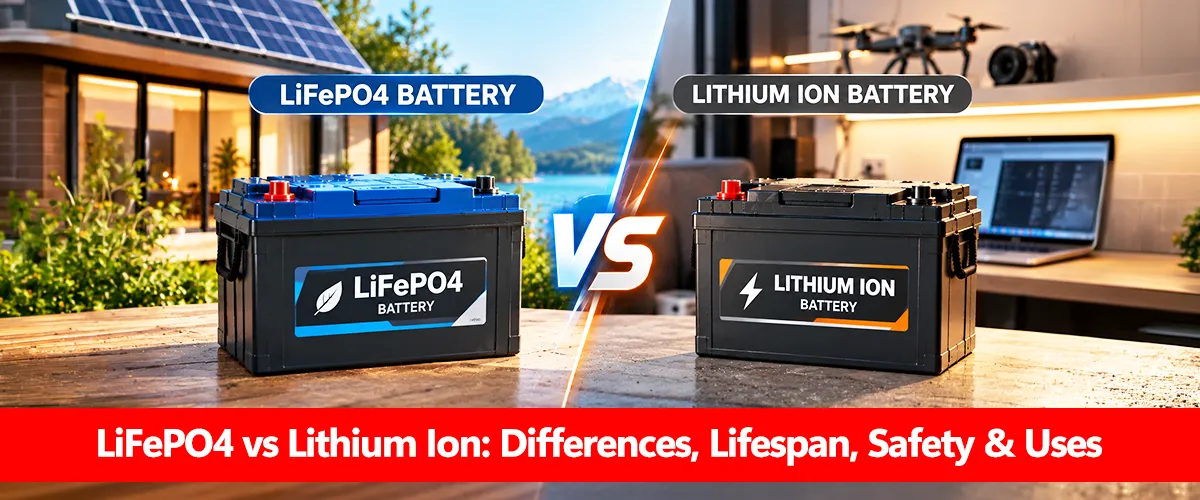
LiFePO4 vs lithium ion is a common comparison when choosing rechargeable batteries for solar energy storage, electric vehicles, portable electronics, UPS systems, and backup power. The main differences involve battery chemistry, energy density, nominal voltage, cycle life, thermal stability, and charging requirements.
An important distinction is that LiFePO4 (Lithium Iron Phosphate) is itself a type of lithium-ion battery. In everyday usage, people often compare LiFePO4 with other lithium-ion chemistries, particularly nickel manganese cobalt (NMC) and nickel cobalt aluminum (NCA).
LiFePO4 batteries generally offer strong thermal stability and long cycle-life potential, while NMC and NCA batteries often provide higher energy density.
What Is a LiFePO4 Battery?
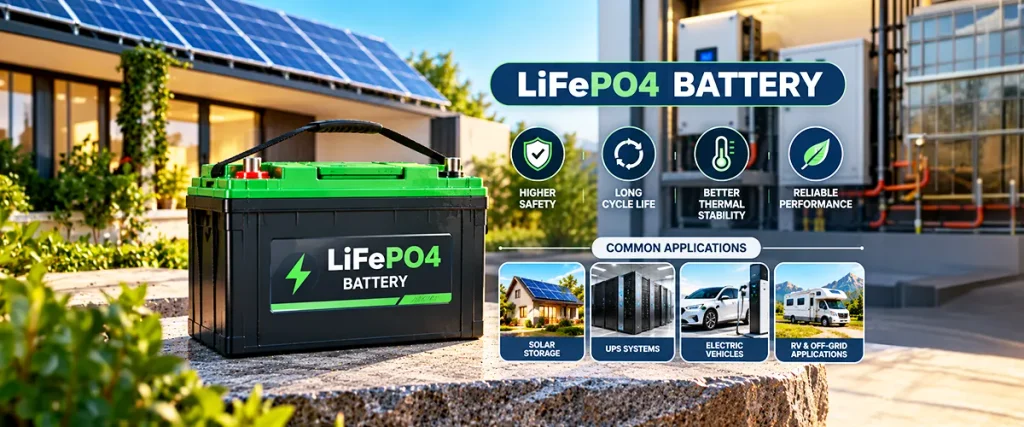
A LiFePO4 battery, also called an LFP battery, is a rechargeable lithium-ion battery that uses lithium iron phosphate as its positive electrode material. LiFePO4 batteries are commonly used in solar storage, UPS systems, electric vehicles, and other applications requiring repeated charging and discharging.
Their chemistry is known for relatively strong thermal stability and long cycle-life potential under suitable operating conditions. For a complete explanation of the technology, read our LiFePO4 battery guide.
What Is a Lithium Ion Battery?
A lithium-ion battery is a rechargeable battery that transfers lithium ions between electrodes during charging and discharging. Lithium-ion technology includes several chemistries, such as LiFePO4, NMC, NCA, and lithium cobalt oxide (LCO). Each uses different electrode materials and offers different performance characteristics.
In this comparison, the term conventional lithium-ion refers mainly to NMC and NCA batteries rather than the entire lithium-ion category. Our lithium ion battery guide explains these technologies and their common applications.
LiFePO4 vs Lithium Ion: Quick Comparison
The main differences between LiFePO4 and NMC/NCA lithium-ion batteries involve nominal cell voltage, energy density, thermal behavior, and cycle-life performance.
| Feature | LiFePO4 (LFP) | NMC / NCA Lithium-Ion |
| Positive electrode | Lithium iron phosphate | Nickel-based metal oxides |
| Nominal cell voltage | Approximately 3.2V | Approximately 3.6–3.7V |
| Energy density | Generally lower | Generally higher |
| Cycle life | Often longer | Varies by design |
| Thermal stability | Generally stronger | Typically requires more thermal management |
| Weight for equal energy | Often higher | Often lower |
| Charging | LFP-specific voltage limits | Chemistry-specific voltage limits |
| Battery management | BMS required for typical packs | BMS required for typical packs |
| Common uses | Solar, backup, EVs | EVs, portable electronics |
| Initial cost | Often competitive | Depends on chemistry and market |
These differences are general trends. Actual performance depends on cell quality, battery design, and operating conditions.
LiFePO4 vs Lithium Ion Performance
Performance is one of the main considerations in the LiFePO4 vs lithium ion comparison. NMC and NCA batteries generally offer higher energy density, allowing more electrical energy to be stored in a smaller and lighter battery. This can be valuable in portable electronics and weight-sensitive applications.
LiFePO4 batteries typically have lower energy density but are well suited to repeated cycling and stationary energy storage. Both technologies can deliver substantial power when designed for the required discharge current. Understanding battery energy density and battery C-rate helps explain these differences without confusing energy storage with power delivery.
LiFePO4 vs Lithium Ion Charging
LiFePO4 and NMC/NCA batteries require different charging voltage limits because their nominal cell voltages and electrochemical characteristics differ. A typical LiFePO4 cell has a nominal voltage of approximately 3.2V, while common NMC and NCA cells have nominal voltages around 3.6–3.7V. Both technologies generally use controlled charging methods, but the charger must follow the manufacturer’s chemistry-specific voltage and current limits.
Important charging considerations include:
- Use a charger compatible with the specific lithium chemistry.
- Follow manufacturer charging voltage and current limits.
- Ensure the battery management system supports the cell configuration.
- Avoid charging outside the approved temperature range.
- Never assume that LFP and NMC/NCA charging profiles are interchangeable.
A battery management system monitors operating conditions and helps protect cells against electrical and thermal faults.
LiFePO4 vs Lithium Ion Lifespan
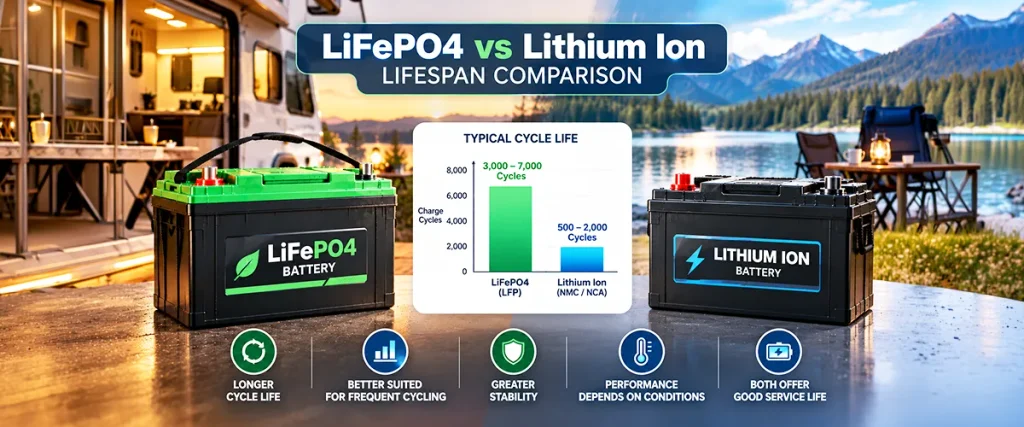
LiFePO4 batteries often provide longer cycle life than many NMC and NCA batteries under comparable operating conditions. Their electrochemical stability can make them attractive for applications requiring frequent charging and discharging.
However, cycle life depends on cell quality, charging conditions, operating temperature, and depth of discharge. High-quality NMC batteries can also provide substantial service life when operated within their specifications. Understanding battery cycle life and depth of discharge helps evaluate manufacturer lifespan claims. For applications involving frequent cycling, also explore our deep cycle vs regular battery comparison.
LiFePO4 vs Lithium Ion Safety
Safety is another important difference between lithium battery chemistries. LiFePO4 generally has greater thermal stability and a lower tendency toward thermal runaway under certain abuse conditions than many nickel-rich lithium-ion chemistries.
However, LiFePO4 batteries are not completely risk-free. Internal short circuits, improper charging, overheating, and physical damage can still cause hazardous failures. NMC and NCA batteries require appropriate protection and thermal management because their safety characteristics differ from LFP. Both technologies require properly designed battery packs, electrical protection, and compatible charging systems.
LiFePO4 vs Lithium Ion Cost
Battery cost depends on cell chemistry, manufacturing quality, capacity, and system requirements. LiFePO4 batteries often offer competitive cell costs and strong long-term value in applications requiring frequent cycling. Their long cycle-life potential can reduce replacement frequency. NMC and NCA batteries may justify their cost where higher energy density and reduced weight are important.
Total ownership cost should consider:
- Initial battery and installation cost.
- Usable energy capacity.
- Expected cycle life.
- Charging efficiency.
- Battery management and thermal requirements.
- Replacement frequency.
For broader cost differences involving older battery technologies, read lithium vs lead acid battery.
Which Is Better: LiFePO4 or Lithium Ion?
The better chemistry depends on application requirements, energy density, safety, and expected cycling frequency.
| Application | Practical Recommendation |
| Solar energy storage | LiFePO4 often suitable |
| Home UPS backup | LiFePO4 commonly suitable |
| Portable electronics | NMC/NCA or other high-energy lithium-ion chemistries |
| Electric vehicles | Both, depending on vehicle design |
| Weight-sensitive applications | NMC/NCA may offer advantages |
| Frequent deep cycling | LiFePO4 often offers advantages |
| Stationary backup systems | LiFePO4 commonly preferred |
| Compact high-energy packs | NMC/NCA often suitable |
For comparisons involving lead-acid batteries, explore LiFePO4 vs lead acid battery and LiFePO4 vs AGM battery.
How to Choose Between LiFePO4 and Lithium Ion Batteries
Choosing the right lithium battery chemistry requires evaluating the electrical system and operating conditions.
Consider these factors:
- Application: Determine whether the battery is intended for stationary storage, vehicles, or portable equipment.
- Energy density: Consider weight and space limitations.
- Voltage compatibility: Match the cell configuration to the equipment.
- Charging requirements: Confirm chemistry-specific charger support.
- Cycle-life rating: Compare manufacturer data under similar conditions.
- Safety: Evaluate battery protection and thermal management.
- Total cost: Consider purchase price, lifespan, and replacement frequency.
For users considering traditional battery alternatives, our AGM vs gel battery guide covers a separate comparison within lead-acid technology.
Conclusion
The LiFePO4 vs lithium ion comparison shows that LiFePO4 is a lithium-ion chemistry with different characteristics from commonly used NMC and NCA batteries. LiFePO4 batteries generally offer strong thermal stability and long cycle-life potential, making them suitable for solar storage, UPS systems, and repeated cycling applications.
NMC and NCA batteries often provide higher energy density, making them attractive for portable electronics and applications where weight and space are important. The best choice depends on voltage compatibility, energy density, charging requirements, safety, expected lifespan, and total ownership cost. Explore more guides in the Battery Comparisons category at Batteries Hub.
Frequently Asked Questions
Is LiFePO4 the Same as Lithium Ion?
LiFePO4 is a type of lithium-ion battery. It differs from other lithium-ion chemistries, such as NMC and NCA, in electrode materials and operating characteristics.
Which Lasts Longer: LiFePO4 or Lithium Ion?
LiFePO4 batteries often provide longer cycle life than many NMC and NCA batteries, but actual lifespan depends on cell design, temperature, charging practices, and usage.
Is LiFePO4 Safer Than Lithium Ion?
LiFePO4 generally offers greater thermal stability than many nickel-rich lithium-ion chemistries. However, all lithium batteries require suitable protection and safe operating conditions.
What Is the Voltage Difference Between LiFePO4 and Lithium Ion?
A typical LiFePO4 cell has a nominal voltage of approximately 3.2V, while common NMC and NCA lithium-ion cells operate around 3.6–3.7V nominally.
Can I Use a Lithium Ion Charger for LiFePO4?
Only if the charger explicitly supports LiFePO4 charging and matches the battery manufacturer’s voltage and current requirements.
Is LiFePO4 Better for Solar Batteries?
LiFePO4 is often suitable for solar energy storage because of its cycle-life potential, thermal stability, and repeated cycling capability.
Are LiFePO4 Batteries More Expensive?
Costs vary by chemistry, capacity, manufacturer, and battery design. LiFePO4 may offer competitive long-term value in applications requiring frequent cycling.