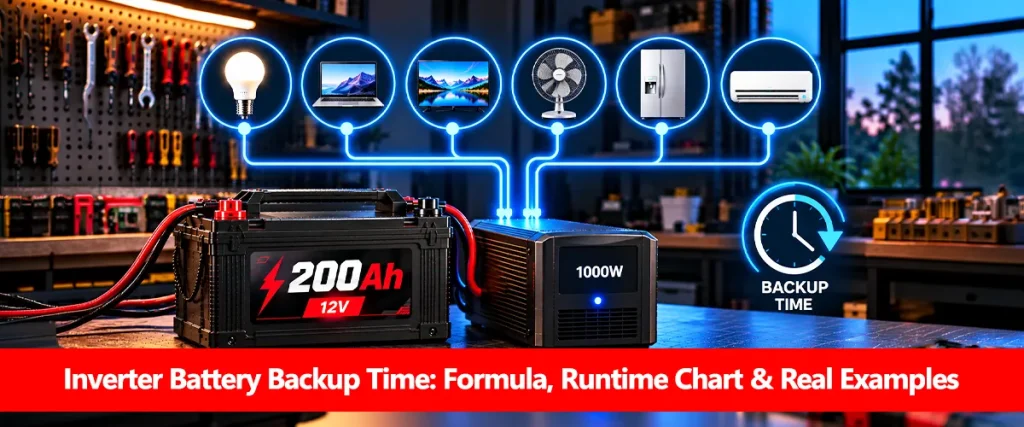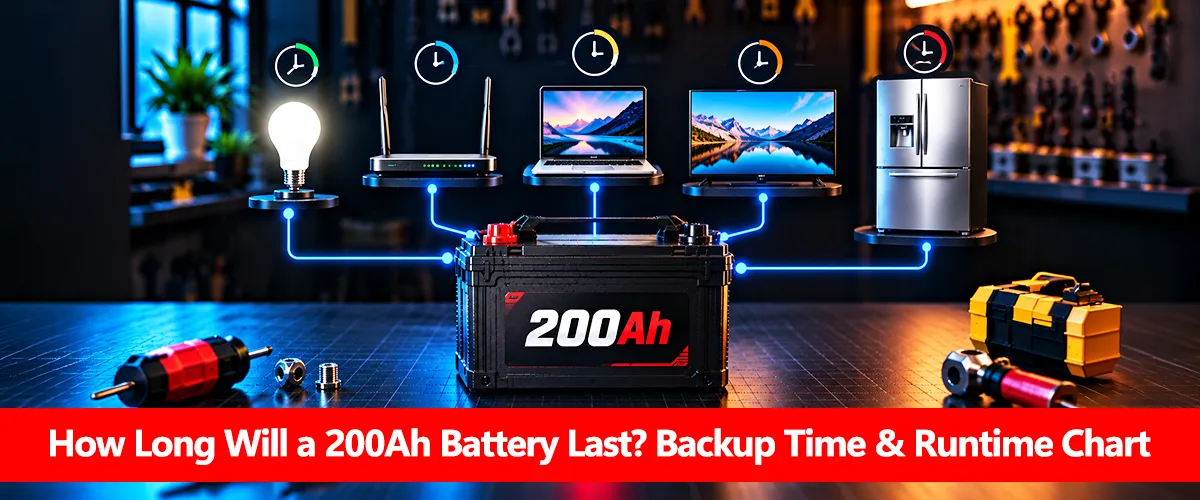
How long will a 200Ah battery last? A 12V 200Ah lead-acid battery can theoretically power a continuous 100W AC load for approximately 10.2 hours, assuming 50% depth of discharge and 85% inverter efficiency. A 12.8V 200Ah LiFePO4 battery could provide around 18.4 hours with 80% depth of discharge and 90% inverter efficiency. These estimates show why battery chemistry, electrical load, and usable capacity matter more than the 200Ah label alone. Actual backup time can change with battery age, temperature, discharge current, and inverter performance.
Whether you’re running fans during load shedding or evaluating solar backup storage, this guide provides realistic calculation scenarios to help you estimate operating time.
How Many Hours Can a 200Ah Battery Provide?
A 200Ah battery does not have one fixed runtime. The amount of energy consumed by connected equipment determines how quickly it discharges. A low-power Wi-Fi router may operate for many hours, while an appliance drawing several hundred watts can use the available energy much faster.
The following chart compares two common battery configurations. All estimates assume healthy, fully charged batteries and continuous AC loads.
| Electrical Load | 12V 200Ah Lead-Acid | 12.8V 200Ah LiFePO4 |
| 50W | 20.4 hours | 36.9 hours |
| 100W | 10.2 hours | 18.4 hours |
| 150W | 6.8 hours | 12.3 hours |
| 200W | 5.1 hours | 9.2 hours |
| 300W | 3.4 hours | 6.1 hours |
| 500W | 2.0 hours | 3.7 hours |
Calculation assumptions:
- Lead-acid: 12V nominal voltage, 50% usable discharge, 85% inverter efficiency.
- LiFePO4: 12.8V nominal voltage, 80% usable discharge, 90% inverter efficiency.
- Constant appliance wattage and no separately added inverter standby consumption.
These values are theoretical energy-based estimates, not manufacturer-guaranteed runtimes. High discharge current can reduce the effective capacity of lead-acid batteries.
How Much Energy Does a 200Ah Battery Store?
Amp-hours measure electric charge, while watt-hours measure stored electrical energy. To estimate battery energy capacity, multiply its nominal voltage by its amp-hour rating. This distinction is important because two 200Ah batteries operating at different voltages do not store the same amount of energy.
For common battery configurations:
- 12V 200Ah: Approximately 2,400Wh (2.4kWh).
- 12.8V 200Ah: Approximately 2,560Wh (2.56kWh).
- 24V 200Ah: Approximately 4,800Wh (4.8kWh).
- 25.6V 200Ah: Approximately 5,120Wh (5.12kWh).
- 48V 200Ah: Approximately 9,600Wh (9.6kWh).
These are nominal energy estimates. For unit conversion details, see our guides to Wh to Ah and what Ah means on a battery.
How to Calculate 200Ah Battery Runtime
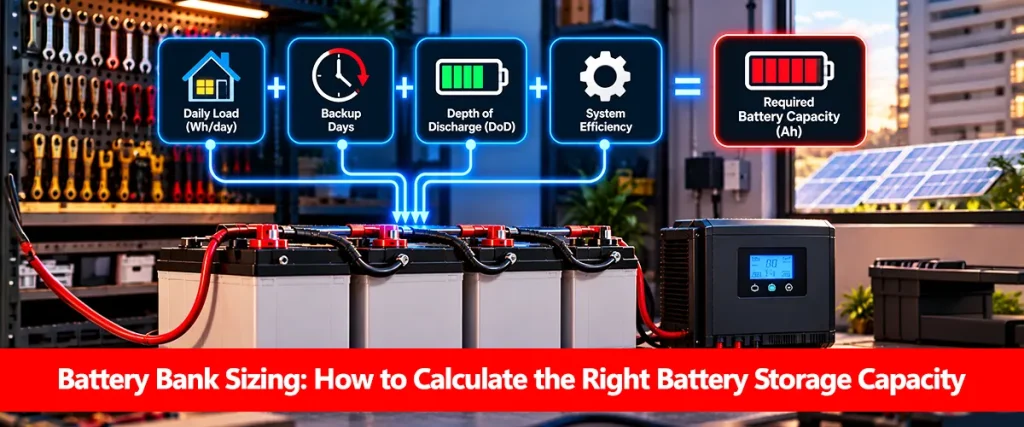
The most practical method is to estimate the energy available to connected equipment and divide it by its power consumption. For an AC appliance powered through an inverter, include both the battery’s permitted discharge percentage and the inverter’s conversion efficiency.
200Ah Battery Runtime Formula:
[
\text{Runtime (hours)} \approx
\frac{\text{Voltage}\times200\times\text{DoD}\times\text{Efficiency}}{\text{Load (W)}}
]
Example: 12V 200Ah Lead-Acid Battery
Suppose a 200Ah battery operates at 12V and powers a constant 200W AC load. Using 50% depth of discharge and 85% inverter efficiency:
- Nominal battery energy: 12 × 200 = 2,400Wh.
- Usable battery energy: 2,400 × 0.50 = 1,200Wh.
- Estimated AC energy: 1,200 × 0.85 = 1,020Wh.
- Runtime: 1,020 ÷ 200 = 5.1 hours.
The calculation assumes the rated energy remains available at the discharge current involved. Real lead-acid performance may differ, especially at heavier loads. For a general calculation method covering other battery sizes, read how to calculate battery runtime.
Real-Life Example: Running Fans and Lights During Load Shedding
Imagine a household in Pakistan using a 12.8V 200Ah LiFePO4 battery for essential backup. The family wants to operate fans, lights, and an internet router during an electricity interruption.
Their estimated electrical load is:
- Three ceiling fans consuming 60W each: 180W.
- Four LED lights consuming 10W each: 40W.
- One Wi-Fi router: 10W.
- Total continuous load: 230W.
With 80% usable discharge and 90% inverter efficiency, the estimated AC energy available is 1,843.2Wh.
Estimated backup time = 1,843.2Wh ÷ 230W = approximately 8 hours.
This estimate assumes all devices operate continuously at the stated power. An actual inverter’s idle consumption, appliance power changes, and battery condition can reduce the result.
Why Do Lead-Acid and Lithium Batteries Last Different Amounts of Time?
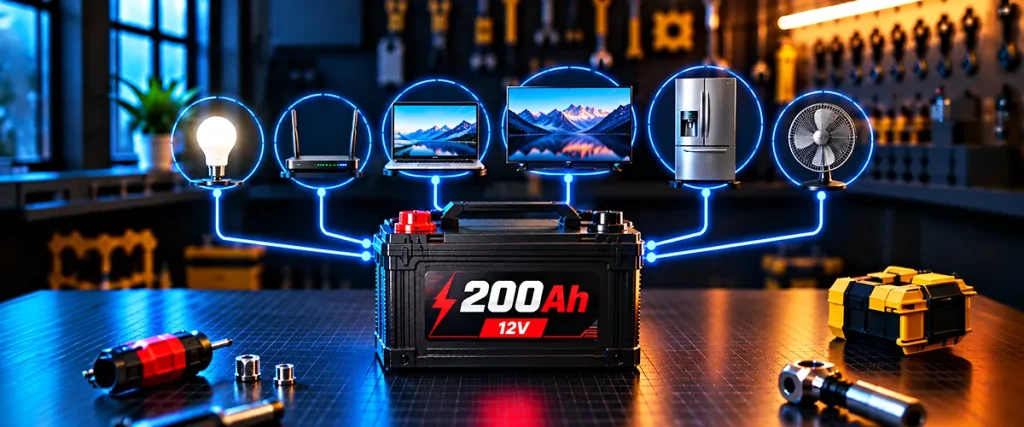
Two batteries labeled 200Ah may deliver different practical backup times because their nominal voltage, discharge characteristics, and operating limits differ. Their chemistry influences how much of the rated capacity is available during use.
- Lead-acid batteries are commonly rated using relatively slow discharge tests. At higher currents, their effective capacity can decrease, and frequent deep discharge may shorten service life. A conservative discharge allowance is often used for long-term backup planning.
- LiFePO4 batteries commonly provide a larger permitted usable capacity and better charge retention under suitable discharge rates. However, their exact current limits and discharge settings depend on the product and battery management system. For broader differences, explore how long a 100Ah battery lasts and our battery capacity calculation guide.
What Can Reduce Your 200Ah Battery Backup Time?
A runtime chart assumes a particular amount of usable energy, but actual batteries operate under changing conditions. Battery aging reduces capacity, while high current and temperature extremes may affect performance before the system reaches its discharge cutoff.
Watch for these factors:
- Higher appliance load: Additional fans, lights, or other equipment increase energy consumption.
- Incomplete charging: A battery starting below 100% state of charge provides less backup.
- Discharge rate: High-current operation can reduce available capacity, particularly in lead-acid batteries.
- Battery aging: Older batteries may no longer deliver their original rated capacity.
- Inverter losses: Conversion efficiency and standby power affect energy delivered to appliances.
- Discharge cutoff: Battery protection settings can restrict usable energy.
A manufacturer’s discharge curve and technical specifications provide a more reliable basis than a generic chart when accurate runtime is essential.
Is a 200Ah Battery Enough for Home Backup?
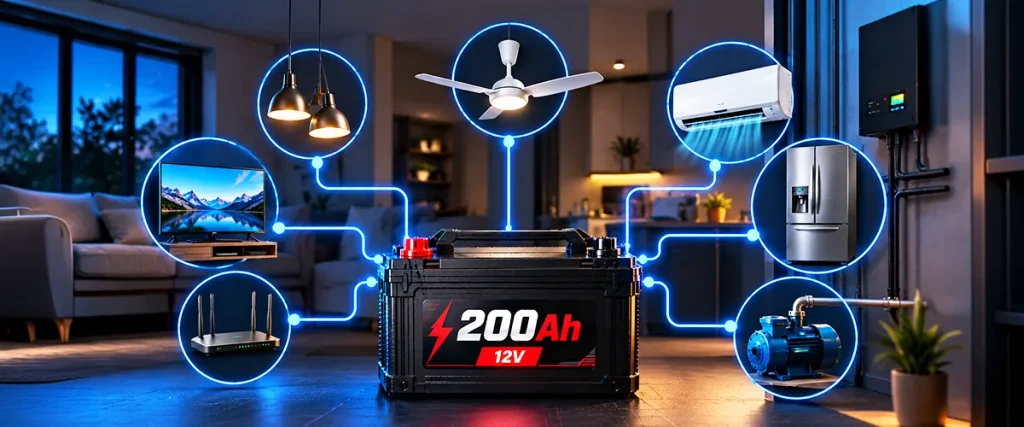
A 200Ah battery can support many modest household loads, but whether it is sufficient depends on your total energy requirement and available system voltage. For example, powering lights and fans for several hours demands less energy than operating pumps, air conditioners, or other high-power appliances.
Before relying on a 200Ah battery, check:
- Total continuous and starting power requirements.
- Desired backup duration.
- Battery voltage and inverter compatibility.
- Usable depth of discharge.
- Manufacturer-approved current limits.
- Battery condition and operating temperature.
A larger Ah rating does not automatically make a battery compatible with an existing system. Voltage, charging requirements, and inverter specifications must also match.
Conclusion
How long will a 200Ah battery last? Its runtime depends on the battery’s voltage, usable energy, and connected electrical load. At 100W, a 12V lead-acid battery may provide around 10 hours, while a 12.8V LiFePO4 battery may offer approximately 18 hours under the assumptions used in this guide. For accurate backup planning, consider discharge limits, inverter efficiency, appliance wattage, and manufacturer specifications rather than relying on amp-hours alone.
Explore more practical guides on battery runtime calculations, 100Ah battery backup time, and battery capacity sizing. Visit Battery Calculations and Sizing or the Batteries Hub homepage for more battery education.
Frequently Asked Questions
How Long Will a 200Ah Battery Last With a 100W Load?
Using the example assumptions, a 12V 200Ah lead-acid battery provides approximately 10.2 hours of theoretical backup. A 12.8V 200Ah LiFePO4 battery provides approximately 18.4 hours.
How Long Will a 200Ah Battery Run a 500W Appliance?
Under the stated conditions, the theoretical estimates are approximately 2 hours for lead-acid and 3.7 hours for LiFePO4. High discharge current may shorten actual lead-acid runtime.
Can a 200Ah Battery Last 24 Hours?
Yes, with a sufficiently small load. Under the lithium example assumptions, available AC energy is approximately 1,843Wh, which would theoretically support an average load of about 77W for 24 hours.
Is a 200Ah Battery Twice as Good as a 100Ah Battery?
At the same nominal voltage and under comparable rating conditions, 200Ah provides twice the rated charge capacity. However, runtime, size, cost, and performance do not necessarily scale perfectly.
Does a 24V 200Ah Battery Last Longer Than a 12V 200Ah Battery?
At equal load and comparable usable-energy conditions, a 24V 200Ah battery has approximately twice the nominal energy of a 12V 200Ah battery and can therefore potentially provide longer runtime.
Can a 200Ah Battery Run an Air Conditioner?
It depends on the air conditioner’s actual power consumption, starting requirements, system voltage, and inverter capabilities. A 200Ah rating alone does not confirm whether the battery can safely operate the equipment.