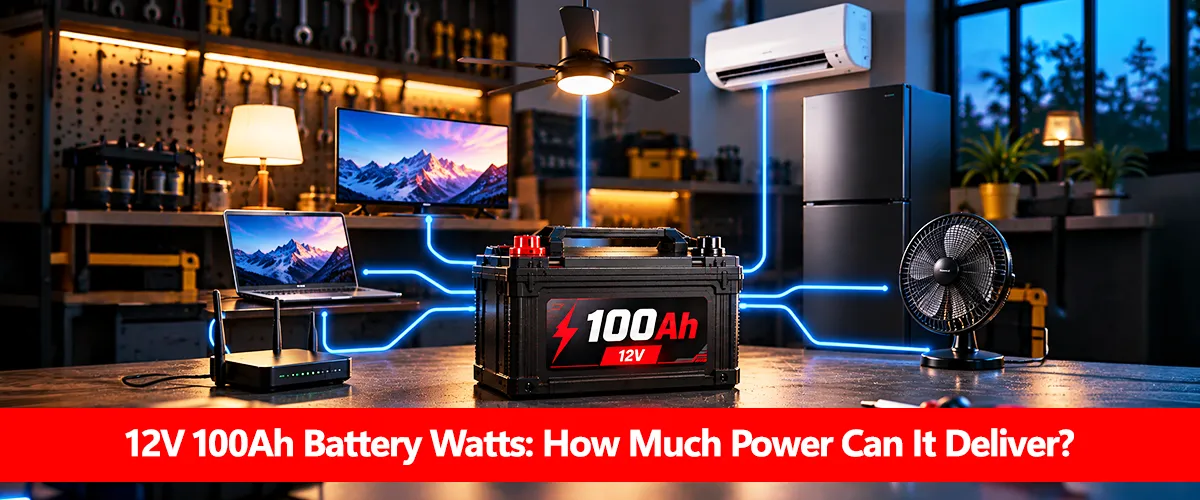
12V 100Ah battery watts are often misunderstood because a battery’s stored energy and its power output are not the same thing. A 12V 100Ah battery stores approximately 1,200 watt-hours (Wh) of nominal energy, but that does not mean it can continuously deliver 1,200 watts of power. The actual wattage a battery can supply depends on its discharge-current rating, chemistry, voltage under load, battery management system, and connected equipment. A battery may have enough stored energy for an appliance but still be unable to support its high power demand.
Understanding this distinction is particularly useful when connecting a 100Ah battery to an inverter, solar system, or household backup setup.
Quick Answer
- Nominal voltage: 12V.
- Battery capacity: 100Ah.
- Nominal stored energy: Approximately 1,200Wh or 1.2kWh.
- Power at 10A: Approximately 120W.
- Power at 50A: Approximately 600W.
- Maximum output: Depends on the battery’s approved discharge-current limit.
How Many Watt-Hours Does a 12V 100Ah Battery Store?
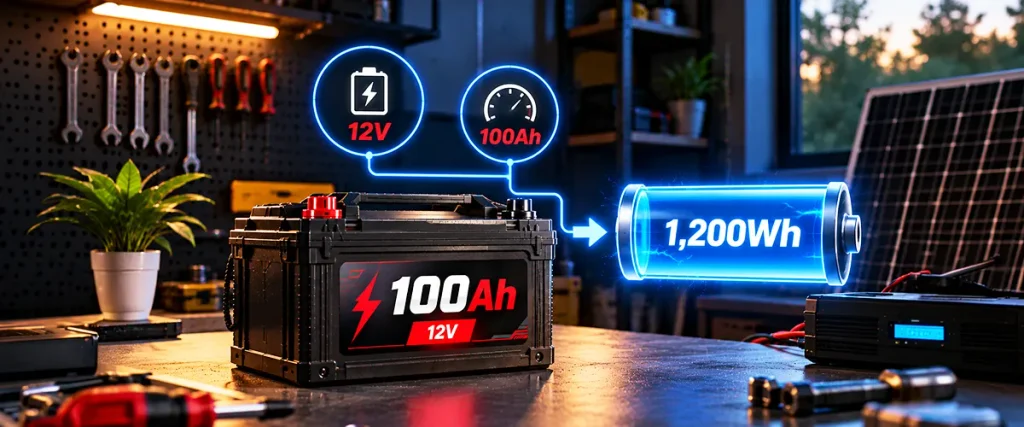
A 12V 100Ah battery combines a nominal voltage of 12 volts with a rated charge capacity of 100 amp-hours. Multiplying these values gives an estimate of its nominal stored electrical energy. This is useful for understanding battery specifications, even though actual energy delivery changes with discharge conditions.
Battery Energy (Wh) = Voltage (V) × Capacity (Ah)
For a standard 12V 100Ah battery:
12V × 100Ah = 1,200Wh
The result means the battery contains approximately 1.2kWh of nominal energy. It does not mean all 1,200Wh will necessarily reach your appliances, because discharge limits, battery aging, temperature, and electrical losses affect usable energy.
For more on these measurements, read what Ah means on a battery and our guide to battery watt-hours.
How Many Watts Can a 12V 100Ah Battery Supply?
Electrical power depends on voltage and current. The relevant formula is Watts = Volts × Amps, which means a battery supplies more power when the connected load draws more current, provided the battery can safely support that demand.
At a nominal 12V, the following values illustrate how current relates to power.
| Battery Current | Approximate DC Power |
| 5A | 60W |
| 10A | 120W |
| 20A | 240W |
| 30A | 360W |
| 50A | 600W |
| 100A | 1,200W |
Important: These are electrical calculations, not guaranteed output ratings. A 100Ah battery may not support 100A continuously. Its maximum permitted current must be verified using the manufacturer specifications.
Battery voltage also changes during operation, so actual wattage at a particular current may differ from the nominal values shown.
Why Doesn’t 100Ah Automatically Mean 1,200 Watts?
The 100Ah rating describes how much electric charge a battery can deliver under specified test conditions. Watts, however, describe the rate at which electrical energy is supplied to equipment. These quantities are related but represent different aspects of battery operation.
For example, a 12V 100Ah battery may have approximately 1,200Wh of nominal energy, but its permissible continuous discharge current could be far below 100A. That would limit its output power, regardless of how much energy it stores.
Three specifications help establish actual capability:
- Rated capacity (Ah): How much charge the battery can deliver.
- Nominal energy (Wh): An estimate of stored electrical energy.
- Maximum discharge current (A): How much current the battery is permitted to supply.
Our Ah vs Wh comparison explains why these units should not be treated as interchangeable.
How Does Battery Chemistry Affect Power Output?
Two batteries labeled 12V 100Ah can have different power capabilities because their chemistry and internal design influence discharge performance. A battery intended for slow, steady energy delivery may not support the same current as one designed for high-power applications.
- Lead-acid batteries are commonly rated at specified discharge rates, such as a 20-hour rate. Drawing substantially more current can reduce effective capacity and increase voltage drop. Starting batteries and deep-cycle batteries also have different intended duties.
- LiFePO4 batteries typically operate at a nominal voltage of 12.8V rather than exactly 12V. A 12.8V 100Ah battery therefore has approximately 1,280Wh of nominal energy. Its permitted output current depends on cell design and battery management system limits.
The battery’s C-rate provides another way to describe charging and discharging current relative to capacity.
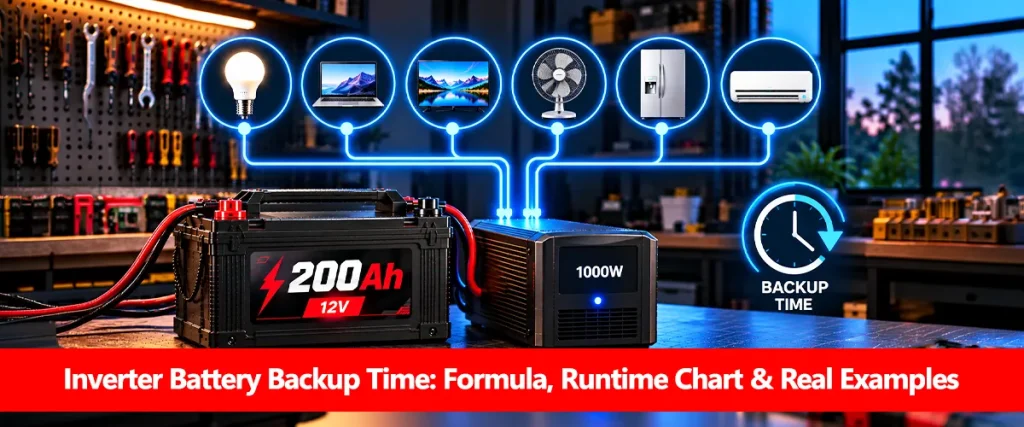
Can a 12V 100Ah Battery Run a 1,000W Inverter?
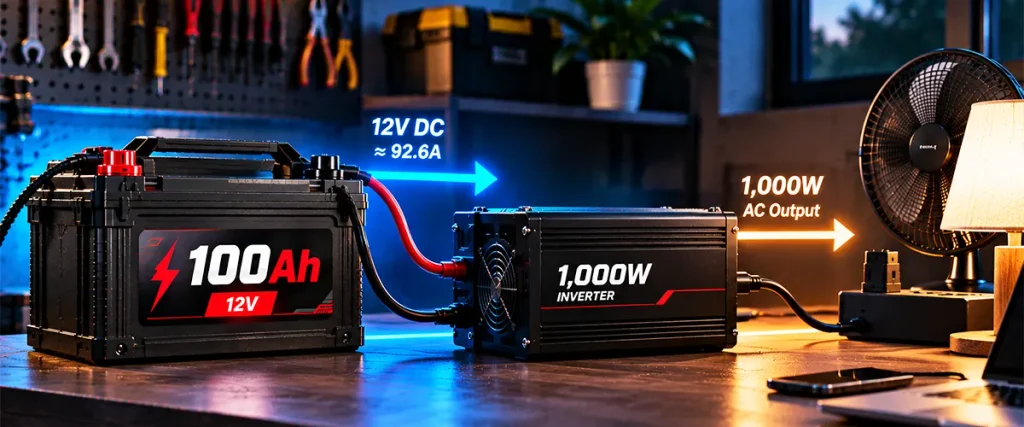
A battery can be connected to a compatible 1,000W inverter only when the battery, inverter, cabling, protection equipment, and installation are rated for the required current. The inverter’s advertised power rating does not establish whether the battery can supply that much power.
Suppose an inverter supplies a continuous 1,000W AC load at 90% efficiency. The approximate DC input current from a 12V battery would be:
1,000W ÷ (12V × 0.90) ≈ 92.6A
That is a substantial current for a 100Ah battery. Some batteries are designed for such operation, while others may experience excessive voltage drop or trigger protective shutdown.
Before connecting an inverter, check:
- Maximum continuous battery discharge current.
- Inverter input-voltage requirements.
- Continuous power and starting-surge requirements.
- Battery management system restrictions.
- Manufacturer-approved cable and circuit protection specifications.
For electrical safety, use an appropriately designed installation rather than selecting an inverter based on Ah alone.
What Appliances Can a 12V 100Ah Battery Power?
Whether an appliance can operate depends on its power demand and the system’s output capabilities. Small DC loads are often less demanding than high-wattage AC equipment, but actual compatibility depends on voltage and current requirements.
Typical examples include:
- LED lighting: Often requires relatively little power.
- Wi-Fi routers: May be suitable with a compatible regulated output.
- DC fans: Can operate directly only when voltage and electrical specifications match.
- AC fans: Require a compatible inverter and sufficient battery current.
- Televisions: Power requirements vary by screen size and technology.
- High-power appliances: Heaters, kettles, and similar loads may exceed the practical limits of a 12V 100Ah setup.
A battery’s ability to power an appliance should not be confused with how long it can run that appliance. For operating-time estimates, see how long a 100Ah battery lasts.
What Reduces the Usable Power and Energy?
Battery performance varies as the battery discharges. Terminal voltage may fall under high current because of internal resistance, while battery protection systems can limit output when operating conditions exceed their approved range.
Factors affecting real-world performance include:
- Discharge rate: High current may reduce available capacity, particularly in lead-acid batteries.
- Depth of discharge: The selected discharge limit affects usable energy.
- Temperature: Cold conditions can reduce power and capacity availability.
- Battery aging: Capacity loss and increased internal resistance affect performance.
- Inverter efficiency: AC equipment receives less energy than the battery supplies because of conversion losses.
These factors explain why two 12V 100Ah batteries may perform differently even when their nominal ratings appear similar.
Is a 12V 100Ah Battery Suitable for UPS and Solar Backup?
A 12V 100Ah battery may be useful for modest backup loads in homes and small offices. In Pakistan, such batteries are commonly considered for lighting, fans, routers, and other essential equipment during load shedding. However, system suitability depends on both energy requirements and instantaneous power demand. A battery with enough watt-hours for several hours of lighting may still be unsuitable for an inverter that demands excessive current. When evaluating a backup system, check the battery’s usable energy, discharge limits, charging compatibility, and the inverter’s operating specifications. For broader sizing, see how to calculate battery capacity.
Conclusion
12V 100Ah battery watts should be understood by separating stored energy from output power. A typical 12V 100Ah battery has approximately 1,200Wh of nominal energy, while its instantaneous wattage depends on the current it can safely deliver. Before connecting appliances or an inverter, check the manufacturer’s discharge-current limits, nominal voltage, usable capacity, and system compatibility. These specifications provide a more accurate picture than multiplying 12V by 100Ah and treating the result as a continuous power rating.
Explore more guides in Battery Calculations and Sizing, including battery capacity calculations and 100Ah battery runtime. Visit Batteries Hub for additional battery education.
Frequently Asked Questions
Is a 12V 100Ah Battery 1,200 Watts?
No. It has approximately 1,200 watt-hours of nominal energy. Its maximum power output depends on the permissible discharge current and battery voltage under load.
How Many Watts Is a 12V 100Ah LiFePO4 Battery?
A typical 12.8V 100Ah LiFePO4 battery stores approximately 1,280Wh of nominal energy. Its continuous output wattage depends on its rated discharge current and operating conditions.
Can a 12V 100Ah Battery Supply 500W?
Possibly, if the battery and electrical system support the required current. At 12V, a 500W DC load draws approximately 41.7A. An inverter supplying 500W AC generally requires greater battery-side input power because of conversion losses.
Is 100Ah the Same as 100 Amps?
No. Ah measures electric charge capacity, while amps measure current. A 100Ah battery does not automatically support a continuous 100A discharge.
Is a 12V 200Ah Battery More Powerful?
A 12V 200Ah battery has approximately twice the nominal stored energy of a 12V 100Ah battery. Whether it can deliver more instantaneous power depends on its current ratings. See our guide to 12V 200Ah battery watts.
Does a Higher Watt-Hour Rating Mean Longer Backup?
Higher usable energy generally supports longer operation with the same electrical load, but actual backup depends on discharge conditions and conversion efficiency. Detailed estimates are covered in battery runtime calculations.