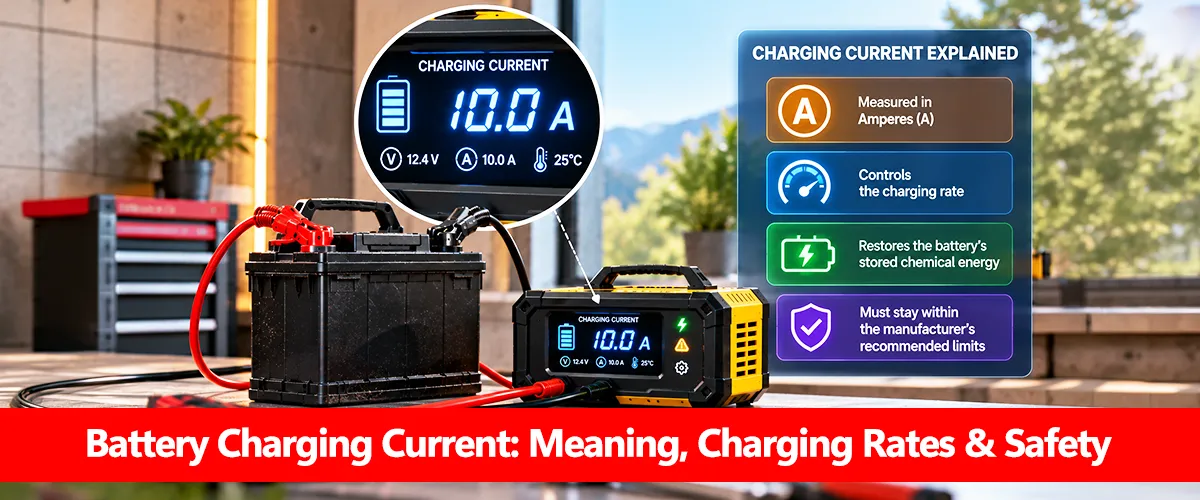
Battery charging current is the amount of electrical current flowing into a rechargeable battery during charging, measured in amperes (A). It influences how quickly a battery receives charge and must remain within the limits specified by the battery manufacturer.
Charging current varies according to battery chemistry, capacity, state of charge, temperature, and the charger’s operating mode. Lead-acid and lithium-ion batteries may accept different charging currents even when their rated capacities are similar.
Understanding charging current helps prevent overheating, premature battery degradation, and charging equipment incompatibility. For an overview of the charging process, read our how battery charging works guide.
What Is Battery Charging Current?
Battery charging current refers to the rate at which electrical charge enters a battery during recharging. It is measured in amperes (A). One ampere represents the movement of one coulomb of electric charge per second.
During charging, an external power source supplies electrical energy to reverse the battery’s discharge reactions. The charging current determines the rate of charge transfer, while the charging voltage provides the required electrical potential.
The correct current depends on the battery’s electrochemical design and the charger’s control system. For the difference between these two electrical quantities, explore our battery charging voltage article.
How Battery Charging Current Works
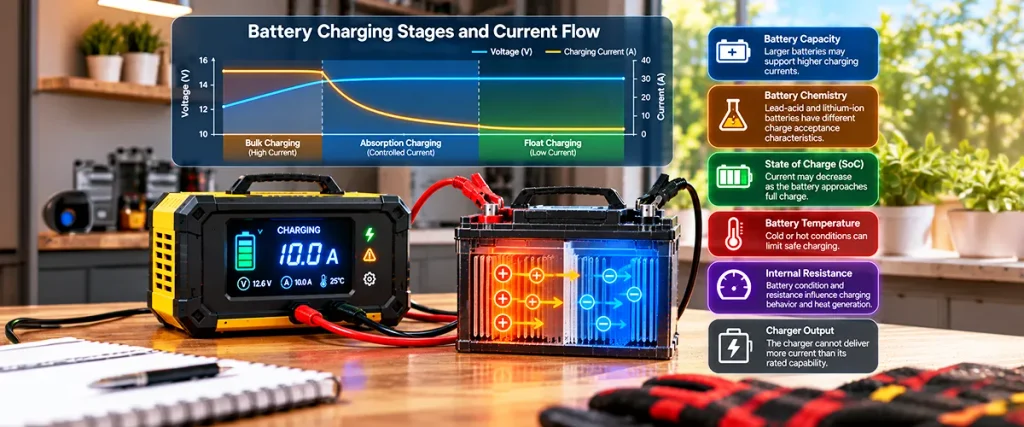
A compatible charger regulates current according to the battery’s charging requirements.
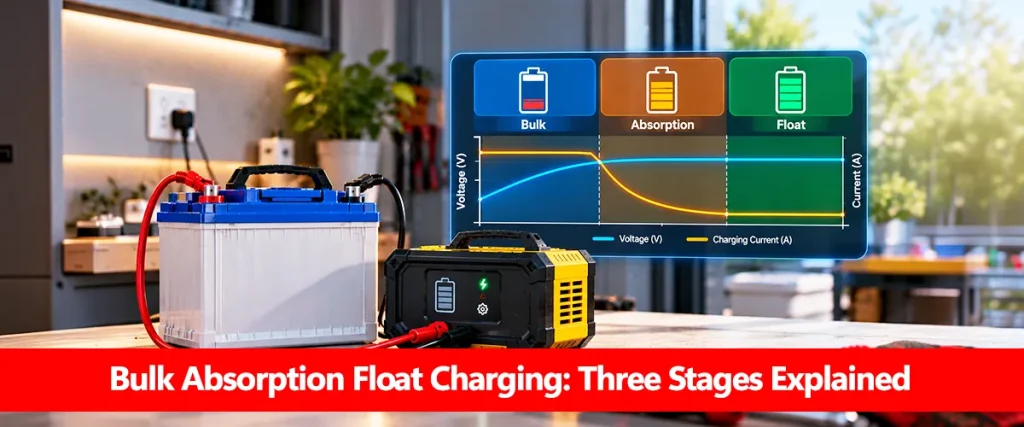
At certain charging stages, the charger may provide a relatively steady current. As the battery approaches full charge, current often decreases to prevent excessive voltage and battery stress.
The charging current depends on:
- Battery capacity: Larger batteries may support higher charging currents.
- Battery chemistry: Lead-acid and lithium-ion batteries have different charge acceptance characteristics.
- State of charge (SoC): Current may decrease as the battery approaches full charge.
- Battery temperature: Cold or hot conditions can limit safe charging.
- Internal resistance: Battery condition and resistance influence charging behavior and heat generation.
- Charger output: The charger cannot deliver more current than its rated capability.
Charging current is therefore not necessarily constant throughout the entire charging process.
Battery Charging Current and C-Rate
C-rate expresses charging or discharging current relative to battery capacity. It provides a convenient way to compare charging rates across batteries of different sizes.
For example, consider a battery rated at 100Ah:
| Charging Rate | Charging Current |
| 0.1C | 10A |
| 0.2C | 20A |
| 0.5C | 50A |
| 1C | 100A |
These values illustrate the relationship between C-rate and amp-hour capacity. They are not recommended charging currents for every 100Ah battery.
A battery must explicitly support the selected C-rate. Charging at a higher rate than permitted can increase heating, stress, and safety risks. Our battery C-rate guide explains this concept in more detail.
Battery Charging Current for Different Chemistries
Different battery chemistries have different current acceptance characteristics.
| Battery Type | Charging Current Considerations |
| Flooded lead-acid | Follow manufacturer current limits and temperature requirements |
| AGM | Use current limits suitable for AGM construction and application |
| Gel | Avoid charging currents exceeding the specified gel battery limits |
| LiFePO4 | Follow cell specifications and BMS charging current limits |
| Other lithium-ion | Match current to the specific chemistry, cell design, and pack configuration |
Lithium batteries can often support relatively high charging currents, but their permitted rates vary substantially between models.
Lead-acid batteries may accept substantial current during early charging, followed by a gradual decrease as charging progresses. Battery chemistry alone does not establish a universal safe charging current.
Constant Current vs Constant Voltage Charging
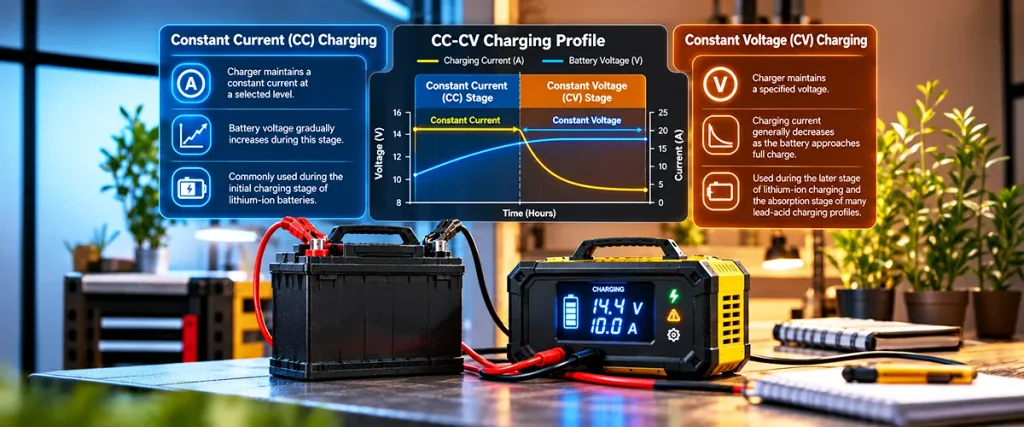
Many rechargeable batteries use charging profiles that control both current and voltage.
Constant Current Charging
During constant current (CC) charging, the charger regulates current at a selected level while the battery’s terminal voltage changes. This approach is commonly used during the initial charging stage of lithium-ion batteries. Current must remain within the battery manufacturer’s permitted limits.
Constant Voltage Charging
During constant voltage (CV) charging, the charger maintains a specified voltage while charging current generally decreases. This is commonly used during the later stage of lithium-ion charging and during the absorption stage of many lead-acid charging profiles.
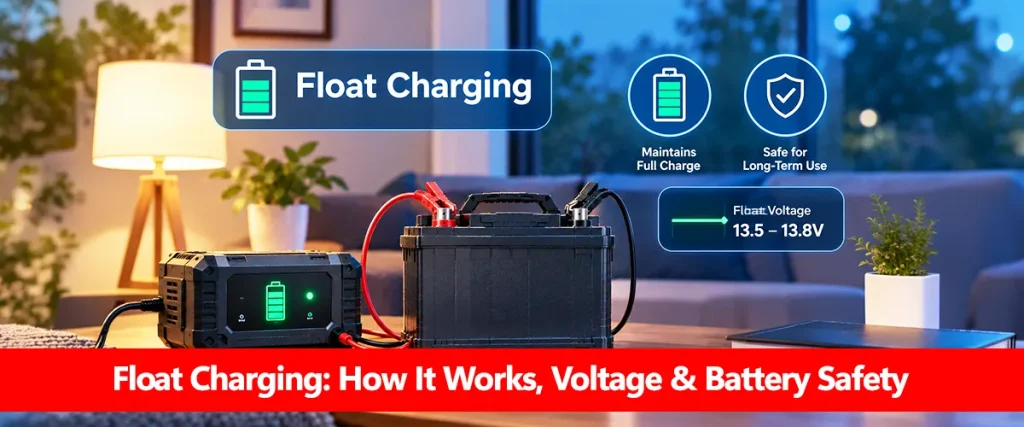
Charging must end or transition appropriately according to the battery chemistry. For lead-acid charging stages, read our bulk absorption float charging guide.
How Charging Current Affects Charging Time
Higher charging current can reduce battery charging time when the battery supports the increased rate. However, charging time is not determined by current alone. Battery capacity, initial state of charge, charging efficiency, temperature, and current reduction near full charge all affect the total time required.
A charger rated at 20A also does not necessarily supply 20A throughout the entire charging process. For detailed charging-time calculations, explore our battery charging time guide.
How Temperature Affects Charging Current
Temperature plays an important role in safe battery charging. At high temperatures, excessive charging current can contribute to additional heating and accelerated degradation. At low temperatures, electrochemical reactions slow down, which can reduce the battery’s ability to accept charge.
Many lithium-ion batteries restrict charging current at low temperatures or prevent charging below specified temperature limits. Some LiFePO4 packs prohibit charging below 0°C unless approved temperature-control features are present.
Lead-acid batteries also require suitable charging conditions, and charging performance changes with temperature. A battery management system may limit or interrupt charging when a lithium battery approaches its permitted operating limits.
What Happens If Charging Current Is Too High?
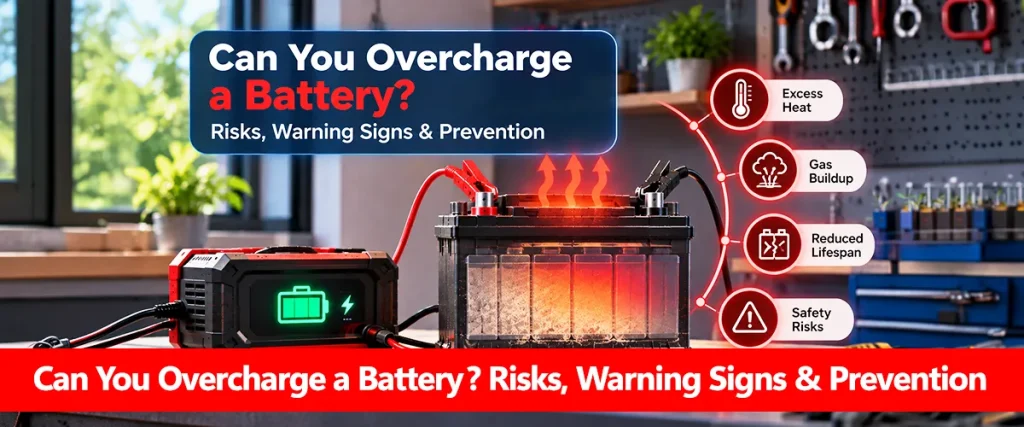
Excessive charging current can cause overheating, accelerated degradation, and potentially unsafe battery conditions. The consequences depend on battery chemistry, construction, and protection systems.
Possible effects include:
- Increased battery temperature.
- Reduced cycle life.
- Excessive charging stress.
- Electrolyte loss or gassing in lead-acid batteries.
- Lithium battery protection shutdown.
- Increased risk of battery damage.
Even when a charger can deliver high current, the battery must be designed to accept it safely. For related safety information, read our battery overcharging guide.
What Happens If Charging Current Is Too Low?
Low charging current generally increases the time needed to recharge a battery. In some applications, slow charging may be acceptable or beneficial, provided the charging process still meets the manufacturer’s requirements. However, very low current may be insufficient to charge a battery effectively while connected equipment is consuming power.
Lead-acid batteries that remain insufficiently charged for extended periods can also experience performance problems. Low-current charging should not be confused with trickle charging, which is a separate charging approach used only in suitable applications.
Why Charger Compatibility Matters
A battery charger must support the battery’s nominal voltage, chemistry, maximum charging current, and required charging profile. A charger’s current rating represents its output capability, not necessarily the current it will force into the battery under every condition.
Compatible automatic chargers regulate charging according to their settings and battery voltage. However, incorrect charger selection can still exceed battery limits.
Before selecting a charger, check:
- Battery chemistry and nominal voltage.
- Manufacturer-recommended charging current.
- Maximum permitted charging current.
- Charger output and supported charging modes.
- Charging temperature restrictions.
- Battery protection and charge termination requirements.
For practical charger selection, read our how to choose battery charger guide.
Common Misconceptions About Battery Charging Current
Myth: Higher charging current is always better.
Higher current can shorten charging time, but exceeding battery limits may cause overheating or degradation.
Myth: A 20A charger always supplies 20A.
Actual charging current depends on the charger profile, battery voltage, state of charge, and operating conditions.
Myth: All 100Ah batteries require the same charging current.
Charging limits depend on chemistry, cell design, temperature, and manufacturer specifications.
Myth: Charging current stays constant until the battery is full.
Many charging profiles reduce current as the battery approaches its charging endpoint. For a safe, practical charging procedure, read our how to charge a battery guide.
Battery Charging Current Safety Tips
Correct current control helps protect rechargeable batteries and charging equipment.
- Follow the manufacturer’s recommended and maximum charging current limits.
- Use a charger compatible with the battery chemistry.
- Monitor temperature during charging.
- Avoid charging damaged or overheated batteries.
- Never bypass lithium battery protection systems.
- Confirm charging current settings when changing battery capacity or chemistry.
- Stop charging and follow manufacturer guidance if the charger reports a fault.
If a battery is not accepting charging current, our battery not charging guide covers possible causes.
Conclusion
Battery charging current determines how quickly electrical charge flows into a rechargeable battery. It is measured in amperes and must be controlled according to battery capacity, chemistry, temperature, and manufacturer specifications.
Higher charging current can reduce charging time, but excessive current may increase battery stress, heating, and safety risks.
Understanding C-rate, charging profiles, and charger compatibility helps support safe, efficient charging and longer battery service life. Explore more educational articles in the Battery Charging category at Batteries Hub.
Frequently Asked Questions
What Is Battery Charging Current?
Battery charging current is the rate at which electrical charge flows into a rechargeable battery during charging. It is measured in amperes (A).
How Is Battery Charging Current Measured?
Charging current is measured in amperes. It can be monitored using suitable charging equipment or an appropriately rated current-measuring instrument.
What Is the Difference Between Charging Current and Charging Voltage?
Charging current measures the rate of electrical charge flow, while charging voltage measures the electrical potential applied to the battery.
What Does 0.2C Charging Current Mean?
A 0.2C charging rate means the current equals 20% of the battery’s rated amp-hour capacity. For a 100Ah battery, this corresponds to 20A.
Does Higher Charging Current Charge a Battery Faster?
Genrally, yes, when the battery supports the higher current. Charging time also depends on battery capacity, temperature, efficiency, and charging profile.
Can Excessive Charging Current Damage a Battery?
Yes. Excessive current can cause overheating, degradation, and potentially unsafe operating conditions.
Is the Charging Current the Same for Lead-Acid and Lithium Batteries?
No. Lead-acid and lithium batteries have different charging characteristics and manufacturer-specified current limits. The correct current depends on the particular battery model.