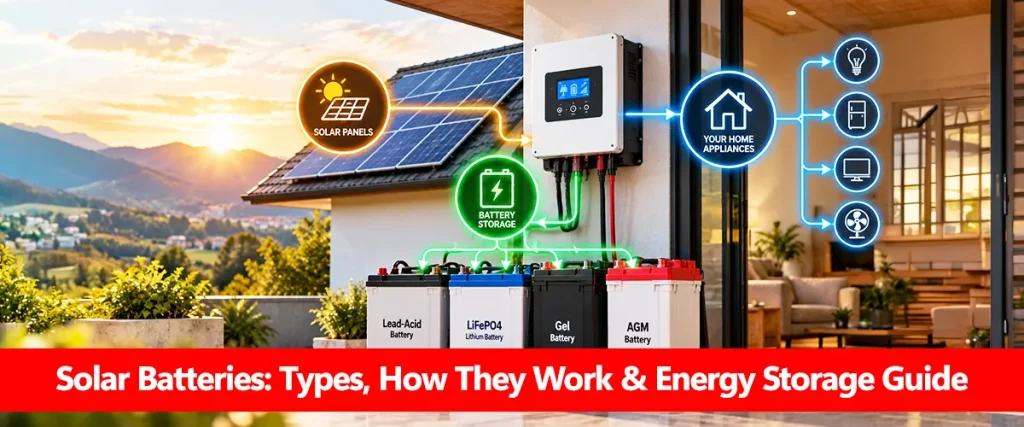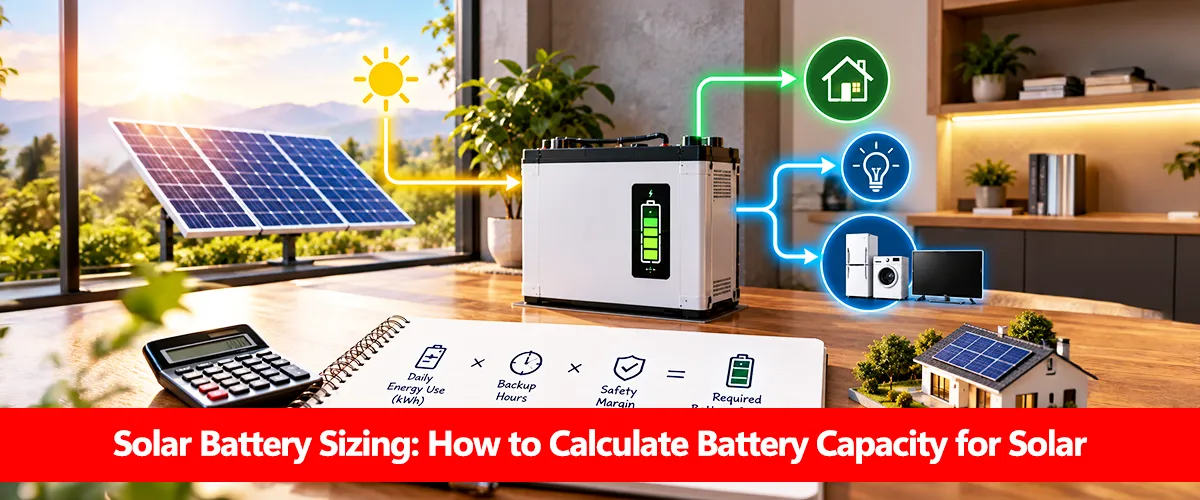
Solar battery sizing is the process of calculating how much battery storage a solar system needs based on electricity consumption, required backup time, usable battery capacity and system efficiency. Correct sizing helps ensure the battery can power connected appliances without unnecessary storage costs.
A solar battery should be selected according to actual energy requirements rather than solar panel wattage alone. Whether the installation uses lithium or lead-acid batteries, the calculation must account for depth of discharge and energy losses. Understanding solar batteries provides the foundation for selecting suitable storage capacity.
What Do You Need to Calculate Solar Battery Size?
Before calculating battery capacity, determine how much electricity your appliances consume and how long you want the battery to supply power without sufficient solar generation.
The main inputs are:
| Parameter | Meaning | Unit |
| Daily energy consumption | Energy required by connected loads | kWh/day |
| Backup duration | Time or days without sufficient charging | Hours or days |
| Depth of discharge (DoD) | Permitted portion of battery capacity used | % |
| Inverter efficiency | Efficiency of DC-to-AC conversion | % |
| Battery capacity | Required nominal storage | kWh |
| System voltage | Nominal battery-bank voltage | V |
Battery capacity is commonly measured in kilowatt-hours (kWh), while individual batteries may be rated in amp-hours (Ah). The relationship between these units is explained in Ah vs Wh.
Solar Battery Sizing Formula
For an AC load supplied by a battery through an inverter, the basic sizing formula is:
Required Battery Capacity (kWh) = Daily Energy Consumption (kWh) × Days of Autonomy ÷ (Depth of Discharge × Inverter Efficiency)
Convert percentages into decimals before using the formula. For example, 80% DoD becomes 0.80, while 90% inverter efficiency becomes 0.90.
This formula provides an initial nominal battery capacity estimate. It assumes the inverter efficiency represents the discharge-side conversion losses and does not separately include battery discharge losses, temperature derating or future degradation. These factors may require additional capacity. The permitted depth of discharge depends on battery chemistry and manufacturer specifications.
How to Size a Solar Battery: Step-by-Step Calculation
Consider a home that needs 6kWh of electricity for essential appliances during a 24-hour period without solar charging.
Assume the following:
| Input | Value |
| Daily electricity consumption | 6kWh |
| Days of autonomy | 1 |
| Battery depth of discharge | 80% |
| Inverter efficiency | 90% |
Step 1: Calculate Required Energy
Multiply daily electricity consumption by the required number of backup days.
Required Energy = 6 × 1 = 6kWh
The system must deliver 6kWh of AC electricity to the connected appliances.
Step 2: Account for Inverter Efficiency
Because the inverter loses some energy during DC-to-AC conversion, the battery must supply more energy than the appliances consume.
Battery Energy Required = 6 ÷ 0.90 = 6.67kWh
This represents the approximate energy that must leave the battery before accounting for the selected discharge limit.
Step 3: Adjust for Depth of Discharge
If the battery is intended to operate at a maximum 80% depth of discharge:
Nominal Battery Capacity = 6.67 ÷ 0.80 = 8.33kWh
The calculated battery bank should therefore provide at least approximately 8.33kWh of nominal capacity, before additional design allowances.
Step 4: Select a Practical Battery Capacity
A battery with exactly 8.33kWh of nominal storage leaves little allowance for temperature effects, degradation or additional system losses.
A nominal 10.24kWh battery bank, for example, would provide approximately:
10.24 × 0.80 × 0.90 = 7.37kWh
This is the estimated AC energy available under the stated assumptions. Actual performance depends on the battery, inverter and operating conditions.
Solar Battery Size for Different Energy Requirements
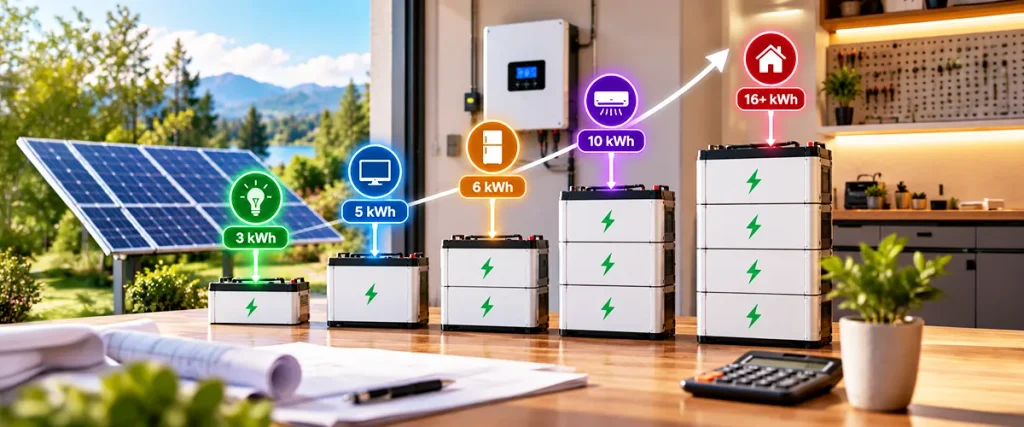
The following table shows how daily electricity consumption and backup duration affect nominal battery capacity.
| Daily Consumption | Backup Duration | Required Battery Capacity |
| 3kWh | 1 day | 4.17kWh |
| 5kWh | 1 day | 6.94kWh |
| 6kWh | 1 day | 8.33kWh |
| 6kWh | 2 days | 16.67kWh |
| 10kWh | 1 day | 13.89kWh |
Assumptions: 80% depth of discharge and 90% inverter efficiency, with no additional derating.
These estimates show that battery capacity increases with energy consumption and required autonomy. Actual battery bank sizing must also consider system voltage, power ratings and battery specifications.
Converting Solar Battery Capacity From kWh to Ah
After calculating nominal energy capacity, you can convert it into amp-hours using the battery bank’s nominal voltage.
Battery Capacity (Ah) = Battery Capacity (kWh) × 1,000 ÷ Battery Voltage (V)
For the calculated 8.33kWh battery bank at a nominal 48V:
8.33 × 1,000 ÷ 48 ≈ 174Ah
This is an approximate capacity at 48V. A LiFePO4 battery bank marketed as 48V-class may have a nominal voltage of 51.2V, so its actual Ah requirement will differ. The correct operating voltage must match the inverter and battery design. Our 12V vs 24V vs 48V battery system guide explains how voltage affects current and system configuration.
How Battery Chemistry Affects Solar Storage Sizing
Lithium and lead-acid batteries can require different nominal capacities to deliver the same usable energy. This is mainly because their recommended discharge limits, efficiency and performance characteristics differ. LiFePO4 batteries often support deeper cycling than conventional lead-acid batteries, but the permitted DoD must come from the manufacturer’s specifications.
| Sizing Factor | LiFePO4 | Lead-Acid |
| Usable discharge range | Often higher | Often more restricted for long cycle life |
| Energy density | Generally higher | Generally lower |
| Charging efficiency | Generally higher | Generally lower |
| Capacity considerations | BMS limits and temperature | Discharge rate, temperature and aging |
Lead-acid battery capacity may also decrease substantially at higher discharge rates, so its advertised Ah rating should not be treated as constant under every load. For chemistry selection, explore best battery type for solar and lead acid vs lithium solar battery.
Battery Capacity vs Inverter Power Rating
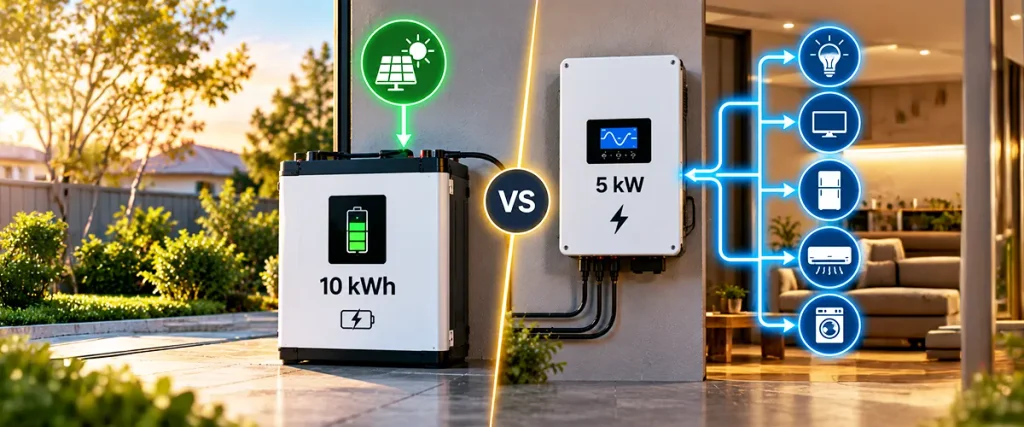
Battery energy capacity and inverter power rating are different specifications. A battery rated at 10kWh describes stored energy, while a 5kW inverter rating describes how much power the inverter can deliver at a given time.
A battery bank may have sufficient stored energy but still be unable to operate high-power appliances simultaneously. Peak load, starting surge and battery discharge-current limits must also be checked.
For backup duration, how to calculate battery runtime explains the relationship between energy capacity and connected load.
Common Solar Battery Sizing Mistakes
Even a correct formula can produce an unsuitable result when the input assumptions are inaccurate.
Avoid these common mistakes:
- Using total household consumption instead of the loads intended for backup.
- Ignoring inverter and electrical losses.
- Treating nominal battery capacity as fully usable.
- Using depth-of-discharge assumptions without checking the battery specifications.
- Confusing battery capacity in kWh with inverter output in kW.
- Ignoring battery aging, operating temperature and reserve requirements.
- Assuming the solar PV system can fully recharge the battery every day.
For systems that must operate through cloudy periods, battery autonomy should reflect realistic solar availability. Understanding how solar batteries work helps distinguish stored energy from daily photovoltaic generation.
Final Checks Before Choosing Solar Battery Capacity
The calculation provides a starting point, but the final battery must satisfy both energy and electrical requirements. Confirm that its usable energy, continuous discharge power, maximum current, voltage range and charging limits are compatible with the hybrid inverter and charge controller.
Battery manufacturers may specify usable capacity directly, along with temperature derating or operating restrictions. Those specifications should take priority over general assumptions. Once the required storage capacity is known, how many batteries for solar and batteries series vs parallel explain how individual battery units may be arranged into a compatible system.
Conclusion
Solar battery sizing starts with calculating daily energy consumption, selecting the required backup duration and adjusting for depth of discharge and inverter efficiency. For a 6kWh daily load with one day of autonomy, 80% DoD and 90% inverter efficiency, the basic calculation gives approximately 8.33kWh of nominal battery capacity before additional allowances. Accurate sizing also requires checking battery chemistry, usable capacity, operating temperature and inverter compatibility. Manufacturer specifications and real electricity consumption should determine the final battery-bank design.
FAQs
How Do You Calculate Solar Battery Size?
Multiply the daily energy consumption by the required backup days, then divide by the permitted depth of discharge and inverter efficiency. Additional losses or design reserves may increase the required capacity.
How Many kWh of Solar Battery Storage Do I Need?
It depends on the electricity consumed by the appliances you want to power, the required backup duration and the usable capacity of the selected battery.
Is a 5kWh Solar Battery Enough for a Home?
A 5kWh battery may support selected household loads for several hours, but actual backup time depends on permitted discharge, inverter losses and appliance consumption.
What Is Depth of Discharge in Solar Battery Sizing?
Depth of discharge represents the percentage of rated battery capacity used during discharge. It helps determine how much nominal capacity is needed to meet usable energy requirements.
Does a Bigger Solar Inverter Need More Batteries?
Not necessarily. Inverter size is based primarily on power requirements, while battery capacity depends on energy consumption and desired backup duration. Battery discharge-current capability must also support the inverter load.
Should Solar Batteries Be Sized for One or Two Days?
The appropriate autonomy depends on backup requirements, solar availability, critical loads and whether grid or generator support is available. Off-grid systems may require greater autonomy than grid-connected hybrid installations.
Can I Use the Same Sizing Formula for Lithium and Lead-Acid Batteries?
Yes, as an initial energy calculation, but use the correct depth of discharge, efficiency and manufacturer ratings for each chemistry. Lead-acid batteries may also require adjustments for discharge rate and temperature.