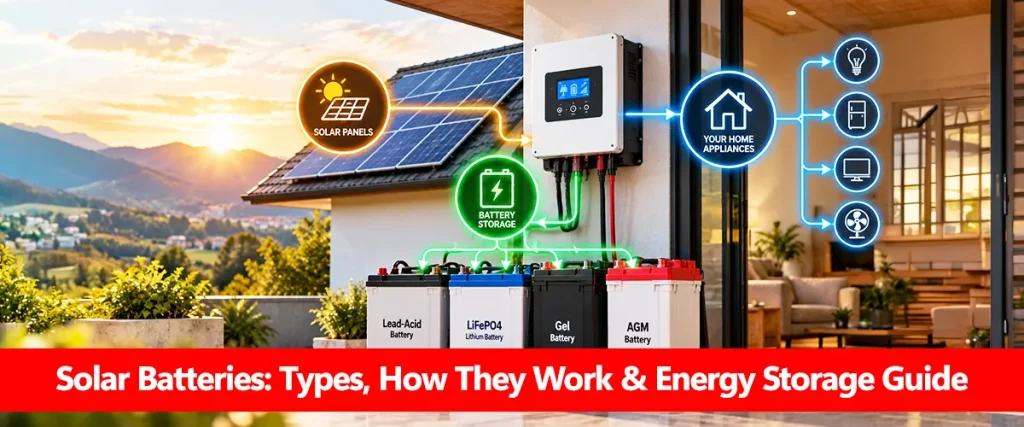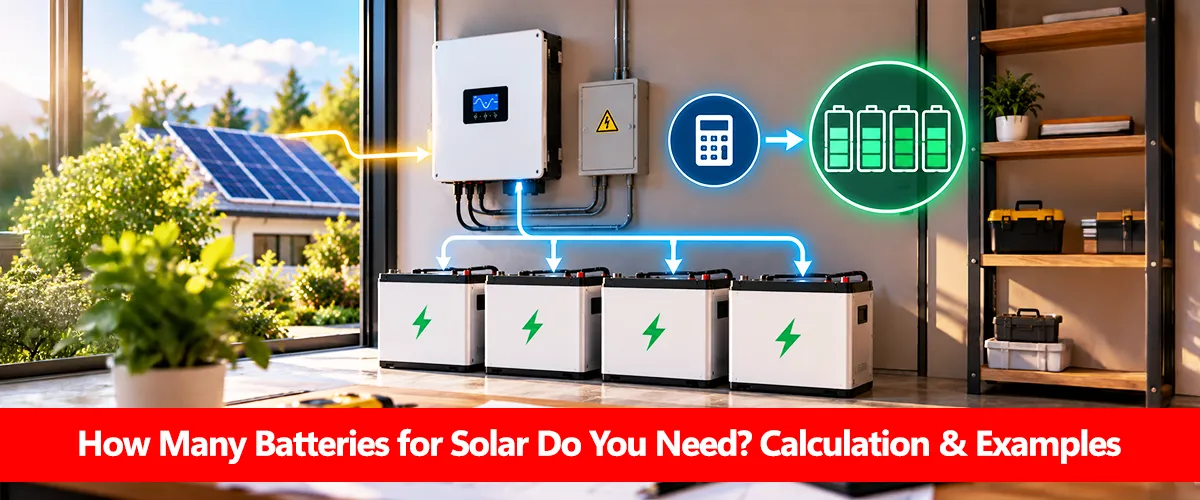
How many batteries for solar you need depends on your electricity consumption, required backup time, battery capacity and usable energy. A small household backup system may need one lithium battery, while a larger installation can require multiple batteries connected in a compatible battery bank.
The number of solar panels alone does not determine battery quantity. A 5kW solar installation, for example, can have different storage requirements depending on the appliances used and the desired backup duration. Understanding solar batteries and their usable capacity is the starting point for calculating the correct number.
What Determines the Number of Solar Batteries?
Before calculating battery quantity, identify how much energy your connected appliances consume and how long you want them to operate without sufficient solar generation. Battery chemistry also matters because different batteries offer different usable capacity and discharge limits.
The main factors include:
- Daily energy consumption: Electricity required by selected appliances, measured in kWh.
- Backup duration: Number of hours or days the batteries must support the load.
- Battery capacity: Energy stored in each battery, measured in Wh or kWh.
- Depth of discharge (DoD): Percentage of rated capacity permitted for use.
- System efficiency: Energy lost through the inverter and related equipment.
- Battery voltage: Determines how batteries can be connected to the inverter.
If your system’s energy requirement is still unknown, use our solar battery sizing guide to establish the required storage capacity before calculating individual battery quantities.
Formula to Calculate How Many Solar Batteries You Need
Once the required energy storage is known, the battery count can be estimated using the usable energy available from each battery.
- Usable AC Energy per Battery (kWh) = Battery Voltage (V) × Capacity (Ah) ÷ 1,000 × DoD × Inverter Efficiency
- Number of Batteries = Required AC Energy (kWh) ÷ Usable AC Energy per Battery (kWh)
Round the result up to a whole number, then adjust for the minimum number of batteries needed to achieve the inverter’s required voltage.
This is an initial energy-based calculation. It assumes the selected inverter efficiency represents discharge-side conversion losses and does not separately account for temperature derating, battery aging or additional reserve capacity. Our Ah vs Wh guide explains how battery voltage and amp-hour ratings determine stored energy.
Example 1: How Many Lithium Batteries for a Solar System?
Suppose a household needs 6kWh of backup electricity and plans to use 51.2V 100Ah LiFePO4 batteries.
Assume:
| Parameter | Value |
| Required backup energy | 6kWh |
| Battery voltage | 51.2V |
| Battery capacity | 100Ah |
| Depth of discharge | 80% |
| Inverter efficiency | 90% |
First, calculate the nominal energy of one battery:
51.2 × 100 ÷ 1,000 = 5.12kWh
Next, calculate its estimated usable AC energy:
5.12 × 0.80 × 0.90 = 3.69kWh
Finally:
6 ÷ 3.69 = 1.63 batteries
Rounding up gives 2 lithium batteries, providing approximately 7.37kWh of usable AC energy under these assumptions.
This arrangement requires batteries and an inverter approved for the intended parallel configuration. Many modern LiFePO4 batteries support suitable battery management and communication features, but actual connection limits depend on the manufacturer.
Example 2: How Many 12V 200Ah Lead-Acid Batteries?
Now consider the same 6kWh backup requirement using 12V 200Ah lead-acid batteries in a nominal 48V battery system.
Assume a maximum 50% depth of discharge and 90% inverter efficiency.
| Parameter | Value |
| Required backup energy | 6kWh |
| Individual battery | 12V 200Ah |
| Battery-bank voltage | 48V |
| Depth of discharge | 50% |
| Inverter efficiency | 90% |
One battery stores approximately:
12 × 200 ÷ 1,000 = 2.4kWh
Four compatible 12V batteries connected in series create one nominal 48V string containing:
4 × 2.4 = 9.6kWh
Estimated usable AC energy per string:
9.6 × 0.50 × 0.90 = 4.32kWh
One string is insufficient for the required 6kWh. Two compatible strings provide approximately 8.64kWh of usable AC energy.
Therefore, this example requires 8 lead-acid batteries, arranged as two parallel strings of four batteries each, subject to equipment and manufacturer approval.
The greater quantity reflects the selected battery capacities, discharge assumptions and voltage configuration. Our battery bank sizing guide covers the wider electrical design requirements.
Quick Solar Battery Count Comparison
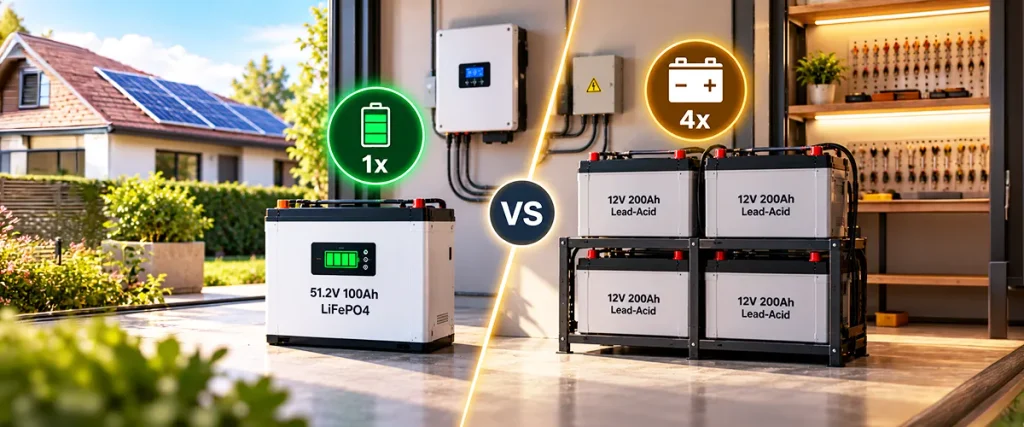
The following estimates compare the same battery models under different backup energy requirements.
| Required AC Energy | 51.2V 100Ah LiFePO4 | 12V 200Ah Lead-Acid |
| 3kWh | 1 battery | 4 batteries |
| 6kWh | 2 batteries | 8 batteries |
| 9kWh | 3 batteries | 12 batteries |
Assumptions: 80% DoD for LiFePO4, 50% DoD for lead-acid, 90% inverter efficiency and a nominal 48V-class system. Lead-acid batteries are counted in complete four-battery series strings.
These results are illustrative rather than universal recommendations. A lithium vs tubular battery for solar comparison can help explain why usable capacity, maintenance and battery chemistry influence storage decisions.
Why Battery Voltage Changes the Count
Battery voltage affects how individual batteries must be connected. A nominal 48V lead-acid bank may use four compatible 12V batteries in series, while a purpose-built 51.2V LiFePO4 battery can form a 48V-class storage unit on its own. Series connections increase voltage, while parallel connections increase the available amp-hour capacity. The number of batteries must therefore satisfy both the required energy storage and the inverter’s operating voltage range.
Before designing a battery bank, check 12V vs 24V vs 48V battery systems and the manufacturer’s series vs parallel battery connection limits. Never combine incompatible battery chemistries or configurations.
Does a 5kW or 10kW Solar System Need More Batteries?
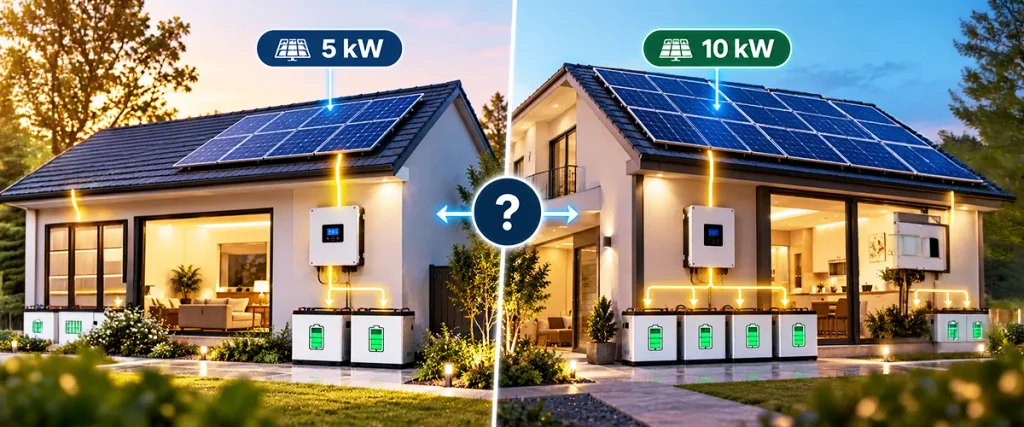
A larger solar panel system does not automatically require a larger battery bank. Solar panel capacity measures potential power generation, while battery capacity determines how much energy can be stored for later use.
For example, two homes with identical 5kW solar systems may need different battery quantities because their evening loads and backup requirements differ. Battery count should be based on energy demand, not panel rating alone.
The operating behavior of the inverter also matters. Our how solar batteries work guide explains how solar generation, household loads and batteries interact throughout the day.
Final Checks Before Selecting Battery Quantity
A calculated battery count is only useful if the selected batteries can safely operate together and deliver the required power.
Before purchasing, confirm:
- Usable energy: Check manufacturer-rated usable capacity rather than nominal capacity alone.
- Inverter compatibility: Match battery voltage, charging profile and discharge requirements.
- Connection limits: Confirm the permitted series and parallel configurations.
- Power output: Ensure the battery bank can handle continuous loads and starting surges.
- Battery protection: Check BMS support, fusing and electrical protection.
- System conditions: Allow for temperature effects, aging and future requirements.
A larger battery count is not always better. The aim is to provide sufficient usable energy with a safe, compatible configuration. For further chemistry selection, our best battery type for solar guide covers the differences between common solar storage options.
Conclusion
Determining how many batteries for solar you need starts with calculating the required backup energy and dividing it by the usable energy available from each battery. The result must then be adjusted for voltage configuration, inverter compatibility and manufacturer limits.
For a 6kWh backup requirement, the examples above show that two 51.2V 100Ah LiFePO4 batteries or eight 12V 200Ah lead-acid batteries can meet the energy target under their respective assumptions. Actual installations should be sized using real household consumption, battery specifications and a properly designed electrical system.
Frequently Asked Questions
How Many Batteries Do I Need for a 5kW Solar System?
A 5kW solar system does not have a fixed battery requirement. The number depends on electricity consumption, desired backup duration, battery chemistry and usable storage capacity.
How Many Batteries Are Needed for a 10kW Solar System?
Battery count depends on the loads the batteries must power rather than the solar system’s 10kW rating. Higher energy demand or longer backup duration generally requires more storage.
Is One Lithium Battery Enough for Solar?
One lithium battery may be sufficient for a small backup requirement if its usable capacity, output power and voltage match the inverter and connected loads.
How Many 200Ah Batteries Do I Need for Solar?
The number depends on each battery’s voltage, permitted depth of discharge and required backup energy. A 48V lead-acid system using 12V batteries generally requires four compatible batteries per series string.
Can I Connect Different Batteries in One Solar System?
Different battery chemistries, capacities or ages should not be mixed without explicit manufacturer approval and a suitable system design. Incompatible combinations can cause imbalance and safety problems.
Does Adding More Batteries Increase Solar Backup Time?
Adding compatible battery capacity can increase available backup energy and extend runtime for the same load. The actual improvement depends on usable capacity, system efficiency and operating limits.