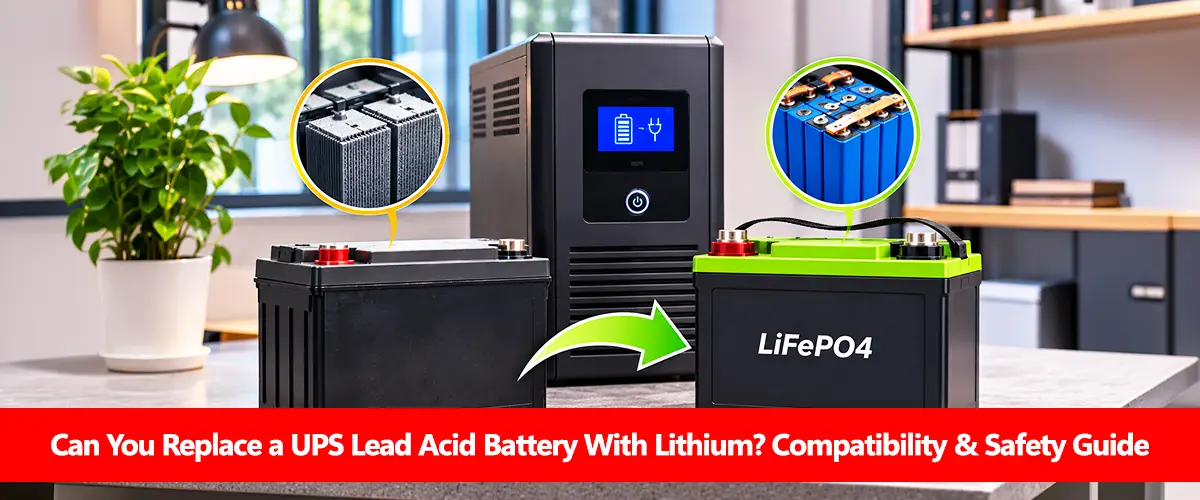
You can replace UPS lead acid battery with lithium only when the UPS manufacturer explicitly supports the conversion. Most conventional UPS systems are designed for specific lead-acid batteries, and installing a lithium battery without approval can create charging, performance and safety problems.
Lithium batteries offer advantages such as longer cycle-life potential, lower weight and greater usable energy. However, changing battery chemistry requires more than matching voltage or physical dimensions. Before replacing an existing UPS battery, it is essential to check the charging system, battery management requirements and the manufacturer’s approved replacement options.
Why Do People Replace Lead-Acid UPS Batteries With Lithium?
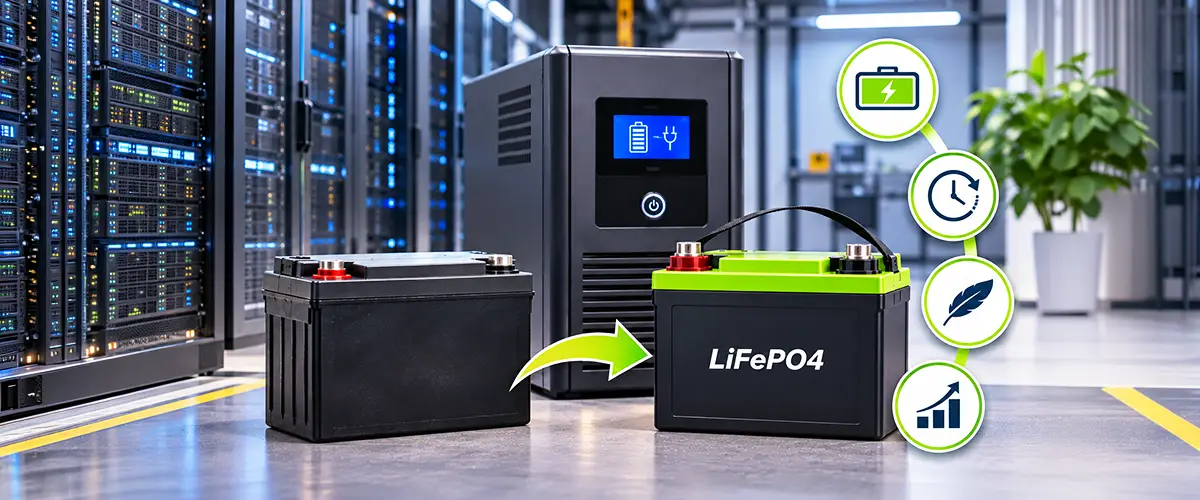
Lead-acid batteries have been widely used in UPS systems because they are affordable, readily available and compatible with established charging technology. However, their usable capacity and service life can be affected by high temperatures, frequent deep discharge and aging.
Lithium batteries are attractive because they generally provide higher energy density and longer cycling performance. For certain commercial UPS applications, manufacturer-designed lithium systems may also reduce battery replacement frequency.
The differences are explained in lithium vs lead-acid battery, while lithium battery for UPS covers lithium storage technology in approved backup systems. These advantages do not mean that a lithium battery is automatically compatible with an existing lead-acid UPS.
Can Every Lead-Acid UPS Be Converted to Lithium?
No. Many desktop and office UPS units contain sealed lead-acid batteries and use chargers specifically designed for that chemistry.
Replacing those batteries with generic lithium packs can cause charging problems, battery-protection shutdowns or incorrect runtime reporting.
| Existing UPS Type | Lithium Replacement Possibility |
| Compact desktop UPS with fixed lead-acid cartridge | Generally not recommended without explicit manufacturer approval |
| Line-interactive UPS using sealed lead-acid batteries | Depends on exact model and approved replacement options |
| UPS with external lead-acid battery bank | Requires manufacturer-supported lithium compatibility |
| Commercial UPS with an approved lithium retrofit kit | Possible through authorized conversion |
| UPS originally designed for lithium batteries | Use manufacturer-approved lithium replacements |
Eaton provides professionally managed lithium retrofit solutions for certain commercial UPS models. These can require different battery cabinets, control-system modifications and commissioning.
For most conventional desktop UPS units, using the approved sealed lead-acid battery replacement remains the safer approach.
Lead-Acid vs Lithium Battery Voltage: Why Matching 12V Is Not Enough
One common misconception is that any battery labeled 12V can replace another 12V battery.
Lead-acid and lithium batteries have different voltage characteristics throughout charging and discharging. A typical four-cell LiFePO4 battery has a nominal voltage of 12.8V, while a conventional six-cell lead-acid battery has a nominal voltage of approximately 12V.
| Specification | Lead-Acid Example | LiFePO4 Example |
| Nominal battery voltage | 12V | 12.8V |
| Typical battery chemistry | VRLA/AGM | Lithium iron phosphate |
| Charging requirements | Lead-acid-specific | Lithium-specific |
| Low-voltage behavior | Depends on discharge conditions | Controlled by cells and BMS |
| Battery protection | UPS and battery design | UPS and BMS coordination |
The exact charging limits depend on the battery model. Similar nominal voltage does not guarantee that the UPS charger, protection circuits or shutdown thresholds will operate correctly. Understanding battery voltage and lead-acid charger for lithium battery helps explain why direct replacement can be unsafe.
What Happens If You Charge Lithium With a Lead-Acid UPS Charger?
A UPS designed for lead-acid batteries may use charging settings that are not appropriate for lithium chemistry. Many lead-acid charging systems use bulk, absorption and float charging. Some also apply temperature compensation or other controls intended specifically for lead-acid batteries.
Lithium batteries require manufacturer-approved charging voltage, current and termination behavior. Some LiFePO4 products support carefully configured absorption and float settings, but that does not make every lead-acid UPS charger suitable. An incompatible charging system can cause incomplete charging, overheating, battery damage or repeated protective disconnections. The correct battery charging voltage and battery charging current must be verified before selecting a replacement.
Why Is BMS Compatibility Important?
Lithium batteries typically include a battery management system (BMS) that monitors cell voltage, temperature and current.
The BMS helps protect the battery against excessive charging, deep discharge and unsafe operating conditions. However, it must work correctly with the UPS.
Important BMS considerations include:
- Maximum continuous discharge current.
- Short-duration surge-current capability.
- Low-voltage shutdown behavior.
- Charging-current restrictions.
- Temperature-related protection.
- Battery monitoring and communication requirements.
- Automatic recovery after a protective shutdown.
If the BMS disconnects the battery while the UPS is supplying a critical load, backup power can stop immediately.
A suitable battery management system is therefore essential, but its presence alone does not establish compatibility with the UPS.
Practical Example: Replacing a 12V 7Ah UPS Battery
Consider a desktop UPS originally designed for a 12V 7Ah sealed lead-acid battery.
The original battery stores approximately:
12V × 7Ah = 84Wh
A 12.8V 7Ah LiFePO4 battery has approximately:
12.8V × 7Ah = 89.6Wh
Although these two batteries have similar nominal energy ratings, they are not automatically interchangeable.
| Compatibility Check | What Must Be Verified |
| Battery voltage | Full charging and discharging range |
| Charger | Approved lithium charging profile |
| Discharge current | Support for UPS load and surge requirements |
| BMS | Suitable protection and shutdown behavior |
| Connection | Approved terminals and battery assembly |
| UPS monitoring | Correct battery detection and runtime behavior |
| Manufacturer approval | Explicit support for the replacement |
Even if the lithium battery physically fits, its BMS may disconnect under a sudden load or its charging requirements may differ from the UPS settings.
For equipment with no approved conversion, choose the manufacturer’s replacement battery instead of attempting a battery-only upgrade.
Will a Lithium Battery Increase UPS Backup Time?
A compatible lithium battery may provide more usable energy than a lead-acid battery of similar nominal capacity. However, replacing battery chemistry does not guarantee longer runtime.
UPS backup duration also depends on the connected load in watts, permitted discharge limits, inverter efficiency and the UPS shutdown settings.
A UPS rated at 1,000VA, for example, has a separate output rating in watts. Installing a larger battery does not increase that output capability.
The appropriate capacity can be determined through how to choose UPS battery capacity, while how to calculate UPS backup time explains runtime estimates.
For larger external-battery systems, 100Ah vs 200Ah battery for UPS covers the effect of battery capacity on backup duration.
LiFePO4 vs Other Lithium Chemistries for UPS Replacement
Not all lithium-ion batteries use the same chemistry. LiFePO4 is commonly considered for stationary backup because of its cycle-life potential and relatively strong thermal stability. Other lithium chemistries may provide higher energy density, but require different charging and protection arrangements.
A LiFePO4 battery may have characteristics suitable for frequent backup cycling, but compatibility must still be confirmed using the exact battery model. Our dedicated LiFePO4 battery for UPS guide explains its voltage configurations, charging requirements and backup applications. Lithium chemistry should never be selected solely because the battery label describes it as a direct replacement.
When Is a Lithium UPS Retrofit Worth Considering?
A lithium upgrade may provide better long-term value when the system experiences frequent outages, battery replacement is difficult or maintenance costs are substantial.
However, the final decision depends on the UPS model and whether an approved conversion exists.
| Situation | Practical Recommendation |
| Existing desktop UPS still works properly | Use an approved replacement cartridge |
| UPS manufacturer offers an authorized lithium conversion | Compare retrofit cost and warranty |
| Existing UPS does not support lithium | Consider a dedicated lithium UPS |
| Battery needs frequent replacement | Review operating temperature and load first |
| Long-duration home backup required | Consider a compatible external-battery UPS or inverter system |
| UPS is old or nearing end of service life | Compare a complete system replacement |
The choice should also consider the difference between UPS vs inverter systems. For some households, a new home backup battery arrangement may be more appropriate than modifying a compact UPS.
How to Check Whether Your UPS Supports a Lithium Upgrade
Before purchasing a battery, follow a manufacturer-led compatibility process rather than attempting a direct replacement based on online claims.
- Identify the UPS model: Locate its exact manufacturer and model number.
- Check the battery specification: Confirm the existing battery chemistry, voltage and approved configuration.
- Review official documentation: Look for an explicitly supported lithium conversion or replacement.
- Confirm charger compatibility: Verify the required charging voltage, current and operating limits.
- Check BMS requirements: Confirm communication, protection and discharge-current compatibility.
- Review the electrical load: Ensure the replacement can support the connected equipment.
- Verify warranty and certification: Check whether the proposed upgrade preserves equipment approval.
- Arrange professional installation: Use authorized service personnel for any approved retrofit.
If the manufacturer does not approve a lithium replacement, do not modify the charging electronics or bypass battery protection to make it operate.
Schneider Electric provides model-specific APC replacement-battery information, while Eaton documents manufacturer-supported lithium retrofit options for selected UPS systems.
Common Mistakes When Replacing UPS Batteries
Several assumptions can lead to unsuitable or unsafe battery replacements.
Common mistakes include:
- Assuming all 12V batteries use the same charging profile.
- Replacing an AGM battery with lithium without UPS approval.
- Ignoring BMS discharge-current and protection limits.
- Installing a larger battery without checking charger capability.
- Combining lithium and lead-acid batteries in one battery bank.
- Assuming higher Ah capacity increases UPS output watts.
- Using an incompatible external battery pack.
- Ignoring thermal protection and installation requirements.
Lead-acid batteries also include different designs, such as AGM batteries, gel batteries and flooded lead-acid batteries. These designs do not necessarily share identical charging settings. For general battery selection, best battery for UPS explains the suitability of different technologies.
Cost, Warranty and Long-Term Value
Lithium batteries commonly have a higher initial purchase price than traditional lead-acid replacements. However, manufacturer-designed lithium UPS systems may offer longer service-life potential and reduced replacement frequency.
Eaton cites approximately 10–15 years of service-life potential for certain lithium UPS applications compared with typical lead-acid replacement intervals of around 3–5 years. These are product-dependent estimates, not universal guarantees.
An approved retrofit may also require additional equipment, firmware changes, commissioning and installation work. Those costs must be included in the comparison.
Before choosing, review how long UPS batteries last and compare available replacement options using UPS battery price in Pakistan. A lower-cost unapproved conversion is not necessarily better value if it introduces safety risks or invalidates the UPS warranty.
What Should You Do With the Old Lead-Acid Battery?
Lead-acid batteries contain hazardous materials and should not be discarded with household waste.
When replacing an approved UPS battery, arrange recycling through an authorized battery collection point, manufacturer program or qualified recycler.
Do not open, puncture or dismantle the old battery. Leaking, swollen or damaged batteries require additional precautions and professional handling.
Proper disposal is an important part of responsible battery replacement, regardless of whether the new UPS system uses lead-acid or lithium technology.
Conclusion
You can replace UPS lead acid battery with lithium only when the manufacturer approves the specific conversion and the UPS supports the required charging, protection and electrical specifications.
Lithium batteries offer advantages in weight, usable capacity and service-life potential, but these benefits do not make them safe direct replacements for conventional lead-acid UPS cartridges.
For most unsupported desktop UPS systems, an approved lead-acid replacement or a dedicated lithium UPS is preferable. Manufacturer-supported commercial retrofits should be installed and commissioned by qualified professionals.
Frequently Asked Questions
Can I Replace a 12V Lead-Acid UPS Battery With a 12V Lithium Battery?
Not automatically. Similar nominal voltage does not guarantee compatibility. The UPS must support the lithium battery’s charging profile, operating-voltage range and BMS behavior.
Can LiFePO4 Be Used as a Direct UPS Battery Replacement?
Only when the UPS manufacturer explicitly approves the specific LiFePO4 battery or conversion arrangement. A generic drop-in replacement claim is not sufficient.
Will Lithium Damage My UPS?
An incompatible lithium battery may cause charging problems, unexpected shutdowns or equipment damage. Manufacturer-approved battery systems are designed to reduce these risks.
Does Lithium Give More Backup Time Than Lead-Acid?
It can provide more usable energy under suitable conditions, but actual runtime depends on battery capacity, connected load, UPS efficiency and shutdown limits.
Can I Use the Existing Lead-Acid UPS Charger for Lithium?
Only if the charger and UPS manufacturer approve the lithium battery’s charging requirements. Lead-acid and lithium charging profiles should not be assumed interchangeable.
Do I Need a BMS When Using Lithium in a UPS?
Lithium battery systems generally require appropriate battery management and protection. The BMS must also operate compatibly with the UPS and its charging system.
Is It Better to Buy a New Lithium UPS?
If your existing UPS does not support an approved lithium conversion, a purpose-built lithium UPS is generally the safer option.
Can I Mix Lithium and Lead-Acid Batteries in a UPS?
No, not in an ordinary battery bank. Mixing chemistries can create incompatible charging, current-sharing and protection conditions.
Is Replacing Lead-Acid With Lithium Worth the Cost?
It may be worthwhile when an approved retrofit is available and longer service life or reduced maintenance provides sufficient value. Include conversion equipment, installation, warranty and battery replacement costs in the comparison.