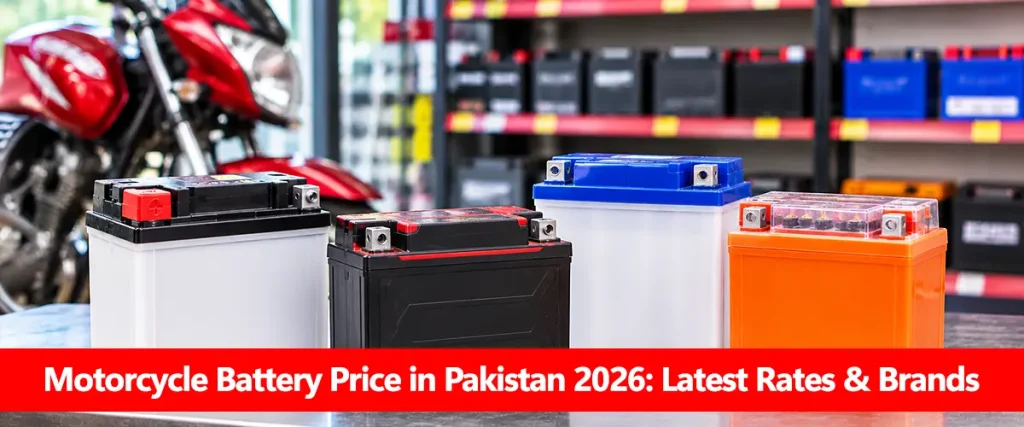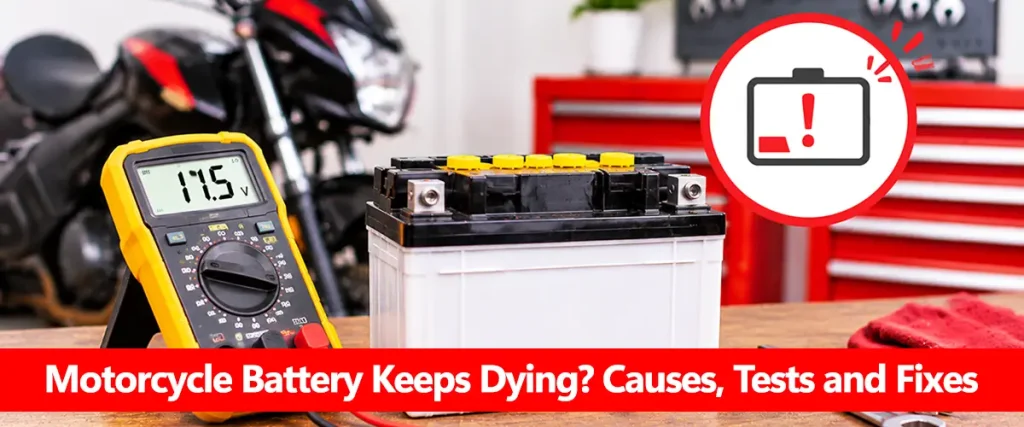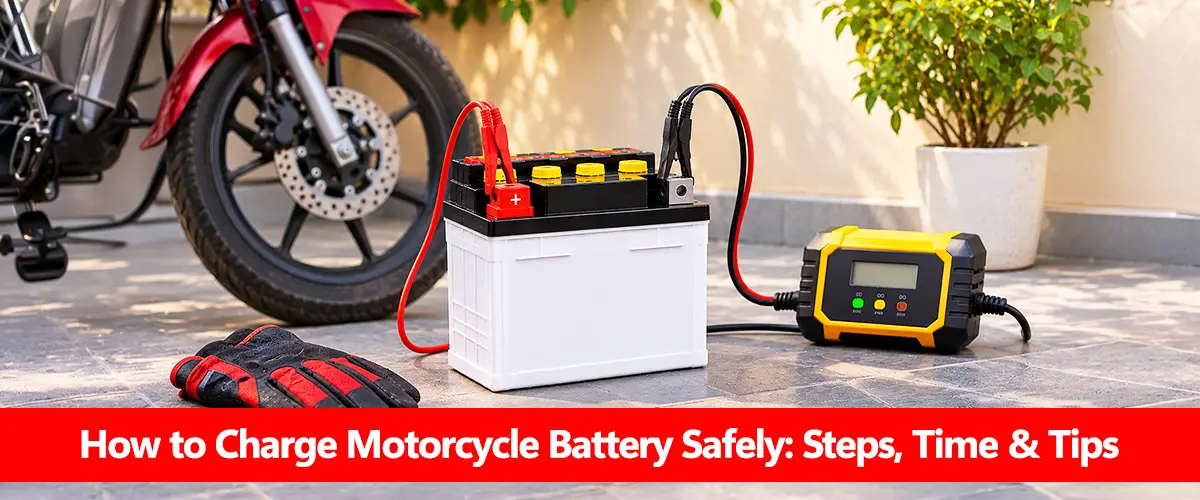
Learning how to charge motorcycle battery is straightforward when you use the correct charger and follow proper safety precautions. First, confirm whether your bike has a 6V or 12V battery, identify its chemistry, and connect a compatible charger using the manufacturer’s recommended procedure.
Most modern motorcycles use 12V lead-acid or AGM batteries, while some older bikes have 6V systems. Motorcycle batteries are also generally smaller than car batteries, so using an unsuitable high-current charger can cause damage. If your bike struggles to start or has been parked for several weeks, charging may restore its performance without requiring immediate replacement.
Choosing the Right Charger for Your Motorcycle
The best charging method depends on the battery’s voltage, capacity and chemistry. An automatic smart charger designed for small motorcycle batteries is generally a practical option because it regulates charging and can switch to maintenance mode when supported.
Before purchasing or connecting a charger, check the battery label and your motorcycle’s manual.
| Battery Type | Suitable Charging Approach |
| 12V flooded lead-acid | Compatible 12V lead-acid charger |
| 12V AGM | Charger with approved AGM settings |
| 6V lead-acid | Dedicated 6V charging mode |
| Gel battery | Manufacturer-approved gel charging profile |
| Lithium starter battery | Compatible lithium charger and BMS requirements |
A conventional lead-acid battery and an AGM battery share basic chemistry, but their charging requirements may differ. Similarly, lithium batteries need appropriate electronic protection and charging settings.
Our motorcycle battery guide explains battery types, while how to choose a battery charger covers charger selection in greater detail.
How to Charge a Motorcycle Battery Step by Step
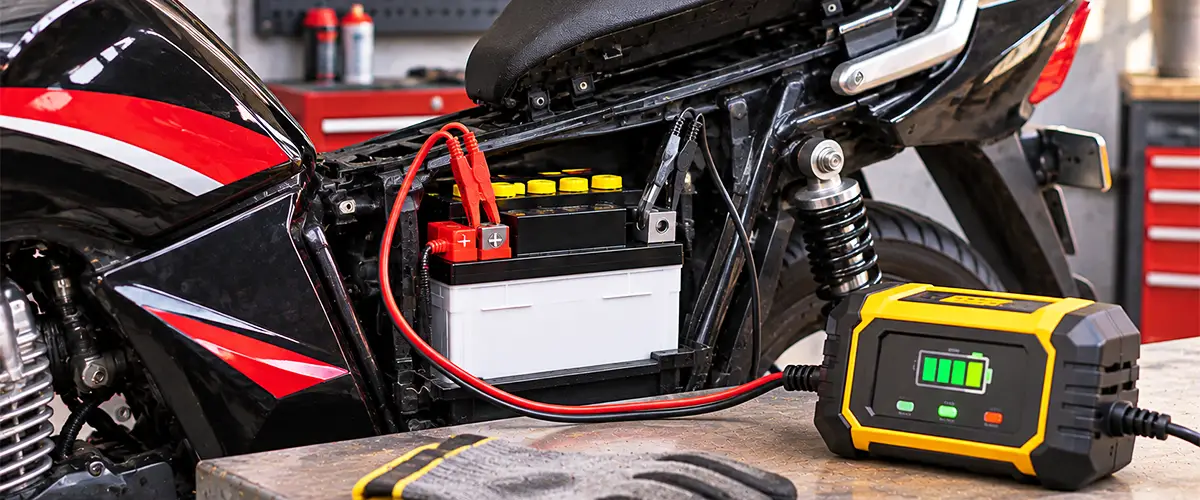
For a conventional motorcycle with a healthy, accessible battery, the following process provides a practical starting point. Always follow the motorcycle and charger manufacturers’ instructions when they specify a different procedure.
- Switch off the motorcycle. Remove the key and park the bike securely in a dry, ventilated area.
- Inspect the battery. Check for visible damage, leakage, swelling or unusual heat before connecting anything.
- Identify the charging points. Find the positive (+) and negative (−) terminals or designated charging connections.
- Connect the positive clamp. With the charger unplugged, attach the red clamp to the approved positive point.
- Connect the negative clamp. Use the manufacturer’s designated chassis ground for an installed battery, or the negative terminal if the battery is removed and the charger instructions permit it.
- Select the correct charging mode. Match the battery’s voltage and chemistry, then connect the charger to the mains supply.
- Let the charging cycle finish. Monitor the charger’s indicator and follow its completion instructions.
- Disconnect safely. Unplug the charger first, remove the negative connection, then remove the positive connection.
Some motorcycles allow charging through a permanent quick-connect lead without removing the seat or battery. Use this arrangement only when the connector and charger are compatible.
Important: Never connect the charger’s clamps while it is powered, reverse their polarity or allow them to touch. Do not charge a cracked, leaking, swollen, frozen or unusually hot battery.
How Long Does a Motorcycle Battery Take to Charge?
Motorcycle battery charging time depends on its Ah capacity, existing charge level and charger output. Smaller batteries often use lower charging currents than car batteries.
For conventional lead-acid batteries, a charging current of approximately 10% of the rated Ah capacity is a commonly used reference when the manufacturer does not specify otherwise.
For example, a 6Ah battery may have a recommended conventional charging current of approximately 0.6A, subject to its manufacturer’s limits.
| Battery Capacity | Illustrative Charging Current |
| 4Ah | 0.4A |
| 5Ah | 0.5A |
| 6Ah | 0.6A |
| 8Ah | 0.8A |
| 10Ah | 1.0A |
Suppose a 6Ah battery is approximately 50% discharged. It needs roughly 3Ah of charge replenished.
Ideal time = 3Ah ÷ 0.6A = 5 hours
In practice, charging takes longer because of efficiency losses and the slower finishing stage. The result is an estimate, not a guaranteed charging duration. For detailed calculations, see battery charging time and battery charging current.
Can You Charge a Motorcycle Battery Without Removing It?
Yes, many motorcycles allow the battery to be charged while installed, provided the charger supports in-vehicle charging and the motorcycle manufacturer permits it.
This is convenient when the battery is under a seat or behind a side cover. However, the correct negative connection point matters, and some vehicles contain electronics that require a particular charging arrangement.
Removing the battery may be necessary when the motorcycle’s service manual requires it, the battery is difficult to access or its condition needs closer inspection.
If removal is necessary, follow the correct terminal-disconnection procedure and avoid pulling on the cables. A technician can help if the battery compartment or wiring is unfamiliar.
How Do You Know When the Battery Is Fully Charged?
An automatic charger’s completion indicator is generally the easiest way to determine when its approved charging program has finished.
For many conventional 12V lead-acid motorcycle batteries, a settled resting voltage around 12.6–12.8V indicates a well-charged condition. AGM and lithium batteries may have different normal readings, so manufacturer specifications take priority.
A full charge does not guarantee that the battery is healthy. An old battery can show reasonable voltage but fail to supply enough starting current.
If your motorcycle still cranks slowly after charging, follow how to test a motorcycle battery rather than assuming another charging session will solve the problem.
Common Charging Mistakes That Damage Motorcycle Batteries
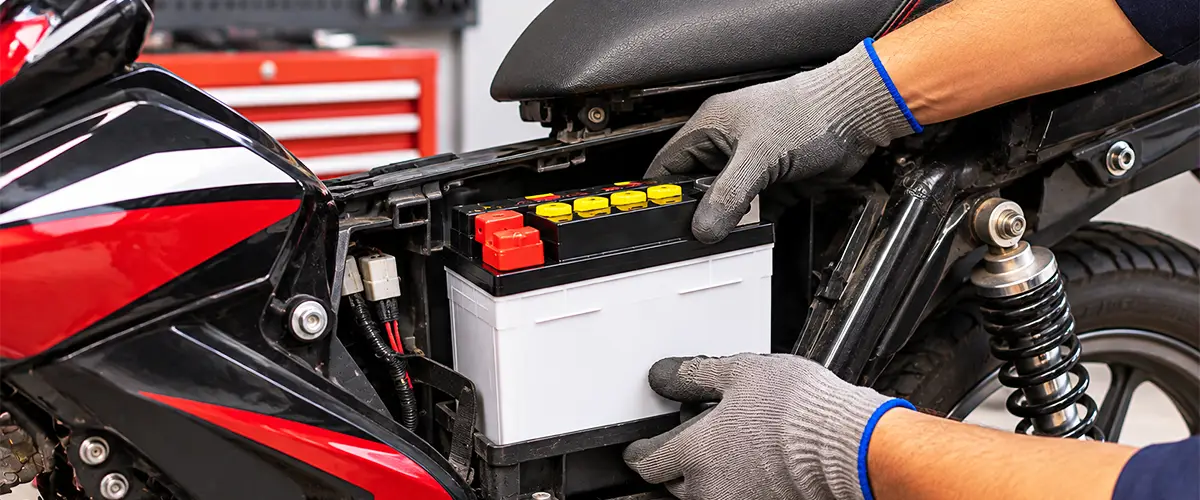
Incorrect charging can reduce battery life even when the motorcycle starts normally afterward.
Avoid these common mistakes:
- Using a 12V charger on a 6V battery.
- Choosing a high charging current without checking battery limits.
- Using lead-acid charging or reconditioning modes on an incompatible lithium battery.
- Leaving a manual charger connected beyond the recommended time.
- Charging in a poorly ventilated area.
- Ignoring repeated charger errors or excessive battery heating.
A properly configured automatic charger helps manage the bulk, absorption and float charging stages used for many lead-acid batteries. However, maintenance mode is not suitable for every chemistry, and specialized lithium batteries require their own approved procedures. For related safety information, read can you overcharge a battery.
What If Your Motorcycle Battery Will Not Charge?
If the charger refuses to start or the battery quickly becomes discharged again, first confirm the correct charger mode and approved connections. A deeply discharged battery may require specialist testing, while a damaged battery should not be charged.
Repeated discharge can also indicate problems with the motorcycle’s stator, regulator-rectifier, electrical wiring or battery condition. Charging alone will not repair these faults.
Our motorcycle battery keeps dying guide covers recurring problems, while how long motorcycle batteries last explains when deterioration becomes more likely.
If the battery is physically damaged, charging causes unusual heating or the manufacturer-approved charger repeatedly reports a fault, stop and seek professional assistance.
Conclusion
Understanding how to charge motorcycle battery safely comes down to using a compatible charger, selecting the correct voltage and chemistry, and following the proper connection sequence.
A small automatic motorcycle charger is generally more appropriate than an oversized car charger. Always follow the battery manufacturer’s charging-current limits, allow the approved program to finish and disconnect the equipment safely.
If the battery repeatedly loses charge or fails to start the motorcycle after charging, check its condition and the bike’s charging system before replacing it.
Frequently Asked Questions
Can I Charge a Motorcycle Battery With a Car Charger?
Only if the car charger has a suitable motorcycle or low-current mode approved for the battery’s voltage, chemistry and capacity. A high-current car charger may damage a small motorcycle battery.
How Long Should I Charge a 12V Motorcycle Battery?
It depends on battery capacity, existing charge and charger current. A partially discharged battery may need several hours, with additional time for the final charging stage.
Can I Charge My Motorcycle Battery Without Removing It?
Yes, when the motorcycle and charger manufacturers permit in-vehicle charging. Use approved charging points and the specified connection method.
What Amp Charger Should I Use for a Motorcycle Battery?
Follow the battery manufacturer’s recommendation. For many conventional lead-acid motorcycle batteries, approximately 10% of Ah capacity is a common reference.
Will Riding My Motorcycle Recharge the Battery?
Normally, the charging system replenishes battery energy while the engine runs. However, short rides may not fully recharge a significantly discharged battery.
Can I Leave My Motorcycle Battery on a Charger Overnight?
Only when the charger and battery manufacturers permit the relevant automatic or maintenance mode under suitable conditions. Do not leave an unsuitable manual charger operating indefinitely.
Is Charging an AGM Motorcycle Battery Different?
AGM batteries may require particular charging-voltage settings. Use an AGM-compatible charger and follow the battery manufacturer’s instructions.
Why Does My Motorcycle Battery Die After Charging?
It may have deteriorated internally, or the motorcycle may have a charging-system or electrical-drain problem. Further testing is needed before replacing it.