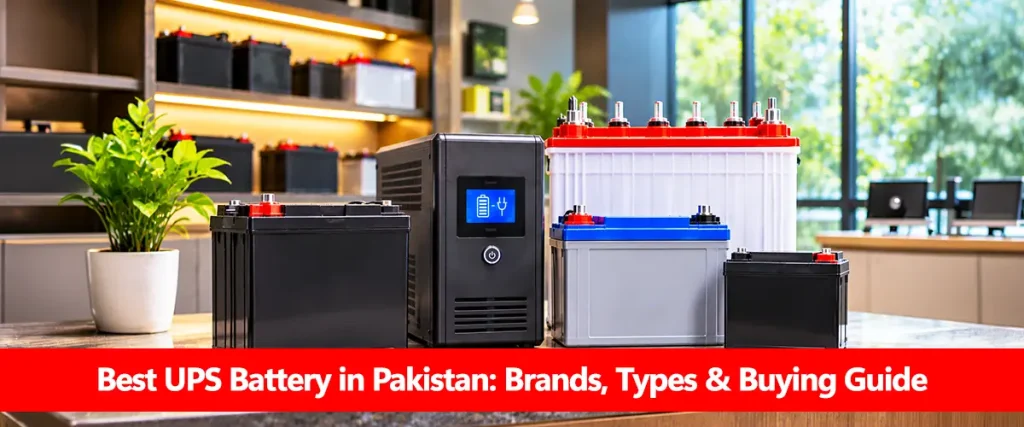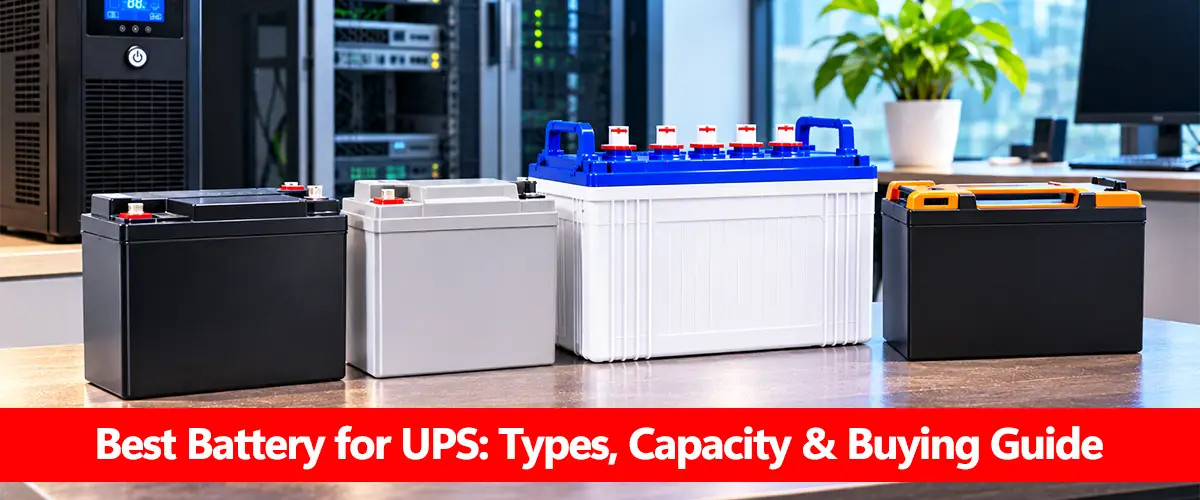
The best battery for UPS depends on your UPS model, connected load, backup duration and charging compatibility. For most compact computer and office UPS units, a manufacturer-approved sealed lead-acid (AGM/VRLA) replacement is a practical choice. For extended household backup, tubular lead-acid batteries may be suitable, while lithium and LiFePO4 batteries offer advantages in systems specifically designed to support them.
Choosing the right battery involves more than comparing amp-hour (Ah) ratings. Battery voltage, discharge capability, charging profile and usable energy all affect performance. Understanding the basic role of a UPS battery helps you select reliable backup power without purchasing an incompatible replacement.
Which Battery Type Is Best for a UPS?
UPS systems use different battery technologies depending on their size, electrical design and intended application. Sealed lead-acid batteries are common in desktop and rack-mounted UPS systems, while larger backup installations may support other chemistries.
| Battery Type | Main Advantage | Best-Suited Application | Main Limitation |
| AGM / VRLA | Sealed, low routine maintenance | Desktop and office UPS | Limited cycle life |
| Tubular lead-acid | Suitable for repeated cycling | Compatible long-backup systems | Size and maintenance |
| Gel lead-acid | Sealed construction | Approved specialized UPS applications | Charging sensitivity |
| Lithium-ion | High energy density and longer service-life potential | Manufacturer-approved lithium UPS | Higher initial investment |
| LiFePO4 | Strong cycle-life and thermal characteristics | Compatible modern backup systems | BMS and charger compatibility |
No battery type is universally better for every UPS. A 12V AGM battery designed for a compact UPS and a 51.2V lithium storage module serve very different equipment requirements.
For a comparison focused on extended backup, see tubular battery for UPS. Modern alternatives are discussed in lithium battery for UPS.
Best Battery for Desktop and Computer UPS Systems
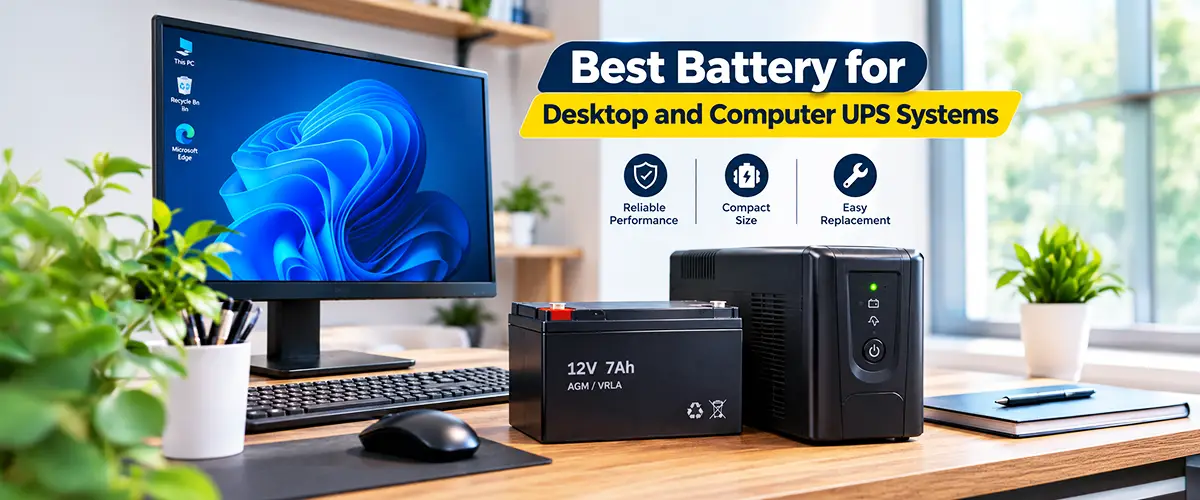
A manufacturer-approved AGM or other valve-regulated lead-acid battery is generally the most straightforward replacement for a desktop UPS originally designed for that chemistry. These sealed batteries require no routine water refilling and are available in compact sizes suitable for UPS enclosures. However, their physical dimensions, electrical ratings and connector arrangement must match the original battery assembly.
For example, Schneider Electric lists an APC replacement cartridge with a 12V, 7Ah VRLA battery and another model with a 12V, 11Ah rating. These are replacement options for different supported UPS models, not interchangeable upgrades.
Buyers should identify the UPS model and use its approved replacement-battery information. Our AGM battery guide explains the underlying technology, while sealed lead-acid batteries covers their general characteristics.
Best Battery for Long UPS Backup
Household and office backup systems designed for external batteries may require substantially more energy than a compact desktop UPS. A suitable tubular battery can be a practical option when the UPS supports external lead-acid storage and the available budget favors a lower initial cost. Lithium batteries may offer more usable energy, reduced weight and longer cycle-life potential, but they must be approved for the connected equipment. Some commercial UPS systems use dedicated lithium battery packs, monitoring electronics and manufacturer-specific charging controls.
For frequent outages, the decision should consider how often the battery discharges and how quickly it needs to recharge. The best battery for inverter guide covers the related requirements of household inverter systems, which should not automatically be treated as identical to compact UPS equipment.
How Much UPS Battery Capacity Do You Need?
The appropriate battery capacity depends on connected appliance wattage and desired backup duration.
A computer UPS used for safe shutdown may only need several minutes of runtime, while a router, CCTV system or office setup may require much longer.
Battery energy can be estimated using:
Nominal Battery Energy (Wh) = Battery Voltage (V) × Battery Capacity (Ah)
For illustration:
| Battery Rating | Nominal Energy |
| 12V 7Ah | 84Wh |
| 12V 9Ah | 108Wh |
| 12V 12Ah | 144Wh |
| 12V 100Ah | 1,200Wh |
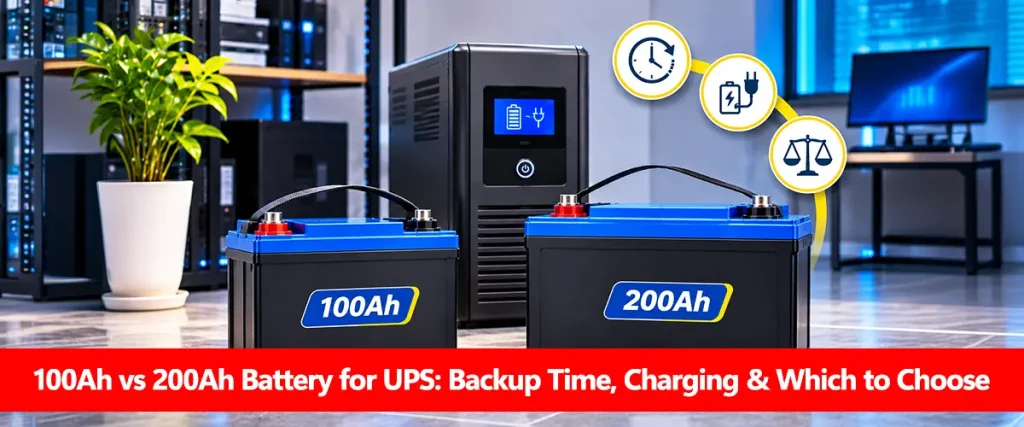
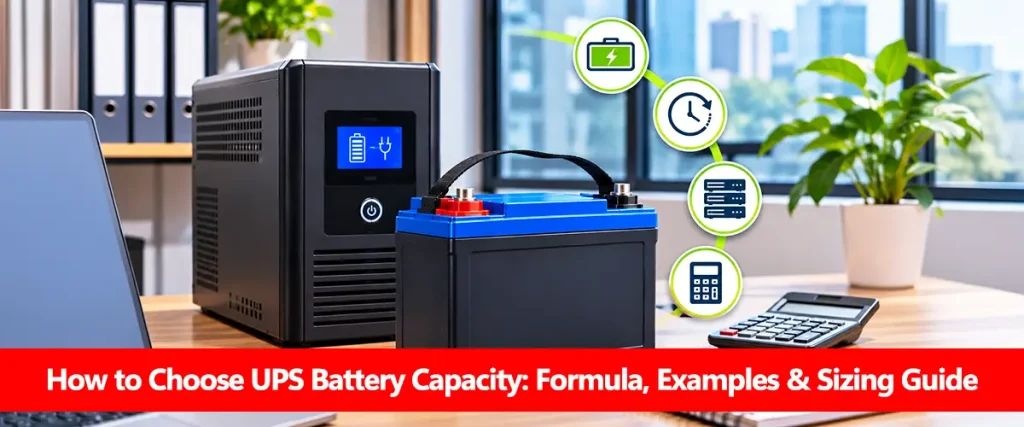
These figures represent nominal stored energy, not guaranteed output to connected appliances. Actual runtime depends on battery discharge behavior, inverter efficiency and the UPS shutdown threshold. Larger Ah capacity is not automatically compatible with the UPS. Use how to choose UPS battery capacity for detailed sizing and 100Ah vs 200Ah battery for UPS for larger external-battery comparisons.
Battery Capacity vs UPS VA and Watt Ratings
A UPS battery stores electrical energy, while the UPS inverter determines how much power the system can deliver.
For example, a UPS advertised as 1,000VA may have a lower maximum output rating in watts. Connecting appliances beyond that watt rating can overload the system, regardless of battery capacity.
Three specifications must be checked together:
- VA: Apparent power rating of the UPS.
- W: Actual power the UPS can supply continuously.
- Wh: Nominal or usable energy available from the battery.
Starting surges also matter for equipment containing motors or compressors. A larger battery will not increase the UPS’s approved output power or surge capability. The relationship between battery watt-hours and Ah vs Wh helps explain why a battery’s capacity should not be confused with the UPS power rating.
How Battery Type Affects Backup Time
The battery’s rated energy is only one factor influencing UPS runtime. Discharge current, allowable depth of discharge, temperature and conversion losses also affect the amount of power delivered.
Lead-acid batteries can provide less than their rated Ah capacity when discharged at high current. Lithium batteries may maintain usable capacity more consistently under suitable loads, but the UPS and battery must still operate within their manufacturer-defined limits.
A useful backup-time estimate is:
Backup Time (Hours) ≈ Usable Battery Energy (Wh) × UPS Efficiency ÷ Load (W)
This formula provides an initial estimate, not a substitute for the manufacturer’s runtime chart. Compact UPS batteries operating at high discharge rates may produce significantly shorter runtimes than a simple energy calculation suggests. For practical calculations, see how to calculate UPS backup time. For broader battery behavior, review battery C-rate and depth of discharge.
AGM vs Lithium UPS Batteries: Which Offers Better Long-Term Value?
AGM batteries are widely used because they are affordable initially, sealed and supported by many conventional UPS designs.
Lithium-ion UPS systems generally offer a longer service-life potential and reduced battery replacement frequency, making them attractive for applications where maintenance access is difficult or downtime is expensive.
Eaton’s UPS guidance describes typical lead-acid replacement intervals of approximately three to five years and lithium-ion service-life expectations of around ten to fifteen years in specified UPS applications. These are manufacturer-level planning references rather than guaranteed lifespans for every battery.
| Buying Factor | AGM / VRLA | Lithium UPS Battery |
| Initial battery cost | Generally lower | Generally higher |
| Weight | Heavier | Generally lighter |
| Routine water maintenance | Not required | Not required |
| Service-life potential | Usually shorter | Often longer |
| Replacement frequency | Often more frequent | Potentially less frequent |
| Charger compatibility | Common in conventional UPS | Requires approved lithium UPS |
| Long-term value | Depends on cost and usage | Can benefit frequent-use systems |
Buyers interested in lithium iron phosphate should also review LiFePO4 battery for UPS. The chemistry’s advantages do not override the UPS manufacturer’s compatibility requirements.
UPS Charging Compatibility and Safety
A battery with matching voltage and physical dimensions is not automatically safe to install in every UPS.
The charging system must support the battery’s chemistry, voltage limits and current requirements. Many traditional UPS chargers are configured specifically for VRLA batteries and may not support lithium batteries without approved modifications.
Check the following before buying:
- Required battery voltage and number of cells or modules.
- Supported chemistry and charging profile.
- Maximum charging and discharge current.
- Battery connector and replacement-cartridge specifications.
- Supported battery management system communication.
- Manufacturer-approved expansion options.
- Temperature and ventilation requirements.
Some lithium UPS systems require an integrated battery management system to monitor voltage, current and temperature.
Do not replace lead-acid batteries with lithium solely because the nominal voltage appears similar. The replace UPS lead-acid battery with lithium guide covers the necessary precautions, while lead-acid charger for lithium battery explains charging differences.
What Should You Check in a UPS Battery Warranty?
Warranty terms can reveal important differences between batteries that appear similar in capacity. A reliable comparison should include the written warranty period, manufacturing date, approved operating conditions and authorized replacement procedure.
| Specification | Why It Matters |
| Manufacturer-approved compatibility | Reduces installation and charging risks |
| Warranty period | Defines the coverage duration |
| Capacity-retention terms | Indicates any guaranteed remaining performance |
| Expected service life | Helps estimate replacement frequency |
| Discharge capability | Determines suitability for UPS loads |
| Service support | Helps with warranty claims and replacement |
| Manufacturing or storage date | Helps assess battery freshness |
For example, Schneider Electric lists a two-year warranty for certain genuine APC lead-acid replacement cartridges and five years for selected lithium-ion replacement batteries. Actual coverage varies by model and market.
Longer warranty coverage does not guarantee unlimited runtime or battery life. Review how long UPS batteries last and battery cycle life when evaluating long-term value.
Best UPS Battery for Different Applications
Different backup requirements call for different battery characteristics.
| Application | Battery Option to Consider |
| Desktop computer UPS | Approved AGM/VRLA cartridge |
| Router and small office UPS | Manufacturer-approved sealed battery |
| Server and network rack UPS | Approved VRLA or dedicated lithium UPS system |
| Long-duration household UPS | Compatible tubular or lithium battery |
| Frequent cycling | Approved lithium system or suitable deep-cycle battery |
| Existing sealed lead-acid UPS | Exact approved replacement assembly |
| Limited maintenance access | Compatible lithium UPS system |
The main rule is to select a battery for the specific UPS rather than expecting one battery technology to work in every application. If your primary requirement is several hours of household electricity during load-shedding, comparing UPS vs inverter can also help determine whether the existing equipment is appropriate.
UPS Battery Price vs Lifetime Cost
A lower purchase price does not always result in a lower total ownership cost. Batteries with different expected service lives, maintenance needs and replacement requirements may produce different costs over several years.
When comparing prices, consider the complete battery assembly, installation, expected replacement interval, warranty and compatibility with the existing UPS.
Lithium may offer financial advantages in frequently used or difficult-to-service installations, while an approved AGM replacement may be the most practical option for a conventional desktop UPS.
For Pakistan-specific options, see best UPS battery in Pakistan and UPS battery price in Pakistan. These dedicated guides cover local purchasing considerations and pricing separately.
Final Checklist Before Buying a UPS Battery
Before purchasing a replacement or choosing a new battery technology, review the following:
- Identify your UPS brand and exact model number.
- Check its approved replacement battery or cartridge.
- Confirm battery voltage, chemistry and connector arrangement.
- Verify the UPS watt rating and connected appliance load.
- Determine the required backup time using manufacturer runtime data.
- Compare battery discharge capability and usable capacity.
- Review warranty coverage and authorized service support.
- Check manufacturing date, storage history and battery condition.
- Ensure the installation follows the manufacturer’s safety instructions.
Avoid modifying sealed battery cartridges or increasing battery-bank capacity unless the UPS manufacturer explicitly supports the change. If your current battery provides unexpectedly short backup, investigate UPS battery draining fast before assuming that a higher-capacity battery is the solution.
Conclusion
The best battery for UPS is the one that matches the UPS manufacturer’s specifications while delivering the required backup time safely.
For compact computer UPS systems, an approved AGM or VRLA replacement is usually the practical starting point. Tubular lead-acid batteries can support compatible extended-backup systems, while dedicated lithium and LiFePO4 solutions offer advantages in service life, weight and cycling performance. Prioritize compatibility, usable energy, discharge capability, warranty and long-term ownership cost rather than selecting a battery by Ah rating or initial price alone.
Frequently Asked Questions
Which Battery Is Best for a Home UPS?
A tubular deep-cycle battery or a compatible lithium battery may suit a home UPS designed for external storage. The correct choice depends on the UPS charging system, required backup duration and budget.
Is AGM Better Than Tubular Battery for UPS?
AGM is common in compact sealed-battery UPS systems, while tubular lead-acid batteries are often used for longer backup with compatible external-battery equipment. Neither is universally better.
Can I Use a Lithium Battery in a Normal UPS?
Only if the UPS manufacturer approves the lithium battery and its charging requirements. Replacing a lead-acid battery with lithium without compatibility verification can damage equipment or create safety risks.
Which Battery Is Best for Computer UPS?
A manufacturer-approved sealed lead-acid replacement is generally suitable for a conventional computer UPS. Dedicated lithium UPS models are another option when supported by the equipment.
Does a Higher Ah Battery Give More UPS Backup?
At the same voltage and under comparable conditions, higher Ah capacity generally means more nominal stored energy. However, runtime also depends on load, battery condition, discharge limits and UPS compatibility.
How Long Should a Good UPS Battery Last?
Service life depends on chemistry, temperature and usage. Conventional VRLA batteries often require replacement sooner than approved lithium UPS batteries. Manufacturer recommendations and battery condition should guide replacement.
Can I Use a 200Ah Battery With a 1,000VA UPS?
Only if the UPS is specifically designed to support that battery configuration. A 1,000VA rating describes apparent power capacity, not the maximum battery Ah the charger can support.
Is a Lithium UPS Battery Worth the Extra Cost?
It can be, particularly where frequent battery replacement, maintenance access or long service life matters. The value depends on total ownership cost and an approved compatible UPS design.
What Is the Most Important Factor When Buying a UPS Battery?
Manufacturer-approved compatibility comes first. Correct voltage, chemistry, discharge capability and charging requirements are essential before comparing capacity, price or warranty.