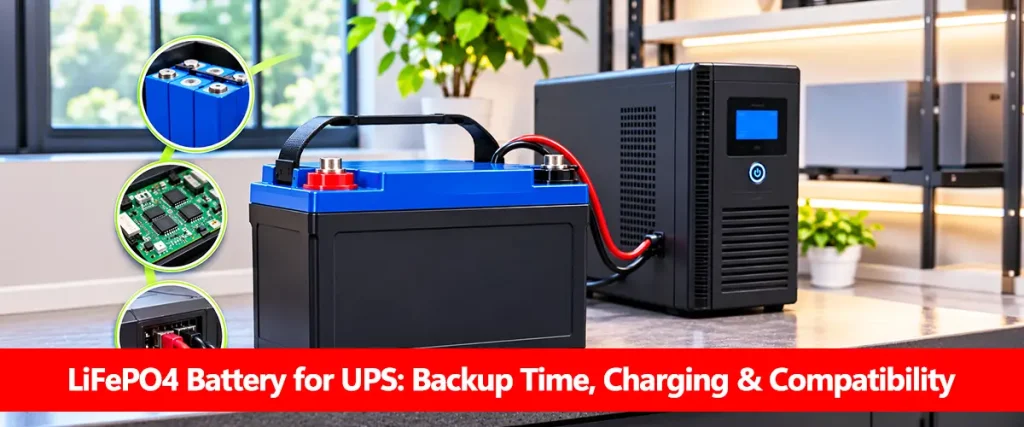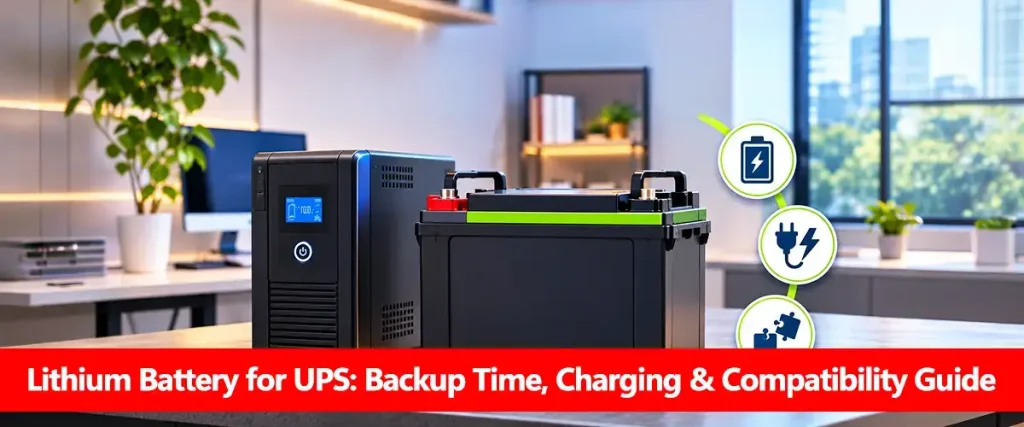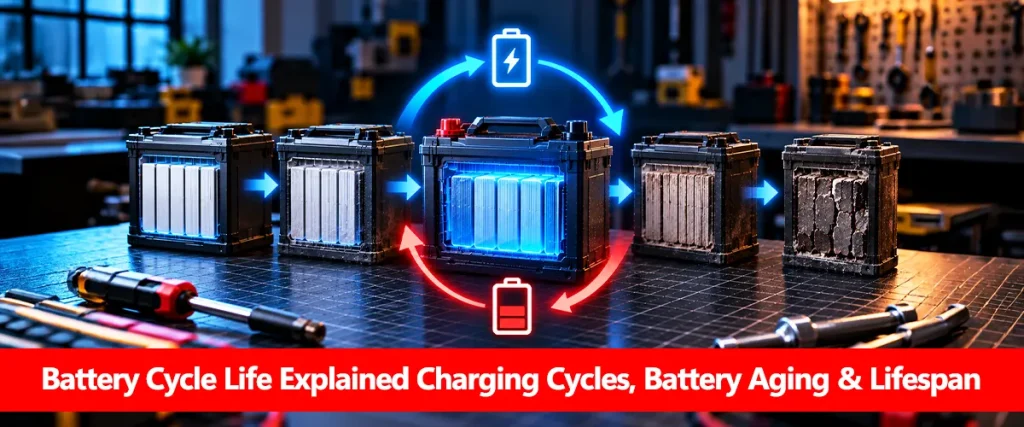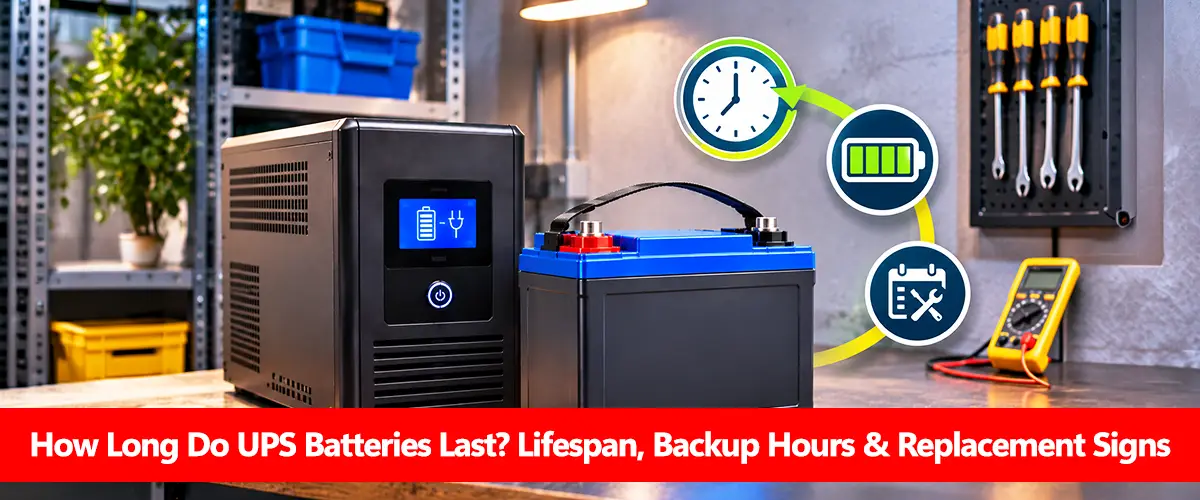
How long do UPS batteries last? Most conventional sealed lead-acid UPS batteries have an expected service life of approximately 3–5 years under suitable conditions. Lithium-ion batteries in manufacturer-designed UPS systems may last 8–15 years, depending on the equipment and battery specifications. However, high temperatures, frequent power outages and improper charging can shorten these periods.
Battery lifespan is different from backup duration. Lifespan describes how many years a battery remains useful, while backup duration describes how many minutes or hours it can supply electricity during a power outage. Both depend on the type and condition of the UPS battery, but they are measured differently.
Average UPS Battery Lifespan by Type
The chemistry used inside a UPS has a major influence on its expected replacement interval. Sealed lead-acid batteries are widely used in conventional UPS units, while some modern models use dedicated lithium battery systems.
| UPS Battery Type | Typical Service-Life Guidance | Important Consideration |
| Sealed lead-acid / VRLA | 3–5 years | Sensitive to heat and repeated discharge |
| AGM lead-acid | Commonly 3–5 years in UPS applications | Depends on charging and temperature |
| Lithium-ion UPS battery | Approximately 8–15 years in selected manufacturer systems | Model-specific lifespan and warranty |
| LiFePO4 UPS battery | Manufacturer-specific, often with high cycle-life potential | Requires compatible UPS and BMS |
| Flooded tubular lead-acid | Varies by product and cycling conditions | Requires approved equipment and maintenance |
Schneider Electric identifies approximately 3–5 years for typical VRLA UPS batteries and 8–10 years for certain lithium-ion UPS models. Eaton provides longer 10–15-year expectations for selected lithium-ion UPS systems.
These are planning ranges rather than guaranteed lifespans. The actual battery cycle life and service life depend on the specific product, installation environment and usage.
Battery Lifespan vs UPS Backup Time
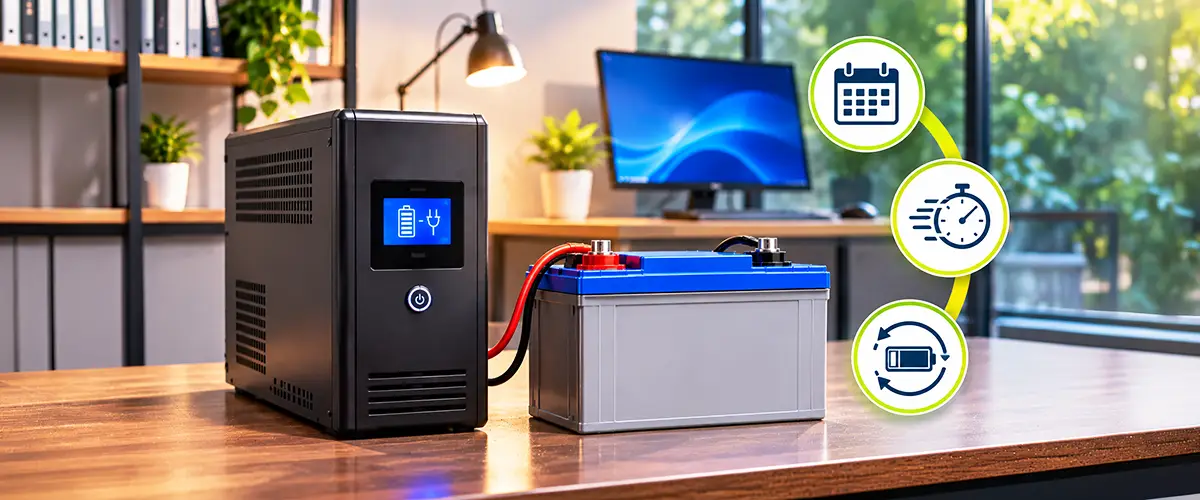
A UPS battery may remain installed for several years while supplying electricity for only a few minutes during each outage. This is normal for compact units designed to protect computers and networking equipment.
For example, a desktop UPS may provide enough backup time to save work and shut down a computer safely. A larger external-battery UPS may operate lights, routers or selected appliances for several hours.
The two measurements should not be confused:
| Measurement | What It Means | Main Influencing Factors |
| Battery lifespan | Years before replacement becomes necessary | Temperature, chemistry, age and cycling |
| Backup duration | Time supplied during one outage | Load in W, stored Wh, efficiency and usable capacity |
| Cycle life | Number of charge-discharge cycles | Depth of discharge and operating conditions |
The calculation behind UPS backup time differs from estimating battery age. A battery can be fully charged yet provide poor runtime if its usable capacity has deteriorated.
How Long Will a UPS Battery Run During a Power Outage?
The backup duration of a UPS battery depends on battery voltage, amp-hour capacity, connected load and conversion losses.
A simplified formula for compatible external-battery systems is:
Backup Time (Hours) ≈ Battery Voltage × Ah × Usable DoD × UPS Efficiency ÷ Load (W)
Consider a nominal 12V 100Ah lead-acid battery with an assumed 50% depth of discharge and 85% UPS efficiency.
| Connected Load | Estimated Backup Duration |
| 100W | 5.1 hours |
| 150W | 3.4 hours |
| 200W | 2.55 hours |
| 300W | 1.7 hours |
These figures are simplified estimates, not guaranteed runtimes. They exclude UPS standby consumption, battery aging and reductions in lead-acid capacity at higher discharge currents.
For example, at a 200W load:
12 × 100 × 0.50 × 0.85 ÷ 200 = 2.55 hours
As the load increases, backup duration decreases. For a more accurate result, especially with compact UPS batteries, consult the manufacturer’s runtime chart and battery discharge rate specifications.
Why Do Some UPS Batteries Last Only Two Years?
Not every lead-acid UPS battery reaches the typical 3–5-year lifespan. Certain operating conditions can cause noticeable deterioration much sooner.
Temperature is particularly important. Schneider Electric recommends an environment around 20–25°C for many lead-acid UPS batteries and explains that every 8°C increase above suitable conditions can roughly halve expected battery life.
For example, a lead-acid battery expected to last four years at 25°C might last only around two years if its operating temperature rises to 33°C.
This is a rule of thumb, not a precise prediction for every battery. The internal battery temperature may also be higher than the surrounding room temperature.
In areas experiencing hot summers and frequent load-shedding, keeping the UPS adequately ventilated can make a meaningful difference to battery longevity.
How Frequent Power Outages Affect Battery Life
Every time a UPS operates on battery power, the battery completes part of a discharge cycle. Repeated outages increase cycling and can gradually reduce available capacity.
For lead-acid batteries, frequent deep discharging typically causes more wear than shallow discharging. A battery that regularly loses most of its charge may therefore age faster than one used for occasional short interruptions.
A correctly sized battery can help avoid unnecessarily deep discharge during routine outages. The relationship between depth of discharge and battery durability is particularly important in areas with repeated daily interruptions.
If outages regularly exceed the available backup time, the system may require different capacity rather than simply replacing the battery with an identical model.
Does Battery Capacity Affect UPS Lifespan?
Battery capacity and lifespan are related, but they do not mean the same thing.
A 200Ah battery generally stores twice the nominal energy of a comparable 100Ah battery at the same voltage. If both power the same load, the larger battery may experience a shallower relative discharge, potentially reducing cycling stress.
However, a 200Ah battery does not automatically last twice as many years. Temperature, product quality, charging conditions and battery chemistry still influence deterioration.
The 100Ah vs 200Ah battery for UPS comparison explains their practical differences, while how to choose UPS battery capacity covers appropriate sizing.
Importantly, a larger battery must be approved for the UPS. Installing unsupported external storage can create charging and safety problems.
Charging Conditions and UPS Battery Aging
A UPS battery spends much of its life connected to a charging system. Correct charging helps maintain capacity and reduces avoidable deterioration.
Lead-acid batteries can be damaged by prolonged undercharging, excessive charging voltage and repeated deep discharge. Suitable systems use charging settings matched to the battery chemistry and operating temperature.
For a traditional lead-acid UPS, battery charging voltage and approved float charging settings are especially important.
Lithium UPS batteries have different charging and protection requirements. They generally rely on compatible electronics and a battery management system to help control operating limits. An incorrect charging profile can shorten lifespan even when the battery capacity appears sufficient.
Does Lithium Last Longer Than Lead-Acid in a UPS?
Manufacturer-designed lithium-ion UPS systems often have longer expected service lives than conventional VRLA systems. Lithium technology can also offer lower weight, higher usable energy and reduced battery replacement frequency. These benefits are particularly relevant for commercial UPS installations and systems with frequent discharge cycles. However, lithium batteries are not universal replacements for conventional lead-acid UPS cartridges.
A compatible lithium battery for UPS must satisfy charging, voltage and protection requirements. The same applies to LiFePO4 batteries for UPS, which have their own operating limits. If an existing UPS was designed exclusively for lead-acid batteries, review replacing UPS lead-acid batteries with lithium before considering a conversion.
Signs Your UPS Battery Is Near the End of Its Life
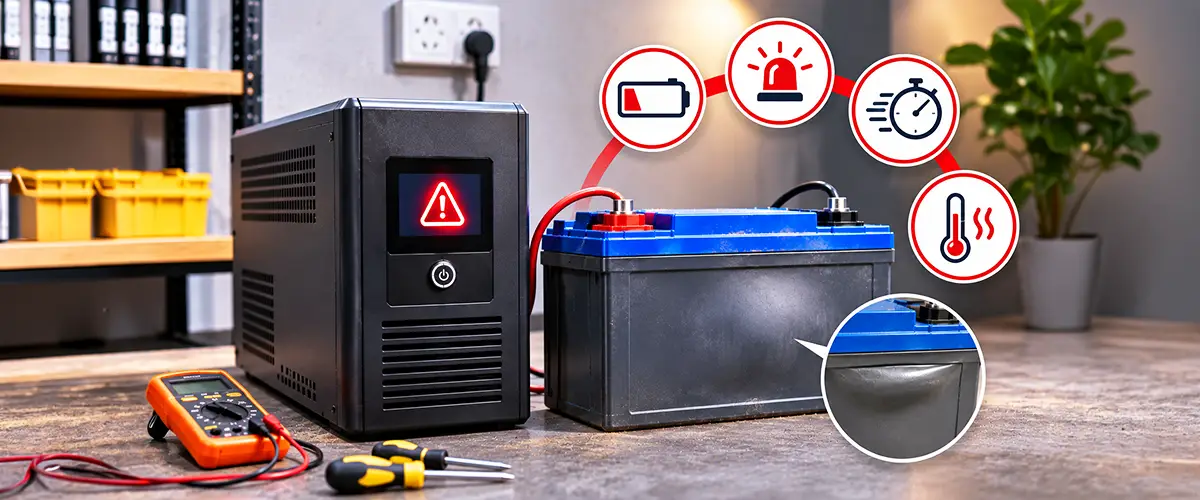
Battery deterioration may become noticeable before the UPS completely stops providing backup power.
Common warning signs include progressively shorter runtime, repeated battery-related alarms and failure of a manufacturer-approved battery self-test.
Other indicators can include unusual heating, swelling, leakage or difficulty maintaining a normal charge level.
| Warning Sign | Possible Explanation |
| Backup duration decreases | Battery capacity deterioration or increased load |
| Replace-battery warning | UPS detects possible battery failure |
| UPS shuts down quickly | Weak battery, overload or system fault |
| Battery does not charge properly | Charger, connection or battery problem |
| Unusual swelling or leakage | Potential battery safety issue |
These symptoms do not always prove the battery needs replacing. A higher connected load, faulty charger or loose connection can produce similar results. Our UPS battery draining fast and battery not charging guides cover those problems separately.
How to Check Whether Your UPS Battery Needs Replacement
The safest starting point is the manufacturer’s diagnostic procedure rather than intentionally draining the battery completely.
Many modern UPS units include battery status indicators, monitoring software and built-in self-tests. Schneider Electric recommends confirming sufficient charge and running an approved UPS self-test when investigating a replace-battery warning.
A practical evaluation involves checking the battery’s installation date, comparing current runtime with previous performance at the same load and reviewing any UPS alerts.
The difference between state of charge and state of health is useful here: a battery may indicate 100% charge while retaining substantially less energy than when it was new.
Avoid opening sealed batteries or conducting improvised high-current tests. If the UPS supports critical equipment, arrange qualified testing before battery performance becomes unreliable.
How to Extend UPS Battery Lifespan
Regular attention to operating conditions can help maintain reliable backup performance.
- Control temperature: Keep the UPS within the manufacturer’s recommended environment.
- Maintain airflow: Avoid blocked vents, direct sunlight and enclosed hot spaces.
- Avoid unnecessary discharge: Use backup power for essential loads.
- Prevent overloads: Keep appliance watts within the UPS output rating.
- Maintain proper charging: Follow approved battery charging settings.
- Monitor battery condition: Review warnings and self-test results.
- Use approved replacements: Match the exact battery configuration and chemistry.
For external batteries, appropriate battery bank sizing and installation protection also matter. Do not mix new and aged batteries in an existing series string unless the manufacturer specifically approves the arrangement.
When Should You Replace a UPS Battery?
For many conventional lead-acid UPS systems, replacement planning begins around the three-year mark, with a common service-life expectation of 3–5 years.
However, a battery exposed to heat or frequent outages may require earlier replacement. A healthy battery with a longer manufacturer-specified lifespan may remain suitable beyond a general estimate, subject to inspection and recommendations.
A failed battery self-test, persistent replacement warning or visibly damaged battery should receive prompt attention. Swollen, leaking or unusually hot batteries should not be handled or reused casually.
If the UPS itself is old, compare the cost of a battery replacement with a complete unit replacement. Selecting the best battery for UPS should always begin with manufacturer compatibility. For Pakistan-specific purchasing considerations, refer to best UPS battery in Pakistan rather than choosing solely by a claimed lifespan.
Conclusion
So, how long do UPS batteries last? Conventional lead-acid UPS batteries commonly last 3–5 years, while dedicated lithium-ion UPS batteries may have expected service lives of 8–15 years, depending on the manufacturer and model.
Backup duration is a separate measurement. A battery may provide minutes or hours of electricity during an outage depending on its usable Wh, connected watts, depth of discharge and UPS efficiency.
For reliable performance, maintain suitable temperatures, follow approved charging and replacement procedures, and monitor battery health before backup time becomes inadequate.
Frequently Asked Questions
How Many Years Does a UPS Battery Last?
Most conventional sealed lead-acid UPS batteries have an expected lifespan of approximately 3–5 years in suitable conditions. Dedicated lithium UPS batteries may last longer according to their manufacturer’s specifications.
How Long Does a UPS Battery Last During a Power Cut?
Backup time depends on the connected load, usable battery capacity and UPS efficiency. Compact desktop UPS units may provide only minutes, while approved larger battery systems can support hours of operation.
Can a UPS Battery Last 10 Years?
Some manufacturer-designed lithium-ion UPS batteries can have expected service lives of 10 years or more. Standard VRLA UPS batteries are generally replaced sooner.
Why Does My UPS Battery Last Only 5 Minutes?
A five-minute runtime may be normal for a heavily loaded compact UPS. It can also indicate battery aging, incomplete charging or increased appliance power consumption.
Does a 200Ah UPS Battery Last Longer Than a 100Ah Battery?
At the same voltage and chemistry, a 200Ah battery generally provides longer backup because it stores more energy. This does not guarantee twice the service life in years.
Does Heat Reduce UPS Battery Life?
Yes. High temperatures can significantly shorten lead-acid UPS battery lifespan and also affect lithium battery aging. Follow the manufacturer’s environmental recommendations.
How Often Should I Replace My UPS Battery?
Many lead-acid UPS batteries are replaced after approximately 3–5 years, but replacement should also consider diagnostics, environmental conditions and manufacturer guidance.
Can Frequent Load-Shedding Damage a UPS Battery?
Frequent discharging increases battery cycling, and repeated deep discharge can accelerate aging, especially in lead-acid batteries. Appropriate sizing and charging help reduce avoidable wear.
How Do I Know if My UPS Battery Is Weak?
Reduced runtime under the same load, battery warnings and failed manufacturer-approved self-tests can indicate deterioration. Confirm charging and load conditions before deciding on replacement.