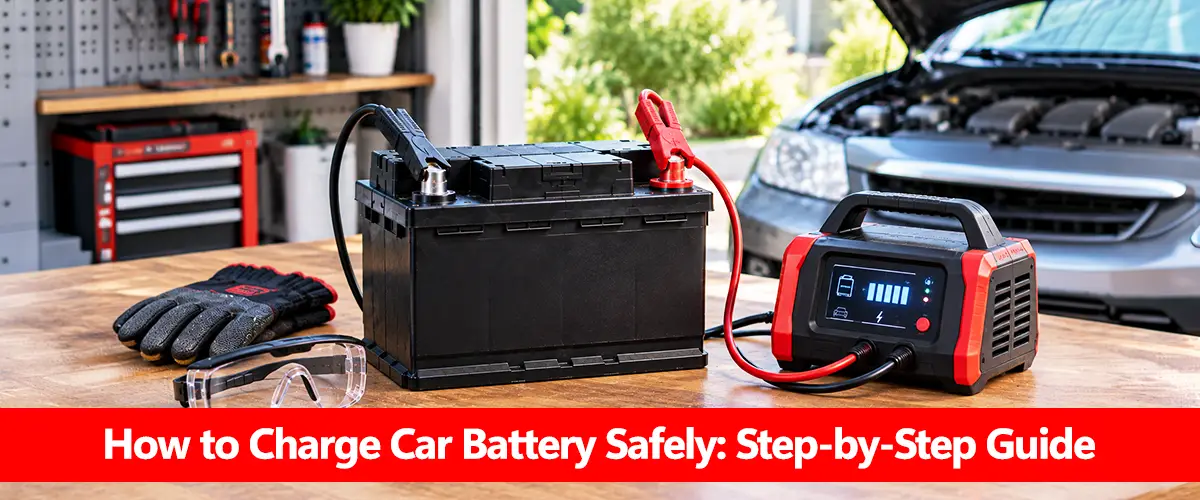
Learning how to charge car battery safely starts with choosing a charger compatible with your vehicle’s battery type. For most conventional 12V lead-acid car batteries, a suitable automatic smart charger can restore charge by supplying controlled electrical current while monitoring battery voltage.
Before charging, switch off the engine, inspect the battery for damage and follow the vehicle manufacturer’s charging instructions. Correct clamp connections, ventilation and charging settings are essential for preventing electrical faults and battery damage.
Whether your battery became discharged after long parking or repeated short journeys, this guide explains the practical charging process. For broader information about battery care and replacement, see our car battery guide.
What Do You Need to Charge a Car Battery?
A compatible battery charger is the most important requirement. Unlike a jump starter, which provides temporary starting assistance, a charger gradually restores stored energy.
For a typical passenger car with a 12V lead-acid battery, an automatic charger with appropriate flooded, AGM or EFB charging support is often a practical option.
Before starting, prepare:
- A charger approved for the battery voltage and chemistry.
- The vehicle owner’s manual and charger instructions.
- Safety glasses and suitable protective gloves.
- A dry, well-ventilated charging location.
- Access to approved battery terminals or remote charging points.
Some chargers automatically recognize battery conditions, while others require users to select the correct mode. The broader battery charger selection guide explains charger features, but vehicle compatibility should always determine the final choice.
Step 1: Identify Your Car Battery Type
Before connecting the charger, check the battery label or vehicle documentation to identify its chemistry and nominal voltage.
Most conventional petrol and diesel passenger vehicles use a nominal 12V lead-acid starter battery. However, vehicles with automatic start-stop systems may use EFB or AGM technology.
| Battery Type | Charging Consideration |
| Flooded lead-acid | Use an approved 12V flooded/wet charging mode |
| Maintenance-free lead-acid | Follow the manufacturer’s sealed-battery requirements |
| AGM | Use an approved AGM charging profile |
| EFB | Use a charger supporting EFB or the specified lead-acid profile |
| Lithium starter battery | Use only a chemistry-compatible charger approved by the manufacturer |
An AGM battery and a conventional flooded lead-acid battery use related electrochemistry, but their recommended charging settings may differ.
Do not assume a charger intended for ordinary lead-acid batteries is suitable for lithium batteries. Charging requirements for different chemistries are explained in lead-acid charger for lithium battery.
Step 2: Check the Battery Before Charging
Park the vehicle in a safe location, switch off the ignition and electrical accessories, and apply the parking brake. Inspect the battery casing and visible connections for cracks, swelling, leakage, heavy corrosion or signs of overheating. A slightly discharged battery may be suitable for normal charging, but physical damage changes the situation.
Do not charge a swollen, leaking, cracked, frozen or unusually hot battery. A strong abnormal odor is also a reason to stop and seek professional assistance. Lead-acid batteries may release flammable hydrogen gas during charging. Keep sparks, flames, cigarettes and ignition sources away from the battery and maintain suitable ventilation. If terminal deposits are visible, consult car battery corrosion before attempting to service them. Do not disconnect damaged or heavily corroded terminals without appropriate training.
Step 3: Decide Whether the Battery Can Stay Connected
Many modern smart chargers support charging a car battery while it remains installed in the vehicle. However, the correct method depends on the vehicle and charger. Some vehicles have dedicated positive charging terminals and chassis-ground points. Cars with electronic battery monitoring may require the charger’s negative connection to be attached to a designated chassis ground rather than directly to the negative battery terminal.
Follow the vehicle owner’s manual and charger instructions to determine whether disconnection is necessary. Avoid disconnecting the battery unnecessarily because some vehicles can lose electronic settings or require initialization procedures. For an older or unusual vehicle, or where the charging instructions are unclear, a qualified technician should confirm the correct arrangement.
Step 4: Connect the Battery Charger Safely
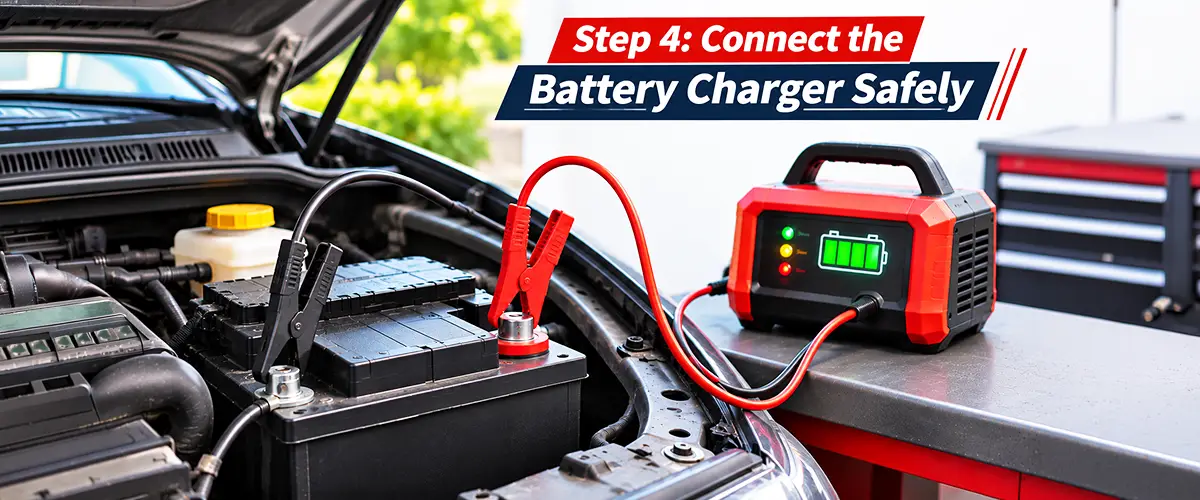
For a typical negative-ground vehicle, the following sequence reflects common automotive smart-charger guidance. Always follow the exact instructions supplied with your equipment.
- Make sure the charger is switched off and unplugged from the mains supply.
- Identify the positive (+) battery terminal or approved positive charging point.
- Attach the charger’s red positive (+) clamp to that point.
- Attach the black negative (−) clamp to the vehicle’s designated chassis-ground point, away from the battery and fuel lines, as directed by the manual.
- Ensure the clamps are secure and the cables are clear of moving or hot components.
- Connect the charger to a suitable mains outlet.
- Select the approved charging program and start charging.
For a battery removed from the vehicle, the charger manufacturer’s procedure may instead specify direct connections to the battery terminals.
Never allow positive and negative clamps to touch each other or bridge the battery terminals. If you are uncertain about polarity or connection points, do not guess.
Step 5: Select the Correct Voltage and Charging Mode
For a conventional 12V automotive battery, choose the charger’s appropriate 12V program.
If your charger offers separate flooded, AGM or other battery modes, select the one recommended for the exact battery.
The charger should regulate voltage and current during the charging process. Many automatic lead-acid chargers use bulk, absorption and maintenance or float stages.
| Charging Stage | Main Purpose |
| Bulk | Restores a substantial portion of the battery’s charge |
| Absorption | Completes charging at controlled voltage |
| Float or maintenance | Maintains charge where the charger and battery permit it |
Some chargers also include reconditioning or repair programs. These modes are not appropriate for every battery and should only be used when explicitly approved. The principles of bulk, absorption and float charging help explain why charging current usually decreases as a lead-acid battery approaches full charge. Correct battery charging voltage is more important than selecting the highest available charging setting.
Step 6: Allow the Battery to Charge
After selecting the correct program, let the charger complete its charging cycle. A smart charger typically adjusts output as battery voltage and charging conditions change. Its display may show charging progress, charging current or a completion indicator. Avoid disconnecting the clamps while the charger is energized. Check the charger’s status according to its instructions, particularly if it reports a fault or abnormal battery condition. If the charger displays a persistent error, the battery becomes unusually hot or a strong odor develops, stop charging according to the manufacturer’s safety procedure and seek professional help. Do not leave a manual charger running indefinitely. Automatic maintenance charging is only appropriate when both the charger and battery manufacturer support it.
How Long Does It Take to Charge a Car Battery?
Charging time depends on battery capacity, how deeply it is discharged, charger current and battery condition.
A simplified initial estimate is:
Ideal Charging Time (Hours) = Charge to Replace (Ah) ÷ Charging Current (A)
Consider a 12V 60Ah lead-acid car battery that is approximately 50% discharged.
Around 30Ah must be replenished, before considering charging losses.
| Charger Output | Ideal Calculation | Practical Consideration |
| 2A | 30 ÷ 2 = 15 hours | Actual time longer |
| 5A | 30 ÷ 5 = 6 hours | Actual time longer |
| 10A | 30 ÷ 10 = 3 hours | Actual time longer |
These are ideal minimum estimates, not guaranteed completion times. Lead-acid charging slows during absorption, and charger current may also be limited by temperature or battery condition.
Interstate Batteries notes that a battery may take approximately 4–8 hours to receive sufficient charge for starting, while complete charging can take 10–24 hours in some circumstances. For a more detailed approach, see battery charging time and battery charging current.
How Do You Know When the Battery Is Fully Charged?
An automatic charger’s completion indicator is usually the first reference for determining whether its charging program has finished.
For a conventional 12V lead-acid battery, a rested voltage around 12.6–12.8V commonly indicates a well-charged condition.
However, voltage should be measured after allowing surface charge to settle, and its interpretation varies with temperature and battery construction.
A battery can also appear fully charged while having insufficient starting-current capability.
Our car battery voltage guide explains normal readings, while how to test a car battery covers methods for checking whether the battery can start the engine reliably. If the charger repeatedly fails to complete charging, the battery or charging equipment may require further testing.
Step 7: Disconnect the Charger Correctly
Once charging has finished, switch off the charger and disconnect it from the mains supply before removing the clamps. For the common negative-ground, in-vehicle connection method, remove the black negative connection first, followed by the red positive connection, unless the manufacturer’s specified procedure differs. Keep the clamps separated throughout removal.
If the battery was disconnected from the vehicle, restore its connections using the vehicle manufacturer’s procedure. Certain modern vehicles may require electronic initialization or battery registration. After charging, check whether the vehicle starts normally and whether any charging-system warning remains active.
Can You Charge a Car Battery by Driving?
In a conventional petrol or diesel vehicle, the alternator normally replenishes battery charge while the engine is running. However, driving is not always a reliable method of fully charging a deeply discharged battery. Frequent short trips, high electrical demand or an aging battery can limit how much charge is restored. A compatible external charger provides a more controlled charging process, especially when the battery has been significantly discharged. Understanding how a car battery works helps explain the alternator’s role. If the car will not start at all, how to jump-start a car covers emergency starting precautions. A jump-start is not the same as fully recharging the battery.
When Charging Does Not Solve the Problem
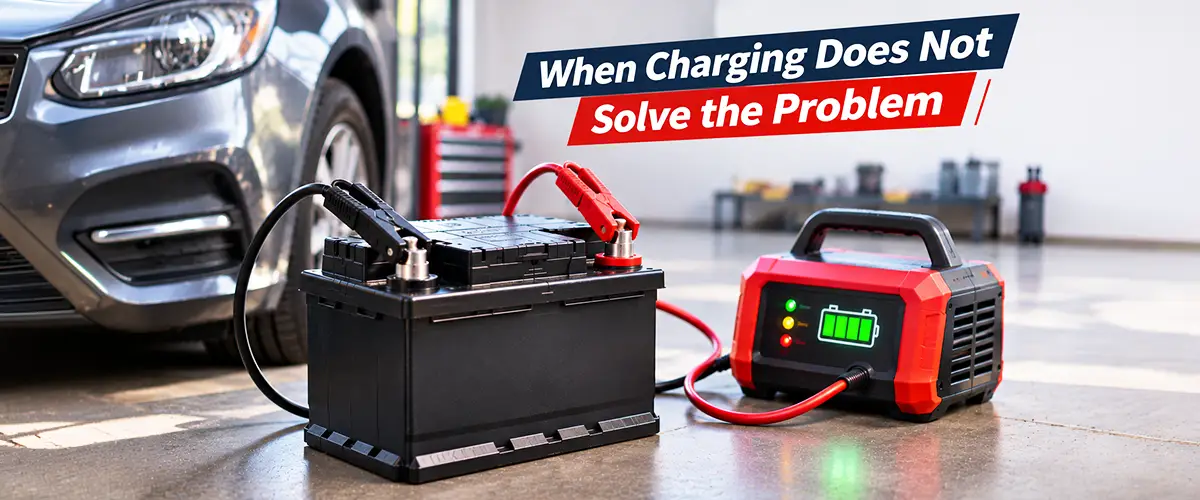
A battery that repeatedly loses charge may be affected by more than an isolated discharge.
Possible explanations include an aging battery, faulty alternator, excessive standby electrical consumption or an unsuitable charger.
| Situation | Recommended Next Step |
| Battery charges and starts normally | Continue monitoring |
| Battery loses charge overnight | Check for parasitic electrical draw |
| Battery remains weak after charging | Arrange a battery-health test |
| Charger repeatedly reports an error | Check compatibility and battery condition |
| Battery warning light remains on | Check the vehicle’s charging system |
| Battery is swollen or leaking | Stop use and seek qualified service |
The signs of a bad car battery guide explains battery-related symptoms.
Repeated problems are covered separately in car battery keeps dying and car battery draining overnight. If a battery cannot hold charge even after appropriate testing, replacement may be necessary.
Important Charging Safety Rules
Safe charging depends on both electrical compatibility and the battery’s physical condition. Always use the correct voltage and chemistry setting, maintain good ventilation and keep charging equipment away from moisture and heat. Do not open sealed batteries, bypass charger safety controls or use high-current boost modes without the required expertise. Never charge a visibly damaged battery or attempt to recover a frozen battery without professional assessment. Lithium automotive batteries require particular care because their voltage profiles and electronic protection differ from lead-acid technology. For information about overcharging risks, see can you overcharge a battery.
Conclusion
Understanding how to charge car battery safely means selecting a compatible charger, inspecting the battery, using the correct connection points and allowing the appropriate charging program to finish. A smart 12V charger with manufacturer-approved settings is generally a practical choice for conventional lead-acid car batteries. Charging duration depends on battery capacity, charger current and discharge level. If the battery repeatedly loses charge or cannot start the vehicle after charging, further testing is necessary. Proper charging can restore a healthy discharged battery, but it cannot reliably repair one that has deteriorated internally.
Frequently Asked Questions
How Do I Charge a Car Battery at Home?
Use a compatible automatic charger, follow the vehicle’s approved connection procedure, select the correct battery chemistry and voltage, and allow the charger to complete its cycle.
How Long Should I Charge a 12V Car Battery?
Charging time depends on capacity, existing charge and charger current. It may take several hours to restore starting capability and significantly longer to reach full charge.
Can I Charge a Car Battery Without Removing It?
Yes, many modern chargers support in-vehicle charging. Use the approved charging points and follow the vehicle and charger manufacturers’ instructions.
Should I Disconnect the Car Battery Before Charging?
Not necessarily. Some vehicles and chargers support charging without battery disconnection. Others have specific requirements, so consult the owner’s manual.
Which Charger Is Best for an AGM Car Battery?
Choose a charger explicitly approved for AGM batteries with appropriate voltage, current and charging-program settings.
Can I Use a 10A Charger on a 60Ah Battery?
It may be suitable if the battery manufacturer permits that charging current and the charger supports the chemistry. Do not assume that a higher current is always appropriate.
How Do I Know My Car Battery Is Fully Charged?
Use the charger’s completion indication and, where appropriate, check settled resting voltage. A conventional well-charged 12V lead-acid battery commonly measures around 12.6–12.8V.
Can I Charge a Completely Dead Car Battery?
Some deeply discharged batteries can be recovered using manufacturer-approved charging procedures, but others may be damaged or unsafe. Follow charger instructions and seek professional testing if the charger rejects the battery.
Is It Safe to Leave a Car Battery Charging Overnight?
Only when the charger and battery manufacturer explicitly support unattended or extended charging under the required conditions. Do not leave an ordinary manual charger operating indefinitely.
Will Charging Fix an Old Car Battery?
Charging can restore energy to a healthy discharged battery, but it cannot reverse severe internal aging or damaged cells. A battery-health test helps determine whether replacement is necessary.